The Honda Insight carved a distinct niche in the compact hybrid sedan segment before Honda discontinued it after the 2022 model year, replacing it with the Civic Hybrid lineup. For used-car shoppers and current owners researching the Honda Insight hybrid interior, efficiency figures, and long-term ownership costs, this guide covers every spec that matters — from EPA MPG to battery warranty to real-world fuel economy — so you can evaluate the Insight against today's hybrid, PHEV, and EV alternatives.
HEV vs PHEV: Where the Honda Insight Fits
Before examining specs, it's critical to understand what the Insight is — and isn't. The Honda Insight is a conventional hybrid electric vehicle (HEV). It pairs a gasoline engine with an electric motor and a small battery that recharges through regenerative braking and the engine. You never plug it in. There is no electric-only driving range of any meaningful distance.
This is fundamentally different from a plug-in hybrid (PHEV) like the Toyota Prius Prime, which carries a larger battery (typically 10–18 kWh), offers 25–44 miles of electric-only range, and can be charged from a wall outlet or public charger. PHEVs qualify for the federal §30D tax credit (up to $7,500, subject to income, MSRP, and battery-sourcing rules); conventional HEVs like the Insight do not.
| Feature | HEV (Honda Insight) | PHEV (e.g., Prius Prime) |
|---|---|---|
| Plug-in charging | No | Yes (Level 1/2) |
| Electric-only range | ~1 mile (low-speed creep) | 25–44 miles |
| Battery size | ~1.2 kWh (NiMH/li-ion) | 10–18 kWh |
| Federal tax credit | Not eligible | Up to $7,500 (§30D) |
| Best for | No home charging access | Home charging + short commutes |
Fuel Economy: EPA Ratings and Real-World MPG
The third-generation Honda Insight (2019–2022) uses Honda's two-motor hybrid system and delivers class-leading efficiency. According to fueleconomy.gov, here is the EPA breakdown by trim:
| Trim / Config | City | Highway | Combined |
|---|---|---|---|
| LX / EX (lighter trims) | 55 | 49 | 52 |
| Touring (heavier, more equipment) | 51 | 45 | 48 |
Real-world expectations: Honda's hybrid system excels in stop-and-go city driving, where the electric motor handles low-speed propulsion and regenerative braking recaptures energy. Many Insight owners report exceeding the EPA city rating in warm-weather urban commuting — 55–60 MPG is achievable on flat terrain at moderate speeds. Highway fuel economy tends to track closer to or slightly below the EPA estimate, especially above 70 mph where aerodynamic drag dominates and the gasoline engine carries the full load. In cold weather (below 30°F), expect a 5–10% MPG reduction as the engine runs more frequently for cabin heat and battery warmup.
Powertrain and Performance Specs
| Spec | Value |
|---|---|
| Engine | 1.5L Atkinson-cycle 4-cylinder |
| Engine horsepower | 107 hp @ 6,000 rpm |
| Electric motor output | 129 hp / 195 lb-ft torque |
| Combined system horsepower | 151 hp |
| Hybrid battery | Lithium-ion, ~1.2 kWh |
| Transmission | e-CVT (single-speed direct drive) |
| 0–60 mph | ~7.7 seconds |
| Drivetrain | Front-wheel drive |
| Fuel tank | 10.6 gallons |
| Total driving range | ~550 miles (LX/EX combined) |
Honda's two-motor system operates differently than Toyota's planetary-gear hybrid setup. At low speeds, the Insight runs primarily on the electric motor while the gasoline engine acts as a generator. At highway speeds, a lockup clutch connects the engine directly to the wheels for efficiency. The result is smooth, linear acceleration in city driving with none of the rubber-band feel associated with older CVTs.
Honda Insight Hybrid Interior: Space, Materials, and Technology
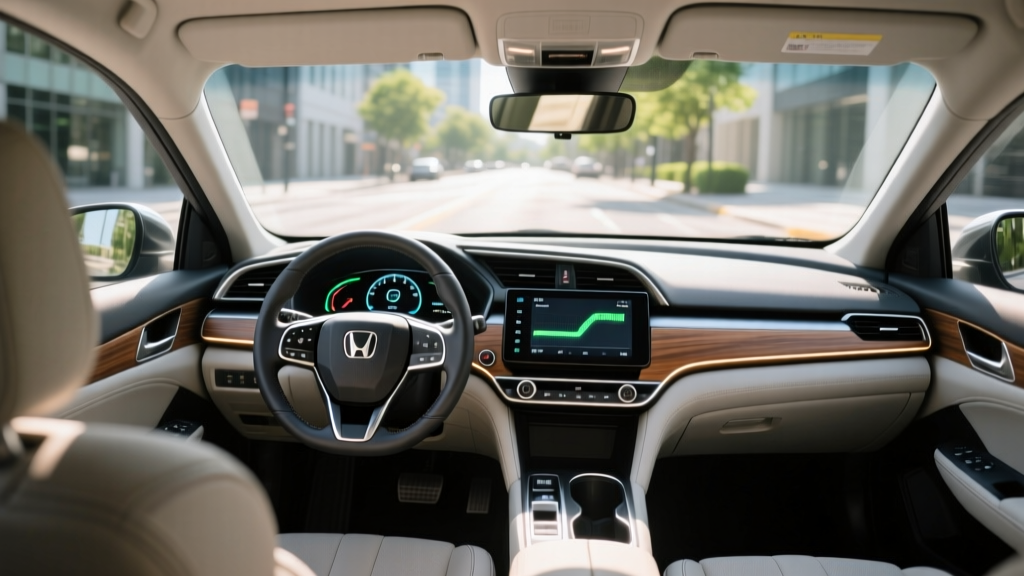
The Insight shares its fundamental architecture with the 10th-generation Honda Civic, and the cabin reflects that lineage — with meaningful upgrades that positioned it above the Civic in Honda's lineup.
Seating and dimensions: The Insight accommodates five passengers with 97.6 cubic feet of passenger volume. Front headroom measures 38.0 inches; rear headroom is 37.1 inches. Rear legroom of 37.4 inches is competitive with the Toyota Corolla Hybrid and notably more generous than the Hyundai Ioniq Hybrid's rear quarters. The seating position is slightly lower than a Civic's, giving the Insight a more planted, premium feel.
Materials by trim: The LX trim uses cloth upholstery with a basic 5-inch infotainment display. The EX steps up to an 8-inch touchscreen with Apple CarPlay and Android Auto, heated front seats, and a leather-wrapped steering wheel. The Touring trim adds leather-trimmed seats, a 10-speaker premium audio system, built-in navigation, and a power-adjustable driver's seat. Across all trims, soft-touch materials cover the upper dash and door panels — a step above the Civic of the same era.
Cargo space: The Insight's trunk offers 15.1 cubic feet of cargo volume — a strong figure for the compact hybrid class. The hybrid battery sits beneath the rear seats (not intruding into the trunk), and a 60/40 split-folding rear seatback is standard on EX and Touring trims, enabling longer cargo. The LX lacks the split-fold feature.
Driver information display: A 7-inch digital instrument cluster replaces the traditional tachometer with a power-flow indicator showing real-time hybrid system operation — when you're in EV mode, when the engine is generating electricity, and when regenerative braking is active. This display is one of the best implementations for helping drivers maximize efficiency through throttle and braking habits.
Battery Warranty, Reliability, and Replacement Costs
Honda covers the Insight's hybrid battery with a 8-year/100,000-mile warranty (extended to 10 years/150,000 miles in California-emissions states: CA, CT, MA, ME, MD, NJ, NY, OR, RI, VT, WA, and others adopting CARB standards). This covers capacity loss below a functional threshold and complete battery failure.
Long-term reliability: Honda's lithium-ion hybrid battery in the third-generation Insight has proven durable. Unlike the nickel-metal hydride (NiMH) packs in earlier Honda hybrids (first-generation Insight, early Civic Hybrids) that were prone to premature degradation, the li-ion pack in the 2019–2022 Insight operates within a narrow state-of-charge window managed by the battery management system. This shallow cycling significantly extends cell life. High-mileage examples exceeding 150,000 miles with original hybrid batteries are common in owner forums.
Battery replacement cost: If the hybrid battery does fail outside warranty, a replacement from Honda runs approximately $2,000–$3,500 including parts and labor. Third-party refurbished or reconditioned packs are available for $1,000–$2,000. This is far less expensive than a full EV battery replacement ($5,000–$20,000+) because the Insight's hybrid battery is small (~1.2 kWh) compared to a BEV's 60–100 kWh pack.
General reliability: The Insight earned strong reliability marks from Consumer Reports and carries a 5-star overall safety rating from NHTSA. The IIHS named the 2019–2022 Insight a Top Safety Pick when equipped with specific headlights. Honda Sensing — the brand's suite of adaptive cruise control, lane-keeping assist, forward collision warning, and automatic emergency braking — is standard on all trims.
Pricing, Tax Credits, and Ownership Economics
Because the Honda Insight was discontinued after the 2022 model year, no new Insights are available. Used pricing in early 2026 typically ranges as follows:
| Model Year | Trim | Price Range |
|---|---|---|
| 2019–2020 | LX / EX | $16,000–$21,000 |
| 2019–2020 | Touring | $19,000–$24,000 |
| 2021–2022 | EX / Touring | $21,000–$28,000 |
Federal tax credit: As a conventional hybrid (HEV), the Honda Insight does not qualify for the IRS §30D Clean Vehicle Credit. That credit — up to $7,500 for new vehicles and up to $4,000 for used EVs/PHEVs — applies only to plug-in vehicles with sufficient battery capacity. The Insight's ~1.2 kWh battery falls well below the 7 kWh minimum threshold for the used-vehicle credit. Check current IRS §30D guidelines for any rule changes.
Ownership cost advantage: Where the Insight saves money is at the pump. At 52 MPG combined and a national average gas price of ~$3.10/gallon (early 2026), an Insight driven 12,000 miles/year consumes roughly 231 gallons — costing about $716 annually in fuel. A comparable non-hybrid compact sedan averaging 30 MPG combined would burn 400 gallons, costing ~$1,240/year. That's a $524/year fuel savings, or roughly $2,620 over five years, with no plug-in infrastructure needed.
Insight vs Civic Hybrid, Prius, and Full EVs: Which Fits You?
The Insight occupies a specific lane. Here's how to decide whether it — or an alternative — is the right choice:
- You lack access to home or workplace charging
- Your budget is $16,000–$25,000
- You want 50+ MPG without any behavior change
- You prefer a conventional sedan driving experience
- Your daily commute is mostly city/suburban stop-and-go
- You can install a Level 2 home charger
- Your daily commute is under 40 miles (electric-only)
- You want to minimize gasoline use without range anxiety
- You qualify for the §30D tax credit (income/MSRP/sourcing)
- You have reliable home Level 2 charging
- You want zero gasoline expenses and minimal maintenance
- Your typical trips fall within 200–300 miles
- You want maximum federal/state incentives
If you're cross-shopping the Insight against the 2025–2026 Honda Civic Hybrid, note that the Civic Hybrid returns 49 MPG combined (EPA) and starts around $29,000 new. You gain a modern interior, updated safety tech, and a full warranty — but at a $5,000–$10,000 premium over a used Insight.
Frequently Asked Questions
How many MPG does the Honda Insight hybrid get?
The EPA rates the Insight LX/EX at 55 city / 49 highway / 52 combined MPG. The Touring trim is rated at 51/45/48. Real-world city driving often exceeds EPA estimates, while sustained highway driving above 70 mph may return 2–5 MPG below the sticker.
Does the Honda Insight need to be plugged in?
No. The Insight is a conventional hybrid (HEV). Its small lithium-ion battery recharges entirely through regenerative braking and the gasoline engine. There is no plug, no charging cable, and no electric-only range to manage.
Is the Honda Insight hybrid reliable, and what does a battery replacement cost?
Yes — the 2019–2022 Insight has strong reliability records. The hybrid battery is warrantied for 8 years/100,000 miles (10 years/150,000 miles in CARB states). Out-of-warranty replacement costs approximately $2,000–$3,500 from a Honda dealer, or $1,000–$2,000 for a refurbished unit.
Does the Honda Insight qualify for any tax credit?
No. The Insight is a conventional hybrid and does not meet the battery-capacity threshold for the federal §30D Clean Vehicle Credit. Some states may offer minor incentives for hybrid purchases, but these vary by jurisdiction — check your state's energy office for current programs.
How does the Insight compare to the Toyota Prius?
The Insight matches or slightly exceeds the Prius Eco's EPA combined rating (52 vs 56 MPG for the Prius Eco, though the Prius Eco is lighter). The Insight's interior is generally regarded as more upscale, with better materials and a more conventional sedan silhouette. The Prius offers AWD-e availability and a hatchback cargo layout the Insight lacks.
Why was the Honda Insight discontinued?
Honda consolidated its hybrid offerings into the Civic lineup starting with the 2023 model year. The Civic Hybrid effectively replaces the Insight with a similar powertrain in a more popular nameplate. Sales volume and platform consolidation drove the decision.