Quick Verdict: The Performance Hybrid That Doesn't Compromise
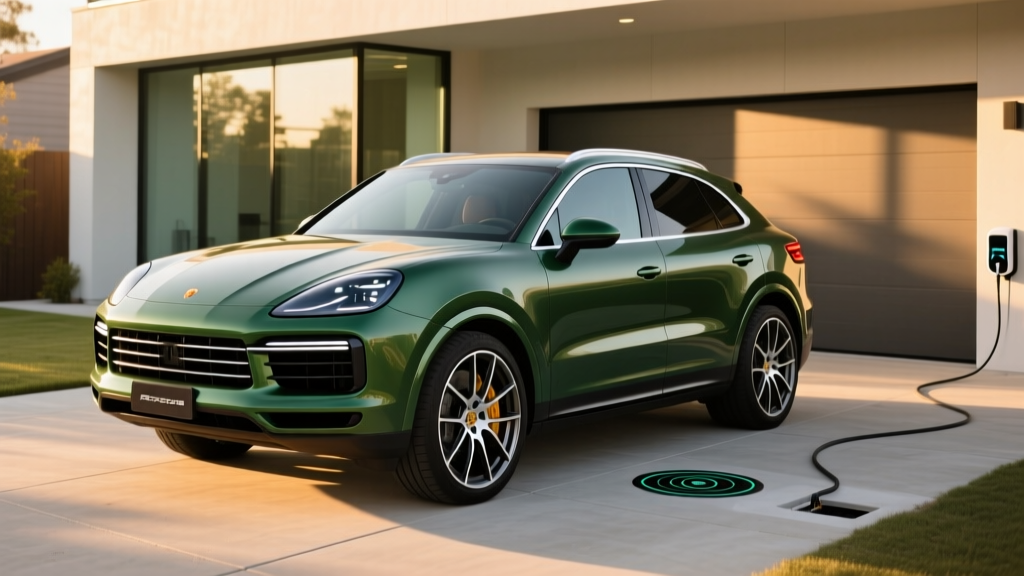
The 2026 Porsche Cayenne Hybrid SUV occupies a specific and compelling niche: luxury SUV buyers who want meaningful electric-only commuting range without surrendering the performance, build quality, and driving dynamics Porsche is known for. Available exclusively as a plug-in hybrid (PHEV) — Porsche dropped the conventional HEV variant from the U.S. Cayenne lineup — the current-generation Cayenne E-Hybrid and S E-Hybrid deliver between 30 and 42 miles of electric-only range, combined outputs up to 729 horsepower, and the ability to DC fast charge at up to 11 kW (AC) or skip public fast charging entirely in favor of home Level 2 convenience.
This guide covers the full powertrain lineup, real-world efficiency expectations, battery longevity, tax credit eligibility under current IRS §30D rules, and a clear framework for deciding whether the Cayenne PHEV fits your garage — or whether a full BEV or conventional SUV makes more sense.
| Specification | Cayenne E-Hybrid | Cayenne S E-Hybrid |
|---|---|---|
| Combined Horsepower | 463 hp | 512 hp |
| Engine | 3.0L Turbo V6 + electric motor | 3.0L Turbo V6 + electric motor |
| Battery (gross / usable) | 25.9 kWh / ~21.5 kWh | 25.9 kWh / ~21.5 kWh |
| EPA Electric-Only Range | ~32 mi (est.) | ~30 mi (est.) |
| EPA Combined MPG (hybrid mode) | ~46 MPGe combined | ~44 MPGe combined |
| 0–60 mph | 4.4 sec | 4.2 sec |
| AC Charging (Level 2) | Up to 11 kW, ~2.5 hrs (0–100%) | Up to 11 kW, ~2.5 hrs (0–100%) |
| DC Fast Charging | Not available | Not available |
| Base MSRP (2026) | $91,400 | $100,200 |
| Battery Warranty | 8 years / 100,000 miles | 8 years / 100,000 miles |
HEV vs PHEV: Understanding the Cayenne's Electrification Strategy
Before diving into specs, a critical distinction: Porsche only sells the Cayenne as a plug-in hybrid (PHEV) in the United States. There is no conventional hybrid (HEV) Cayenne — the kind that charges its small battery solely through regenerative braking and the engine, with no plug. If you see older references to a "Cayenne S Hybrid," that was a pre-2015 conventional HEV that Porsche discontinued over a decade ago.
HEV vs PHEV at a Glance
| Feature | Conventional Hybrid (HEV) | Plug-In Hybrid (PHEV) |
|---|---|---|
| Battery size | 1–2 kWh | 15–30+ kWh |
| Electric-only range | 0–2 miles (assist only) | 20–50+ miles |
| Plug-in charging | No — self-charging via regen/engine | Yes — Level 1/Level 2 AC |
| Federal tax credit | No | Potentially, up to $7,500 (see rules below) |
| Ideal for | Drivers without home charging access | Drivers with home/workplace charging who want EV commuting + gas flexibility |
The Cayenne PHEV's 25.9 kWh battery (gross) is roughly 15–20 times larger than a typical HEV battery, which is what enables its 30–42 mile electric-only range. You plug it in at home or at a public Level 2 station, and for most daily commutes, you'll burn zero gasoline. When the battery depletes, the turbocharged V6 engine takes over seamlessly — you never need to think about it.
Fuel Economy: EPA Numbers and Real-World Expectations
The 2026 Cayenne PHEV's efficiency depends entirely on how you use it. Drive within the electric-only range and charge daily, and your gasoline consumption drops to near zero on weekdays. Take a 600-mile road trip without charging, and you're running a 5,000-pound luxury SUV on its gasoline engine alone.
| Metric | Cayenne E-Hybrid | Cayenne S E-Hybrid |
|---|---|---|
| MPGe (combined, with full battery) | ~46 MPGe | ~44 MPGe |
| MPG (gas only, battery depleted — city) | ~21 mpg | ~20 mpg |
| MPG (gas only, battery depleted — highway) | ~24 mpg | ~23 mpg |
| MPG (gas only, battery depleted — combined) | ~22 mpg | ~21 mpg |
| Electric-only range (EPA est.) | ~32 miles | ~30 miles |
| Total combined range (electric + gas) | ~440 miles | ~420 miles |
Source: fueleconomy.gov — verify exact figures for your trim and model year, as EPA ratings can shift with mid-year updates.
Real-World MPG: What to Actually Expect
The gap between EPA estimates and real-world results is significant for PHEVs, and it cuts both ways:
- City driving with daily charging: If your commute is under 30 miles and you charge every night, you may use zero gasoline for weeks at a time. Owners with short commutes report effectively infinite MPG during weekday driving.
- Highway road trips: Once the battery is depleted, expect 20–23 mpg at 70–75 mph. This is typical for a heavy luxury SUV — the gas-only Cayenne V6 achieves similar numbers. Cold weather and aggressive driving will push this closer to 18 mpg.
- Mixed driving without charging: If you never plug in (which defeats the purpose of a PHEV), expect 21–22 mpg combined. You're essentially hauling 300+ extra pounds of battery you're not using.
Bottom line: The Cayenne PHEV rewards owners who charge regularly. Treat it like a gas car and you'll get gas-car efficiency with added weight. Treat it like an EV for daily driving and you'll see 80–100+ MPGe on average.
Electric-Only Range and Charging: What Owners Need to Know
The 2026 Cayenne E-Hybrid's 25.9 kWh gross battery (approximately 21.5 kWh usable, with Porsche maintaining a top-and-bottom buffer to protect longevity) delivers an EPA-estimated 30–32 miles of electric-only driving. In real-world conditions:
- Mild weather, city/suburban driving: 28–35 miles is achievable, especially with regenerative braking recapturing energy in stop-and-go traffic.
- Highway driving at 70 mph: Expect 22–26 miles — electric motors are less efficient at sustained high speeds.
- Cold weather (below 32°F): Plan for 20–25 miles. Battery chemistry is less efficient in cold temperatures, and cabin heating draws significant power.
Charging Speed and Connector Details
The Cayenne PHEV charges exclusively via AC — there is no DC fast charging capability. This is a deliberate Porsche engineering decision shared with most European PHEVs in this segment. The rationale: the battery is small enough that overnight Level 2 charging is sufficient, and adding DC fast-charge hardware would add weight and cost without meaningfully improving the ownership experience.
| Charging Level | Power | 0–100% Time | Notes |
|---|---|---|---|
| Level 1 (120V household outlet) | ~1.4 kW | ~15–17 hours | Emergency/trickle only — not practical for daily use |
| Level 2 (240V, 32A) | ~7.7 kW | ~3.5 hours | Standard home wallbox — sufficient for overnight |
| Level 2 (240V, 48A+) | Up to 11 kW | ~2.5 hours | Requires 48A+ EVSE and Cayenne's optional onboard charger upgrade |
The Cayenne uses a standard J1772 connector for Level 2 AC charging in North America. It is not compatible with NACS (Tesla) or CCS DC fast charging connectors, which are irrelevant here since the vehicle cannot accept DC charge.
Home charging setup: Most Cayenne PHEV owners install a 240V Level 2 wallbox (such as a ChargePoint Home Flex or Porsche's own wall connector) on a 40A or 50A circuit. Expect $500–$1,500 for the charger hardware and $800–$2,500 for professional electrician installation, depending on your panel capacity and conduit run distance. A panel upgrade (to 200A service) can add $1,500–$4,000 if your home has older 100A service.
Powertrain Deep Dive: Where 463–512 Horsepower Comes From
Both Cayenne PHEV variants pair a turbocharged 3.0-liter V6 gasoline engine with an electric motor integrated into the 8-speed Tiptronic S automatic transmission. The combined system output differs by trim:
- Cayenne E-Hybrid: The V6 produces approximately 348 hp, the electric motor adds 174 hp, for a combined system output of 463 hp and 479 lb-ft of torque. The 0–60 mph sprint takes 4.4 seconds.
- Cayenne S E-Hybrid: A higher-output tune of the same V6 produces roughly 389 hp, paired with the same 174 hp electric motor, yielding 512 hp combined and 553 lb-ft of torque. The 0–60 time drops to 4.2 seconds.
Porsche's hybrid system allows several driving modes: E-Power (electric-only, default on startup), Hybrid Auto (seamlessly blends gas and electric for optimal efficiency), Sport (aggressive combined output), and E-Charge (the engine charges the battery while driving — useful before entering zero-emission zones or to save electric range for city driving at your destination).
The electric motor is positioned between the engine and transmission, enabling genuine torque-fill that eliminates turbo lag. In practice, this means the Cayenne PHEV feels more responsive off the line than its gas-only counterpart — the electric motor delivers instant torque while the turbo spools up.
Pricing, Trims, and Tax Credit Eligibility
The 2026 Porsche Cayenne PHEV lineup starts just under $92,000 and can exceed $130,000 when optioned heavily. Here's the base MSRP by trim:
- Cayenne E-Hybrid: $91,400 MSRP (before destination and options)
- Cayenne S E-Hybrid: $100,200 MSRP
- Cayenne Turbo E-Hybrid (if available for 2026): Expected above $145,000 — check Porsche's configurator for current availability
Destination charges add approximately $1,650. Popular options (adaptive air suspension, panoramic roof, Sport Chrono Package, premium audio) routinely add $15,000–$30,000 to the final price.
Federal Tax Credit: Does the Cayenne PHEV Qualify?
IRS §30D Clean Vehicle Credit — 2026 Rules
The Cayenne PHEV's eligibility for the federal tax credit is unlikely under current rules, for two compounding reasons:
- MSRP cap: SUVs must have an MSRP at or below $80,000 to qualify. The Cayenne E-Hybrid starts at $91,400, which exceeds this cap.
- Battery sourcing requirements: Even if the MSRP qualified, the vehicle must meet escalating critical-mineral and battery-component sourcing thresholds that shift annually. European-assembled PHEVs face significant headwinds here.
What about state incentives? Some states (California, Colorado, New York, and others) offer their own EV/PHEV rebates that may not have the same MSRP caps. Check your state's energy office or DMV for current programs. These vary by jurisdiction and change frequently — consult official state sources.
Always verify current eligibility at irs.gov and consult a tax professional before relying on credit availability for purchase decisions.
Battery Longevity, Warranty, and Replacement Costs
Porsche PHEV Battery Warranty
Porsche covers the Cayenne's high-voltage battery for 8 years or 100,000 miles (whichever comes first), warranting it against capacity loss below approximately 70% of original capacity. This is in line with industry standards for PHEVs and matches the coverage offered by BMW, Mercedes-Benz, and Volvo for their electrified models.
How Long Will the Battery Actually Last?
The Cayenne's 25.9 kWh NMC (nickel-manganese-cobalt) lithium-ion battery benefits from several longevity-protecting design choices:
- Conservative buffer: Porsche locks away approximately 4+ kWh at the top and bottom of the battery, meaning the usable 21.5 kWh represents only about 83% of total capacity. This reduces stress on cells during charging and discharging.
- Thermal management: The battery pack is liquid-cooled and heated, maintaining optimal cell temperature during operation and charging — a critical factor in preventing accelerated degradation.
- Moderate cycle depth: Daily 0–100% cycling of the full usable range would accumulate approximately 300+ full equivalent cycles per year for a 30-mile commuter. NMC cells typically handle 1,000–2,000 full cycles before reaching 80% capacity.
Realistic expectation: Based on degradation data from similar Porsche and VW Group PHEV platforms, expect 10–15% capacity loss over 8–10 years of typical use. This translates to electric-only range dropping from 32 miles to approximately 27–29 miles after a decade — still highly functional for daily commuting.
Battery Replacement Cost
Out-of-warranty replacement of the Cayenne PHEV's high-voltage battery is estimated at $12,000–$18,000 including parts and labor, based on current Porsche service pricing for the Cayenne platform. This is a worst-case scenario — most batteries outlast the warranty period with meaningful capacity remaining. Additionally, individual cell modules can sometimes be replaced rather than the entire pack, reducing costs substantially.
Reliability: What the Data Shows
Porsche's hybrid systems have proven generally reliable in the Cayenne and Panamera lineups. The 8-speed Tiptronic transmission with integrated electric motor has been in production across the VW Group's premium brands since 2017, giving it a substantial track record. Key reliability notes:
- Powertrain: The 3.0L turbo V6 is a well-established engine shared across Audi, Porsche, and Bentley applications. No widespread systemic failures have been reported in PHEV configuration.
- Electrical systems: Porsche's 12V auxiliary battery management and high-voltage system electronics are mature. Some owners of earlier (2019–2021) Cayenne E-Hybrids reported software glitches with the infotainment system and charge scheduling — most resolved via OTA or dealer updates.
- Brakes: Regenerative braking significantly reduces wear on the mechanical brake pads and rotors. Many PHEV owners report brake pad life exceeding 80,000 miles.
For the most current reliability and crash-test data, check NHTSA and IIHS ratings as they become available for the 2026 model year.
Who Should Choose the Cayenne PHEV — and Who Shouldn't
Decision Framework: Is the Cayenne PHEV Right for You?
Choose the Cayenne PHEV if:
- You have home or workplace Level 2 charging access and a commute under 35 miles
- You want a luxury performance SUV that can drive on electricity daily but still take cross-country road trips without charging-infrastructure anxiety
- You value Porsche's driving dynamics, build quality, and resale value
- You frequently drive in areas with HOV lane access for PHEVs (check your state's rules)
- You want to reduce fuel consumption without committing to a full BEV's charging logistics on long trips
Choose a full EV (BEV) instead if:
- You want zero gasoline purchases and zero oil changes, ever
- Your daily driving exceeds 40 miles but you have reliable DC fast charging access for road trips
- You want to maximize federal and state tax credits (BEVs like the BMW iX, Tesla Model X, or Rivian R1S have clearer credit eligibility)
- You prefer the lowest possible maintenance costs — BEVs eliminate spark plugs, engine oil, transmission fluid, and exhaust systems
Choose a gas-only SUV instead if:
- You have no access to home or workplace charging (a PHEV driven exclusively on gas is an expensive, heavy conventional car)
- Your budget is under $70,000 — the Cayenne PHEV's premium is significant
- You drive predominantly long highway miles where hybrid efficiency gains are minimal
Pros
- 30–32 mi electric-only range covers most commutes gasoline-free
- 463–512 hp with instant electric torque fill — genuinely quick
- Level 2 AC charging fully replenishes overnight (2.5–3.5 hours)
- Porsche build quality, driving dynamics, and resale value
- No range anxiety on road trips — gas engine provides 420+ total miles
- Regenerative braking extends brake pad life significantly
Cons
- $91,400+ base MSRP — exceeds $80K federal tax credit SUV cap
- No DC fast charging — road-trip charging limited to slow AC
- 30-mile electric range is modest vs. rivals (Toyota RAV4 Prime: 42 mi)
- Gas-only MPG of ~22 combined is unremarkable when battery is depleted
- Premium maintenance costs (Porsche dealer service rates)
- Heavy curb weight (~5,200 lbs) affects tire wear and handling limits
Frequently Asked Questions
How many MPG does the Porsche Cayenne Hybrid get?
With a full battery, the 2026 Cayenne E-Hybrid achieves approximately 46 MPGe combined. Once the battery is depleted and you're running on gasoline alone, expect about 22 mpg combined (21 city / 24 highway). Real-world results depend heavily on whether you charge daily — owners who plug in every night often use almost no gasoline during weekday commuting.
How far can the Cayenne PHEV go on electric power only?
The EPA-estimated electric-only range is approximately 30–32 miles depending on trim. In real-world conditions, expect 28–35 miles in mild city driving, 22–26 miles on the highway, and 20–25 miles in cold weather. This is sufficient for most daily commutes but falls short of the 40+ mile range offered by some competitors like the Toyota RAV4 Prime or the Jeep Wrangler 4xe.
Does the Porsche Cayenne Hybrid qualify for a federal tax credit?
Under current 2026 IRS §30D rules, the Cayenne PHEV almost certainly does not qualify for the federal clean vehicle credit. The $80,000 MSRP cap for SUVs is the primary disqualifier — the Cayenne E-Hybrid starts at $91,400. State-level incentives may still apply depending on your jurisdiction. Always verify at irs.gov and consult a tax professional.
Is the Cayenne Hybrid reliable, and what does battery replacement cost?
Porsche's hybrid powertrain has proven generally reliable since its 2019 introduction in the current-generation Cayenne. The high-voltage battery is warranted for 8 years / 100,000 miles against capacity loss below ~70%. Based on NMC chemistry degradation data, expect 10–15% capacity loss over a decade of normal use. Out-of-warranty battery replacement is estimated at $12,000–$18,000, though most batteries retain meaningful capacity well beyond the warranty period.
Can the Cayenne PHEV charge at Tesla Superchargers or DC fast chargers?
No. The Cayenne PHEV only accepts AC charging (Level 1 or Level 2) via a J1772 connector. It has no DC fast charging hardware. It cannot use Tesla Superchargers, Electrify America DC stations, or any CCS/CHAdeMO/NACS DC fast charger. For a PHEV with a ~25 kWh battery, this is standard — overnight Level 2 home charging is the intended use case.
How does the Cayenne PHEV compare to the BMW X5 xDrive50e?
The BMW X5 xDrive50e is the Cayenne's closest rival: similar price range ($90K–$100K+), comparable power output (~483 hp), and a slightly larger battery offering approximately 38–40 miles of electric range. The BMW also lacks DC fast charging. The Porsche holds an edge in driving dynamics and steering feel; the BMW offers marginally more electric range and a slightly more practical cargo area. Both are excellent choices — the decision typically comes down to brand preference and which dealer is closer to your home.