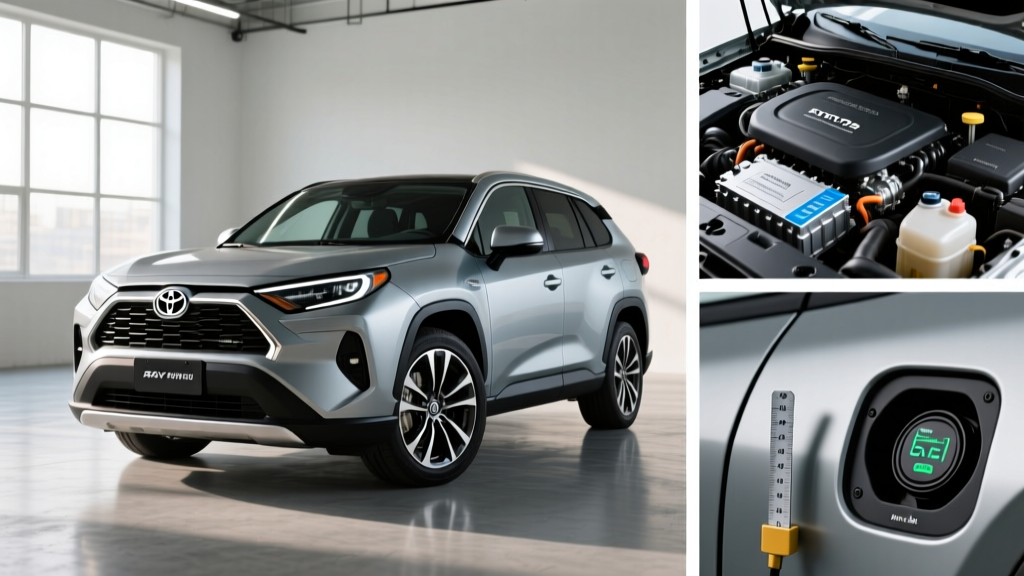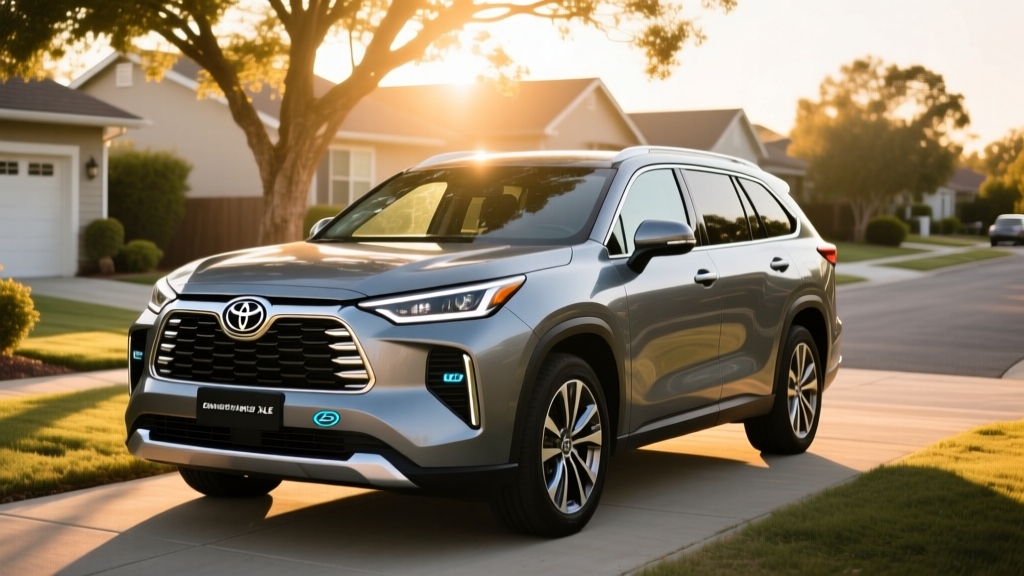
The 2024 Toyota Grand Highlander Hybrid XLE sits in a narrow but highly practical segment: a three-row family hauler that sips fuel without requiring a plug, a charging routine, or any change in driving habits. If you've been cross-shopping midsize SUVs and keep landing on the Grand Highlander, the Hybrid XLE trim is arguably the sweet spot — it brings Toyota's proven hybrid powertrain, a spacious third row, and EPA-estimated fuel economy that embarrasses many compact crossovers.
But sticker numbers don't tell the whole story. Below, we break down the exact MPG you can expect in real-world driving, how the hybrid system actually works, what the battery warranty covers, and whether this HEV makes more financial sense than a plug-in hybrid or a full battery-electric SUV in 2026.
HEV vs. PHEV: Where the Grand Highlander Hybrid Fits
Before we get into the numbers, it's critical to distinguish what you're buying. The Grand Highlander Hybrid is a conventional hybrid electric vehicle (HEV) — it does not plug in. It charges its small battery through regenerative braking and the gasoline engine. You fuel it at any gas station and drive it exactly like a conventional car.
This is fundamentally different from a plug-in hybrid (PHEV) like the Toyota RAV4 Prime, which carries a larger battery, offers 20–40+ miles of electric-only driving, and requires plugging in to capture its efficiency advantage. Toyota does not currently offer a Grand Highlander PHEV in the U.S. market, and the Grand Highlander Hybrid Max (a performance-oriented variant with a turbocharged engine) is a different powertrain entirely with lower fuel economy.
| Feature | HEV (Grand Highlander Hybrid) | PHEV (e.g., RAV4 Prime) |
|---|---|---|
| Plug-in charging required? | No | Yes (for EV range benefit) |
| Electric-only range | ~1 mile at low speed | 20–42 miles typical |
| Battery size | ~1.6 kWh (NiMH) | 18–22 kWh (lithium-ion) |
| Fueling | Gas station only | Gas station + Level 1/2 plug |
| Federal tax credit (§30D) | Not eligible | Up to $7,500 if eligible |
| Best for | No home charging access | Home charging + short commutes |
Fuel Economy: EPA Ratings and Real-World MPG
The headline number for the 2024 Grand Highlander Hybrid XLE with front-wheel drive (FWD) is an EPA-estimated 36 MPG combined, breaking down to 37 MPG city and 34 MPG highway, according to fueleconomy.gov. The all-wheel-drive (AWD) variant drops slightly to 35 MPG combined (36 city / 32 highway).
| Drivetrain | City MPG | Highway MPG | Combined MPG |
|---|---|---|---|
| FWD | 37 | 34 | 36 |
| AWD (eAWD) | 36 | 32 | 35 |
Real-World MPG: What Owners Actually See
Toyota hybrids tend to perform close to — or even slightly above — their EPA city estimates in stop-and-go driving, because regenerative braking recovers energy that a gas-only vehicle wastes as heat. On suburban and city-heavy routes, many Grand Highlander Hybrid owners report 35–38 MPG in mixed driving.
However, highway-only driving at 75+ MPH will pull numbers down to 30–32 MPG, especially when loaded with passengers and cargo. Cold weather (below 30°F) typically reduces hybrid efficiency by 5–10% due to increased engine idling for cabin heat and reduced battery efficiency. If your commute is mostly highway miles in winter, plan for roughly 31–33 MPG combined rather than the 36 MPG sticker.
For context, the non-hybrid Grand Highlander with the turbo-4 engine achieves 24 MPG combined — meaning the hybrid saves roughly 3.5 gallons per 100 miles driven, or about $525 per year at 15,000 miles and $3.50/gallon fuel.
Powertrain and Performance Specs
The Grand Highlander Hybrid XLE uses Toyota's fifth-generation hybrid system, pairing a 2.5-liter inline-4 Atkinson-cycle engine with front and (on AWD models) rear electric motors.
| Specification | Value |
|---|---|
| Engine | 2.5L 4-cyl Atkinson cycle |
| Combined system horsepower | 245 HP |
| Transmission | eCVT (electronically controlled) |
| Drivetrain | FWD or eAWD (rear electric motor) |
| Hybrid battery | ~1.6 kWh, Nickel-Metal Hydride (NiMH) |
| 0–60 MPH | ~7.8 seconds (est.) |
| Towing capacity | 3,500 lbs |
| Seating | 7 or 8 passengers |
| Cargo (behind 3rd row) | 20.6 cu ft |
| Cargo (all rows folded) | 97.5 cu ft |
The 245 HP output is adequate for a family SUV of this size — it won't feel quick off the line, but highway merging and passing are confident. The eCVT eliminates shift shock and keeps the engine in its most efficient RPM band. The eAWD system uses a separate 40 kW rear motor that engages automatically for traction, with no mechanical driveshaft — a reliability advantage over traditional AWD systems.
Pricing, Trim Value, and Tax Credit Eligibility
The 2024 Grand Highlander Hybrid XLE started at an MSRP of approximately $44,670 (FWD), with AWD adding roughly $1,600. Destination charges brought the out-the-door base to around $46,000. Options like captain's chairs, panoramic roof, and the Technology package could push a well-equipped XLE past $50,000.
Federal Tax Credit: Not Eligible
Here's a common point of confusion. Under IRS §30D rules, the federal clean vehicle tax credit (up to $7,500) applies only to plug-in electric vehicles — battery-electric vehicles (BEVs) and plug-in hybrids (PHEVs) with at least 7 kWh of battery capacity. The Grand Highlander Hybrid is a conventional HEV with a ~1.6 kWh battery. It does not qualify for the §30D federal tax credit.
There is no separate federal tax credit for conventional hybrids. Some states may offer minor incentives (HOV lane access in certain jurisdictions, employer rebates), but these vary widely. Check your state's energy office or the Alternative Fuels Data Center for current local programs.
Battery Warranty, Lifespan, and Replacement Cost
Hybrid battery longevity is consistently the top concern for first-time hybrid buyers. Toyota addresses this with robust warranty coverage:
Toyota Hybrid Battery Warranty
- Hybrid battery: 10 years / 150,000 miles (whichever comes first), for 2020+ model year vehicles
- Hybrid system components: 8 years / 100,000 miles (inverter, transaxle, control modules)
- Transferability: Warranty transfers to subsequent owners at no cost
Source: Toyota Owner's Warranty Guide
Real-World Battery Longevity
Toyota's NiMH hybrid batteries have an exceptionally strong track record. The Prius, which uses similar chemistry, commonly reaches 150,000–200,000+ miles on the original hybrid battery. Degradation in conventional hybrids is less critical than in EVs because the battery is small and the system is designed to operate within a narrow state-of-charge window (roughly 40–80%), which minimizes stress.
If replacement is needed out of warranty, a refurbished Grand Highlander hybrid battery runs approximately $2,000–$3,500 installed, while a new OEM unit may cost $4,000–$5,500. Independent hybrid repair shops have become more common and often offer cell-level repair for under $1,500.
Grand Highlander Hybrid vs. EV vs. PHEV: Which Fits You?
The decision between a conventional hybrid, a plug-in hybrid, and a full EV comes down to your charging access, daily mileage, and willingness to adapt your routine.
Choose the Grand Highlander Hybrid (HEV) if:
- You don't have access to home or workplace Level 2 charging
- You regularly take long road trips (400+ miles) and don't want to plan around chargers
- You want a three-row SUV with minimal upfront premium over a gas model
- You want zero behavior change — just fuel up and go
Consider a PHEV (when available in this class) if:
- You have home Level 2 charging and a commute under 30 miles
- You want some electric-only driving without range anxiety on road trips
- You want potential federal tax credit eligibility
Consider a full EV (e.g., Kia EV9, Tesla Model X) if:
- You have reliable home charging and want the lowest per-mile fuel cost
- Your daily driving is under 250 miles and you're comfortable with DC fast charging on road trips
- You want the $7,500 federal tax credit (subject to MSRP, income, and sourcing rules per IRS §30D)
Who Should Buy the 2024 Grand Highlander Hybrid XLE?
The XLE trim hits a pragmatic middle ground. You get SofTex-trimmed seats, a 12.3-inch touchscreen with wireless Apple CarPlay and Android Auto, Toyota Safety Sense 3.0 (adaptive cruise, lane-keeping, automatic emergency braking), heated front seats, and a power liftgate — all standard. You skip the base LE's cloth interior and smaller feature set without paying the Limited or Platinum premium.
Pros
- 36 MPG combined in a true three-row SUV — best in class
- No plug-in required; zero lifestyle change from a gas car
- Strong 10-year/150k-mile hybrid battery warranty
- Spacious third row fits adults (unlike many competitors)
- 3,500-lb towing covers small boats and campers
- Toyota reliability and resale value track record
Cons
- No federal tax credit (HEV, not PHEV/BEV)
- 245 HP is adequate, not quick — highway passing requires planning
- Highway MPG drops to ~30–32 in real-world 75+ MPH driving
- XLE lacks ventilated seats and premium audio (upgrade to Limited)
- No spare tire on some trims (tire repair kit instead)
Frequently Asked Questions
How many MPG does the 2024 Toyota Grand Highlander Hybrid XLE get?
The FWD model achieves an EPA-estimated 37 city / 34 highway / 36 combined MPG. The AWD version is rated at 36 city / 32 highway / 35 combined. Real-world mixed driving typically yields 33–38 MPG depending on route, speed, and temperature.
Does the Grand Highlander Hybrid need to be plugged in?
No. It is a conventional hybrid (HEV) and charges its battery entirely through regenerative braking and the gasoline engine. You fuel it at any gas station. There is no plug, no charging cable, and no electric-only driving range to manage.
How far can the Grand Highlander Hybrid go on electric only?
Effectively about one mile at very low speeds (under 25 MPH) in EV mode. This is not a plug-in hybrid — the electric motor assists the gas engine and handles low-speed maneuvering, but the gasoline engine does the vast majority of propulsion. Total range on a single tank is roughly 540–580 miles.
Does the Grand Highlander Hybrid qualify for any federal tax credit?
No. The IRS §30D clean vehicle credit applies only to plug-in vehicles (BEVs and PHEVs) with at least 7 kWh of battery capacity. The Grand Highlander Hybrid's ~1.6 kWh battery does not meet this threshold. No federal tax credit exists for conventional hybrids.
Is the Grand Highlander Hybrid reliable, and what does a battery replacement cost?
Toyota's hybrid systems are among the most proven in the industry, with millions of units on the road. The hybrid battery carries a 10-year/150,000-mile warranty. Out-of-warranty replacement costs roughly $2,000–$3,500 for a refurbished unit or $4,000–$5,500 for new OEM. Many hybrids reach 200,000+ miles on the original battery.
How does the Grand Highlander Hybrid compare to the Hybrid Max?
The Hybrid Max is a performance-oriented powertrain pairing a 2.4L turbocharged engine with electric motors for 362 HP. It achieves roughly 27 MPG combined — about 9 MPG less than the standard hybrid. The Max is available only on higher trims (Limited, Platinum) and commands a significant price premium. Choose it for acceleration; choose the standard hybrid for efficiency.
Is the eAWD system worth the MPG trade-off?
If you live in a region with snow, ice, or frequent rain, the eAWD system's traction benefit is meaningful and costs only 1 MPG combined (35 vs. 36). The rear electric motor engages seamlessly with no driver input. For dry, warm climates, FWD saves fuel and a small amount of weight.