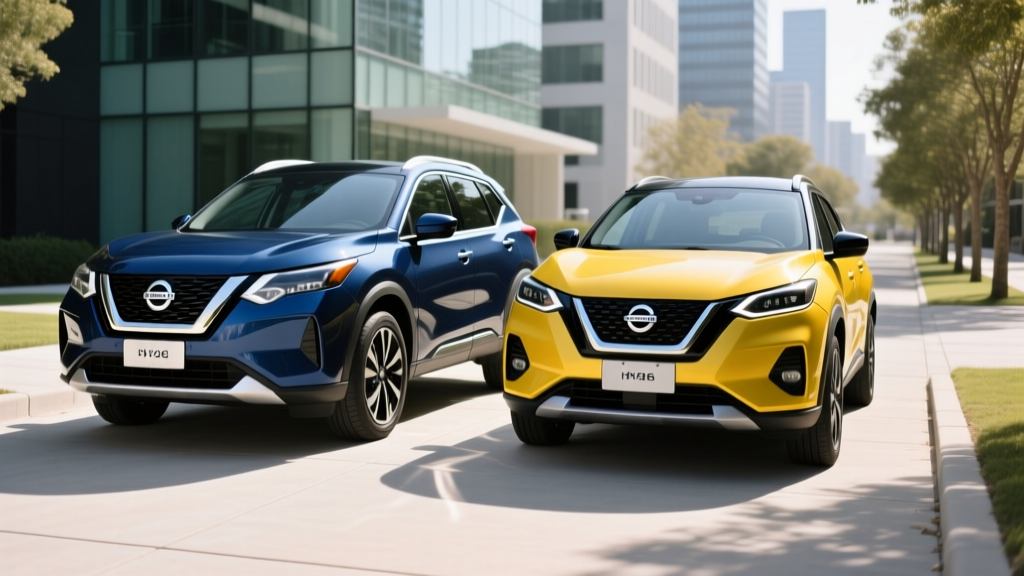
If you've been browsing Nissan's showroom wondering, does Nissan make a hybrid SUV? — the answer in 2026 is yes, but with important distinctions depending on which model you're considering. Nissan currently offers hybrid technology in two of its most popular SUVs: the compact Rogue and the subcompact Kicks. However, neither is a plug-in hybrid (PHEV). Both use conventional hybrid (HEV) systems that recharge their batteries through regenerative braking and the gasoline engine — no plug required.
This guide breaks down exactly what Nissan's hybrid SUVs deliver in MPG, how their powertrains work, real-world efficiency expectations, battery longevity, and whether a Nissan hybrid is the right bridge between a gas car and a full battery-electric vehicle (BEV).
HEV vs PHEV: What Nissan Actually Sells
Before diving into specs, it's critical to understand the difference between the two hybrid types, because Nissan's lineup only covers one of them.
| Feature | Conventional Hybrid (HEV) | Plug-in Hybrid (PHEV) |
|---|---|---|
| Battery Size | ~1.0–1.5 kWh | 10–25+ kWh |
| Plug-in Charging | No — self-charging via regen + engine | Yes — Level 1/2 plug-in capable |
| Electric-Only Range | Less than 1 mile at low speeds | 20–50+ miles |
| Federal Tax Credit (§30D) | Not eligible | Up to $7,500 (if eligible) |
| Driving Experience | Seamless gas-electric blend | EV-like for daily commutes, gas for road trips |
| Nissan Availability (2026) | Rogue Hybrid, Kicks Hybrid | Not currently offered in US |
Nissan does not currently sell a PHEV in the United States. If plug-in electric-only range is a priority — say, a 30-mile daily commute on electrons alone — you'll need to look at competitors like the Toyota RAV4 Prime or Hyundai Tucson PHEV. Nissan's hybrid strategy focuses on conventional HEVs that improve MPG without requiring any change in fueling behavior.
2026 Nissan Rogue Hybrid: Specs and Fuel Economy
The Rogue is Nissan's best-selling SUV, and the hybrid variant pairs a turbocharged three-cylinder engine with an electric motor integrated into the transmission. This is not a mild hybrid — it's a full parallel hybrid system capable of moving the vehicle on electric power alone at low speeds and assisting under hard acceleration.
| Specification | 2026 Nissan Rogue Hybrid (AWD) |
|---|---|
| Engine | 1.5L VC-Turbo 3-cylinder + electric motor |
| Combined Horsepower | 201 hp (net system output) |
| Combined Torque | 225 lb-ft |
| Transmission | Xtronic CVT |
| Drivetrain | AWD standard |
| Battery | ~1.5 kWh lithium-ion (self-charging) |
| EPA MPG (City / Hwy / Combined) | 38 / 35 / 37 MPG |
| Fuel Tank | 14.5 gallons |
| Total Driving Range | ~536 miles |
| 0-60 mph (est.) | ~7.8 seconds |
| Cargo Volume | 31.6 cu ft (rear seats up) |
| Base MSRP | ~$33,500 (S Hybrid trim) |
How Many MPG Does the Rogue Hybrid Actually Get?
The EPA rates the 2026 Rogue Hybrid AWD at 38 city / 35 highway / 37 combined MPG. That's a significant improvement over the gas-only Rogue AWD, which returns roughly 31 / 29 / 30 MPG. The hybrid system pays its biggest dividends in stop-and-go city driving, where regenerative braking recaptures energy that would otherwise be lost as heat in the brake pads.
2026 Nissan Kicks Hybrid: The Subcompact Option
For buyers who want a smaller footprint and lower price, the Kicks Hybrid brings Nissan's e-Power series-hybrid system to the subcompact SUV segment. Unlike the Rogue's parallel hybrid, the Kicks e-Power system uses the gasoline engine exclusively as a generator — the wheels are always driven by the electric motor. This creates an EV-like driving feel without any plug-in requirement.
| Specification | 2026 Nissan Kicks Hybrid (FWD) |
|---|---|
| Engine | 1.2L 3-cylinder (generator only) |
| Drive Motor Output | 134 hp / 206 lb-ft |
| System Type | e-Power series hybrid |
| Transmission | Single-speed reduction gear |
| Drivetrain | FWD |
| Battery | ~1.5 kWh lithium-ion (self-charging) |
| EPA MPG (City / Hwy / Combined) | 40 / 37 / 39 MPG |
| Fuel Tank | 10.8 gallons |
| Total Driving Range | ~421 miles |
| 0-60 mph (est.) | ~8.5 seconds |
| Cargo Volume | 25.3 cu ft (rear seats up) |
| Base MSRP | ~$26,500 (S trim) |
The Kicks Hybrid's 40 MPG city rating is impressive for a crossover and is a direct result of the series-hybrid architecture: the engine runs only at its most efficient RPM to generate electricity, while the motor handles all propulsion. Drivers report that the Kicks Hybrid feels smoother and more responsive around town than its gas-only counterpart, thanks to instant electric torque.
Battery Warranty and Longevity: What Hybrid Buyers Need to Know
Battery replacement cost is consistently the top concern for hybrid shoppers. Here's the reassurance: Nissan's hybrid battery systems are covered under a robust warranty, and real-world data shows these batteries frequently outlast their warranty periods by significant margins.
- Coverage: 8 years / 100,000 miles (whichever comes first)
- What's covered: Battery capacity loss below a defined threshold, defects, and cell failures
- Replacement cost (out of warranty): Approximately $2,000–$3,500 for the hybrid battery pack, plus ~$500–$800 labor
- Real-world lifespan: Data from long-running Nissan hybrid systems (including the previous-generation Rogue Hybrid) shows most packs retain 85%+ capacity at 150,000 miles
Unlike full EVs with 60–100 kWh battery packs that can cost $10,000–$20,000 to replace, the small ~1.5 kWh hybrid batteries in the Rogue and Kicks are relatively inexpensive. The hybrid battery cycles far less deeply than an EV battery — it typically operates between 40% and 80% state of charge, which dramatically reduces degradation stress. Many Toyota and Nissan hybrid batteries have exceeded 200,000 miles without replacement.
Tax Credits and Incentives: Does a Nissan Hybrid Qualify?
This is where conventional hybrids differ sharply from PHEVs and BEVs. Under current IRS §30D rules, the federal clean vehicle credit of up to $7,500 applies only to plug-in electric vehicles — battery-electric vehicles (BEVs) and plug-in hybrids (PHEVs) with battery capacity of at least 7 kWh.
Since the Nissan Rogue Hybrid and Kicks Hybrid are conventional HEVs with ~1.5 kWh batteries and no plug-in capability, neither qualifies for the federal §30D tax credit. They also do not qualify for most state EV rebates that require plug-in capability.
However, some states and local utilities offer smaller incentives for any high-efficiency vehicle. Check your state's energy office and local utility for possible rebates — these vary widely by jurisdiction and change frequently.
Hybrid vs PHEV vs EV: Which Nissan SUV Buyer Are You?
Choosing between Nissan's hybrid SUVs, a competitor's PHEV, or a full BEV comes down to your daily routine, charging access, and budget.
Nissan Hybrid SUV Pros
- No plug-in charging required — fuel like a gas car
- 37–39 MPG combined cuts fuel costs ~25% vs gas-only
- Lower purchase price than PHEVs and BEVs
- No range anxiety — 420–536 miles total range
- Proven hybrid reliability with 8yr/100k warranty
- AWD available (Rogue Hybrid)
Nissan Hybrid SUV Cons
- No electric-only driving range
- No federal tax credit eligibility
- Still burns gasoline — not a zero-tailpipe-emission vehicle
- Less performance benefit than a PHEV or BEV
- Nissan offers no PHEV option if you want plug-in capability
- Choose a Nissan Hybrid (HEV) if: You don't have access to home or workplace charging, you want better MPG without changing your fueling habits, and you want a lower upfront price. Ideal for apartment dwellers and those who take frequent long road trips.
- Choose a competitor PHEV (RAV4 Prime, Tucson PHEV) if: You have Level 2 home charging, your daily commute is under 35 miles, and you want to drive mostly on electricity while keeping gas for road trips. PHEVs qualify for the §30D credit if eligible.
- Choose a full BEV (Nissan Ariya, Tesla Model Y, Ioniq 5) if: You have reliable home charging, want zero tailpipe emissions, want the lowest per-mile fuel cost, and your daily driving is within the vehicle's range (250–330 miles for most modern BEVs).
Reliability and Ownership Costs
Nissan's hybrid systems have benefited from years of iteration. The e-Power series-hybrid architecture in the Kicks has been deployed in millions of vehicles globally (particularly in Japan), while the Rogue's parallel hybrid system uses a proven CVT-based design.
According to fueleconomy.gov, the 2026 Rogue Hybrid's annual fuel cost is estimated at approximately $1,550 (based on 15,000 miles/year and $3.40/gallon regular), compared to roughly $1,950 for the gas-only Rogue AWD. That's about $400/year in fuel savings, meaning the hybrid's ~$2,000 price premium pays for itself in roughly 5 years at current fuel prices.
Insurance premiums for the hybrid variants are typically comparable to their gas counterparts — unlike BEVs, which can carry 15–25% higher insurance costs due to repair complexity. Maintenance costs are also similar to gas models: the hybrid system adds no additional scheduled maintenance items (no plug, no charging port, no coolant loops for a large battery).
The Bottom Line on Nissan's Hybrid SUVs
If your question was simply "does Nissan make a hybrid SUV?" — yes, in the form of the Rogue Hybrid (compact, 37 MPG combined, AWD, ~$33,500) and the Kicks Hybrid (subcompact, 39 MPG combined, FWD, ~$26,500). Both are conventional hybrids requiring no plug-in charging, making them practical for buyers without garage or driveway charging access.
What Nissan doesn't offer in 2026 is a plug-in hybrid. If electric-only commuting range is on your wishlist, you'll need to cross-shop the Toyota RAV4 Prime (42 miles EV range), Hyundai Tucson PHEV (33 miles EV range), or the Kia Sportage PHEV (34 miles EV range). For the full EV experience from Nissan, the Nissan Ariya remains the brand's only all-electric SUV, offering up to 304 miles of EPA range.
Does Nissan make a plug-in hybrid SUV?
No. As of the 2026 model year, Nissan does not sell a plug-in hybrid (PHEV) SUV in the United States. The Rogue Hybrid and Kicks Hybrid are both conventional hybrids (HEVs) that cannot be plugged in and have no meaningful electric-only range. Nissan has not announced a PHEV for the US market.
How many MPG does the Nissan Rogue Hybrid get?
The 2026 Nissan Rogue Hybrid AWD is EPA-rated at 38 city / 35 highway / 37 combined MPG. Real-world city driving often matches or slightly exceeds the EPA figure, while sustained highway driving at higher speeds may yield 32–34 MPG.
Does the Nissan Rogue Hybrid qualify for a tax credit?
No. The federal §30D clean vehicle credit applies only to plug-in electric vehicles (BEVs and PHEVs). Since the Rogue Hybrid is a conventional HEV with no plug-in capability, it does not qualify. Check your state and local utility for possible efficiency rebates, which vary by jurisdiction.
How long will the Nissan hybrid battery last?
Nissan covers the hybrid battery for 8 years / 100,000 miles. Real-world data from similar hybrid systems shows most packs retain strong capacity well beyond 150,000 miles. Out-of-warranty replacement costs approximately $2,000–$3,500 — far less than a full EV battery replacement.
Is the Nissan Kicks Hybrid better on gas than the Rogue Hybrid?
Yes, slightly. The Kicks Hybrid FWD achieves 39 MPG combined vs the Rogue Hybrid AWD's 37 MPG combined. The Kicks is lighter and uses a series-hybrid system optimized for city efficiency. However, the Rogue Hybrid offers AWD, more cargo space (31.6 vs 25.3 cu ft), and more horsepower (201 vs 134 hp).
Can I charge the Nissan Rogue Hybrid at home?
No. The Rogue Hybrid is a conventional hybrid — it charges its small battery exclusively through regenerative braking and the gasoline engine. There is no charging port. You fuel it at any gas station with regular unleaded.