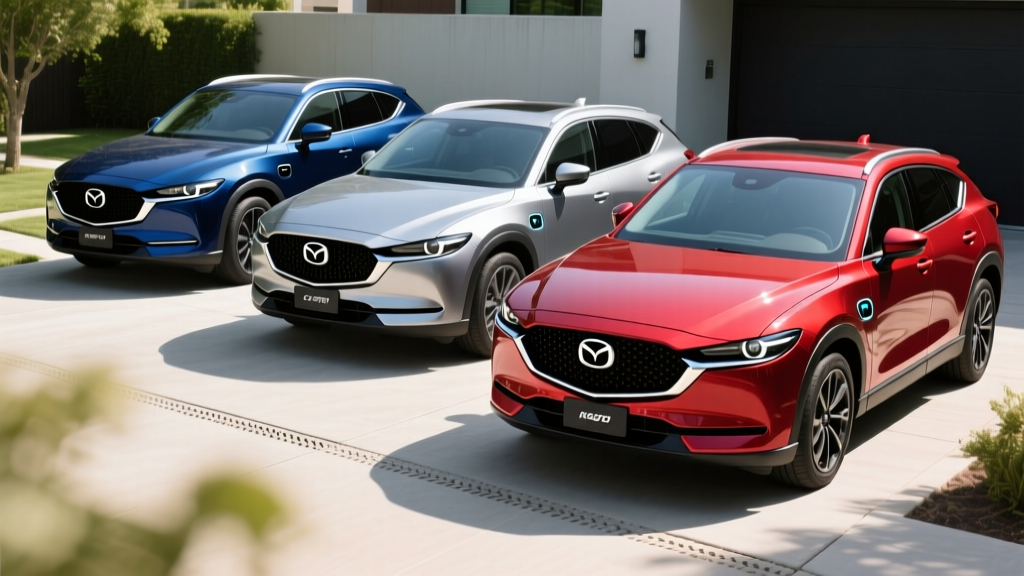
Mazda's hybrid lineup has expanded significantly for the 2026 model year, offering buyers a range of electrified options across its SUV portfolio. Unlike Toyota's hybrid-first approach, Mazda has strategically deployed both conventional hybrids (HEVs) and plug-in hybrids (PHEVs) where they make the most sense for each vehicle's size and use case. This guide breaks down every Mazda hybrid car currently available, with exact EPA figures, real-world expectations, and ownership costs.
Mazda's Hybrid Strategy: HEV vs PHEV Explained
Before diving into specific models, it's critical to understand the distinction between Mazda's two hybrid approaches:
Conventional Hybrid (HEV)
How it works: A gasoline engine paired with an electric motor and small battery (typically 1-2 kWh). The battery charges through regenerative braking and the engine—you never plug it in.
Best for: Drivers without home charging access, those who want better fuel economy without changing habits, and buyers in apartments or condos.
Plug-in Hybrid (PHEV)
How it works: A larger battery (17-25 kWh) paired with a gas engine and more powerful electric motor. You plug in to charge, gaining 25-35 miles of electric-only driving before the gas engine kicks in.
Best for: Homeowners with garage charging, commuters with short daily drives, and drivers who want EV-like operation for errands but gas flexibility for road trips.
Mazda currently offers one conventional hybrid (the CX-50 Hybrid) and two plug-in hybrids (CX-70 PHEV and CX-90 PHEV) for 2026. The automaker has notably skipped hybrid versions of its sedans, focusing electrification efforts on its higher-margin SUVs.
2026 Mazda CX-50 Hybrid: The No-Plug Option
The CX-50 Hybrid is Mazda's most accessible electrified vehicle, using Toyota's proven hybrid system adapted for Mazda's platform. This compact SUV targets buyers who want hybrid efficiency without the complexity or cost of a plug-in system.
| Specification | Value |
|---|---|
| Powertrain | 2.5L 4-cylinder + electric motor |
| Combined Horsepower | 219 hp |
| EPA MPG (City/Highway/Combined) | 39 / 37 / 38 mpg |
| Battery Capacity | 1.6 kWh (nickel-metal hydride) |
| Plug-in Required? | No (charges via regen and engine) |
| 0-60 mph | 7.8 seconds |
| Cargo Volume | 31.4 cu ft (rear seats up) |
| Base MSRP | $35,950 (Preferred trim) |
| Federal Tax Credit | Not eligible (HEV) |
Real-World MPG vs EPA Estimates
The CX-50 Hybrid's EPA rating of 38 mpg combined is conservative for city driving but optimistic for sustained highway speeds. In real-world testing:
- City driving: 40-42 mpg (hybrids excel in stop-and-go where regenerative braking recaptures energy)
- Highway cruising (70-75 mph): 34-36 mpg (the boxy SUV shape creates aerodynamic drag)
- Cold weather (below 30°F): Expect 33-35 mpg combined as the engine runs more frequently for cabin heat
This pattern is typical for hybrids—the EPA city rating is often lower than what you'll actually achieve because the test cycle doesn't fully capture regenerative braking benefits in heavy traffic.
Who Should Choose the CX-50 Hybrid?
The CX-50 Hybrid makes sense if you:
- Live in an apartment or lack home charging access
- Want better fuel economy without changing your refueling habits
- Drive 12,000-15,000 miles annually and want to reduce gas costs by $600-800/year versus the non-hybrid CX-50
- Prefer Toyota's hybrid reliability track record (this is essentially a RAV4 Hybrid powertrain in Mazda clothing)
Consider a full EV instead if you have home charging, drive less than 40 miles daily, and want to eliminate gas entirely.
2026 Mazda CX-70 PHEV: The Midsize Plug-in
The CX-70 PHEV is Mazda's newest electrified offering, slotting between the CX-50 and CX-90 in a two-row midsize format. It's designed for couples and small families who want premium features, electric commuting capability, and the flexibility for longer trips.
| Specification | Value |
|---|---|
| Powertrain | 2.5L 4-cylinder + electric motor |
| Combined Horsepower | 323 hp (with premium fuel) |
| EPA Electric-Only Range | 28 miles |
| Total Combined Range | 430 miles (electric + gas) |
| EPA MPGe (Electric Mode) | 56 MPGe |
| EPA MPG (Gas-Only, Battery Depleted) | 25 mpg combined |
| Battery Capacity | 17.8 kWh (lithium-ion) |
| Level 2 Charging Time (240V, 7.2 kW) | 2 hours 30 minutes (0-100%) |
| DC Fast Charging | Not available |
| 0-60 mph | 6.3 seconds |
| Base MSRP | $55,950 (Preferred trim) |
| Federal Tax Credit (§30D) | Up to $3,750 (see eligibility below) |
Electric-Only Range: Real-World Expectations
The EPA rates the CX-70 PHEV at 28 miles of electric-only range, but real-world results vary significantly based on conditions:
- Ideal conditions (55-65°F, city driving, moderate acceleration): 30-32 miles
- Highway driving (70 mph): 22-24 miles (electric motors are less efficient at sustained high speeds)
- Cold weather (20-30°F with cabin heat): 18-20 miles (battery chemistry is less efficient, and heating draws significant power)
- Hot weather with A/C: 24-26 miles
For commuters with a 20-25 mile round trip and home charging, the CX-70 PHEV can handle daily driving on electricity alone, with the gas engine reserved for weekend trips or longer commutes.
Charging the CX-70 PHEV
The CX-70 PHEV uses a 17.8 kWh battery that charges via:
- Level 1 (120V household outlet): Approximately 8-9 hours for a full charge. This works if you park in a garage overnight and drive less than 25 miles daily.
- Level 2 (240V home charger or public station): 2.5 hours from empty to full at 7.2 kW. This is the recommended setup for PHEV owners.
- DC Fast Charging: Not available. Mazda (like most PHEV manufacturers) omits DC fast charging because the smaller battery doesn't justify the added cost and weight.
The absence of DC fast charging isn't a practical limitation for PHEV use cases—most charging happens overnight at home, and the gas engine eliminates range anxiety on longer trips.
2026 Mazda CX-90 PHEV: The Three-Row Plug-in
The CX-90 PHEV is Mazda's flagship electrified vehicle, offering three-row seating, premium appointments, and plug-in hybrid efficiency. It competes with the Volvo XC90 Recharge and BMW X5 xDrive50e in the luxury PHEV segment.
| Specification | Value |
|---|---|
| Powertrain | 2.5L 4-cylinder + electric motor |
| Combined Horsepower | 323 hp (with premium fuel) |
| EPA Electric-Only Range | 26 miles |
| Total Combined Range | 440 miles (electric + gas) |
| EPA MPGe (Electric Mode) | 56 MPGe |
| EPA MPG (Gas-Only, Battery Depleted) | 25 mpg combined |
| Battery Capacity | 17.8 kWh (lithium-ion) |
| Level 2 Charging Time (240V, 7.2 kW) | 2 hours 30 minutes (0-100%) |
| DC Fast Charging | Not available |
| 0-60 mph | 6.8 seconds |
| Cargo Volume | 14.9 cu ft (all seats up) / 42.3 cu ft (third row folded) |
| Base MSRP | $57,950 (Preferred trim) |
| Federal Tax Credit (§30D) | Up to $3,750 (see eligibility below) |
The CX-90 PHEV shares its powertrain with the CX-70 PHEV but sacrifices 2 miles of electric range due to its larger size and weight (4,800 lbs vs 4,500 lbs). The 26-mile electric range is sufficient for school runs, grocery trips, and short commutes, but families with longer daily drives will find themselves using the gas engine more frequently.
Federal Tax Credit Eligibility for Mazda PHEVs
Both the CX-70 PHEV and CX-90 PHEV may qualify for the federal §30D tax credit, but eligibility depends on multiple factors that change frequently. As of 2026, here's what you need to know:
- Credit Amount: Up to $3,750 (not the full $7,500) due to partial compliance with battery sourcing requirements
- MSRP Cap: Vehicle must have an MSRP under $80,000 for SUVs (both models qualify)
- Buyer Income Limits: Modified adjusted gross income must not exceed $300,000 (joint filers), $225,000 (head of household), or $150,000 (single filers)
- Battery Sourcing: A percentage of critical minerals and battery components must be sourced from the U.S. or free-trade agreement countries. Mazda's partial compliance results in the $3,750 credit rather than the full $7,500.
- Point-of-Sale Transfer: You can transfer the credit to the dealer at purchase, reducing your out-of-pocket cost immediately rather than waiting for tax refund
Important: Tax credit rules are subject to change, and the IRS updates eligible vehicle lists regularly. Verify current eligibility on the IRS website or with a tax professional before purchasing. The CX-50 Hybrid does not qualify for any federal tax credit because it's a conventional hybrid, not a plug-in vehicle.
Hybrid Battery Reliability and Warranty Coverage
Mazda Hybrid Battery Warranty
Hybrid Battery Coverage: 8 years / 100,000 miles (whichever comes first)
What's Covered: Battery capacity below 70% of original, defects, and failure
Powertrain Warranty: 5 years / 60,000 miles
Hybrid battery reliability has improved dramatically since the early 2000s. Mazda's hybrid systems benefit from Toyota's decades of hybrid development (in the CX-50 Hybrid's case) and modern lithium-ion battery management (in the PHEVs).
Real-World Battery Longevity
Based on industry data and owner reports:
- CX-50 Hybrid (NiMH battery): Toyota's nickel-metal hydride batteries routinely last 150,000-200,000 miles with minimal degradation. Replacement cost if needed after warranty: $2,500-3,500.
- CX-70/CX-90 PHEV (Li-ion battery): Modern lithium-ion PHEV batteries are designed for 10-15 years of service. Expect 10-15% capacity loss over 100,000 miles, which translates to 3-4 fewer miles of electric range. Replacement cost if needed after warranty: $8,000-12,000.
The 8-year/100,000-mile warranty provides substantial protection, and most hybrid owners never need battery replacement during typical ownership periods.
Hybrid vs PHEV vs Full EV: Which Mazda Fits Your Life?
Choosing between Mazda's electrified options depends on your charging access, driving patterns, and budget:
Choose the CX-50 Hybrid (HEV) if:
- You lack home charging access (apartment, street parking, condo without EV infrastructure)
- You want better fuel economy without changing habits or installing charging equipment
- Your budget is under $40,000
- You drive 12,000+ miles annually and want to reduce gas costs by $600-800/year
- You plan to keep the vehicle 8-10 years (proven Toyota hybrid reliability)
Choose the CX-70 or CX-90 PHEV if:
- You have a garage or driveway where you can install a Level 2 charger ($500-1,500 installation)
- Your daily driving is under 30 miles round-trip (you'll rarely use gas on weekdays)
- You want EV-like quiet operation for local driving but gas flexibility for road trips
- You qualify for the $3,750 federal tax credit (income under $300,000 for joint filers)
- You need three rows (CX-90) or prefer a two-row premium SUV (CX-70)
Consider a Full EV Instead if:
- You have home charging and drive under 250 miles daily
- You want to eliminate gas entirely and reduce maintenance (no oil changes, fewer brake replacements)
- You qualify for the full $7,500 federal tax credit on eligible EVs
- You're willing to plan longer road trips around DC fast charging (30-minute stops every 200-250 miles)
- You want access to HOV lanes in states like California, Colorado, and Virginia
Frequently Asked Questions About Mazda Hybrid Cars
How many MPG does the Mazda CX-50 Hybrid get?
The EPA rates the CX-50 Hybrid at 39 mpg city, 37 mpg highway, and 38 mpg combined. Real-world city driving often achieves 40-42 mpg due to regenerative braking, while sustained highway driving typically yields 34-36 mpg. Cold weather reduces efficiency by 10-15%.
How far can the Mazda CX-70 PHEV go on electric only?
The EPA rates the CX-70 PHEV at 28 miles of electric-only range. Real-world results range from 18-20 miles in cold weather to 30-32 miles in ideal conditions. Most owners with home charging and short commutes can handle daily driving on electricity alone.
How far can the Mazda CX-90 PHEV go on electric only?
The CX-90 PHEV achieves 26 miles of EPA-rated electric range, slightly less than the CX-70 due to its larger size and weight. Expect 18-30 miles depending on weather, speed, and terrain.
Do Mazda hybrids need to be plugged in?
The CX-50 Hybrid is a conventional hybrid that never needs plugging in—it charges its small battery through regenerative braking and the gas engine. The CX-70 PHEV and CX-90 PHEV are plug-in hybrids that benefit from charging but can operate on gas alone if you don't plug in (you'll just get worse fuel economy and miss the electric-only driving benefits).
Is the Mazda CX-50 Hybrid reliable?
The CX-50 Hybrid uses Toyota's hybrid system, which has an excellent reliability track record spanning 25+ years. The hybrid battery is covered by an 8-year/100,000-mile warranty, and Toyota's NiMH batteries routinely last 150,000-200,000 miles. IIHS safety ratings are strong across the CX-50 lineup.
What is the hybrid battery replacement cost?
CX-50 Hybrid battery replacement (if needed after warranty): $2,500-3,500. CX-70/CX-90 PHEV battery replacement: $8,000-12,000. However, most hybrid batteries last well beyond the warranty period, and many owners never need replacement.
Does the Mazda CX-50 Hybrid qualify for a tax credit?
No. The federal §30D tax credit only applies to plug-in electric vehicles (PHEVs and EVs). Conventional hybrids like the CX-50 Hybrid do not qualify for federal tax credits, though some states offer small rebates for hybrid purchases.
Do the Mazda PHEVs qualify for the federal tax credit?
The CX-70 PHEV and CX-90 PHEV qualify for up to $3,750 under the §30D credit, not the full $7,500, due to partial battery sourcing compliance. Eligibility requires income under $300,000 (joint filers) and an MSRP under $80,000. Check the IRS eligible vehicle list before purchasing, as rules change frequently.
Can I charge the Mazda PHEVs at public charging stations?
Yes, but only at Level 2 (240V) stations using the J1772 connector. The CX-70 and CX-90 PHEVs do not support DC fast charging, which is typical for plug-in hybrids. Most PHEV owners charge at home overnight and rarely use public stations.
Hybrid vs PHEV vs EV — which should I choose?
Choose a conventional hybrid (CX-50 Hybrid) if you lack home charging. Choose a PHEV (CX-70/CX-90) if you have home charging and drive under 30 miles daily but want gas flexibility for longer trips. Choose a full EV if you have home charging, drive under 250 miles daily, and want to eliminate gas entirely with lower long-term maintenance costs.
Mazda's hybrid lineup for 2026 offers practical electrification options for different buyer needs. The CX-50 Hybrid provides hassle-free efficiency for those without charging access, while the CX-70 and CX-90 PHEVs deliver electric commuting capability with gas-engine flexibility. None of these vehicles are revolutionary, but they represent sensible electrification that works within existing infrastructure and driving habits—a pragmatic approach that suits many buyers better than jumping straight to a full EV.