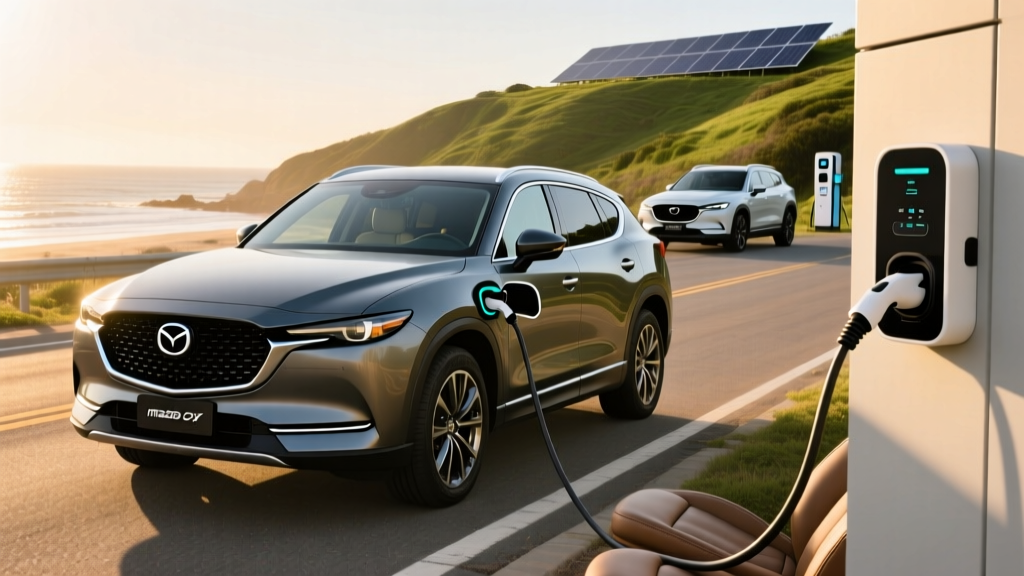
Quick Verdict: The Mazda CX-90 PHEV SUV at a Glance
The Mazda CX-90 PHEV occupies a specific niche in the three-row SUV market: buyers who want premium styling and genuine electric commuting capability without committing to a full battery-electric vehicle. With 26 miles of EPA-rated electric-only range, 327 combined horsepower, and a starting MSRP around $55,875, the CX-90 PHEV targets families who can charge at home but still need the security of a gasoline engine for road trips.
Unlike a conventional hybrid (HEV), which you never plug in, the CX-90 PHEV carries a 17.8 kWh lithium-ion battery that you charge from a wall outlet or Level 2 station. That distinction matters enormously for your daily driving costs, your tax credit eligibility, and your home electrical setup. This guide breaks down every spec that matters.
| Spec | Value |
|---|---|
| EPA Electric Range | 26 miles |
| EPA MPGe (electric + gas) | 56 MPGe |
| Gas-Only Combined MPG | 25 MPG |
| Battery Capacity | 17.8 kWh (lithium-ion) |
| Combined Horsepower | 327 hp / 369 lb-ft torque |
| Engine | 2.5L inline-4 + electric motor |
| Level 2 Charge Time (0–100%) | ~2 hours 20 min (at 7.2 kW) |
| DC Fast Charging | Not available |
| 0–60 mph | ~6.3 seconds |
| Base MSRP (Preferred) | $55,875 |
| Federal Tax Credit (§30D) | Up to $7,500 (eligibility varies) |
| Battery Warranty | 8 years / 100,000 miles |
HEV vs PHEV: What's the Difference and Why It Matters
Before diving into the CX-90 PHEV specifically, it's critical to understand the distinction between a conventional hybrid (HEV) and a plug-in hybrid (PHEV). Mazda does not currently offer a conventional HEV version of the CX-90 — the electrified variant is exclusively a PHEV.
| Feature | Conventional Hybrid (HEV) | Plug-In Hybrid (PHEV) |
|---|---|---|
| Plug in to charge? | No — charges via regen and engine | Yes — plug in for electric range |
| Electric-only range | 0–2 miles at low speed | 20–40+ miles typical |
| Battery size | 1–2 kWh | 10–25+ kWh |
| Federal tax credit | None | Up to $7,500 (§30D, if eligible) |
| Home charging needed | No | Strongly recommended for value |
If you cannot charge at home or at work, a PHEV like the CX-90 still functions as a conventional hybrid once the battery depletes — you'll get approximately 25 MPG combined on gasoline alone. But you'll be carrying around 400+ pounds of battery you never use, reducing efficiency versus a lighter HEV or mild-hybrid alternative. The CX-90 PHEV makes financial and practical sense primarily when you can plug in regularly.
Electric Range and Fuel Economy: The Real Numbers
The EPA rates the CX-90 PHEV at 26 miles of electric-only range and 56 MPGe when operating in combined electric-gasoline mode. Once the battery is depleted, the vehicle operates as a conventional hybrid, delivering an EPA-estimated 25 MPG combined (24 city / 27 highway). These figures come from fueleconomy.gov.
| Mode | City | Highway | Combined |
|---|---|---|---|
| Electric-only (MPGe) | — | — | 56 MPGe |
| Gasoline-only (MPG) | 24 | 27 | 25 |
Real-world expectations: The 26-mile electric range holds up reasonably well in moderate temperatures and city driving, where regenerative braking recaptures energy. In cold weather (below 30°F), expect that range to drop to roughly 20–22 miles due to battery chemistry limitations and cabin heating demands. Highway driving at 70+ mph will also reduce electric range to approximately 22–23 miles because electric motors are less efficient at sustained high speeds.
The total combined range — electric plus gasoline — is approximately 460 miles with a full tank and a full battery, based on the 16.9-gallon fuel tank. That's more than enough for any road trip without range anxiety.
EPA Electric Range: 26 miles
Real-world expectation: 22–26 miles depending on temperature, terrain, and speed. Cold weather or sustained highway driving will push you toward the lower end. For commutes under 20 miles round-trip, the CX-90 PHEV can operate almost entirely on electricity year-round.
Powertrain and Performance Specs
The CX-90 PHEV pairs a 2.5-liter naturally aspirated inline-4 engine with a single electric motor integrated into the 8-speed automatic transmission. Combined output is 327 horsepower and 369 lb-ft of torque — significantly more than the turbocharged inline-6 mild-hybrid variants of the CX-90 in base tune (280 hp).
All CX-90 PHEV models come with Mazda's i-Activ all-wheel drive as standard. The 0–60 mph sprint takes approximately 6.3 seconds, which is respectable for a 4,900-pound three-row SUV. The electric motor provides immediate torque from a stop, making the CX-90 PHEV feel more responsive in city driving than its gasoline-only siblings.
The powertrain manages transitions between electric and gasoline operation smoothly. In EV mode, the cabin is nearly silent. When the gasoline engine engages — either under heavy acceleration or when the battery depletes — the 2.5L four-cylinder is audible but not intrusive. It lacks the refinement of Mazda's inline-6 options, which is a trade-off for the electric capability.
Charging the CX-90 PHEV: What You Need to Know
The CX-90 PHEV's 17.8 kWh battery charges exclusively via AC power. There is no DC fast charging capability — a limitation shared with most PHEVs in this class. Here's what charging looks like at each level:
| Charging Level | Power (kW) | 0–100% Time | Typical Source |
|---|---|---|---|
| Level 1 (120V) | ~1.4 kW | ~12–13 hours | Standard household outlet |
| Level 2 (240V) | Up to 7.2 kW | ~2 hours 20 min | Home wallbox or public L2 station |
| DC Fast Charge | N/A | N/A | Not supported |
The CX-90 PHEV uses a standard J1772 connector for AC charging. Mazda includes a dual-voltage charging cable (Level 1 and Level 2 capable) with the vehicle, though many owners opt to install a dedicated Level 2 home charger for convenience.
Key insight on kW vs kWh: The battery stores 17.8 kWh of energy (capacity). The onboard charger accepts up to 7.2 kW of power (rate). At the full 7.2 kW rate, 17.8 kWh ÷ 7.2 kW ≈ 2.5 hours, minus some efficiency losses — hence the ~2 hour 20 minute estimate. This distinction between kW (the speed of energy flow) and kWh (the total energy stored) is the single most common point of confusion for new PHEV owners.
Home charging setup: For Level 2 charging at home, you'll need a 240V circuit — typically a NEMA 14-50 outlet or a hardwired wallbox. Installation costs range from $500–$1,500 if your electrical panel has spare capacity, or $2,000–$4,000+ if a panel upgrade is required. A licensed electrician should assess your home's 200-amp (or 100-amp) panel before committing to equipment.
Pricing, Trims, and Federal Tax Credit Eligibility
The 2026 Mazda CX-90 PHEV is available in three trims, with pricing starting at $55,875 (including destination):
- Preferred: $55,875 — leatherette seats, 10.25-inch infotainment, power liftgate
- Premium: $59,375 — Nappa leather, 12.3-inch display, panoramic moonroof, Bose audio
- Premium Plus: $62,875 — quilted Nappa leather, second-row captain's chairs, head-up display
All trims include all-wheel drive, the full PHEV powertrain, and Mazda's i-Activsense safety suite.
Federal §30D Tax Credit — Eligibility Checklist
The CX-90 PHEV may qualify for up to $7,500 in federal tax credits under IRS §30D rules, but eligibility depends on multiple factors that change frequently:
- MSRP cap: SUVs must have an MSRP at or below $80,000 — all CX-90 PHEV trims qualify
- Buyer income cap: Modified AGI must not exceed $150,000 (single), $225,000 (head of household), or $300,000 (joint filers)
- Battery sourcing: Critical minerals and battery components must meet phased-in percentages from US or FTA partners — verify current-year compliance on the IRS qualified vehicles list
- Point-of-sale transfer: As of 2024+, eligible buyers can transfer the credit to the dealer at purchase for an immediate price reduction rather than waiting for tax filing
- Tax liability: The credit is non-refundable — you must have sufficient federal tax liability to claim it (unless transferred at point of sale)
Always verify current eligibility on the IRS qualified vehicles list before purchasing. Battery sourcing requirements tighten annually, and a model that qualifies in one year may lose eligibility the next. Consult a tax professional for your specific situation.
Battery Warranty, Reliability, and Replacement Cost
Mazda PHEV Battery Warranty: 8 years or 100,000 miles (whichever comes first), covering defects and capacity loss below a specified threshold (typically 60–70% of original capacity). The hybrid system components, including the electric motor and power control unit, carry the same coverage. This aligns with industry standards and California Air Resources Board (CARB) requirements that apply in all 50 states.
Mazda's PHEV powertrain is relatively new to the US market — the CX-90 PHEV debuted for the 2024 model year — so long-term reliability data spanning 100,000+ miles is still accumulating. However, the 2.5L naturally aspirated inline-4 is a proven engine family with a track record in Mazda's lineup, and the electric motor and battery management system are less mechanically complex than a traditional transmission.
Battery replacement cost: If the high-voltage battery requires replacement outside of warranty, expect a cost in the range of $8,000–$12,000 including parts and labor, based on current PHEV battery pricing for batteries in the 15–20 kWh range. This is significantly less than a full EV battery replacement (often $15,000–$25,000) because the PHEV battery is much smaller. In practice, PHEV batteries rarely require full replacement within the first decade — gradual degradation of 10–15% over 8–10 years is more typical.
NHTSA complaint databases show minimal powertrain-related complaints for the CX-90 PHEV through early 2026, though the model's relative newness means the sample size remains limited. Mazda's overall brand reliability has trended positively in recent industry surveys.
Who Should Choose the CX-90 PHEV vs a Full EV or Gas SUV
Choose the Mazda CX-90 PHEV if:
- Your daily commute is under 25 miles round-trip and you can charge at home
- You need a three-row SUV for family hauling but want to minimize fuel costs on weekdays
- You take road trips where charging infrastructure is sparse or unreliable
- You want to reduce emissions without committing to full EV ownership
- You value Mazda's interior quality and driving dynamics over maximum electric range
Choose a full EV (like the Kia EV9 or Tesla Model X) if:
- You have reliable home and workplace charging
- Your typical driving rarely exceeds 250 miles in a single day
- You want zero tailpipe emissions and minimal maintenance (no oil changes, no gasoline engine)
- You want access to DC fast charging for road trips (10–80% in 20–30 minutes)
Choose a conventional gas or mild-hybrid SUV if:
- You cannot charge at home or at work
- Your budget is tighter and you don't want to pay the PHEV premium
- You drive predominantly long highway miles where the PHEV electric range offers minimal benefit
Pros
- 26-mile electric range covers most daily commutes
- 327 hp provides strong acceleration for a three-row SUV
- Premium interior materials rival luxury competitors
- No range anxiety — gasoline engine provides 460+ total miles
- Eligible for up to $7,500 federal tax credit (if sourcing/income requirements met)
- Standard AWD across all PHEV trims
Cons
- No DC fast charging — long road trips run on gasoline only
- 2.5L four-cylinder is less refined than the available turbo I-6 mild-hybrid
- Electric range drops to ~20 miles in cold weather
- Third row is tight for adults on long trips
- Starting price above $55,000 even before options
- PHEV battery adds ~400 lbs, reducing efficiency when battery is depleted vs a lighter HEV
Frequently Asked Questions
How many MPG does the Mazda CX-90 PHEV get?
Once the battery is depleted, the CX-90 PHEV returns an EPA-estimated 25 MPG combined (24 city / 27 highway) operating as a conventional hybrid. When factoring in electric driving, the combined rating is 56 MPGe. Real-world results vary: city driving with a charged battery can yield much higher effective MPGe, while sustained highway driving on an empty battery may dip to 23–24 MPG.
How far can the CX-90 PHEV go on electric only?
The EPA rates the CX-90 PHEV at 26 miles of electric-only range. In real-world conditions, expect 22–26 miles depending on temperature, speed, and terrain. Cold weather (below 30°F) and sustained highway speeds above 70 mph will push range toward the lower end of that band.
Does the Mazda CX-90 PHEV qualify for a tax credit?
It may qualify for up to $7,500 under the federal §30D clean vehicle credit, subject to buyer income limits ($150K single / $300K joint), the $80,000 SUV MSRP cap (all trims qualify), and battery critical-mineral sourcing requirements that change annually. Verify current eligibility on the IRS qualified vehicles list and consult a tax professional. Some states offer additional rebates — check your state's energy or environmental agency.
Can the CX-90 PHEV use DC fast chargers?
No. The CX-90 PHEV charges only via AC power — Level 1 (120V household outlet) or Level 2 (240V home or public station). A full Level 2 charge takes approximately 2 hours and 20 minutes. This is typical for PHEVs, which have smaller batteries that don't warrant the added cost and weight of DC fast-charge hardware.
Is the CX-90 PHEV reliable, and what does battery replacement cost?
Long-term data is still building since the model launched for 2024, but the 2.5L engine family is proven and the electric powertrain has fewer moving parts than a conventional transmission. The high-voltage battery is warranted for 8 years / 100,000 miles. Out-of-warranty replacement is estimated at $8,000–$12,000, though full battery replacements within the first decade are uncommon — gradual 10–15% capacity loss is more typical.
Hybrid vs PHEV vs EV — which is right for me?
If you can charge at home and your daily driving is under 30 miles, the CX-90 PHEV offers the best of both worlds: electric commuting with gasoline backup for road trips. If you can't charge at home, a conventional hybrid (HEV) or the CX-90's turbo I-6 mild-hybrid variant is a better fit — you won't benefit from the PHEV's battery without plugging in. If you have reliable charging and rarely drive more than 250 miles in a day, a full EV eliminates gasoline entirely and reduces maintenance costs further.
Do I need to install a home charger for the CX-90 PHEV?
You don't need one — the included Level 1 cable will fully charge the battery overnight in about 12–13 hours from a standard 120V outlet. However, a Level 2 home charger (240V) reduces that to about 2.5 hours, making it far more practical to top up between drives. Installation typically costs $500–$1,500 for homes with adequate panel capacity.