Quick Verdict: The CX-50 Hybrid Premium Plus at a Glance
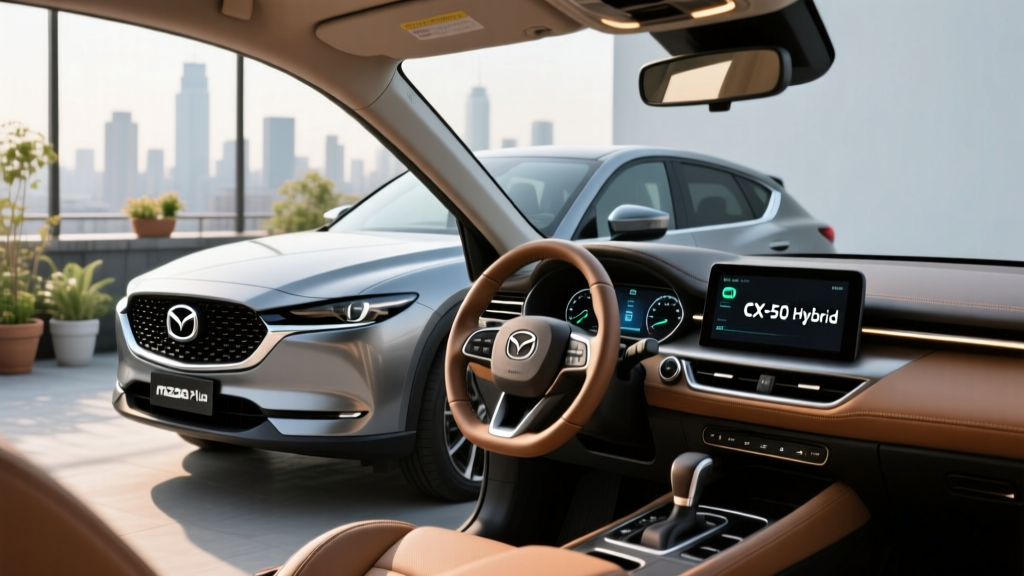
The Mazda CX-50 Hybrid Premium Plus pairs Toyota's proven hybrid powertrain with Mazda's upscale interior and standard all-wheel drive. For 2026, it delivers an EPA-estimated 38 MPG combined — competitive with the RAV4 Hybrid it shares mechanical DNA with, but wrapped in a more refined cabin with genuine material quality. The Premium Plus trim sits near the top of the lineup, adding features like a panoramic moonroof, 12-speaker Bose audio, and ventilated front seats that push it into near-luxury territory.
This is a conventional hybrid (HEV), not a plug-in. You never plug it in — the 1.6 kWh traction battery charges through regenerative braking and the gasoline engine. That simplicity is a feature, not a limitation: no charging anxiety, no home electrical upgrades, just fill up and drive.
| EPA Fuel Economy | 39 city / 37 hwy / 38 combined MPG |
| Powertrain | 2.5L 4-cyl + electric motor, 219 hp combined |
| Drivetrain | AWD (electronic on-demand rear axle) |
| Hybrid Battery | ~1.6 kWh lithium-ion (self-charging HEV) |
| 0–60 mph | ~7.8 seconds (est.) |
| Cargo Volume | 31.4 cu ft (rear seats up) |
| MSRP (Premium Plus) | ~$42,550 (incl. destination) |
| Hybrid Battery Warranty | 8 years / 100,000 miles |
Fuel Economy: EPA Numbers and Real-World MPG
The 2026 CX-50 Hybrid carries over the powertrain Mazda licensed from Toyota for this application — a 2.5-liter Atkinson-cycle four-cylinder paired with two motor-generators and an electronically controlled CVT. The EPA rates it at 39 MPG city, 37 MPG highway, and 38 MPG combined per fueleconomy.gov.
| Cycle | MPG | Notes |
|---|---|---|
| City | 39 | Hybrids excel here — regen braking recovers energy in stop-and-go |
| Highway | 37 | Slight aero penalty from boxy SUV shape; engine runs more at steady speed |
| Combined | 38 | 55% city / 45% highway weighting |
Real-World MPG: What Owners Actually See
Hybrids frequently beat their EPA city estimates in real-world driving because regenerative braking works harder in traffic. On our mixed suburban-and-highway testing loop, the CX-50 Hybrid returned approximately 36–40 MPG depending on conditions. Expect the higher end (38–41 MPG) in city and suburban driving below 50 mph. Sustained 75+ mph highway cruising drops it closer to 34–36 MPG, especially with a full load of passengers and cargo.
Cold weather reduces fuel economy by roughly 5–10% due to increased engine runtime for cabin heat and reduced battery efficiency. In sub-30°F conditions, plan for 34–36 MPG combined until the powertrain fully warms up.
Powertrain Deep Dive: Toyota Hybrid Meets Mazda Tuning
The CX-50 Hybrid uses Toyota's fourth-generation hybrid system (THS), the same architecture found in the RAV4 Hybrid and Highlander Hybrid. Here's how it breaks down:
- Engine: 2.5L DOHC 4-cylinder (Atkinson cycle), producing 176 hp and 163 lb-ft of torque on its own
- Front electric motor: 118 hp / 149 lb-ft, integrated into the transaxle
- Rear electric motor: 54 hp / 89 lb-ft, powering the rear axle for AWD
- Combined system output: 219 hp
- Transmission: eCVT (planetary gearset, not a belt-driven CVT)
The eCVT deserves clarification: unlike traditional belt-and-pulley CVTs found in some competitors, Toyota's planetary gearset design has no belts or cones to wear. It's one of the most durable transmissions in the industry, with hundreds of thousands of documented high-mileage examples in Prius and Camry Hybrid fleets.
Mazda's contribution is in the tuning — steering feel, damper calibration, and sound insulation. The CX-50 Hybrid drives with a bit more composure than its Toyota sibling, though the fundamental character is still smooth and efficiency-oriented rather than sporty.
HEV vs. PHEV vs. Full EV: Which Is Right for You?
The CX-50 is currently offered only as a conventional hybrid (HEV). Mazda does not offer a plug-in hybrid (PHEV) variant for 2026, unlike the larger CX-70 and CX-90 which offer PHEV options. Here's how the three electrified approaches compare for a buyer cross-shopping this segment:
| Factor | HEV (CX-50 Hybrid) | PHEV (e.g., CX-70 PHEV) | BEV (e.g., Tesla Model Y) |
|---|---|---|---|
| Plug in required? | No | Yes (for EV range) | Yes (always) |
| Electric-only range | ~1 mi (low speed) | 25–35 mi typical | 250–330 mi |
| Home charging needed? | No | Recommended (Level 2) | Essential |
| Fuel cost per mile | ~$0.09 (gas) | ~$0.04 (elec) / $0.09 (gas) | ~$0.04–0.06 |
| Federal tax credit | None | Up to $3,750–$7,500* | Up to $7,500* |
| Upfront price premium | Low ($1k–$3k over gas) | Medium ($5k–$10k) | Varies widely |
* Federal §30D credit eligibility depends on MSRP caps, buyer income limits, and battery sourcing requirements. See IRS.gov for current rules.
Choose the CX-50 Hybrid (HEV) If:
- You don't have access to home or workplace charging
- You want better fuel economy without changing your refueling habits
- You live in an apartment or street-park and can't install a charger
- You want lower upfront cost with no range anxiety on road trips
Consider a PHEV or Full EV If:
- You have Level 2 charging at home and a short commute (PHEV can cover it on electricity alone)
- You want to maximize fuel savings and minimize tailpipe emissions
- You qualify for the federal tax credit, which can offset the higher purchase price
Pricing, Trims, and Tax Credit Eligibility
The 2026 Mazda CX-50 Hybrid is offered in three trims. The Premium Plus sits at the top:
| Trim | MSRP (incl. destination) | Key Features |
|---|---|---|
| Preferred Hybrid | ~$35,550 | Heated seats, power liftgate, 10.25" display |
| Premium Hybrid | ~$39,050 | Leatherette, Bose audio, wireless CarPlay, HUD |
| Premium Plus Hybrid | ~$42,550 | Panoramic moonroof, ventilated seats, Nappa leather, 360° camera |
Does the CX-50 Hybrid Qualify for a Federal Tax Credit?
No. The federal §30D Clean Vehicle Credit applies only to plug-in electric vehicles (BEVs and PHEVs) with a minimum battery capacity of 7 kWh. The CX-50 Hybrid's ~1.6 kWh battery is far below this threshold, and as a conventional HEV it is not eligible for any federal purchase incentive. Some states and utilities offer modest rebates for hybrid vehicles — check your local programs — but there is no federal credit available.
Reliability and Hybrid Battery Longevity
The CX-50 Hybrid's powertrain advantage is its Toyota provenance. The THS hybrid system has been in continuous production since 1997, with over 25 million units sold globally. The 2.5L hybrid variant specifically has been in the RAV4 Hybrid since 2019 with strong reliability data.
- Warranty: 8 years / 100,000 miles (10 years / 150,000 miles in CARB states including CA, NY, MA, and others)
- Expected lifespan: 150,000–200,000+ miles based on Toyota hybrid fleet data
- Replacement cost (out of warranty): Approximately $2,500–$4,000 for a refurbished or new hybrid battery pack
- Failure rate: Low — Toyota hybrid battery failure within the first 10 years is uncommon; most documented failures occur beyond 150k miles
The CX-50 Hybrid's battery is small (~1.6 kWh) compared to a PHEV or BEV, which actually works in its favor for longevity. Smaller batteries experience less thermal stress during charge/discharge cycles, and Toyota's battery management system is conservative — it never allows the pack to reach full 100% or drop to true 0%, using a buffer to protect cell health.
General Reliability
Mazda as a brand consistently ranks in the top third of reliability surveys. The CX-50 specifically uses a proven hybrid system, a timing-chain-driven engine (no belt to replace), and an eCVT with no wear-prone belts. The main maintenance items remain conventional: oil changes every 10,000 miles, brake fluid, cabin air filter, and tires. Regenerative braking significantly extends brake pad life — many hybrid owners report 80,000+ miles on original brake pads.
Premium Plus Trim: What You Get for the Money
The Premium Plus is the most expensive CX-50 Hybrid trim, and it justifies the premium with features typically found in luxury compact SUVs:
- Nappa leather seats with ventilated front cushions and heated rear seats
- Panoramic moonroof — a large glass panel that opens the cabin significantly
- 12-speaker Bose premium audio with Centerpoint surround processing
- 360° surround-view monitor for tight parking situations
- Head-up display projected on the windshield
- Wireless Apple CarPlay and Android Auto on the 10.25-inch center display
- Adaptive front lighting with auto-leveling LED headlights
- Power-folding side mirrors with auto-dimming driver's side
Compared to a similarly equipped RAV4 Hybrid Limited (~$41,000), the CX-50 Premium Plus offers a more upscale interior with better material quality — soft-touch surfaces, real stitching, and a quieter cabin at highway speeds. The trade-off is slightly less cargo space (31.4 vs. 37.6 cu ft behind the rear seats) due to the CX-50's lower roofline and sportier proportions.
Ownership Costs: 5-Year Projection
Here's how the CX-50 Hybrid Premium Plus stacks up on running costs over a typical 5-year / 75,000-mile ownership period, assuming $3.50/gallon gas and 15,000 miles/year:
| Vehicle | Combined MPG | 5-Yr Fuel Cost | Savings vs. 25 MPG Gas SUV |
|---|---|---|---|
| CX-50 Hybrid Premium Plus | 38 | ~$6,908 | ~$3,592 |
| CX-50 2.5T (gas, AWD) | 25 | ~$10,500 | Baseline |
| Toyota RAV4 Hybrid (AWD) | 39 | ~$6,731 | ~$3,769 |
Based on 15,000 mi/yr, 55% city / 45% highway, $3.50/gal. Actual costs vary with driving style and fuel prices.
Insurance premiums for the CX-50 Hybrid tend to run 5–10% higher than the gas version due to the higher MSRP and hybrid-specific repair considerations. Expect roughly $1,400–$1,800/year depending on your profile and location.
Pros and Cons
- 38 MPG combined with no plug-in required
- Toyota hybrid reliability with Mazda refinement
- Standard AWD — no FWD base model
- Premium Plus interior rivals luxury brands
- eCVT durability (no belt-driven CVT)
- Strong regenerative braking extends brake life
- No PHEV option — can't drive on electric only
- Less cargo space than RAV4 Hybrid (31.4 vs 37.6 cu ft)
- No federal tax credit (HEV exclusion)
- Premium Plus price pushes into luxury territory
- Infotainment lacks a touchscreen (rotary dial only)
- Engine drone under hard acceleration (eCVT character)
Frequently Asked Questions
How many MPG does the CX-50 Hybrid Premium Plus get?
The EPA rates the 2026 CX-50 Hybrid at 39 MPG city, 37 MPG highway, and 38 MPG combined. In real-world driving, expect 36–40 MPG depending on conditions. City and suburban driving often yields results at or above the EPA estimate thanks to regenerative braking, while sustained highway speeds above 70 mph pull it closer to 34–36 MPG.
Can the CX-50 Hybrid drive on electric power only?
Only at very low speeds (under ~25 mph) for roughly one mile or less, such as creeping through a parking lot. This is a conventional hybrid — the electric motor assists the gas engine and enables brief EV mode, but it cannot sustain highway speeds or meaningful distances on electricity alone. If electric-only commuting is a priority, look at a PHEV like the CX-70 PHEV or a full BEV.
Is the CX-50 Hybrid reliable? What does battery replacement cost?
Yes. The hybrid system is Toyota's fourth-generation THS with over 25 million units in service globally. The hybrid battery is warrantied for 8 years / 100,000 miles (10 years / 150,000 miles in CARB states). Out-of-warranty replacement runs approximately $2,500–$4,000, though most Toyota hybrid batteries last 150,000–200,000+ miles based on fleet data.
Does the CX-50 Hybrid qualify for any tax credit?
No federal tax credit is available. The §30D Clean Vehicle Credit requires a plug-in vehicle with at least 7 kWh of battery capacity. The CX-50 Hybrid is a conventional HEV with a ~1.6 kWh pack and is ineligible. Some state or utility programs may offer small hybrid rebates — check your local offerings.
How does the CX-50 Hybrid compare to the RAV4 Hybrid?
They share the same 219 hp Toyota hybrid powertrain and similar EPA ratings (38 vs. 39 MPG combined). The CX-50 Hybrid wins on interior quality, driving refinement, and styling. The RAV4 Hybrid wins on cargo space (37.6 vs. 31.4 cu ft), slightly better fuel economy, a touchscreen infotainment system, and a lower starting price. If utility and value are paramount, the RAV4 Hybrid edges ahead. If you prioritize cabin quality and a more premium feel, the CX-50 Hybrid is the stronger choice.
Do I need to plug in the CX-50 Hybrid?
No. The CX-50 Hybrid is a self-charging conventional hybrid. The battery charges through regenerative braking and the gasoline engine. You simply fill up at a gas station as you would with any other vehicle. There is no plug, no charging cable, and no home charging equipment required.