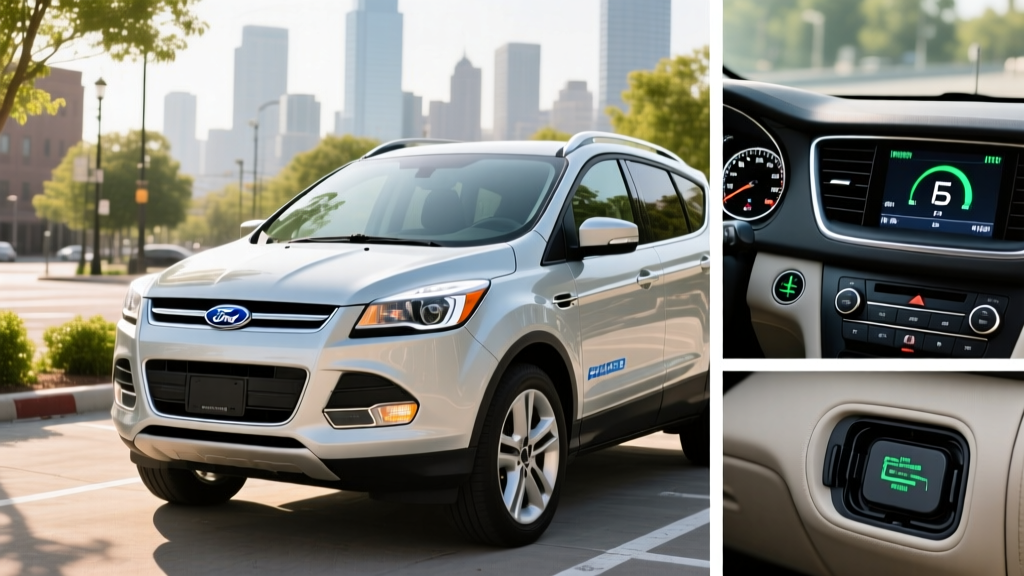
The 2012 Ford Escape Hybrid holds a unique place in the used-hybrid market: it was the final model year of Ford's first-generation Escape HEV before the nameplate switched to EcoBoost turbo-gas engines and, eventually, the modern Escape PHEV. For bargain hunters eyeing a cheap, proven hybrid SUV, the 2012 Escape Hybrid still surfaces in used listings. But with a nickel-metal hydride (NiMH) battery that's now 14 years old, is it a smart buy or a ticking time bomb?
This guide covers the real-world fuel economy, powertrain specs, battery reliability and replacement costs, and how the 2012 Escape Hybrid stacks up against modern alternatives. If you're cross-shopping a used hybrid against a new PHEV or full EV, we'll help you decide which path fits.
HEV vs PHEV: What the 2012 Escape Hybrid Actually Is
Before diving into specs, let's nail down terminology — because confusion between conventional hybrids and plug-in hybrids is the single most common mistake used-car shoppers make.
| Feature | 2012 Escape Hybrid (HEV) | Modern PHEV (e.g., 2026 Escape PHEV) |
|---|---|---|
| Plug-in charging required? | No — charges via regen & engine | Yes — plug in for EV range |
| Electric-only driving | Very limited, low-speed only (~1 mi) | 30-40 miles at highway speed |
| Battery size | ~1.8 kWh (NiMH) | ~14.4 kWh (lithium-ion) |
| Federal tax credit (new) | None (expired long ago) | Up to $3,750 (§30D, if eligible) |
| Best for | No home charging, city driving | Home charging, short commutes |
The 2012 Escape Hybrid is a conventional hybrid (HEV). You never plug it in. The gasoline engine and regenerative braking charge the small battery pack. It can creep short distances on electric power alone at low speeds (typically under 25 mph), but the engine is doing most of the work. This is fundamentally different from a plug-in hybrid (PHEV), which carries a much larger battery you charge from a wall outlet for 30+ miles of true electric-only driving before the engine kicks in.
Fuel Economy: EPA Ratings and Real-World MPG
The headline number on the 2012 Escape Hybrid was always its fuel efficiency — a significant upgrade over the gas-only Escape's ~23 MPG combined at the time.
| Drivetrain | City MPG | Highway MPG | Combined MPG |
|---|---|---|---|
| FWD Hybrid | 34 | 31 | 32 |
| AWD (4WD) Hybrid | 30 | 28 | 29 |
| Gas-only 2012 Escape (2.5L 4-cyl) | 22 | 28 | 24 |
Source: EPA Fuel Economy
Real-World MPG: What Owners Actually Report
Like most Toyota/Ford hybrids of this era (the Escape Hybrid used a powertrain licensed from Toyota's Synergy Drive architecture), the 2012 Escape Hybrid tends to meet or slightly exceed its EPA city rating in stop-and-go driving. That's because city driving maximizes regenerative braking and electric assist. On the highway, where the gasoline engine runs continuously, expect numbers closer to the EPA highway figure or slightly below.
Real-world owner reports from FuelEconomy.gov's "My MPG" tracker cluster around 28-33 MPG combined for the FWD model, with a few owners reporting as high as 36 MPG in warm-climate city driving. AWD models typically deliver 2-3 MPG less. Cold weather, aggressive driving, and highway-heavy commutes push numbers toward the low end.
Powertrain Specs: Engine, Motor, and Combined Output
| Specification | 2012 Ford Escape Hybrid |
|---|---|
| Engine | 2.5L Atkinson-cycle 4-cylinder |
| Engine horsepower | 156 HP @ 6,000 RPM |
| Electric motor | Permanent-magnet AC synchronous |
| Combined net horsepower | 177 HP |
| Transmission | eCVT (planetary gearset, no belts) |
| Battery type | Nickel-metal hydride (NiMH) |
| Battery capacity | ~1.8 kWh (usable) |
| 0-60 mph | ~10.5 seconds (estimated) |
| Drivetrain options | FWD or AWD (eCVT-based) |
| Cargo volume | 29.2 cu ft (rear seats up), 67.2 cu ft (folded) |
| Towing capacity | 1,000 lbs |
The 2.5-liter Atkinson-cycle four-cylinder is the same displacement used in the Toyota Camry Hybrid of the same era, and the eCVT is a planetary gearset — not a belt-driven CVT like those in Nissan or Subaru products. This matters for reliability: planetary eCVTs have proven extremely durable, with no belts to wear or pulleys to fail.
The 177 combined horsepower figure was competitive in 2012, though it feels modest by 2026 standards. Acceleration is adequate for merging and passing but won't win any stoplight races. The electric motor fills in torque at low RPM, which gives the Escape Hybrid a surprisingly responsive feel around town despite the leisurely 0-60 time.
Battery Lifespan, Reliability, and Replacement Cost
This is the make-or-break question for any 14-year-old hybrid: how much life is left in the battery?
How Long Do These NiMH Batteries Actually Last?
The 2012 Escape Hybrid's NiMH pack has a well-documented track record. Unlike early lithium-ion packs that could degrade unpredictably, NiMH chemistry degrades gradually and linearly. The most common failure mode is individual cell imbalance rather than total pack death — and that's often repairable.
Based on owner reports and hybrid specialist shops:
- Typical lifespan: 150,000-200,000 miles before significant capacity loss or cell failure
- Age factor: At 14 years old, even low-mileage examples may show degradation from calendar aging — NiMH cells lose capacity over time regardless of use
- Warning signs: Reduced MPG (2-5 MPG drop), frequent engine cycling, battery state-of-charge gauge staying in the low range, or a check-engine light with hybrid system codes
Battery Replacement Costs
If the pack does fail, here's what you're looking at in 2026:
| Option | Estimated Cost | Notes |
|---|---|---|
| New OEM battery (Ford dealer) | $3,500-$5,000 | May be difficult to source for a 2012 model |
| Remanufactured pack (hybrid specialist) | $1,800-$2,800 | Replaced weak cells, reconditioned — most common route |
| Individual cell replacement | $800-$1,500 | Viable if only 1-2 cells are bad; requires specialist diagnosis |
| Used salvage pack | $500-$1,200 + install | Risky — you're inheriting someone else's degradation |
For context, a clean 2012 Escape Hybrid typically sells for $5,000-$9,000 in 2026 depending on mileage and condition. A $2,500 remanufactured battery represents a significant chunk of the vehicle's value — factor this into your purchase decision. Always request a pre-purchase inspection from a hybrid-qualified technician and ask for a battery health report.
Does the 2012 Escape Hybrid Qualify for Any Tax Credits?
No. The federal hybrid tax credit for the Escape Hybrid expired years ago — both because the manufacturer (Ford) hit its credit phase-out threshold and because the current §30D Clean Vehicle Credit only applies to new plug-in vehicles (PHEVs and BEVs), not conventional hybrids.
On the used market, the Used Clean Vehicle Credit (up to $4,000 or 30% of sale price, whichever is less) also does not apply to conventional hybrids — only to used BEVs and PHEVs that meet battery-capacity thresholds. The 2012 Escape Hybrid's NiMH pack is too small to qualify under any current IRS provision.
If tax incentives are a priority, you'll need to look at a plug-in hybrid or full EV to access federal credits.
Who Should Buy the 2012 Escape Hybrid — And Who Shouldn't
Choose the 2012 Escape Hybrid If:
- You want a cheap, no-plug hybrid SUV under $8,000
- You live in an apartment or lack home charging access
- Your driving is mostly city/suburban with lots of stops
- You want proven Toyota-derived hybrid reliability
- You need AWD in a budget hybrid
Look Elsewhere If:
- You want plug-in EV range for short commutes (get a PHEV)
- You want modern safety tech (AEB, lane-keep, blind-spot)
- You drive mostly highway (the MPG advantage shrinks)
- You're risk-averse about a 14-year-old battery
- You want eligibility for any federal or state tax credit
Hybrid vs PHEV vs EV: Which Fits You?
| Scenario | Best Choice |
|---|---|
| No home/work charging, tight budget | Used HEV (like this Escape Hybrid) |
| Home charging available, 20-35 mi commute | New or used PHEV (e.g., 2026 Escape PHEV, RAV4 Prime) |
| Home charging, mostly under 250 mi/day | Full EV (e.g., Tesla Model Y, Hyundai Ioniq 5) |
| Frequent long road trips, no home charging | HEV or PHEV — avoid BEV if charging access is limited |
How the 2012 Escape Hybrid Compares to Its Peers
If you're shopping used hybrids in this price range, the Escape Hybrid competes with several alternatives:
| Model | Combined MPG | Notes |
|---|---|---|
| 2012 Ford Escape Hybrid (FWD) | 32 | AWD available; SUV utility |
| 2012 Toyota Highlander Hybrid | 28 | 3-row; higher cost; stronger reliability record |
| 2012 Lexus RX 450h | 30 | Luxury variant; expensive on used market |
| 2012 Toyota Prius v | 42 | Wagon; much better MPG; less ground clearance |
| 2012 Honda Civic Hybrid | 44 | Sedan; IMA system less robust than Ford/Toyota eCVT |
The Escape Hybrid's main advantage is its SUV form factor at a low price point. If cargo space and ground clearance aren't priorities, a used Prius or Civic Hybrid will deliver significantly better fuel economy for similar money.
FAQ: 2012 Ford Escape Hybrid
How many MPG does the 2012 Ford Escape Hybrid get?
The EPA rates the FWD model at 34 city / 31 highway / 32 combined MPG. The AWD model is rated at 30/28/29. Real-world owners typically report 28-33 MPG combined, with city-heavy driving occasionally exceeding the EPA city rating thanks to regenerative braking.
Does the 2012 Escape Hybrid need to be plugged in?
No. It's a conventional hybrid (HEV), not a plug-in hybrid. The battery charges through the gasoline engine and regenerative braking. There is no charging port.
How far can the 2012 Escape Hybrid drive on electric power alone?
Less than 1 mile, and only at very low speeds (under ~25 mph). The battery is too small (~1.8 kWh) for meaningful electric-only driving. This is normal for conventional hybrids — the electric motor assists the engine rather than replacing it.
Is the 2012 Escape Hybrid reliable?
The powertrain — particularly the eCVT planetary gearset and the Toyota-derived hybrid system — has a strong reliability reputation. The main risk in 2026 is battery age. At 14 years old, the NiMH pack is near or past its typical service life, and a remanufactured replacement runs $1,800-$2,800. Get a pre-purchase hybrid battery inspection before buying.
What does it cost to replace the hybrid battery?
A remanufactured battery pack from a hybrid specialist typically costs $1,800-$2,800 installed. A new OEM pack from a Ford dealer can run $3,500-$5,000, though sourcing may be difficult. Individual cell replacement is sometimes possible for $800-$1,500 if only a few cells have failed.
Does the 2012 Escape Hybrid qualify for any tax credits?
No. Federal hybrid tax credits expired long ago, and current IRS §30D credits only apply to plug-in vehicles (PHEVs and BEVs). The used-vehicle credit also does not cover conventional hybrids. You will pay full price with no federal incentive.
Should I buy a 2012 Escape Hybrid or a newer plug-in hybrid?
If your budget is under $10,000 and you can't charge at home, the used Escape Hybrid is a reasonable choice — just budget for a potential battery replacement. If you can spend $30,000+ and have home charging, a modern PHEV like the Toyota RAV4 Prime or Ford Escape PHEV gives you 30-40 miles of electric-only range, far better fuel economy when the engine runs, modern safety features, and potential tax credit eligibility.