The 2015 Ford Fusion Hybrid SE occupies a specific niche in the used-car market: a midsize sedan that delivers genuinely strong city fuel economy without requiring any change in driving habits. No plug, no range anxiety, no charging apps — just a conventional hybrid (HEV) that sips fuel in stop-and-go traffic and runs on proven Toyota-licensed hybrid architecture. For buyers in 2026 weighing a used hybrid against a newer plug-in hybrid (PHEV) or a full battery-electric vehicle (BEV), the Fusion Hybrid SE offers a compelling, low-risk entry point into electrified driving at a fraction of the cost.
This guide breaks down the exact EPA figures, real-world MPG observations, battery longevity data, powertrain specs, and ownership costs you need to evaluate whether a decade-old Fusion Hybrid SE is the right electrified vehicle for your commute.
HEV vs PHEV vs EV: Where the Fusion Hybrid Fits
Before diving into specs, it's critical to understand what the 2015 Fusion Hybrid SE is — and what it isn't. This is a conventional hybrid electric vehicle (HEV). It cannot be plugged in. Its small battery recharges exclusively through regenerative braking and the gasoline engine. Ford also sold a Fusion Energi, which is the plug-in hybrid (PHEV) variant with a larger battery and electric-only range. These are fundamentally different vehicles, and confusing them is the most common buyer mistake in this segment.
| Feature | Fusion Hybrid (HEV) | Fusion Energi (PHEV) | Full EV (BEV) |
|---|---|---|---|
| Plug-in charging | No | Yes (Level 1/2) | Yes (Level 1/2/DC) |
| Electric-only range | ~0.5 mi at low speed | ~20 mi (EPA) | 200–400+ mi |
| Battery size | 1.4 kWh (usable) | 7.6 kWh (usable) | 60–100+ kWh |
| Fuel required | Gasoline | Gasoline + electricity | Electricity only |
| Best use case | City-heavy commute, no home charging access | Short commute + road trips | Home charging + mostly under 250 mi/day |
| Federal tax credit (new) | None | Up to $4,007 (expired) | Up to $7,500 (§30D) |
If you have access to home or workplace charging and a commute under 20 miles, a PHEV or BEV will save more on fuel. But if you live in an apartment, park on the street, or simply want zero behavior change, the HEV architecture of the Fusion Hybrid is the practical choice.
Fuel Economy: EPA Ratings and Real-World MPG
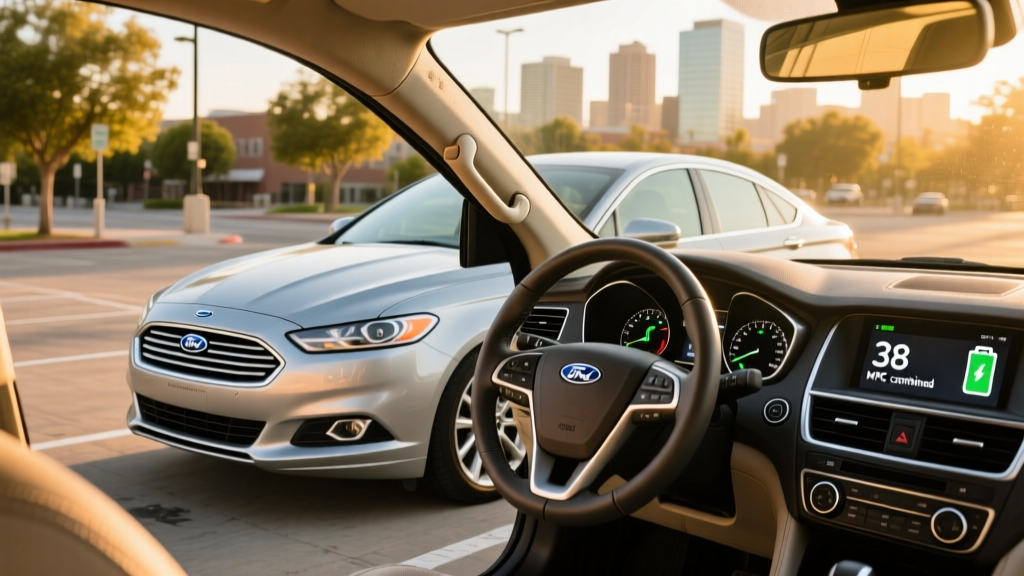
The 2015 Ford Fusion Hybrid SE carries EPA ratings of 44 MPG city / 41 MPG highway / 42 MPG combined, per fueleconomy.gov. These numbers placed it among the most efficient midsize sedans of its era, competitive with the Toyota Camry Hybrid and ahead of the Hyundai Sonata Hybrid in city driving.
| Driving Scenario | EPA Rating | Real-World Expectation |
|---|---|---|
| City (stop-and-go) | 44 MPG | 42–48 MPG (hybrids often exceed EPA in city) |
| Highway (70+ mph) | 41 MPG | 36–40 MPG (less regen benefit at sustained speed) |
| Combined | 42 MPG | 38–43 MPG (varies with driving mix) |
| Cold weather (below 30°F) | — | 34–38 MPG (engine runs more for cabin heat) |
The key insight with conventional hybrids: city MPG often exceeds the EPA sticker because regenerative braking recovers energy that a gas car wastes as brake heat. Highway driving is where hybrids lose their advantage — there's less braking to recapture energy, and the gasoline engine does most of the work. If your commute is 80% city, expect to see numbers at or above the EPA city rating. If you're doing 75 MPH on the interstate daily, expect numbers closer to 36–38 MPG.
Cold weather hits all hybrids harder than gas-only cars because the engine must run continuously to provide cabin heat, eliminating the electric-only low-speed operation that drives city efficiency. Plan on a 10–15% MPG reduction in sustained sub-freezing temperatures.
Powertrain Specs: Engine, Motor, and Combined Output
The 2015 Fusion Hybrid pairs a 2.0-liter Atkinson-cycle inline-4 gasoline engine with a permanent-magnet electric motor, connected through an electronically controlled continuously variable transmission (e-CVT). This architecture is licensed from Toyota's Hybrid Synergy Drive patent portfolio and is mechanically similar to the system in the Camry Hybrid.
| Specification | Value |
|---|---|
| Gasoline engine | 2.0L Atkinson-cycle I-4 |
| Engine horsepower | 141 HP @ 6,000 RPM |
| Engine torque | 129 lb-ft @ 4,000 RPM |
| Electric motor output | 118 HP (88 kW) |
| Combined system output | 188 HP |
| Transmission | e-CVT (planetary gearset) |
| Battery type | Lithium-ion (Li-ion) |
| Battery capacity | 1.4 kWh (usable) |
| 0–60 MPH | ~7.6 seconds |
| Drivetrain | Front-wheel drive |
| Fuel tank | 13.5 gallons |
| Total driving range | ~567 miles (combined) |
The 188 combined horsepower is adequate for highway merging and passing, though not quick by modern standards. The e-CVT delivers smooth, linear acceleration without the rubber-band feel that plagues some competitors. The 1.4 kWh battery is small by design — it buffers energy for short electric-only bursts at low speed (roughly under 25 MPH for brief distances) but is not intended for sustained electric driving.
Battery Longevity, Warranty, and Replacement Cost
For a 2015 model being purchased used in 2026, battery health is the single most important factor. Here's what you need to know.
Original Battery Warranty
Ford covered the 2015 Fusion Hybrid's lithium-ion battery for 8 years / 100,000 miles (whichever came first) under the hybrid component warranty. In California Air Resources Board (CARB) states, the warranty extended to 10 years / 150,000 miles. For a 2015 model, the standard warranty has expired as of 2023; CARB-state coverage may have extended through 2025 depending on mileage.
Degradation reality: The Fusion Hybrid's 1.4 kWh battery is small and operates within a narrow state-of-charge window (roughly 40–60% SoC), which dramatically reduces stress on the cells. Real-world data from high-mileage Fusion Hybrids shows modest capacity loss — typically 10–20% over 150,000+ miles. Because the battery is small and the engine backs it up, even noticeable degradation has minimal impact on fuel economy. You may see 1–3 MPG reduction in a high-mileage example, not the catastrophic range loss feared in full EVs.
Replacement cost: A new OEM replacement battery pack from Ford runs approximately $2,000–$3,500 including parts and labor at a dealership. Independent hybrid specialists often offer refurbished packs for $1,200–$2,000. Given that most Fusion Hybrids reach 200,000+ miles on the original pack, this is a low-probability expense for most buyers.
Pre-purchase tip: Ask a mechanic to pull the battery's state-of-health (SoH) data via OBD-II. Tools like Forscan (Ford-specific diagnostic software) can read individual cell voltages and the battery's learned capacity. A healthy pack shows cell voltages within 0.1V of each other at rest.
Used Pricing in 2026 and Tax Credit Reality
The 2015 Ford Fusion Hybrid SE originally carried an MSRP of approximately $26,995 (before destination). In the 2026 used market, examples with 80,000–130,000 miles typically sell for $7,000–$11,000 depending on condition, mileage, and region. Well-maintained examples under 100,000 miles command the top of that range.
Tax credit status: The 2015 Fusion Hybrid SE does not qualify for the federal §30D clean vehicle credit. That credit applies exclusively to new plug-in vehicles (PHEVs and BEVs) meeting battery sourcing, MSRP, and buyer income requirements. Conventional hybrids like the Fusion Hybrid have never qualified for the federal purchase credit.
However, buyers of used electrified vehicles may qualify for the §25E used clean vehicle credit — but only for PHEVs and BEVs, not conventional HEVs. The Fusion Hybrid SE does not qualify for this credit either. The purchase is a straightforward used-car transaction with no federal incentive. Some states offer minimal hybrid rebates or HOV lane access for hybrids; check your state's DMV or energy office for current programs.
Ownership Costs: Fuel Savings vs. Gas-Only Fusion
The practical financial case for the Fusion Hybrid SE comes down to fuel savings over a gas-only 2015 Fusion with the 1.5L EcoBoost (EPA 22/34/26 combined). Here's a 5-year comparison assuming 15,000 miles/year and $3.40/gallon regular unleaded:
| Cost Factor | Fusion Hybrid SE (42 MPG) | Fusion 1.5L EcoBoost (26 MPG) |
|---|---|---|
| Annual fuel consumption | 357 gallons | 577 gallons |
| Annual fuel cost | $1,214 | $1,962 |
| 5-year fuel cost | $6,070 | $9,810 |
| 5-year fuel savings | $3,740 in favor of hybrid | |
Over a 5-year ownership period, the hybrid saves approximately $3,740 in fuel. If you paid a $2,000 premium for the hybrid over a comparably equipped gas Fusion on the used market, the payback period is roughly 2.5 years. Beyond fuel, maintenance costs are comparable — the hybrid has no additional routine service items, and brake pad life is often longer due to regenerative braking reducing friction-brake use.
Reliability Record and Common Issues
The 2015 Fusion Hybrid rates well for long-term reliability. The powertrain is mechanically conservative — the Atkinson-cycle engine is under-stressed, the e-CVT has no clutches or bands to wear (it's a planetary gearset), and the battery operates in a protected state-of-charge window. NHTSA gave the 2015 Fusion a 5-star overall safety rating.
Common issues reported by owners and mechanics for the 2013–2016 Fusion Hybrid generation include:
- 12V battery drain: The auxiliary 12V battery (not the hybrid pack) can discharge if the car sits unused for extended periods. A $30 trickle charger solves this.
- Brake actuator recalls: Ford issued recalls for the regenerative brake system on some model years. Verify recall completion via the VIN at nhtsa.gov.
- Infotainment glitches: The SYNC system in 2015 models is dated by 2026 standards and can be slow or unresponsive. This is a nuisance, not a mechanical concern.
- Coolant leaks: Some owners report coolant seepage from the hybrid system's separate cooling loop around 100,000+ miles. Inspect coolant levels and look for crusty residue around hoses.
Who Should Buy the 2015 Fusion Hybrid SE?
Pros
- 44 MPG city — excellent for stop-and-go commuters
- No plug-in required — zero behavior change from a gas car
- Low battery replacement risk ($2,000–$3,500 if needed)
- Smooth e-CVT with no conventional transmission wear items
- Spacious midsize cabin, large trunk (12.0 cu ft)
- Strong safety ratings (5-star NHTSA)
- Low used-market price ($7,000–$11,000 in 2026)
Cons
- No electric-only range to speak of — always burns some gas
- Highway MPG drops to 36–38 in real-world driving
- Dated infotainment and driver-assist tech
- No federal tax credit eligibility
- Cold-weather MPG penalty (10–15% loss)
- Trunk space reduced by battery placement vs. gas Fusion
The Decision Framework
Choose the 2015 Fusion Hybrid SE if: Your commute is city-heavy (under 45 MPH average), you lack home or workplace charging access, you want a proven hybrid under $11,000, and you plan to drive the car 3–5 more years with minimal maintenance risk.
Look at a used PHEV (Chevy Volt, Fusion Energi, Prius Prime) if: You have home charging, your daily round-trip commute is under 25 miles, and you want to eliminate most gasoline use on weekdays while keeping a gas engine for road trips.
Look at a used BEV (Leaf, Bolt, Model 3) if: You have reliable home Level 2 charging, your daily driving is under 150 miles, and you want zero gasoline costs and zero oil changes.
Stick with a gas car if: You drive primarily highway miles (hybrid advantage is minimal), you live in an extreme-cold climate year-round, or you find a gas Fusion for $4,000+ less than the hybrid equivalent.
Frequently Asked Questions
How many MPG does the 2015 Ford Fusion Hybrid SE get?
The EPA rates it at 44 city / 41 highway / 42 combined. Real-world results vary: city-heavy drivers often see 42–48 MPG, while highway-dominant driving drops to 36–40 MPG. Cold weather reduces efficiency by 10–15%.
Does the 2015 Fusion Hybrid need to be plugged in?
No. The Fusion Hybrid is a conventional HEV. Its 1.4 kWh battery recharges entirely through regenerative braking and the gasoline engine. You fuel it exactly like a gas car. Only the Fusion Energi (PHEV) requires or accepts a plug.
How long does the hybrid battery last?
Most 2015 Fusion Hybrid batteries last 150,000–200,000+ miles with gradual capacity loss (10–20%). The small battery size and narrow operating window reduce degradation stress. Replacement costs $2,000–$3,500 for an OEM pack, or $1,200–$2,000 for a refurbished unit.
Does the 2015 Fusion Hybrid qualify for any tax credit?
No. The federal §30D credit and §25E used-vehicle credit apply only to plug-in vehicles (PHEVs and BEVs). The Fusion Hybrid is a conventional HEV and has never qualified for federal purchase incentives. Check your state for any local hybrid rebates.
Is the Fusion Hybrid or Fusion Energi better for a used buyer?
It depends on charging access. The Energi (PHEV) offers ~20 miles of electric-only range and lower operating costs if you can charge at home. But the Energi's larger battery is more expensive to replace ($4,000–$6,000), and its trunk is significantly smaller. If you can't charge at home, the Hybrid is the simpler, lower-risk choice.
What should I check before buying a used 2015 Fusion Hybrid?
Prioritize: (1) hybrid battery SoH via OBD-II scan (Forscan or dealer tool), (2) recall completion for the brake actuator, (3) coolant level in the hybrid cooling loop, (4) 12V battery age, and (5) a standard pre-purchase inspection. Verify maintenance records showing regular oil changes — the Atkinson-cycle engine still requires standard maintenance.