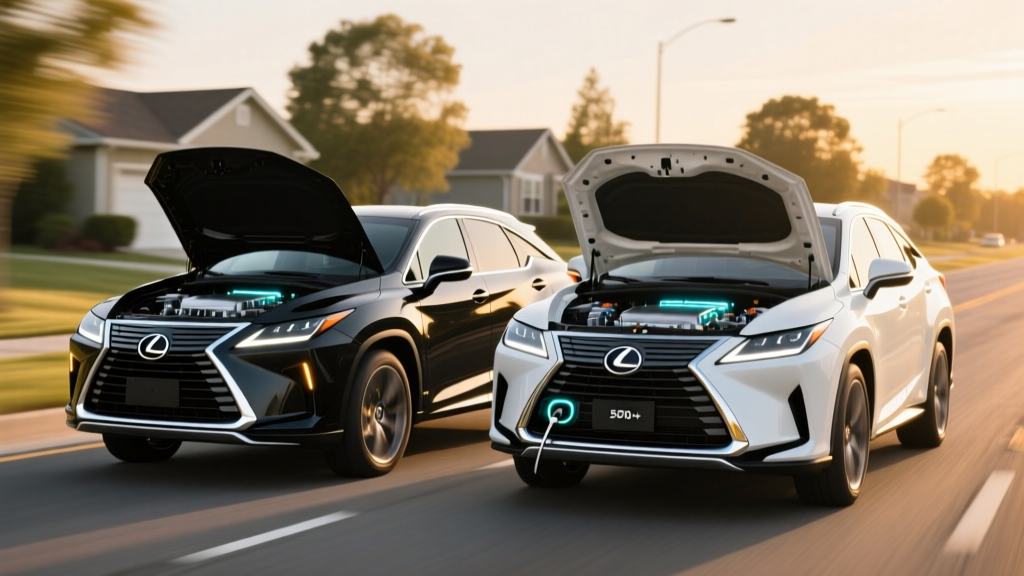
The Lexus RX has been a hybrid benchmark since it introduced the first luxury hybrid SUV in 2005. For the current generation (2023-present, updated through 2026), Lexus offers two distinct electrified flavors: the conventional RX 350h hybrid and the RX 500h+ plug-in hybrid. Both target luxury buyers who want efficiency without range anxiety — but the Lexus RX hybrid MPG story is more nuanced than the EPA sticker alone.
In this guide, we break down every RX hybrid variant available in the US, deliver exact EPA and real-world MPG figures, compare HEV versus PHEV ownership, and help you decide which version — or whether a full EV — is the right move for your driveway.
Lexus RX 350h MPG: EPA Ratings and Real-World Efficiency
The RX 350h is the volume-selling hybrid. It pairs a 2.5-liter inline-4 with two electric motors and a continuously variable transmission (CVT) in Lexus's fourth-generation hybrid system. Here are the EPA numbers from fueleconomy.gov:
| Configuration | City MPG | Highway MPG | Combined MPG | Annual Fuel Cost* |
|---|---|---|---|---|
| RX 350h AWD | 37 | 34 | 36 | $2,200 |
| RX 350h FWD (if available) | 38 | 35 | 36 | $2,150 |
*Based on 15,000 mi/yr at $3.50/gal regular unleaded. Your cost varies with local fuel prices.
Real-World MPG: What Owners Actually See
The RX 350h's city-biased MPG split (37 city vs. 34 highway) is typical of Toyota/Lexus hybrids — regenerative braking and low-speed electric assist shine in stop-and-go traffic. In real-world mixed driving, most owners report:
- City-dominant commuting: 38-41 MPG (the hybrid system recovers more energy at low speeds)
- Highway cruising at 70-75 mph: 31-33 MPG (aerodynamic drag reduces the hybrid advantage)
- Mixed suburban driving: 35-37 MPG (closely matches EPA combined)
- Cold-weather penalty: Expect a 5-8% drop in winter months as the engine runs more to heat the cabin
The takeaway: if your commute involves city traffic, you'll likely beat the EPA combined number. Sustained highway driving at high speeds will dip below it.
Lexus RX 500h+ Plug-In Hybrid: Electric-Only Range and Combined MPG
The RX 500h+ is Lexus's first plug-in hybrid RX. It uses a 2.5-liter inline-4 paired with more powerful electric motors and an 18.1 kWh lithium-ion battery pack (usable capacity approximately 14.5 kWh). This is a fundamentally different ownership experience from the 350h.
| Specification | Value |
|---|---|
| Combined System Output | 302 hp |
| Battery Pack (total / usable) | 18.1 kWh / ~14.5 kWh |
| EPA Electric-Only Range | 37 miles |
| EPA Combined MPG (gas mode) | 35 MPG |
| MPGe (electric + gas combined) | 65 MPGe |
| Total Combined Range (electric + gas) | ~420 miles |
| Level 2 Charging Time (0-100%) | ~2.5 hours at 6.6 kW |
| DC Fast Charging | Not available |
| 0-60 mph | 6.2 seconds |
| Drivetrain | AWD (eAxle rear motor) |
Living With 37 Miles of Electric Range
Thirty-seven electric-only miles covers the average American's daily commute round-trip. If you can charge at home (a standard 120V outlet adds about 3-4 miles per hour of charging; a 240V Level 2 charger fully replenishes in roughly 2.5 hours), you may go weeks without visiting a gas station.
However, the RX 500h+ does not support DC fast charging. This is a deliberate Lexus choice — PHEV batteries are small enough that Level 2 charging is sufficient overnight, but it means you cannot rapidly top up on road trips. Once the battery depletes, the 500h+ operates as a conventional hybrid at 35 MPG combined.
RX 350h vs RX 500h+: HEV vs PHEV Compared Side by Side
| Attribute | RX 350h (HEV) | RX 500h+ (PHEV) |
|---|---|---|
| Powertrain Type | Conventional Hybrid | Plug-In Hybrid |
| Requires Plugging In? | No (self-charging) | Yes (to access EV range) |
| Combined Horsepower | 246 hp | 302 hp |
| EPA Combined MPG | 36 MPG | 35 MPG (gas) / 65 MPGe |
| Electric-Only Range | ~1 mile (low-speed assist) | 37 miles |
| Battery Capacity | 1.6 kWh (NiMH) | 18.1 kWh (Li-ion) |
| Charging Hardware Needed | None | Level 2 recommended |
| Starting MSRP (2026) | ~$52,000 | ~$63,000 |
| Federal Tax Credit (§30D) | Not eligible | Up to $7,500* |
| 0-60 mph | 7.4 seconds | 6.2 seconds |
Critical distinction: The RX 350h is a conventional hybrid — it charges its small battery through regenerative braking and the engine. You never plug it in. The RX 500h+ has a much larger battery that you charge from a wall outlet or charger to unlock its 37-mile electric range. If you never plug in the 500h+, you're carrying extra battery weight for nothing and getting slightly worse MPG than the 350h.
Pricing, Tax Credits, and the True Cost Equation
The RX 500h+ carries an $11,000 premium over the 350h at base MSRP. The federal §30D tax credit can offset up to $7,500 of that gap — but eligibility is not automatic. Per current IRS rules, the buyer must meet all of the following:
- Income caps: Modified AGI ≤ $150,000 (single) or ≤ $300,000 (married filing jointly)
- MSRP cap: Vehicle MSRP must not exceed $80,000 for SUVs (RX 500h+ qualifies at base; loaded trims may approach the cap)
- Battery sourcing: Critical minerals and battery components must meet phased-in domestic-content thresholds — verify the specific VIN with the IRS portal or your tax professional before purchase
- Point-of-sale transfer: As of 2024+, buyers can transfer the credit to the dealer for an immediate price reduction at purchase
If you qualify for the full $7,500, the effective price gap narrows to roughly $3,500. At $3.50/gallon and 15,000 miles/year, the 350h saves about $1,600 annually over a comparable gas-only RX 350 (24 MPG combined). The 500h+ saves even more if you charge daily and drive within its electric range.
Battery Longevity, Warranty, and Replacement Costs
Lexus Hybrid Battery Warranty
RX 350h (NiMH battery): 10 years / 150,000 miles (whichever comes first) in all 50 states, per Lexus's hybrid battery warranty.
RX 500h+ (Li-ion battery): 10 years / 150,000 miles, with a capacity retention guarantee of 70% minimum during the warranty period.
Hybrid system components (inverter, transaxle, control modules): 8 years / 100,000 miles.
Real-World Battery Lifespan and Replacement Costs
Lexus (and parent company Toyota) has the longest track record in hybrid battery durability. NiMH packs in the RX 350h are proven technology — many first-generation RX 400h hybrids (2006-2008) are still running on original batteries at 200,000+ miles. When replacement is eventually needed outside warranty:
- RX 350h NiMH replacement: $3,000-$4,500 (dealer) or $2,000-$3,000 (independent hybrid specialist with refurbished cells)
- RX 500h+ Li-ion replacement: $8,000-$12,000 estimated (larger pack, newer technology — limited aftermarket options currently)
Li-ion packs in PHEVs typically experience 1-2% capacity loss per year under normal use. The 500h+'s 70% retention warranty threshold means Lexus guarantees at least ~26 miles of electric range after 10 years — a conservative floor, as most Toyota/Lexus PHEV batteries retain 85-90%+ capacity at that age based on early RAV4 Prime data.
Powertrain Deep Dive: How Lexus's Hybrid System Works
The RX 350h uses Lexus's proven series-parallel hybrid architecture. The 2.5L Atkinson-cycle engine (184 hp alone) pairs with front and rear electric motors for a combined 246 hp. The rear motor enables electronic AWD without a mechanical driveshaft — reducing weight and parasitic loss. The CVT keeps the engine in its most efficient RPM band, which is why the 350h achieves 37 MPG in city driving where a conventional gas SUV of this size would return 18-20.
The RX 500h+ steps up to a more powerful plug-in system. The 2.5L engine is joined by a 134 kW front motor and a 40 kW rear eAxle motor, totaling 302 hp. The larger 18.1 kWh battery enables genuine electric-only driving at highway speeds (up to ~84 mph in EV mode), not just low-speed assist. When you floor it, both engine and motors deliver maximum thrust — the 6.2-second 0-60 time makes it the quickest RX this side of the F Sport Handling trim.
Who Should Choose the RX Hybrid — and Who Should Look Elsewhere?
Choose the RX 350h (HEV) if:
- You cannot install a home charger (apartment, street parking, no garage)
- You want zero behavior change — just drive it like a normal SUV
- Your budget tops out around $55,000-$60,000
- You want the lowest-maintenance, most proven hybrid system on the market
- Highway driving dominates your commute (where the HEV penalty is smallest)
Choose the RX 500h+ (PHEV) if:
- You can charge at home or work (Level 2 strongly recommended)
- Your daily round-trip commute is under 35 miles
- You qualify for the §30D federal tax credit, narrowing the price gap
- You want stronger acceleration (6.2s 0-60) and occasional silent electric driving
- You want to reduce gas consumption dramatically without any range anxiety
Consider a Full EV (like the Tesla Model Y or Genesis Electrified GV70) if:
- You have reliable home charging and your daily needs are under 250 miles
- You want zero tailpipe emissions and minimal drivetrain maintenance
- You want access to the full $7,500 tax credit on a wider selection of models
- You don't take frequent road trips exceeding 300 miles in a single day
RX 350h Pros
- 36 MPG combined without plugging in
- Proven 10-year battery warranty
- Lower entry price
- No charging infrastructure needed
- Excellent resale value
RX 350h Cons
- No electric-only driving capability
- No federal tax credit eligibility
- CVT drone under hard acceleration
- 246 hp feels adequate, not exciting
RX 500h+ Pros
- 37 miles electric-only covers most commutes
- 302 hp — quickest RX variant
- Up to $7,500 federal tax credit
- No range anxiety on road trips
- Silent, smooth EV mode around town
RX 500h+ Cons
- $11,000 premium over 350h (before credit)
- No DC fast charging
- Requires home charging to realize value
- Heavier — slightly worse gas MPG when battery depletes
- Li-ion replacement cost is high out of warranty
Frequently Asked Questions
How many MPG does the Lexus RX hybrid get?
The RX 350h achieves 37 city / 34 highway / 36 combined MPG per the EPA. Real-world results vary: city-heavy drivers often see 38-41 MPG, while sustained highway driving at 75+ mph can drop to 31-33 MPG. The RX 500h+ plug-in hybrid gets 35 MPG combined in gas-only mode, or 65 MPGe when factoring in electric driving.
How far can the Lexus RX 500h+ go on electric only?
The EPA rates the RX 500h+ at 37 miles of electric-only range. In mild weather at moderate speeds, some owners report 39-42 miles. In cold weather (below 32°F) or at sustained highway speeds, expect 28-32 miles before the gas engine engages. Once the battery is depleted, the vehicle continues as a conventional hybrid — you're never stranded.
Does the Lexus RX hybrid qualify for a tax credit?
The RX 350h conventional hybrid does not qualify for the federal §30D clean vehicle credit. The RX 500h+ plug-in hybrid may qualify for up to $7,500, subject to buyer income limits ($300K joint / $150K single), MSRP caps ($80K for SUVs), and battery critical-mineral sourcing requirements. Rules change periodically — verify your specific VIN's eligibility on the IRS portal or with a tax professional before purchasing.
Is the Lexus RX hybrid reliable, and what does battery replacement cost?
Lexus consistently ranks at or near the top of J.D. Power and Consumer Reports reliability surveys, and the hybrid system is among the most proven in the industry. The hybrid battery is warranted for 10 years/150,000 miles. Out-of-warranty replacement runs $3,000-$4,500 for the 350h's NiMH pack and an estimated $8,000-$12,000 for the 500h+'s larger Li-ion pack. Most Toyota/Lexus hybrid batteries last well beyond the warranty period — 200,000+ miles on the original pack is common.
Should I get the RX hybrid, the plug-in, or a full EV?
If you lack home charging access or regularly drive 400+ miles in a day, the RX 350h HEV is the safest choice — zero lifestyle change, strong MPG. If you can charge at home and your daily driving is under 35 miles, the RX 500h+ PHEV lets you commute on electricity while keeping gas flexibility for road trips. If you have home charging, rarely exceed 250 miles daily, and want the lowest operating cost and zero tailpipe emissions, a full EV like the Tesla Model Y or Hyundai Ioniq 5 may be a better long-term fit. Check IIHS safety ratings for crash-test performance across all options.
Does the RX hybrid need to be plugged in?
The RX 350h does not need to be plugged in — it's a self-charging conventional hybrid that recovers energy through regenerative braking and the engine. The RX 500h+ should be plugged in regularly to take advantage of its 37-mile electric range. If you never plug in the 500h+, it functions as a heavier, less efficient hybrid than the 350h.
The Bottom Line on Lexus RX Hybrid MPG
The RX 350h delivers exactly what it promises: 36 MPG combined with no charging, no behavior change, and Lexus's industry-leading hybrid reliability. The RX 500h+ adds a compelling electric-commute layer and 302 hp for buyers who can charge at home and navigate the tax credit rules. Neither is a compromise — they're two different solutions for two different ownership situations. Your daily mileage, charging access, and budget determine which Lexus RX hybrid MPG story becomes yours.