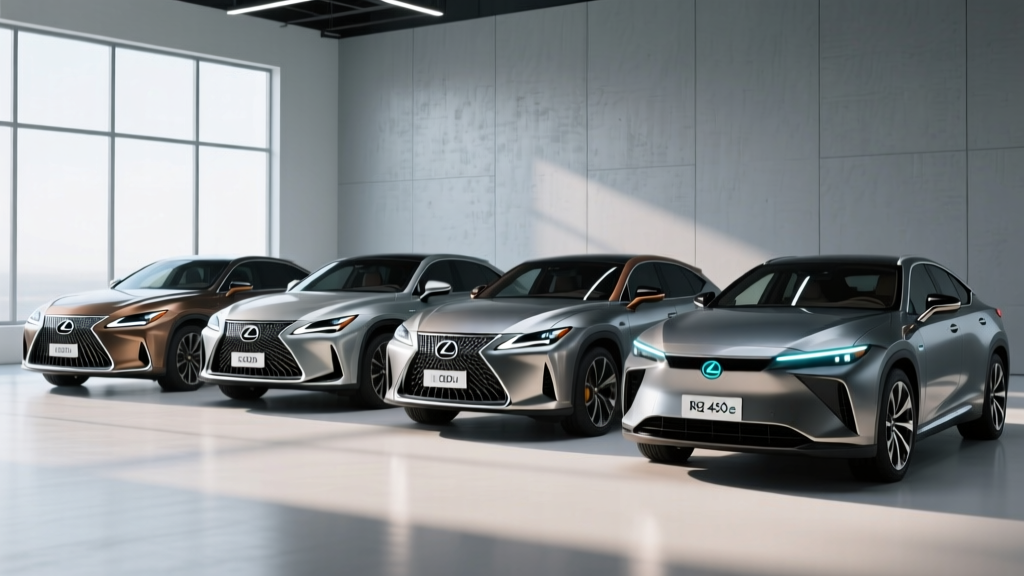
Lexus has spent two decades refining hybrid powertrains, and the 2025 lineup represents the brand's broadest electrified offering yet. With six hybrid models spanning subcompact crossovers to three-row SUVs and luxury coupes, the 2025 Lexus hybrid range covers nearly every luxury segment. But with both conventional hybrids (HEVs) and plug-in hybrids (PHEVs) in the mix, choosing the right one requires understanding exactly what each powertrain delivers in real-world driving.
This guide breaks down every 2025 Lexus hybrid with exact EPA figures, real-world MPG expectations, battery warranty details, and tax credit eligibility — so you can match the right model to your driving pattern.
HEV vs PHEV: What Lexus Offers in 2025
Before comparing models, the distinction between Lexus's two hybrid types matters for your daily routine and your wallet.
Conventional Hybrid (HEV)
Lexus HEVs like the UX 300h, RX 350h, and ES 300h use a small battery (typically 1-2 kWh) paired with a gasoline engine and electric motor(s). You never plug them in — the battery charges through regenerative braking and the engine. They excel at city driving where the electric motor handles low-speed operation, delivering 35-44 MPG combined without any charging infrastructure.
Plug-In Hybrid (PHEV)
The NX 450h+ and RX 450h+ carry larger batteries (18.1 kWh usable) that you plug in overnight for 37-38 miles of pure electric driving. Once the battery depletes, they operate as conventional hybrids. PHEVs suit drivers with home charging and short commutes who want electric daily driving without range anxiety on longer trips.
Full 2025 Lexus Hybrid MPG and Powertrain Specs
The table below captures every current 2025 Lexus hybrid with EPA-rated fuel economy, powertrain output, and pricing. All figures sourced from fueleconomy.gov and Lexus official specifications.
| Model | Type | EPA City/Hwy/Combined MPG | Combined HP | Engine | Battery | Base MSRP |
|---|---|---|---|---|---|---|
| UX 300h | HEV | 43 / 41 / 42 | 196 hp | 2.0L 4-cyl | ~1.4 kWh NiMH | $39,840 |
| NX 350h | HEV | 41 / 37 / 39 | 240 hp | 2.5L 4-cyl | ~1.6 kWh NiMH | $43,515 |
| NX 450h+ | PHEV | 84 MPGe / 36 MPG (hybrid) | 304 hp | 2.5L 4-cyl | 18.1 kWh Li-ion | $52,415 |
| RX 350h | HEV | 37 / 34 / 36 | 246 hp | 2.5L 4-cyl | ~1.6 kWh NiMH | $53,290 |
| RX 450h+ | PHEV | 83 MPGe / 35 MPG (hybrid) | 304 hp | 2.5L 4-cyl | 18.1 kWh Li-ion | $64,040 |
| TX 500h | HEV | 27 / 28 / 27 | 366 hp | 2.4L turbo 4-cyl | ~1.4 kWh NiMH | $64,590 |
| ES 300h | HEV | 43 / 44 / 44 | 215 hp | 2.5L 4-cyl | ~1.6 kWh NiMH | $46,410 |
| LC 500h | HEV | 26 / 33 / 29 | 354 hp | 3.5L V6 | ~1.1 kWh Li-ion | $103,300 |
PHEV Deep Dive: Electric-Only Range and Charging
For buyers considering the NX 450h+ or RX 450h+, the electric-only range determines how much gasoline you'll actually use. Here's what the EPA rates and what to expect in practice.
| Metric | NX 450h+ | RX 450h+ |
|---|---|---|
| EPA Electric-Only Range | 37 miles | 37 miles |
| Total Combined Range (EV + Gas) | ~540 miles | ~520 miles |
| Battery Capacity (Usable) | 18.1 kWh | 18.1 kWh |
| Level 2 Charge Time (0-100%) | ~3 hours (6.6 kW) | ~3 hours (6.6 kW) |
| DC Fast Charging | No | No |
| MPG After Battery Depletion | 36 combined | 35 combined |
| MPGe (EV Mode) | 84 MPGe | 83 MPGe |
Real-world electric range caveat: The 37-mile EPA figure assumes moderate temperatures and mixed driving. In winter conditions (below 40°F), expect 28-32 miles of electric range due to cabin heating demands and reduced battery efficiency. Highway-only driving at 70+ mph will similarly reduce EV range to roughly 30-33 miles. For most commutes under 30 miles round-trip, these PHEVs effectively operate as daily EVs.
Neither Lexus PHEV supports DC fast charging. The onboard 6.6 kW charger means a full recharge takes about 3 hours on a 240V Level 2 outlet. On a standard 120V household outlet (Level 1), expect roughly 10-12 hours for a full charge — adequate for overnight top-ups but slow for same-day turnaround.
Real-World MPG: Where Lexus Hybrids Beat the EPA Sticker
Lexus hybrids consistently exceed their EPA ratings in city driving, where the electric motor handles the stop-and-go workload that tanks fuel economy in conventional cars. Here's what owner data and independent testing suggest:
- UX 300h (EPA 42 combined): Owners report 44-47 MPG in urban-heavy commutes. Highway-only trips at 75 mph drop to 37-39 MPG.
- ES 300h (EPA 44 combined): Real-world city driving yields 45-48 MPG. Highway cruising at 70 mph returns 40-42 MPG. This sedan is the efficiency king of the lineup.
- NX 350h (EPA 39 combined): Expect 40-43 MPG in city driving, 35-37 on extended highway trips.
- RX 350h (EPA 36 combined): City driving delivers 37-39 MPG; highway drops to 32-34 MPG. The larger mass shows at sustained speeds.
- TX 500h (EPA 27 combined): As the heaviest model with a turbo engine, real-world figures cluster tightly around the EPA rating — 26-28 MPG regardless of driving mix.
The pattern is clear: if your driving is predominantly urban or suburban with frequent stops, a Lexus HEV will likely beat its sticker. If you drive mostly highway miles, expect to fall 2-5 MPG below the combined rating.
Battery Warranty, Longevity, and Replacement Costs
Lexus Hybrid Battery Warranty
All 2025 Lexus hybrids carry a 10-year / 150,000-mile hybrid battery warranty (whichever comes first), up from the previous 8-year/100,000-mile coverage. This applies to both HEV and PHEV models and covers battery capacity loss below a defined threshold as well as complete failure.
Lexus hybrid batteries have demonstrated exceptional longevity in real-world use. The Toyota/Lexus hybrid system has accumulated billions of miles of fleet data, with many original Prius and Lexus HEV batteries lasting 200,000+ miles before significant degradation. The HEV batteries (NiMH in most models) are small and lightly cycled — they rarely see full charge or full discharge, which dramatically extends cell life.
Replacement cost if out of warranty:
- HEV battery replacement: $2,000-$4,000 depending on model (refurbished options available from $1,500)
- PHEV battery replacement (NX/RX 450h+): $8,000-$12,000 (larger lithium-ion pack)
For context, a Lexus HEV battery replacement at $3,000 after 15 years of ownership amounts to $200/year — far less than the fuel savings the hybrid system delivers over that period.
Tax Credits and Incentives for 2025 Lexus Hybrids
Federal tax credit eligibility for 2025 depends on whether you're buying an HEV or PHEV, and current IRS rules under §30D have specific requirements.
- Conventional HEVs (UX 300h, NX 350h, RX 350h, TX 500h, ES 300h, LC 500h): Do NOT qualify for the federal §30D EV tax credit. This credit applies only to plug-in vehicles with sufficient battery capacity.
- PHEVs (NX 450h+, RX 450h+): May qualify for up to $7,500 under §30D, but eligibility depends on multiple factors that change frequently.
For the NX 450h+ and RX 450h+ to qualify for the federal credit, the following must all be true (per IRS clean vehicle credit rules):
- Buyer modified AGI falls below caps: $150,000 single / $300,000 joint
- Vehicle MSRP is under $80,000 for SUVs (both PHEVs qualify)
- Battery components and critical minerals meet North American sourcing thresholds (these requirements tighten annually — verify current-year compliance at purchase)
- Vehicle is assembled in North America (the NX and RX for the US market are assembled in Japan, which currently disqualifies them from the §30D new vehicle credit)
Bottom line: As of 2025, Lexus PHEVs assembled in Japan do not qualify for the federal §30D new clean vehicle credit. However, some states offer their own rebates for PHEVs regardless of assembly location — check your state's energy office or DMV for current programs. Point-of-sale transfer rules apply to qualifying vehicles at participating dealers.
Who Should Choose a Lexus Hybrid vs. a Full EV or Gas Car
Choose a Lexus HEV if:
- You lack access to home or workplace charging
- You want maximum MPG with zero behavior change — just gas up and drive
- Your annual mileage is high (15,000+ miles) and you want fuel savings without plug-in logistics
- You value Lexus's reliability reputation and want a proven, low-complexity powertrain
- Your budget is under $50,000 (UX 300h, NX 350h, ES 300h)
Choose a Lexus PHEV (NX/RX 450h+) if:
- You have Level 2 home charging and a commute under 35 miles round-trip
- You want electric daily driving but need 500+ mile road-trip capability without charging stops
- You frequently drive in areas with unreliable public charging infrastructure
- You want the performance boost (304 hp) alongside electric efficiency
Choose a full BEV instead if:
- You have reliable home Level 2 charging and want zero gasoline purchases
- Your state offers substantial EV-only rebates (e.g., California, Colorado)
- You want the lowest per-mile fuel cost (electricity at $0.13/kWh ≈ $0.04/mile vs. hybrid at $0.10-0.12/mile)
- Models like the Tesla Model Y, Hyundai Ioniq 5, or BMW iX fit your needs and budget
Lexus Hybrid Advantages
- Best-in-class reliability ratings (consistently top J.D. Power and Consumer Reports)
- 10-year/150,000-mile battery warranty — among the longest in the industry
- No charging infrastructure required for HEVs
- Strong resale value — Lexus hybrids depreciate slower than most competitors
- Smooth, quiet powertrain transitions that have been refined over 20+ years
Lexus Hybrid Limitations
- No DC fast charging on PHEVs — limits electric driving to home/destination charging
- HEVs don't qualify for federal tax credits
- PHEVs assembled in Japan currently miss §30D eligibility
- Infotainment system still lags behind European competitors in responsiveness
- TX 500h fuel economy is only marginally better than non-hybrid three-row SUVs
Frequently Asked Questions
How many MPG does the best 2025 Lexus hybrid get?
The ES 300h sedan leads the lineup at 44 MPG combined (43 city / 44 highway). The UX 300h subcompact crossover follows closely at 42 MPG combined. In real-world city driving, both models routinely achieve 45-48 MPG thanks to heavy electric motor usage at low speeds.
How far can the Lexus NX 450h+ drive on electric only?
The EPA rates the NX 450h+ at 37 miles of electric-only range. In real-world conditions, expect 30-33 miles on the highway and 28-32 miles in cold weather (below 40°F). For city commutes in moderate temperatures, the full 37 miles is achievable.
Do Lexus hybrids need to be plugged in?
No — conventional Lexus hybrids (HEVs) like the UX 300h, NX 350h, RX 350h, ES 300h, TX 500h, and LC 500h never require plugging in. They charge their small batteries through regenerative braking and the gasoline engine. Only the PHEV models (NX 450h+ and RX 450h+) benefit from plug-in charging to access their electric-only range.
How long do Lexus hybrid batteries last?
Lexus covers all hybrid batteries for 10 years or 150,000 miles. Real-world data from the Toyota/Lexus hybrid system shows many original batteries lasting 200,000+ miles with minimal degradation. The small HEV batteries are never deeply cycled, which preserves cell health far better than full EV batteries that regularly charge to 100% and discharge to low states.
Is a Lexus hybrid worth it over a regular gas car?
For most buyers, yes. The UX 300h hybrid starts at $39,840 versus a comparable gas-only luxury subcompact at similar pricing, yet delivers 42 MPG versus 25-28 MPG from gasoline competitors. Over 5 years at 15,000 miles/year and $3.50/gallon gas, the hybrid saves approximately $3,500-$4,500 in fuel — essentially paying for any price premium while also reducing emissions and providing smoother low-speed driving.
Does the 2025 Lexus RX 450h+ qualify for a tax credit?
The RX 450h+ is a PHEV with sufficient battery capacity to potentially qualify under §30D, but it is assembled in Japan. Current IRS rules require North American final assembly for the new clean vehicle credit, which disqualifies it from the federal $7,500 credit. State-level incentives may still apply — check your state's clean vehicle program. Always verify eligibility with your tax professional before purchase.