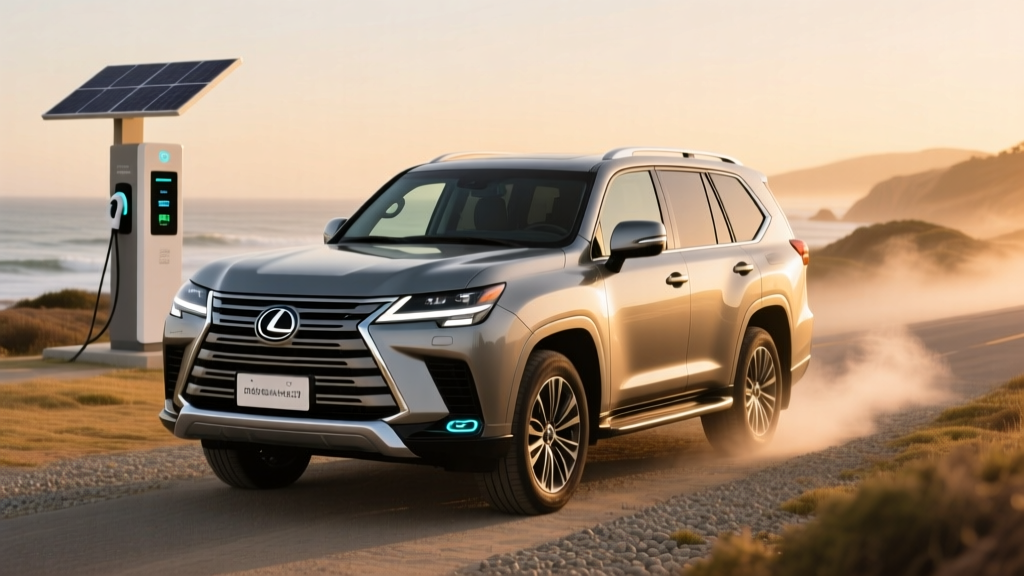
The 2025 Lexus GX 550h is the first hybrid ever offered in the GX lineup, slotting into the redesigned third-generation body-on-frame SUV that debuted for the 2024 model year. It pairs a twin-turbo V6 with a hybrid electric motor system to deliver 326 horsepower and 465 lb-ft of torque — figures that would have seemed absurd for a hybrid luxury SUV just a few years ago. But the real question for buyers isn't the power. It's whether the hybrid powertrain delivers meaningful fuel savings over the standard GX 550, whether it's worth the price premium, and how the hybrid battery holds up long-term.
This guide covers everything you need to know about the 2025 Lexus GX hybrid: real-world MPG versus EPA estimates, the i-FORCE MAX powertrain in detail, battery warranty and replacement costs, tax credit eligibility, and who should choose this HEV over a plug-in hybrid or a full electric SUV.
2025 Lexus GX 550h: Core Specs at a Glance
| Spec | Value |
|---|---|
| Powertrain | 3.4L twin-turbo V6 + electric motor (i-FORCE MAX) |
| Combined Horsepower | 326 hp |
| Combined Torque | 465 lb-ft |
| Transmission | 8-speed automatic |
| Drivetrain | Full-time 4WD |
| EPA MPG (City / Hwy / Combined) | 21 / 22 / 21 |
| Battery Type | Nickel-metal hydride (NiMH), hybrid-assist |
| 0-60 mph | ~6.5 seconds (est.) |
| Towing Capacity | 6,000 lbs |
| Hybrid Battery Warranty | 10 years / 150,000 miles |
| Base MSRP (Premium+ trim) | $78,590 (including destination) |
| Federal Tax Credit | Not eligible (§30D requires plug-in capability) |
HEV vs PHEV: The Lexus GX 550h Is a Conventional Hybrid
Before evaluating fuel economy, it's critical to understand what the GX 550h is — and what it isn't. The 2025 Lexus GX 550h is a conventional hybrid electric vehicle (HEV). It does not have a plug. It cannot charge from a wall outlet or public charger. It cannot drive on electric-only power for meaningful distances.
The hybrid system recovers energy during braking and deceleration, stores it in a small NiMH battery pack, and uses the electric motor to assist the gasoline engine during acceleration and low-speed driving. The engine shuts off at stoplights and in stop-and-go traffic, reducing idle fuel consumption. You refuel it exactly like a gas car — at a gas station.
HEV (this vehicle): Self-charging via regenerative braking. No plug. Small battery (~1-2 kWh). Electric motor assists the gas engine. Typical MPG improvement: 15-30% over gas-only equivalent.
PHEV: Plugs into a wall or charger. Larger battery (15-40 kWh). Can drive 20-50 miles on electricity alone before the gas engine engages. May qualify for the §30D federal tax credit if it meets sourcing, income, and MSRP requirements.
BEV: Fully electric. No gas engine. 200-400+ miles of range. Requires home or public charging infrastructure.
As of the 2025 model year, Lexus does not offer a PHEV version of the GX. If plug-in capability is a dealbreaker, you'll need to look at competitors like the BMW X5 xDrive50e or the Jeep Grand Cherokee 4xe.
Fuel Economy: EPA Ratings and Real-World MPG
The EPA rates the 2025 Lexus GX 550h at 21 MPG city / 22 MPG highway / 21 MPG combined according to fueleconomy.gov. For context, the non-hybrid GX 550 (same twin-turbo V6, no electric motor assist) is rated at 15 city / 21 highway / 17 combined. That's a meaningful gap — the hybrid delivers roughly a 24% improvement in combined fuel economy.
| Model | City MPG | Highway MPG | Combined MPG |
|---|---|---|---|
| GX 550h (Hybrid) | 21 | 22 | 21 |
| GX 550 (Gas) | 15 | 21 | 17 |
| Improvement (Hybrid) | +6 MPG (+40%) | +1 MPG (+5%) | +4 MPG (+24%) |
The city MPG improvement is dramatic because that's where hybrid systems shine: regenerative braking recovers energy in stop-and-go traffic, and the engine shuts off at idle. Highway driving is less affected because the gas engine operates at a relatively efficient steady state anyway, and the added weight of the hybrid system slightly offsets any gains.
Real-World MPG Expectations
Body-on-frame SUVs with aggressive off-road tires and boxy aerodynamics rarely exceed their EPA highway numbers. In real-world mixed driving, expect the GX 550h to deliver:
- City / suburban: 20-22 MPG — the hybrid system works hardest here, and you may match or slightly exceed the EPA city figure in moderate traffic
- Highway (70-75 mph): 18-20 MPG — aerodynamic drag and the 5,000+ lb curb weight work against efficiency at sustained high speeds
- Cold weather (below 30°F): 17-19 MPG combined — the engine runs longer to warm the cabin and catalytic converter, reducing hybrid assist frequency
- Towing: 12-14 MPG — hybrids help with low-speed trailer maneuvering, but highway towing fuel economy remains poor regardless of powertrain
If you drive primarily in the city and suburbs, the GX 550h's real-world advantage over the gas model will be substantial. If most of your miles are highway, the gap narrows considerably.
The i-FORCE MAX Powertrain: Engine + Motor Specs
The GX 550h uses Toyota's i-FORCE MAX hybrid system, which is fundamentally different from the hybrid system in a Prius or RAV4 Hybrid. Instead of a small four-cylinder engine paired with a high-output electric motor, the i-FORCE MAX starts with a robust 3.4-liter twin-turbocharged V6 (the same engine in the non-hybrid GX 550 and Toyota Tundra) and sandwiches an electric motor between the engine and the 8-speed automatic transmission.
The result is a system optimized for torque and towing rather than maximum fuel economy:
- 3.4L twin-turbo V6: Produces the bulk of the 326 hp
- Electric motor (integrated in bell housing): Fills in torque at low RPM before the turbos spool up, eliminating turbo lag and providing instant throttle response
- NiMH battery pack: Stores regenerative braking energy; small capacity (~1.5 kWh) by design — this isn't meant for electric-only driving
- 8-speed automatic: The motor is positioned to work through the transmission, so all gears benefit from electric assist
The 465 lb-ft of peak torque arrives at just 1,700 RPM — significantly lower than the non-hybrid GX 550's 479 lb-ft at 2,000 RPM. This makes the hybrid feel more responsive around town and more capable when pulling a trailer from a stop.
Pricing, Trims, and Tax Credit Eligibility
The 2025 Lexus GX 550h is offered in three trims, all with standard full-time 4WD:
| Trim | MSRP (incl. destination) |
|---|---|
| Premium+ | $78,590 |
| Overtrail | $82,900 |
| Luxury+ | $91,870 |
The hybrid powertrain commands a premium over the equivalent gas-only trims. The GX 550 Premium (gas) starts at $64,250, though trim content differs — the hybrid is only available starting at the Premium+ level, which includes additional features like a 14-inch touchscreen, heated and ventilated front seats, and a 360-degree camera.
Federal Tax Credit: Not Eligible
The 2025 Lexus GX 550h does not qualify for the IRS §30D federal clean vehicle tax credit. The credit applies only to plug-in electric vehicles (PHEVs and BEVs) with a minimum battery capacity of 7 kWh. The GX 550h's NiMH hybrid battery is far below that threshold, and the vehicle has no plug-in capability.
No state-level hybrid-specific purchase incentives are widely available as of 2025, though some states offer minor registration fee reductions or HOV lane access for hybrids. Check your state's DMV or energy office for current programs.
The §30D credit of up to $7,500 is reserved for plug-in vehicles that meet strict battery sourcing, critical mineral, buyer income, and MSRP cap requirements. Conventional hybrids like the GX 550h have never qualified. If federal incentives are a priority in your purchase decision, you'll need to consider a PHEV or BEV.
Battery Warranty, Lifespan, and Replacement Cost
Hybrid battery longevity is the single most common concern among first-time hybrid buyers. Here's what Lexus provides:
Coverage: 10 years or 150,000 miles, whichever comes first — for the hybrid battery pack and all hybrid system components (inverter, electric motor, control unit).
What's covered: Defects in materials or workmanship, and battery capacity loss below a defined threshold (typically 60-70% of original capacity, though Lexus does not publish the exact figure publicly).
Transferability: Yes — the warranty transfers to subsequent owners, which supports resale value.
How Long Will the Hybrid Battery Last?
Toyota and Lexus hybrid systems have an exceptional long-term reliability record. The NiMH battery chemistry used in the GX 550h is mature, well-understood, and less prone to the degradation issues that affect larger lithium-ion packs in BEVs. Based on data from the millions of Toyota/Lexus hybrids on the road:
- Most hybrid batteries last the lifetime of the vehicle (150,000–250,000+ miles) without replacement
- Failures before 100,000 miles are rare and would be covered under warranty
- NiMH batteries degrade gradually rather than failing suddenly — you'll notice slightly reduced fuel economy over many years, not a hard stop
Battery Replacement Cost
If the hybrid battery does need replacement out of warranty (typically after 150,000+ miles or 10+ years):
- OEM replacement from Lexus: $3,000–$5,000 for the battery pack, plus labor (~$500–$1,000)
- Refurbished/aftermarket options: $1,500–$3,000 from third-party hybrid specialists
- Individual cell replacement: Some independent shops replace only the failed cells within the pack for $500–$1,500
These costs are far lower than BEV battery replacements ($10,000–$20,000+) because the hybrid battery pack is small. For most owners, the battery will never need replacement.
Reliability and Long-Term Ownership
The GX 550h benefits from one of the strongest reliability reputations in the industry. Lexus consistently ranks at or near the top of IIHS and J.D. Power dependability studies. The i-FORCE MAX powertrain is shared with the Toyota Tundra and Sequoia, meaning it will be produced in high volume with extensive real-world validation.
Key reliability factors specific to the hybrid system:
- No high-voltage lithium-ion pack: NiMH is chemically stable, with minimal thermal runaway risk
- No plug-in charging cycles: The battery operates in a narrow state-of-charge window (roughly 40-80%), which dramatically extends cycle life compared to BEVs that charge to 100%
- Proven architecture: Toyota's hybrid synergy drive concept has been in production since 1997 — nearly three decades of iteration
- Standard Lexus warranty: 4 years/50,000 miles basic, 6 years/70,000 miles powertrain, 10 years/150,000 miles hybrid components
Who Should Choose the GX 550h — And Who Shouldn't
Choose the GX 550h If:
- You want a body-on-frame luxury SUV with real off-road and towing capability (6,000 lbs)
- Most of your driving is city/suburban, where the hybrid's 21 MPG city rating saves the most fuel
- You don't have access to home or workplace charging (no plug needed)
- You plan to keep the vehicle 8-10+ years and want proven hybrid reliability
- You want the low-end torque benefit for trailer towing without turbo lag
Look Elsewhere If:
- You want electric-only driving for short commutes (you need a PHEV like the BMW X5 xDrive50e)
- Federal tax credit eligibility is a priority in your purchase decision
- Most of your miles are highway — the hybrid advantage narrows significantly at 70+ mph
- Budget is tight — the hybrid premium adds $5,000+ over gas-only trims, and fuel savings take years to recoup
- You want a fully electric SUV with 300+ miles of range (consider the Rivian R1S or Tesla Model X)
The Fuel Savings Math
At 15,000 miles per year and $3.75/gallon regular unleaded:
- GX 550 (gas, 17 combined MPG): ~$3,309/year in fuel
- GX 550h (hybrid, 21 combined MPG): ~$2,679/year in fuel
- Annual savings: ~$630
- Payback period for the hybrid premium (~$5,000–$8,000 depending on trim comparison): 8-13 years
The fuel savings alone don't justify the hybrid premium on a pure payback basis. The real value is in the improved driving experience (instant torque, no turbo lag), reduced emissions, and potential resale-value advantage as the market increasingly favors electrified vehicles.
Frequently Asked Questions
How many MPG does the 2025 Lexus GX hybrid get?
The EPA rates the GX 550h at 21 city / 22 highway / 21 combined MPG. Real-world city driving typically matches or slightly exceeds the EPA city figure (20-22 MPG), while highway driving at 70+ mph tends to fall slightly below (18-20 MPG). Cold weather and towing reduce these numbers further.
Does the Lexus GX hybrid need to be plugged in?
No. The GX 550h is a conventional hybrid (HEV), not a plug-in hybrid (PHEV). It charges its own battery through regenerative braking and the gasoline engine. You refuel it at a gas station like any other vehicle.
Is there a plug-in hybrid (PHEV) version of the Lexus GX?
Not as of the 2025 model year. Lexus has not announced a GX PHEV. If plug-in hybrid capability is essential, the closest competitors in the body-on-frame or luxury midsize SUV segment include the BMW X5 xDrive50e (38 miles electric-only) and the Jeep Grand Cherokee 4xe (26 miles electric-only).
Does the 2025 Lexus GX 550h qualify for a federal tax credit?
No. The IRS §30D Clean Vehicle Credit applies only to plug-in electric vehicles (PHEVs and BEVs) with battery capacity of at least 7 kWh. The GX 550h is a conventional hybrid with a small NiMH battery and no plug-in capability, so it does not qualify. Consult a tax professional for any applicable state incentives.
How long will the GX 550h hybrid battery last?
Lexus covers the hybrid battery for 10 years / 150,000 miles. Based on Toyota/Lexus's track record with NiMH hybrid batteries across millions of vehicles, most hybrid batteries last 150,000–250,000+ miles without replacement. The narrow state-of-charge operating window and chemically stable NiMH chemistry contribute to exceptional longevity.
What does it cost to replace the hybrid battery?
An OEM replacement battery from Lexus costs approximately $3,000–$5,000 plus labor. Refurbished or aftermarket options range from $1,500–$3,000. Independent shops that replace individual cells within the pack may charge $500–$1,500. This is significantly less than BEV battery replacement costs.
How does the GX 550h compare to the gas-only GX 550?
The hybrid delivers 4 more MPG combined (21 vs 17), significantly better city fuel economy (21 vs 15 MPG), and more low-end torque (465 lb-ft at 1,700 RPM vs 479 lb-ft at 2,000 RPM). The tradeoff is a higher starting price and the hybrid's availability only in higher trim levels (Premium+ and above).
Can the GX 550h tow as much as the gas model?
The GX 550h is rated to tow 6,000 lbs, which is slightly less than the gas-only GX 550's 8,000-lb rating. If maximum towing capacity is your top priority, the gas model has an advantage. For trailers under 6,000 lbs (most boat trailers, small campers, and utility trailers), the hybrid is fully capable and benefits from its instant low-RPM torque.