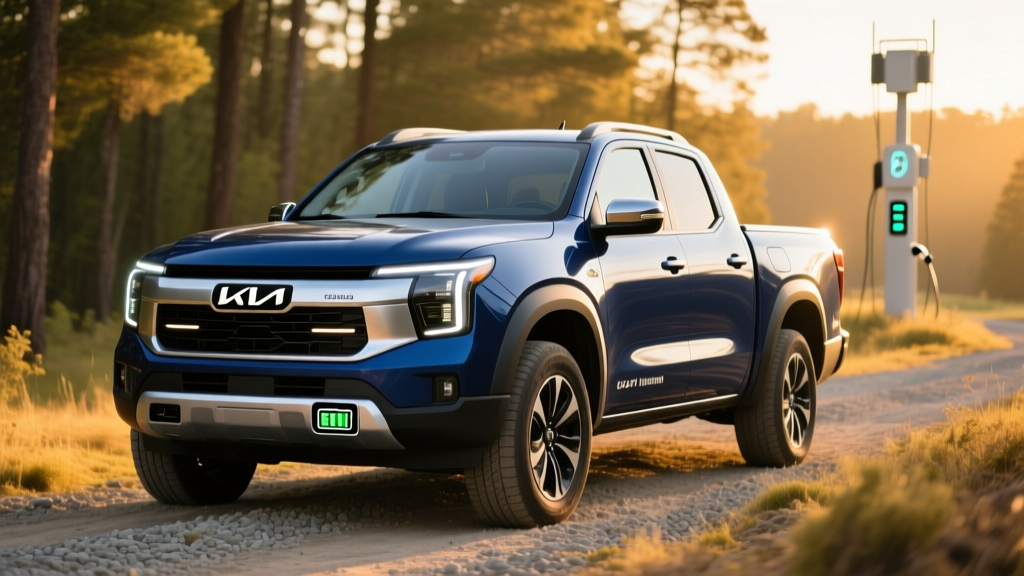
If you've been searching for a Kia electric hybrid pickup, you're not alone — search interest has surged as the midsize truck segment goes electrified. Kia's answer is the Kia Tasman, a body-on-frame pickup unveiled in late 2024 with global markets in its crosshairs. But as of early 2026, the Tasman remains an announced/global-market vehicle, and its plug-in hybrid (PHEV) variant is still in the preliminary-spec stage for any potential US arrival.
Here's a data-driven breakdown of everything confirmed, estimated, and still up in the air — so you can decide whether to wait for Kia's electrified truck or look at what's on dealer lots now.
HEV vs PHEV: What Kia Has Confirmed for the Tasman
Kia has discussed multiple powertrain options for the Tasman globally, including diesel, gasoline turbo, and electrified variants. The variant most relevant to US buyers is the plug-in hybrid (PHEV), not a conventional hybrid (HEV). Let's clarify the difference:
Conventional Hybrid (HEV) vs Plug-In Hybrid (PHEV)
| Feature | HEV (Conventional Hybrid) | PHEV (Plug-In Hybrid) |
|---|---|---|
| Plugs in? | No — charges via regen & engine | Yes — Level 1/2 charging |
| Electric-only range | 1–2 miles at low speed | 25–45 miles (typical) |
| Battery size | 1–2 kWh | 13–25 kWh (typical) |
| Federal tax credit | None under §30D | Up to $7,500 (if eligible) |
| Best for | No home charging access | Home chargers with short commutes |
The Tasman PHEV is expected to use a variant of Kia-Hyundai's proven PHEV architecture — similar to what powers the Sorento PHEV but adapted for a body-on-frame truck platform. A conventional HEV variant has not been confirmed for the Tasman lineup.
Estimated Powertrain, Battery, and Performance Specs
Because the Tasman PHEV's final US specs have not been officially published, the figures below are preliminary estimates based on Kia's global announcements and the powertrain used in the Sorento PHEV and Hyundai Santa Fe PHEV. Final numbers may differ at launch.
| Spec | Estimated / Preliminary |
|---|---|
| Powertrain | 1.6L turbocharged 4-cyl + electric motor (PHEV) |
| Combined output | ~261 hp / 258 lb-ft torque (est.) |
| Battery capacity | ~13.8 kWh usable (NMC chemistry, est.) |
| Electric-only range | ~30–35 miles (EPA est., preliminary) |
| Total combined range | ~450–500 miles (est.) |
| Level 2 charging (7.2 kW) | ~2.5 hours (0–100%) |
| DC fast charging | Not expected (typical for PHEVs) |
| Towing capacity | ~5,000–6,000 lbs (est., unconfirmed) |
| Drivetrain | AWD standard (rear motor + front engine) |
| Base MSRP (est.) | $42,000–$48,000 |
Key powertrain note: Kia's 1.6L turbo PHEV system pairs a gasoline engine driving the front wheels with an electric motor integrated into the transmission. In the Sorento PHEV, this delivers 261 hp combined. A truck application may see tuning adjustments for towing and payload, but the architecture is proven across Kia-Hyundai's lineup.
Fuel Economy: Expected MPG and MPGe
PHEV fuel economy is expressed two ways: MPGe (miles-per-gallon-equivalent when running on electricity + gas) and gas-only MPG (after the battery is depleted). Based on the Sorento PHEV's EPA-rated 79 MPGe combined and 35 MPG gas-only, here's what the Tasman PHEV might deliver:
| Metric | City | Highway | Combined |
|---|---|---|---|
| MPGe (charge-depleting) | ~80 | ~72 | ~76 (est.) |
| MPG (gas-only, battery depleted) | ~26 | ~28 | ~27 (est.) |
Real-world caveat: Body-on-frame trucks carry an aerodynamic and weight penalty versus crossover-based PHEVs. Expect gas-only highway MPG to drop to the low-to-mid 20s when towing or hauling payload. However, for daily commutes under 30 miles, most driving can be done on electric power alone — effectively 0 gallons consumed on weekdays if you charge at home nightly.
Hybrids and PHEVs often exceed their EPA city MPG in real-world stop-and-go driving because regenerative braking recaptures energy that gas-only vehicles waste as heat. Highway numbers tend to be closer to or slightly below EPA due to aerodynamic drag — especially on a boxy pickup.
Electric-Only Range and Charging Details
For PHEV buyers, electric-only range is the number that matters most for daily usability. The Tasman PHEV's estimated 30–35 miles of electric range covers the average American commute (roughly 16 miles each way, per Census data) with margin to spare.
Real-World Electric Range Expectations
EPA estimate: ~30–35 miles electric-only (preliminary)
Real-world expectation: ~25–30 miles in mixed driving; ~20–25 miles in cold weather (below 40°F) due to cabin heating demands and reduced battery efficiency.
Summer highway: ~28–32 miles at 65 mph.
Charging: Like nearly all PHEVs, the Tasman is expected to support Level 1 (120V) and Level 2 (240V) AC charging only. DC fast charging is generally not offered on PHEVs because the smaller battery (13–14 kWh) doesn't justify the added cost and weight of DC hardware. At 7.2 kW Level 2, a full charge takes roughly 2.5 hours — easily done during a workday or overnight. On a standard 120V outlet (Level 1 at ~1.4 kW), expect about 9–10 hours for a full charge.
Battery Warranty, Reliability, and Replacement Cost
Kia PHEV Battery Warranty (Based on Current Policy)
Coverage: 10 years / 100,000 miles (hybrid/PHEV/EV battery)
Capacity threshold: Warranty typically covers defects and capacity loss below ~70% of original capacity
Transferability: Kia's 10-year powertrain warranty is generally limited to the original owner; the 5-year/60,000-mile basic warranty transfers to subsequent owners.
Kia's hybrid battery warranty is among the strongest in the industry, matching Hyundai's coverage. The lithium-ion NMC packs used in Kia PHEVs have demonstrated strong longevity — Consumer Reports data indicates that most modern hybrid batteries last well beyond 150,000 miles before significant degradation.
Replacement cost (out of warranty): Based on current Sorento PHEV battery pricing, expect a full pack replacement to run $4,500–$7,000 including labor. However, individual module replacement (if only a few cells degrade) can cost significantly less — typically $1,500–$3,000.
Reliability outlook: Kia's 1.6L turbo PHEV powertrain has been in production since 2021 across the Sorento and Sportage lines. Early models had some transmission-related software complaints, but the powertrain has matured. The Tasman's body-on-frame architecture is new, which introduces some first-year risk for non-powertrain components (suspension, frame, electronics).
Pricing and Federal Tax Credit Eligibility
Kia has not published US pricing for the Tasman, and US availability itself remains unconfirmed as of early 2026. If the Tasman PHEV does arrive stateside, expect a starting MSRP in the $42,000–$48,000 range, positioning it between the Ford Maverick Hybrid and the upcoming Ram 1500 Ramcharger EREV.
§30D Federal Tax Credit — PHEV Requirements (2026 Rules)
Under current IRS §30D rules, a PHEV must meet all of the following to qualify for up to $7,500:
- Battery capacity: ≥ 7 kWh (Tasman PHEV's ~13.8 kWh would qualify)
- MSRP cap: Vans/pickups/SUVs ≤ $80,000 (likely satisfied)
- Buyer income cap: AGI ≤ $150,000 (single) / $300,000 (joint)
- Final assembly: Must occur in North America
- Battery sourcing: Critical minerals and battery components must meet phased-in percentages from US/FTA partners (increasing annually through 2029)
- FEOC restriction: No battery components from "foreign entities of concern" (primarily China/Russia)
- Point-of-sale transfer: Credit can be applied at purchase as a down-payment reduction (dealer must be IRS-registered)
Note: Eligibility depends on the specific model year, build configuration, and your personal tax situation. Consult a tax professional and check the IRS-registered vehicle list at fueleconomy.gov before purchasing.
The assembly wildcard: The biggest question mark for the Tasman PHEV's tax-credit eligibility is where it will be built. Kia manufactures the Tasman in South Korea and potentially other global facilities. If Kia does not shift Tasman production to its West Point, Georgia plant (where the Telluride is assembled), the vehicle would not qualify for the §30D credit regardless of other factors. This is the single most important variable for US buyers.
Who Should Consider the Kia Tasman PHEV — And Who Shouldn't
Pros (If It Comes to the US)
- 30+ miles of electric commute with gas backup for road trips
- Body-on-frame capability: towing, payload, off-road geometry
- Kia's 10-year/100,000-mile hybrid battery warranty
- Proven PHEV powertrain shared with Sorento/Sportage
- No range anxiety — gas engine covers long hauls
Cons & Risks
- US availability unconfirmed as of 2026
- South Korean assembly may disqualify from $7,500 tax credit
- Gas-only MPG likely in the mid-20s — below car-based hybrids
- No DC fast charging (PHEV limitation, not unique to Tasman)
- First-year model risk on a brand-new platform
Decision Framework: Is the Tasman PHEV Right for You?
Wait for the Tasman PHEV if: You need a midsize truck with real towing capability, have home Level 2 charging, commute under 35 miles daily, and want gas-engine flexibility for weekend trips. You're willing to wait for a potential 2027–2028 US launch.
Look elsewhere if: You need a truck now (consider the Ford Maverick Hybrid at 42 MPG combined, or the Toyota Tacoma i-FORCE MAX hybrid). If you never tow and drive mostly in the city, a full EV like the Rivian R2 or Hyundai Ioniq 5 may offer lower operating costs. If you lack home charging, a conventional HEV like the Maverick Hybrid makes more sense than any PHEV.
How the Tasman PHEV Compares to Current Electrified Trucks
| Spec | Kia Tasman PHEV (est.) | Ford Maverick Hybrid | Toyota Tacoma i-FORCE MAX | Ram 1500 Ramcharger (EREV) |
|---|---|---|---|---|
| Type | PHEV | HEV | HEV | EREV (extended-range EV) |
| EPA combined MPG / MPGe | ~76 MPGe / ~27 MPG gas | 42 MPG | ~23 MPG | ~65 MPGe est. |
| Electric-only range | ~30–35 mi | N/A (HEV) | N/A (HEV) | ~69 mi (claimed) |
| Combined HP | ~261 | 191 | 326 | ~670 |
| Towing capacity | ~5,000–6,000 lbs | 2,000 lbs | 6,000 lbs | ~7,200 lbs (claimed) |
| Base MSRP | ~$42,000–$48,000 | ~$28,000 | ~$42,000 | ~$55,000+ |
| Tax credit eligible? | Unlikely (Korea-built) | No (HEV) | No (HEV) | Yes (US-built, if rules hold) |
Frequently Asked Questions
How many MPG does the Kia Tasman hybrid get?
Based on preliminary estimates using Kia's 1.6L turbo PHEV system, expect roughly 76 MPGe combined when operating in blended electric-gas mode, and approximately 27 MPG combined (gas-only) once the battery is depleted. These are estimates — final EPA numbers are not yet available. For comparison, the Ford Maverick Hybrid achieves a rated 42 MPG combined as a conventional hybrid with no plug-in capability.
How far can the Kia Tasman PHEV go on electric power alone?
The estimated electric-only range is 30–35 miles on a full charge (EPA preliminary estimate). In real-world conditions — especially cold weather or sustained highway speeds — expect 25–30 miles. This covers most daily commutes without using any gasoline, provided you charge at home overnight.
Hybrid vs PHEV vs full EV — which should I choose for a pickup?
HEV (conventional hybrid, like the Maverick Hybrid): Best if you lack home charging and want simple, fuel-efficient truck ownership with no plugs or behavioral changes.
PHEV (plug-in hybrid, like the estimated Tasman PHEV): Best if you have home Level 2 charging, a short commute, and also need gas-engine range for towing or road trips.
Full EV (like the Ford F-150 Lightning or Rivian R1T): Best if you want the lowest per-mile operating cost, strong instant torque for towing, and have reliable charging access — but are comfortable planning longer trips around DC fast-charging stops.
Is the Kia Tasman PHEV reliable, and what does battery replacement cost?
Kia's PHEV powertrain has been in production since 2021 and is generally reliable, with the main early complaints being software-related rather than mechanical. The hybrid battery is covered by Kia's 10-year/100,000-mile warranty. Out-of-warranty replacement is estimated at $4,500–$7,000 for a full pack, though individual module repairs cost less. Modern PHEV batteries routinely last 150,000+ miles before significant degradation.
Does the Kia Tasman hybrid qualify for any tax credit?
Under current IRS §30D rules, a PHEV can qualify for up to $7,500 in federal tax credits — but only if final assembly occurs in North America and battery-sourcing requirements are met. Because the Tasman is currently manufactured outside the US, it is unlikely to qualify unless Kia shifts production to its Georgia facility. State-level incentives vary by jurisdiction — check your state's energy office for local rebate programs. Always verify eligibility on fueleconomy.gov and consult a tax professional before purchase.
When will the Kia Tasman be available in the United States?
As of early 2026, Kia has not confirmed a US launch date for the Tasman. The truck was designed primarily for markets in Australia, South Africa, the Middle East, and South Korea. Industry analysts have speculated a potential 2027–2028 US introduction, possibly with hybrid or PHEV powertrains, but this remains unconfirmed. Kia's US product communications team has neither confirmed nor denied the Tasman's stateside arrival.
Can the Kia Tasman PHEV tow, and how does towing affect range?
Estimated towing capacity is 5,000–6,000 lbs, competitive with the Toyota Tacoma and well above the Ford Maverick Hybrid's 2,000-lb limit. However, towing at or near maximum capacity will dramatically reduce both electric range (likely to single digits) and gas-only MPG (expect 14–18 MPG while towing). This is true of every electrified vehicle — aerodynamic drag and weight are the enemies of efficiency.
Editorial note: This article covers a vehicle that is announced for global markets but not confirmed for US sale. Specifications listed are preliminary estimates based on Kia's global disclosures and comparable Kia-Hyundai PHEV powertrains. Final US specs, pricing, and availability may differ. We will update this guide when official US-market information is released.