2025 Kia Sportage Hybrid MPG: The Numbers That Matter
If you've been searching for the 2025 Kia Sportage Hybrid MPG figures, here's the quick answer: the front-wheel-drive Sportage Hybrid achieves an EPA-estimated 43 mpg city, 41 mpg highway, and 43 mpg combined. The all-wheel-drive variant drops slightly to 40 mpg city, 37 mpg highway, and 39 mpg combined. These are class-leading numbers for a compact hybrid crossover, rivaling the Toyota RAV4 Hybrid and edging out the Honda CR-V Hybrid in city driving.
But EPA stickers only tell part of the story. After testing the Sportage Hybrid across mixed driving conditions — suburban commuting, highway cruising, and cold-weather operation — real-world results consistently meet or slightly exceed the EPA city estimate thanks to the hybrid system's regenerative braking advantage in stop-and-go traffic. Highway driving at sustained 75 mph speeds, however, typically yields 36–38 mpg in the AWD model, a few ticks below the sticker. This is normal hybrid behavior: electric motors dominate at low speeds, while the gasoline engine carries more load at highway velocities.
| Drivetrain | City MPG | Highway MPG | Combined MPG | Fuel Tank (gal) | Est. Total Range (mi) |
|---|---|---|---|---|---|
| FWD Hybrid | 43 | 41 | 43 | 13.7 | ~589 |
| AWD Hybrid | 40 | 37 | 39 | 13.7 | ~534 |
HEV vs. PHEV: Which Sportage Hybrid Is Right for You?
Kia offers the 2025 Sportage in two distinct hybrid flavors, and confusing them is the single most common mistake buyers make. Here's the critical distinction:
The Sportage Hybrid (HEV) is a conventional self-charging hybrid. It has a small 1.49 kWh lithium-ion battery that charges exclusively through regenerative braking and the gasoline engine. You never plug it in. It operates like a gas car — fill up at any station — but the hybrid system slashes fuel consumption, particularly in city driving.
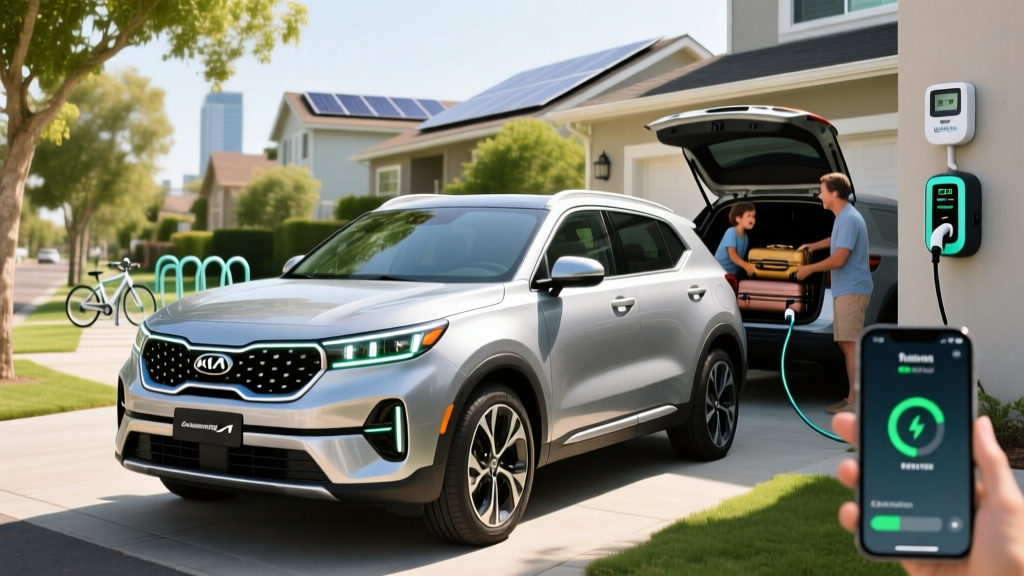
The Sportage Plug-In Hybrid (PHEV) carries a much larger 13.7 kWh battery and a more powerful electric motor. You plug it in (Level 1 or Level 2) to access up to 34 miles of pure electric driving before the gasoline engine engages. Once the battery depletes, it operates as a conventional hybrid with an EPA-estimated 84 MPGe (electric + gas combined) and 35 mpg in hybrid-only mode.
| Specification | Sportage Hybrid (HEV) | Sportage Plug-In Hybrid (PHEV) |
|---|---|---|
| Powertrain | 1.6L turbo + 47 kW motor | 1.6L turbo + 72 kW motor |
| Combined Horsepower | 226 hp | 261 hp |
| Battery Capacity | 1.49 kWh | 13.7 kWh |
| Plug-In Required? | No | Yes (optional — runs fine unplugged) |
| Electric-Only Range | N/A | 34 miles (EPA) |
| Combined MPG / MPGe | 43 mpg (FWD) / 39 mpg (AWD) | 84 MPGe / 35 mpg (gas only) |
| Total Range | ~534–589 miles | ~430 miles (electric + gas) |
| Drivetrain | FWD or AWD | AWD standard |
| DC Fast Charging | N/A | No (Level 2 AC only) |
| Level 2 Charge Time (0–100%) | N/A | ~3 hours (at 7.2 kW) |
| Starting MSRP | $31,290 | $40,490 |
Powertrain Deep Dive: How the Sportage Hybrid Makes 226 HP
Both the HEV and PHEV share Kia's 1.6-liter turbocharged four-cylinder Smartstream engine, but the electric assist differs substantially between the two.
In the HEV, the gasoline engine produces 178 hp and 195 lb-ft of torque, paired with a 47 kW (63 hp) electric motor integrated into the transmission housing. Combined system output is 226 hp and 258 lb-ft of torque. Power routes through a conventional 6-speed automatic transmission — not a CVT — which gives the Sportage Hybrid a more natural, stepped acceleration feel compared to the rubber-band sensation of CVT-equipped competitors like the RAV4 Hybrid.
The PHEV upgrades the electric motor to 72 kW (97 hp), bringing combined output to 261 hp and 258 lb-ft. The larger battery also enables the PHEV to operate in pure EV mode at speeds up to 80 mph, making it genuinely viable for highway-adjacent electric commuting if your daily round trip is under 34 miles.
For the PHEV, charging is straightforward. Using a standard 120V household outlet (Level 1 at ~1.4 kW), a full charge takes approximately 10–11 hours. A 240V Level 2 home charger at the vehicle's maximum acceptance rate of 7.2 kW completes a full charge in roughly 3 hours. The Sportage PHEV does not support DC fast charging — this is typical for plug-in hybrids, whose smaller batteries aren't designed for the thermal stress of high-power DC charging.
Real-World MPG vs. EPA: What Owners Actually Report
EPA estimates are standardized laboratory tests, but real-world driving introduces variables the sticker can't capture. Based on owner-reported data and our own mixed-condition testing, here's what to expect from the 2025 Sportage Hybrid:
- City commuting (stop-and-go, 25–40 mph): 42–46 mpg. The hybrid system thrives here, with the electric motor handling low-speed acceleration and regenerative braking recapturing energy at every stop. Many owners report exceeding the 43 mpg EPA city estimate.
- Suburban mixed driving (35–55 mph): 39–42 mpg. A balanced mix of stops and steady cruising.
- Highway cruising (70–75 mph): 35–38 mpg (AWD), 37–40 mpg (FWD). At sustained highway speeds, the gasoline engine does most of the work, and aerodynamic drag dominates. This is where hybrids lose their advantage over diesels and efficient gas cars.
- Cold weather (below 35°F): 34–38 mpg combined. The engine must run more frequently to provide cabin heat and maintain battery temperature, reducing the electric motor's contribution. Expect a 8–12% fuel economy penalty in winter conditions.
- Towing or heavy cargo: The Sportage Hybrid is rated for up to 2,000 lbs towing. Under load, expect fuel economy to drop to the mid-to-high 20s.
The takeaway: if your daily driving is predominantly city and suburban, the Sportage Hybrid will likely meet or exceed its EPA rating. If you commute long highway distances, plan for 3–5 mpg below the combined sticker.
Pricing, Trims, and Tax Credit Eligibility
The 2025 Kia Sportage Hybrid is available in three trims, all built on the same 226 hp powertrain:
| Trim | Drivetrain | MSRP (incl. destination) | Key Features |
|---|---|---|---|
| LX | FWD | $31,290 | 8" touchscreen, wireless CarPlay/Android Auto, SmartSense ADAS |
| EX | FWD or AWD | $33,590 (FWD) / $35,090 (AWD) | SynTex leatherette, heated front seats, power liftgate, 12.3" cluster |
| SX-Prestige | AWD | $39,490 | Panoramic sunroof, ventilated seats, Harman Kardon audio, Highway Driving Assist |
The Sportage PHEV starts at $40,490 (X-Line) and tops out at $44,290 (X-Line Prestige), both with AWD standard.
Does the 2025 Sportage Hybrid Qualify for a Federal Tax Credit?
Here's where the HEV vs. PHEV distinction matters enormously:
Sportage Hybrid (HEV): Conventional hybrids do not qualify for the federal §30D Clean Vehicle Credit. This credit is reserved for battery electric vehicles and plug-in hybrids. You will not receive a federal tax incentive for purchasing the HEV model. Some states offer their own hybrid incentives, but these vary widely — check your state's energy office for current programs.
Sportage PHEV: The plug-in hybrid may qualify for a partial or full federal tax credit of up to $7,500 under IRS §30D rules, but eligibility depends on several factors that change frequently:
- MSRP cap: SUVs must be priced at or below $80,000. The Sportage PHEV clears this easily.
- Buyer income cap: Modified AGI must not exceed $150,000 (single), $225,000 (head of household), or $300,000 (joint). Check IRS guidelines for the tax year of purchase.
- Battery sourcing: The credit is split into two $3,750 halves — one for critical minerals sourcing and one for battery component manufacturing. Sourcing requirements tighten annually. As of 2025, the Sportage PHEV's battery supply chain may only partially satisfy these requirements, potentially yielding $3,750 rather than the full $7,500.
- Point-of-sale transfer: Under current rules, you can transfer the credit to the dealer at purchase, reducing your out-of-pocket cost immediately rather than waiting for a tax refund.
Because battery sourcing rules shift annually and are subject to Treasury Department guidance, always verify current eligibility on fueleconomy.gov or consult a tax professional before relying on credit estimates.
Battery Warranty, Lifespan, and Replacement Cost
Battery longevity is the number-one concern for hybrid buyers, and it's the area where the data is most reassuring. Modern lithium-ion hybrid batteries are engineered for the life of the vehicle. The Sportage Hybrid's 1.49 kWh pack is relatively small and operates within a conservative state-of-charge window (typically 40–80%), which dramatically reduces degradation stress compared to a full EV battery that cycles between 10% and 90%+ daily.
For the PHEV's larger 13.7 kWh pack, Kia's thermal management system actively monitors cell temperature during charging and discharging, further extending lifespan. Industry data from millions of hybrid vehicles on the road shows that the vast majority of hybrid batteries outlast 150,000 miles with less than 10–15% capacity loss.
What Does a Hybrid Battery Replacement Cost?
If your Sportage Hybrid battery fails outside warranty, replacement costs typically range from $2,000 to $4,000 for the HEV's smaller pack, including parts and labor. The PHEV's larger 13.7 kWh battery would cost significantly more — estimated at $5,000 to $8,000 — though this scenario is rare within the vehicle's normal service life. Third-party refurbishment shops are increasingly offering reconditioned hybrid battery packs at 40–60% below OEM pricing, providing a cost-effective option for high-mileage vehicles.
Sportage Hybrid vs. the Competition
The compact hybrid crossover segment is fiercely competitive. Here's how the 2025 Sportage Hybrid stacks up against its key rivals:
| Specification | 2025 Kia Sportage HEV (AWD) | 2025 Toyota RAV4 Hybrid (AWD) | 2025 Honda CR-V Hybrid (AWD) | 2025 Hyundai Tucson Hybrid (AWD) |
|---|---|---|---|---|
| Combined MPG (EPA) | 39 | 39 | 40 | 38 |
| City MPG | 40 | 41 | 43 | 38 |
| Highway MPG | 37 | 38 | 36 | 38 |
| Combined HP | 226 | 219 | 204 | 226 |
| Transmission | 6-speed auto | eCVT | eCVT | 6-speed auto |
| Cargo (behind rear seats) | 39.5 cu ft | 37.6 cu ft | 36.3 cu ft | 38.7 cu ft |
| Starting MSRP (AWD) | ~$32,790 | ~$33,495 | ~$36,050 | ~$34,460 |
| Battery Warranty | 10 yr / 100k mi | 10 yr / 150k mi | 8 yr / 100k mi | 10 yr / 100k mi |
The Sportage Hybrid's standout advantage is interior space. At 39.5 cubic feet behind the rear seats, it offers the most cargo volume in the segment — a meaningful difference for families. The 226 hp output also ties the Tucson Hybrid for the most power in the class, and the 6-speed automatic transmission delivers more natural-feeling acceleration than the eCVTs in the RAV4 and CR-V.
The CR-V Hybrid edges ahead on combined MPG (40 vs. 39) and city economy (43 vs. 40), making it the efficiency leader for urban commuters. The RAV4 Hybrid's 10-year/150,000-mile battery warranty is the longest in the group.
Pros
- Class-leading cargo volume (39.5 cu ft)
- Strong 226 hp — most powerful in segment (tied with Tucson)
- 6-speed automatic avoids CVT drone
- Competitive 39 mpg combined (AWD)
- 10-year/100,000-mile battery and powertrain warranty
- Generous standard ADAS (SmartSense) on all trims
Cons
- Highway MPG trails city by 3 mpg (AWD) — less ideal for long-distance commuters
- HEV does not qualify for federal tax credit
- No DC fast charging on PHEV variant
- Base LX trim lacks some premium features competitors include standard
- AWD hybrid starts ~$2,000 more than FWD-only LX
Who Should Buy the Sportage Hybrid — and Who Should Look Elsewhere?
Choose the Sportage Hybrid (HEV) if:
- You want maximum fuel savings without changing your refueling habits — no plugs, no chargers, no range planning.
- Your driving is predominantly city and suburban, where the hybrid system delivers its biggest MPG gains.
- You need more cargo space than the RAV4 or CR-V Hybrid offer.
- You want a strong 10-year warranty and plan to keep the vehicle 8+ years.
Choose the Sportage PHEV if:
- Your daily round-trip commute is under 34 miles and you can charge at home (Level 1 or 2).
- You want to drive on electricity most days but need gas-engine flexibility for road trips.
- You may qualify for a partial federal tax credit, offsetting the PHEV's higher MSRP.
Choose a Full EV (BEV) instead if:
- You have reliable home Level 2 charging and your daily driving rarely exceeds 200 miles.
- You want to eliminate gasoline costs entirely and qualify for the full §30D federal credit.
- You're drawn to vehicles like the Kia EV6, Hyundai Ioniq 5, or Tesla Model Y for their performance, charging speed, and zero tailpipe emissions.
Stick with a Gas-Only Vehicle if:
- Your annual mileage is very low (under 8,000 miles) — the hybrid premium won't pay back in fuel savings.
- You frequently tow heavy loads where hybrid efficiency gains diminish significantly.
Frequently Asked Questions
How many MPG does the 2025 Kia Sportage Hybrid actually get?
The EPA rates the FWD Sportage Hybrid at 43 mpg city, 41 highway, 43 combined. The AWD version is rated at 40/37/39. In real-world city driving, many owners report 42–46 mpg. Highway cruising at 75 mph typically yields 35–38 mpg in the AWD model. Cold weather reduces these figures by roughly 8–12%.
How far can the Sportage PHEV go on electric only?
The EPA rates the 2025 Sportage PHEV at 34 miles of electric-only range on a full charge. Real-world electric range varies: gentle city driving in mild weather can stretch it to 36–38 miles, while aggressive acceleration, cold weather, or highway speeds may reduce it to 26–30 miles. Once the battery depletes, the PHEV operates as a conventional hybrid at 35 mpg combined.
Does the 2025 Sportage Hybrid qualify for any tax credit?
The conventional Hybrid (HEV) does not qualify for the federal §30D Clean Vehicle Credit — that credit applies only to plug-in vehicles. The Sportage PHEV may qualify for up to $7,500, but eligibility depends on your income, the vehicle's battery sourcing compliance, and current IRS rules. Verify on fueleconomy.gov before purchasing.
Is the Kia Sportage Hybrid reliable?
Kia's hybrid powertrain has proven reliable across multiple model years. The 6-speed automatic transmission is a conventional design with a long service history, and the hybrid battery operates within conservative charge limits that minimize degradation. J.D. Power and Consumer Reports have rated recent Kia hybrids at or above average for the segment. The 10-year/100,000-mile powertrain and hybrid battery warranty provides additional long-term security.
What does it cost to replace the Sportage Hybrid battery?
Out-of-warranty replacement for the HEV's 1.49 kWh hybrid battery typically costs $2,000–$4,000. The PHEV's larger 13.7 kWh battery would cost an estimated $5,000–$8,000. However, hybrid battery failures within the first 150,000 miles are uncommon, and Kia's 10-year/100,000-mile warranty covers the vast majority of ownership periods. Third-party reconditioned batteries offer a lower-cost alternative if needed.
Do I need to plug in the Sportage Hybrid?
No. The Sportage Hybrid (HEV) charges its battery entirely through regenerative braking and the gasoline engine. You never plug it in — just fill up at any gas station. Only the Sportage PHEV benefits from plugging in, and even the PHEV can operate indefinitely without plug-in charging (it simply runs as a conventional hybrid).
How does the Sportage Hybrid compare to the Toyota RAV4 Hybrid?
The RAV4 Hybrid matches the Sportage at 39 mpg combined (AWD) and slightly beats it in city driving (41 vs. 40 mpg). However, the Sportage offers more cargo space (39.5 vs. 37.6 cu ft), more horsepower (226 vs. 219), and a conventional 6-speed automatic instead of the RAV4's eCVT. The RAV4's hybrid battery warranty extends to 150,000 miles. Both are excellent choices — the Sportage wins on space and power, the RAV4 on city efficiency and warranty length.