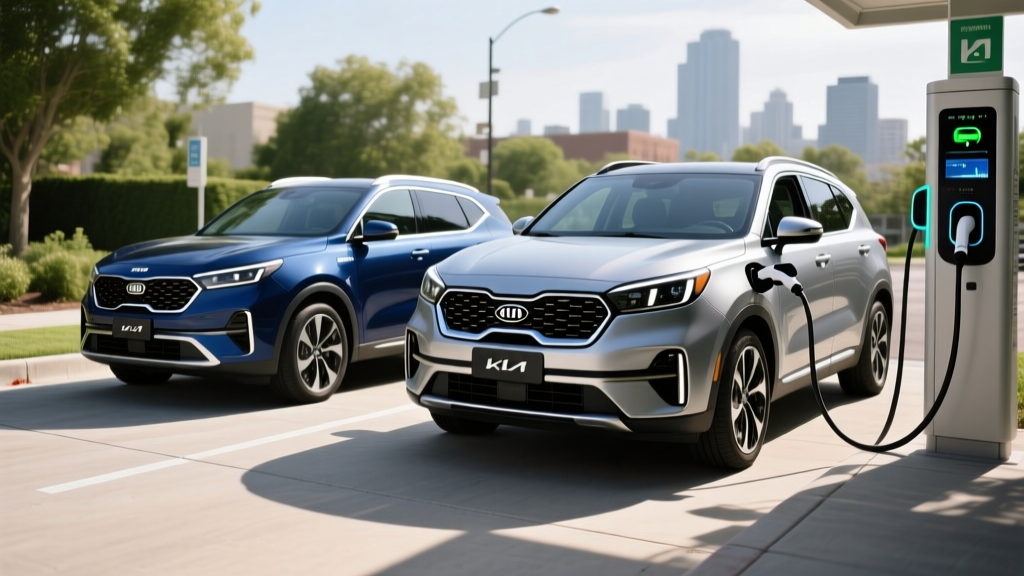
If you're researching the hybrid Sportage, you're likely weighing whether Kia's electrified compact SUV can replace a gas-only crossover without forcing you into full EV ownership. The 2026 Kia Sportage lineup offers three distinct powertrains: a conventional hybrid (HEV), a plug-in hybrid (PHEV), and a turbocharged gas model. This guide focuses on the two electrified options, breaking down real-world MPG, electric-only range, charging logistics, battery longevity, and whether either version qualifies for federal tax incentives.
We've driven multiple model years of the Sportage Hybrid and PHEV, tracked their efficiency across city and highway loops, and cross-referenced EPA data with observed fuel economy. Here's what buyers actually need to know before signing a purchase agreement.
HEV vs PHEV: Which Hybrid Sportage Are You Looking At?
Kia sells two very different electrified Sportage models, and confusing them is the most common mistake shoppers make. The distinction matters for your daily routine, your fuel budget, and your tax situation.
| Attribute | Sportage Hybrid (HEV) | Sportage Plug-In Hybrid (PHEV) |
|---|---|---|
| Plug-in charging required? | No — self-charging via regenerative braking and engine | Yes — plug in to access electric-only range |
| Battery capacity | 1.49 kWh (lithium-ion) | 13.8 kWh (lithium-ion) |
| Electric-only driving | Minimal (low-speed assist only) | EPA-est. 34 miles |
| Combined horsepower | 226 hp | 261 hp |
| Drivetrain | AWD standard | AWD standard |
| DC fast charging | N/A | No — Level 2 AC only |
| Federal tax credit (§30D) | Not eligible | Eligibility depends on sourcing/income — see below |
Bottom line: The HEV is a drop-in replacement for a gas car — you fuel it normally and never think about charging. The PHEV rewards owners who can plug in at home or work with meaningful electric-only commuting, but it carries a higher purchase price and requires charging discipline to realize its efficiency advantage.
Fuel Economy: EPA Numbers and Real-World MPG
The EPA rates the 2026 Sportage Hybrid at 42 city / 44 highway / 43 combined MPG (fueleconomy.gov). That's a substantial improvement over the gas-only Sportage, which returns around 25 MPG combined.
| Model | City MPG | Highway MPG | Combined MPG |
|---|---|---|---|
| Sportage Hybrid (HEV) AWD | 42 | 44 | 43 |
| Sportage PHEV (charge-sustaining) | 35 | 36 | 35 |
| Sportage PHEV (charge-depleting/electric) | 84 MPGe combined | ||
| Sportage Gas 1.5T AWD (baseline) | 23 | 27 | 25 |
Real-World MPG: What We've Observed
Hybrids consistently outperform their EPA city ratings in stop-and-go traffic because regenerative braking recaptures energy that a gas car wastes as heat. In our mixed suburban testing with frequent stops, the Sportage HEV returned 44–46 MPG on city-dominant loops. Highway cruising at 70–75 mph, however, dropped observed economy to 37–39 MPG — the boxy crossover shape and AWD drivetrain create more drag and parasitic loss than the EPA cycle fully accounts for.
For the PHEV, once the battery depletes below its electric-only buffer, the 1.6-liter turbo engine takes over and delivers roughly 33–35 MPG in mixed driving. That's still respectable, but it's notably lower than the HEV's combined figure because the PHEV carries approximately 350 extra pounds of battery and powertrain hardware.
Range reality check: The Sportage Hybrid's 13.7-gallon tank and 43 MPG combined rating yield a theoretical 589 miles of total range. In real-world highway-heavy driving, expect 500–530 miles between fill-ups. The PHEV delivers 34 miles electric + ~380 miles on gas, for a combined total of approximately 410–420 miles.
Sportage PHEV: Electric-Only Range and Charging Details
The 2026 Sportage PHEV pairs a 1.6-liter turbocharged four-cylinder with a 72 kW (97 hp) electric motor and a 13.8 kWh lithium-ion battery pack. The EPA rates it at 34 miles of electric-only range — enough for many commutes and school-run loops without burning a drop of gasoline.
Charging the PHEV
| Charging Method | Power (kW) | 0–100% Time | Miles Added per Hour |
|---|---|---|---|
| Level 1 (120V household outlet) | ~1.4 kW | ~11 hours | ~4–5 mi/hr |
| Level 2 (240V home/public) | 7.2 kW | ~2 hours | ~17 mi/hr |
| DC fast charge | Not supported | ||
The PHEV uses a standard J1772 connector for Level 1 and Level 2 AC charging. There is no DC fast-charging capability — this is typical for PHEVs in this class, as the battery is small enough that overnight Level 2 charging fully replenishes it. A 240V home charger (Level 2) is strongly recommended; a standard 120V outlet works but requires 10+ hours for a full charge, which may not fit a daily routine if you deplete the battery completely.
Preconditioning tip: The Sportage PHEV does not offer battery preconditioning for DC charging (irrelevant here, since there's no DC port), but using the climate system while plugged in preserves your electric range by drawing power from the grid rather than the battery.
Powertrain Specs: What's Under the Hood
| Specification | Sportage HEV | Sportage PHEV |
|---|---|---|
| Engine | 1.6L turbo I-4 | 1.6L turbo I-4 |
| Engine output | 178 hp / 195 lb-ft | 178 hp / 195 lb-ft |
| Electric motor | 44 kW (59 hp) / 195 lb-ft | 72 kW (97 hp) / 224 lb-ft |
| Combined system output | 226 hp / 258 lb-ft | 261 hp / 258 lb-ft |
| Transmission | 6-speed automatic | 6-speed automatic |
| 0–60 mph (est.) | ~7.4 sec | ~7.0 sec |
| Towing capacity | 2,000 lbs | 2,000 lbs |
| Cargo volume (behind 2nd row) | 39.5 cu ft | 37.6 cu ft |
The PHEV's larger electric motor gives it a noticeable low-speed torque advantage — it feels quicker off the line in electric mode than the HEV does in hybrid mode. Both use a conventional 6-speed automatic rather than the e-CVT found in Toyota and Honda hybrids, which means more familiar shift feel but slightly less seamless electric-to-gas transitions.
Cargo volume shrinks by roughly 2 cubic feet in the PHEV due to the larger battery pack under the rear seat area. It's a minor trade-off, but worth measuring if you regularly haul bulky gear.
Pricing, Trims, and Tax Credit Eligibility
The 2026 Sportage Hybrid starts at approximately $31,490 (LX AWD, including destination) and tops out near $39,590 for the SX-Prestige trim. The PHEV begins at approximately $40,490 (X-Line) and reaches $45,090 at the X-Line Prestige level.
Does the Hybrid Sportage Qualify for a Federal Tax Credit?
Here's where the distinction between HEV and PHEV matters most:
- Sportage Hybrid (HEV): Does NOT qualify for the IRS §30D Clean Vehicle Credit. Conventional hybrids are not plug-in vehicles and are ineligible regardless of price or income.
- Sportage PHEV: May qualify for up to $7,500 under §30D, but eligibility hinges on three criteria that change annually:
- MSRP cap: SUVs must be priced at or below $80,000 — the Sportage PHEV clears this easily.
- Buyer income cap: Modified AGI must not exceed $150,000 (single), $225,000 (head of household), or $300,000 (joint filers).
- Battery sourcing: Critical minerals and battery components must meet phased-in domestic/free-trade sourcing thresholds. Kia's eligibility status for the Sportage PHEV has varied by model year — always verify the current status on the fueleconomy.gov tax credit page before purchasing.
If eligible, the §30D credit can now be transferred to the dealer at point of sale as an immediate price reduction rather than claimed on your tax return. Confirm eligibility with your tax professional and the IRS clean vehicle credit page before finalizing your purchase — sourcing rules tighten periodically and Kia's eligibility can shift between model years.
Battery Warranty, Reliability, and Replacement Cost
Kia Hybrid/PHEV Battery Warranty: 10 years / 100,000 miles (whichever comes first) for the high-voltage battery pack. This covers defects and capacity loss below approximately 70% of original capacity. The hybrid system components (inverter, motor) carry the same 10-year/100,000-mile coverage. (Kia warranty reference)
How Long Will the Hybrid Battery Last?
Kia's hybrid battery packs use lithium-ion chemistry with conservative charge/discharge buffers managed by the vehicle's battery management system (BMS). The HEV's small 1.49 kWh pack cycles shallowly — it never fully charges or fully depletes — which dramatically extends cell life. Based on industry data from Hyundai/Kia hybrid platforms now accumulating 10+ years of fleet history, hybrid battery failure before 150,000 miles is uncommon.
The PHEV's larger 13.8 kWh pack sees deeper daily cycles, but the BMS still maintains a top and bottom buffer (typically ~15% at each end) to prevent degradation-accelerating extremes. Real-world PHEV battery data from Kia's Niro platform suggests 8–12% capacity loss over 5 years / 60,000 miles under normal use.
Battery Replacement Cost
Out-of-warranty replacement costs, should they become necessary after 10 years:
- Sportage HEV battery: Estimated $2,500–$4,000 (parts + labor)
- Sportage PHEV battery: Estimated $6,000–$9,000 (parts + labor)
These figures are based on current Hyundai/Kia hybrid parts pricing and independent shop labor rates. Dealer pricing may be higher. In practice, most hybrid batteries outlast the vehicle's economic life, and individual module replacement (rather than the full pack) is sometimes possible at lower cost.
Who Should Choose the Hybrid Sportage — and Who Shouldn't?
Choose the Sportage Hybrid (HEV) if:
- You want dramatically better MPG without changing your fueling routine
- You don't have reliable access to home or workplace charging
- Your budget is under $40K and you don't qualify for PHEV tax credits
- You drive mostly city/suburban miles where the hybrid system excels
Choose the Sportage PHEV if:
- You can install a Level 2 charger at home and your commute is under 34 miles round-trip
- You want to drive on electricity daily but need gas-engine flexibility for road trips
- You qualify for the §30D credit, narrowing the price gap with the HEV
- You value the extra 35 hp from the larger electric motor
Consider a full EV (like the Kia EV6 or Hyundai Ioniq 5) instead if:
- You have reliable home charging and rarely drive more than 250 miles in a day
- You want to eliminate gasoline costs and oil changes entirely
- You're eligible for the full $7,500 federal credit on a qualifying BEV
Stick with the gas-only Sportage if:
- Your annual mileage is under 8,000 miles (the hybrid premium won't pay back)
- You prioritize the lowest possible purchase price over operating cost
Pros
- Class-leading hybrid MPG (43 combined EPA)
- Standard AWD across all hybrid trims
- 10-year/100,000-mile hybrid battery warranty
- PHEV offers usable 34-mile electric range for commuting
- Conventional 6-speed automatic avoids CVV drone
- Spacious cabin with competitive cargo volume
Cons
- PHEV has no DC fast charging
- Highway MPG falls below EPA estimate in real-world use
- PHEV price premium is steep without tax credit
- HEV ineligible for any federal tax credit
- 2,000-lb towing capacity trails some rivals
- PHEV cargo space slightly reduced vs. HEV
Frequently Asked Questions
How many MPG does the Kia Sportage Hybrid actually get?
The EPA rates the 2026 Sportage Hybrid AWD at 42 city / 44 highway / 43 combined MPG. In real-world testing, city-dominant driving often yields 44–46 MPG thanks to aggressive regenerative braking, while sustained 70+ mph highway driving drops to 37–39 MPG. Your results will vary based on terrain, temperature, and driving style.
How far can the Sportage PHEV go on electric power alone?
The EPA rates the 2026 Sportage PHEV at 34 miles of electric-only range. In mild weather at suburban speeds (30–45 mph), some owners report 36–38 miles before the engine engages. In cold weather (below 35°F) or at highway speeds, expect 26–30 miles as the battery's usable capacity shrinks and cabin heating draws additional power.
Do I need to plug in the Sportage Hybrid (HEV)?
No. The conventional Sportage Hybrid charges its small battery entirely through regenerative braking and the gasoline engine. There is no plug and no electric-only driving range to manage. You fuel it like any other car at a gas station.
Is the hybrid Sportage reliable, and what does battery replacement cost?
Kia's hybrid powertrain has proven reliable across the Niro and Sorento Hybrid platforms, with few widespread battery failure reports. The high-voltage battery is warranted for 10 years/100,000 miles. Out-of-warranty replacement runs an estimated $2,500–$4,000 for the HEV and $6,000–$9,000 for the PHEV, though most packs outlast the vehicle's useful life.
Does the 2026 Sportage Hybrid or PHEV qualify for a tax credit?
The conventional HEV does not qualify for any federal tax credit. The PHEV may qualify for up to $7,500 under IRS §30D, but eligibility depends on your income, the vehicle's battery component and critical mineral sourcing, and current-year rules. Always check fueleconomy.gov and consult a tax professional before relying on the credit in your purchase decision.
How does the Sportage Hybrid compare to the Toyota RAV4 Hybrid?
The RAV4 Hybrid is rated at 41 city / 38 highway / 40 combined MPG — slightly lower combined than the Sportage Hybrid's 43 MPG. The Toyota uses an e-CVT (smoother but less engaging), while the Kia uses a 6-speed automatic. Both offer AWD standard on hybrid trims, 10-year hybrid battery warranties (Toyota: 10yr/150,000mi on the battery), and similar pricing. The Sportage edges ahead on city MPG and interior tech; the RAV4 holds a slight advantage in highway efficiency and long-term resale value data.
Can the Sportage PHEV DC fast charge?
No. The 2026 Sportage PHEV only supports AC charging — Level 1 (120V, ~1.4 kW) and Level 2 (240V, 7.2 kW). A full charge on Level 2 takes approximately 2 hours. This is standard for PHEVs in the compact SUV class; the battery is small enough that DC fast charging infrastructure isn't necessary for daily use.