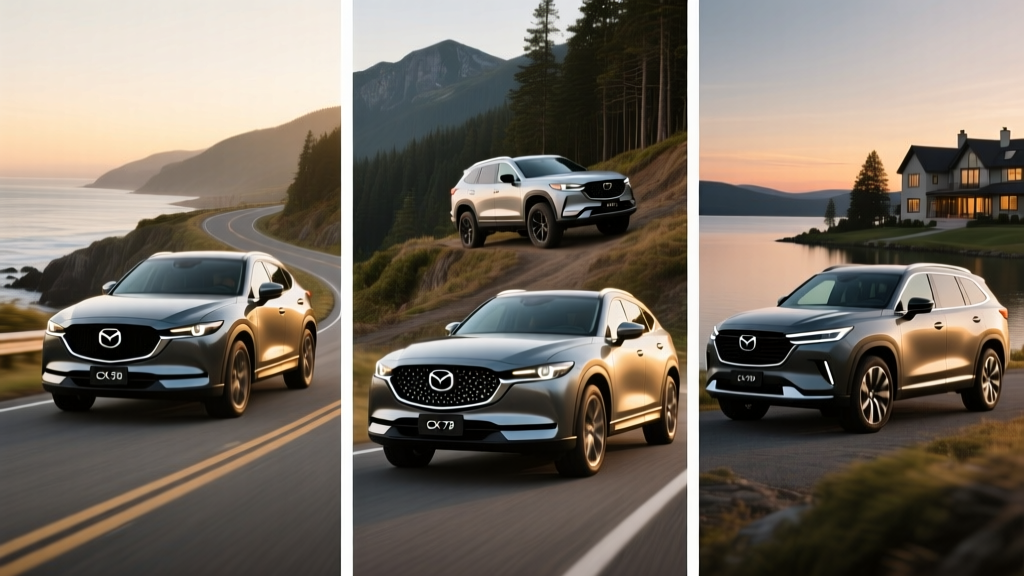
Mazda has taken a deliberate path into electrification, offering a mix of conventional hybrids (HEVs) developed with Toyota and plug-in hybrids (PHEVs) built on its own rear-biased architecture. If you're shopping Mazda hybrid SUVs in 2026, the lineup spans three distinct vehicles: the compact CX-50 Hybrid, the two-row CX-70 PHEV, and the three-row CX-90 PHEV. Each serves a different buyer — and confusing them is easy if you don't know the difference between a self-charging hybrid and one you plug in.
This guide breaks down every Mazda hybrid SUV currently on sale with exact EPA figures, battery specs, real-world expectations, pricing, and tax-credit eligibility so you can match the right model to your driving pattern.
HEV vs PHEV: What Mazda Actually Offers
Before comparing models, the distinction matters for your wallet and your routine:
Conventional Hybrid (HEV) — CX-50 Hybrid
- No plug required — the gas engine and regenerative braking recharge a small battery
- Smaller battery (~1.6 kWh) — purely an efficiency assist
- No electric-only driving beyond very low-speed creep
- No federal tax credit eligibility
- Lower upfront cost, higher fuel economy than gas equivalent
Plug-In Hybrid (PHEV) — CX-70 & CX-90 PHEV
- Plugs into a wall outlet or Level 2 charger to fill a larger battery
- 17.8 kWh battery pack delivers 26–28 miles of pure electric driving
- Gas engine kicks in seamlessly once battery depletes
- Potential federal tax credit (up to $3,750) if sourcing rules are met
- Higher MSRP, but daily commutes can run on electricity alone
If you can charge at home and your commute is under 30 miles round-trip, a PHEV lets you drive electric most weekdays while keeping gas capability for road trips. If you lack home charging access, the CX-50 HEV delivers strong MPG without any lifestyle change.
2026 Mazda CX-50 Hybrid: Compact Efficiency
The CX-50 Hybrid pairs Mazda's outdoorsy compact SUV with Toyota's proven fourth-generation hybrid system — the same architecture underpinning the RAV4 Hybrid. It's Mazda's only conventional hybrid SUV and the most affordable entry point.
| Spec | 2026 CX-50 Hybrid |
|---|---|
| Powertrain | 2.5L 4-cyl + 2 electric motors (AWD) |
| Combined HP | 219 hp |
| Battery | ~1.6 kWh NiMH (self-charging) |
| EPA MPG (City / Hwy / Combined) | 39 / 34 / 38 |
| 0-60 mph | ~7.5 sec |
| Towing Capacity | 1,500 lb |
| Base MSRP | $35,395 (Preferred Hybrid) |
| Battery Warranty | 8 years / 100,000 miles |
Real-World MPG: What to Actually Expect
The EPA rates the CX-50 Hybrid at 38 MPG combined, but Toyota-derived hybrid systems tend to exceed their city rating in stop-and-go traffic thanks to aggressive regenerative braking and engine-off coasting. Expect 38–42 MPG in city and suburban driving. Highway cruising at 75+ MPH will dip to 31–33 MPG because the boxy, rugged styling creates more aerodynamic drag than a RAV4. On a mixed 400-mile road trip, plan for roughly 35–36 MPG actual.
2026 Mazda CX-70 PHEV: Two-Row Plug-In Power
The CX-70 is Mazda's two-row midsize SUV, and the PHEV variant is the performance flagship of the hybrid lineup. It shares its inline-six-based architecture with the CX-90 but sacrifices the third row for a sportier profile and slightly more cargo room behind the second row.
| Spec | 2026 CX-70 PHEV |
|---|---|
| Powertrain | 2.5L 4-cyl PHEV + electric motor (AWD) |
| Combined HP | 323 hp / 369 lb-ft torque |
| Battery | 17.8 kWh lithium-ion |
| EPA Electric-Only Range | 26 miles |
| Total Combined Range | ~430 miles |
| EPA MPGe (EV mode) | 56 MPGe |
| EPA MPG (gas-only, combined) | 25 MPG |
| Level 2 Charge Time (0-100%) | ~2.5 hours at 7.2 kW |
| DC Fast Charging | Not available |
| 0-60 mph | ~5.8 sec |
| Base MSRP | $55,895 (Preferred Plus PHEV) |
| Battery Warranty | 8 years / 100,000 miles |
The 26-mile electric range covers most commutes. Charge overnight on a standard 120V outlet (Level 1) in about 7–8 hours, or install a Level 2 home charger for a full replenishment in roughly 2.5 hours. The absence of DC fast charging is typical for PHEVs — the battery is too small to justify the hardware cost and weight.
2026 Mazda CX-90 PHEV: Three-Row Family Plug-In
The CX-90 PHEV extends the same powertrain into Mazda's largest SUV, adding a third row for up to seven passengers. It's aimed at families who want electric weekday commuting without giving up road-trip flexibility.
| Spec | 2026 CX-90 PHEV |
|---|---|
| Powertrain | 2.5L 4-cyl PHEV + electric motor (AWD) |
| Combined HP | 323 hp / 369 lb-ft torque |
| Battery | 17.8 kWh lithium-ion |
| EPA Electric-Only Range | 26 miles |
| Total Combined Range | ~420 miles |
| EPA MPGe (EV mode) | 56 MPGe |
| EPA MPG (gas-only, combined) | 25 MPG |
| Level 2 Charge Time (0-100%) | ~2.5 hours at 7.2 kW |
| DC Fast Charging | Not available |
| 0-60 mph | ~6.1 sec |
| Base MSRP | $51,495 (Preferred Plus PHEV) |
| Battery Warranty | 8 years / 100,000 miles |
According to fueleconomy.gov, the CX-90 PHEV achieves 56 MPGe in electric mode and 25 MPG combined once the battery is depleted. The heavier three-row body doesn't significantly hurt electric range because the battery and motor are identical to the CX-70's.
Fuel Economy Comparison: All Mazda Hybrid SUVs
| Model | Type | City MPG | Highway MPG | Combined MPG | EV Range (mi) | MPGe (EV) |
|---|---|---|---|---|---|---|
| CX-50 Hybrid | HEV | 39 | 34 | 38 | — | — |
| CX-70 PHEV | PHEV | 25* | 25* | 25* | 26 | 56 |
| CX-90 PHEV | PHEV | 25* | 25* | 25* | 26 | 56 |
* Gas-only MPG after battery depletion. In EV mode, these PHEVs use no gasoline.
Battery Longevity: What Mazda Covers
All three Mazda hybrid SUVs carry an 8-year / 100,000-mile hybrid battery warranty (10 years in California and states adopting CARB emissions standards). This covers defects and capacity loss below a manufacturer-defined threshold — typically 60–70% of original capacity. Toyota-sourced hybrid batteries in the CX-50 have an extensive real-world track record; replacement costs for out-of-warranty NiMH packs run $2,000–$3,500. The CX-70/CX-90 lithium-ion PHEV batteries are newer to market, and replacement estimates range from $6,000–$9,000 based on comparable PHEV platforms, though failures within the warranty period are rare.
Pricing, Trims & Tax Credit Eligibility
Here's what each Mazda hybrid SUV costs before incentives:
- CX-50 Hybrid: $35,395 – $41,720 (Preferred to Premium Plus)
- CX-70 PHEV: $55,895 – $61,895 (Preferred Plus to Premium Plus)
- CX-90 PHEV: $51,495 – $61,450 (Preferred Plus to Premium Plus)
Federal Tax Credit (§30D) — PHEVs Only
The CX-50 Hybrid, as a conventional hybrid, does not qualify for any federal EV tax credit. The CX-70 PHEV and CX-90 PHEV may qualify for a partial or full credit under IRS §30D rules, but eligibility depends on several factors that change frequently:
- MSRP cap: SUVs must be under $80,000 — all Mazda PHEV trims qualify
- Buyer income cap: AGI must not exceed $150K (single) / $300K (joint)
- Battery sourcing: Critical minerals and battery components must meet phased-in domestic/free-trade sourcing thresholds — this requirement tightens annually and may reduce or eliminate credit for some model years
- Point-of-sale transfer: Buyers can transfer the credit to the dealer for an immediate price reduction, or claim it on their tax return
As of early 2026, the Mazda PHEVs have been eligible for up to $3,750 (meeting one of the two sourcing thresholds). Verify current eligibility on the IRS clean vehicle credit page and with your dealer before purchase, as battery-component sourcing rules tighten each year.
Hybrid vs PHEV vs Full EV: Which Mazda Fits You?
Mazda's lineup doesn't include a fully electric SUV in the US as of 2026 (the MX-30 EV was discontinued), so the choice is between their hybrid options and competitors' BEVs. Here's a decision framework:
Choose the CX-50 Hybrid (HEV) if:
- You have no access to home or workplace charging
- You want maximum MPG with zero behavior change
- Your budget is under $42K
- You primarily drive in city/suburban traffic where hybrids shine
Choose the CX-70 or CX-90 PHEV if:
- You can install a Level 2 charger at home
- Your daily commute is under 26 miles round-trip
- You want EV-like weekday driving with gas freedom for weekend trips
- You need 323 hp and premium performance without full-EV pricing
Look at a full EV (e.g., Tesla Model Y, Hyundai Ioniq 5) instead if:
- You drive more than 50 miles daily and want to avoid gas entirely
- You have reliable home charging and access to DC fast chargers for road trips
- You want lower per-mile fuel costs (electricity at $0.13/kWh ≈ $0.04/mile vs. gas at ~$0.12/mile for the PHEV in gas mode)
Reliability & Long-Term Ownership
Mazda's conventional vehicles consistently earn strong reliability marks from Consumer Reports and J.D. Power. The CX-50 Hybrid benefits from Toyota's hybrid system, which has over two decades of proven durability — taxi fleets routinely log 300,000+ miles on original hybrid batteries. The PHEV powertrain in the CX-70 and CX-90 is newer (introduced for the 2024 model year), so long-term data is still accumulating, but the 2.5L four-cylinder is a well-known Mazda engine and the electric motor adds minimal mechanical complexity.
For the PHEVs, plan to charge nightly on Level 1 (120V) for a full morning battery, or invest in a Level 2 home station (~$500–$1,200 installed) for faster turnaround. The 17.8 kWh battery is small enough that even a standard outlet replenishes it overnight — a genuine advantage over full EVs that require dedicated 240V circuits.
Pros
- CX-50 Hybrid achieves nearly 40 MPG with no plug required
- PHEVs offer 26 mi electric range — enough for most commutes
- 323 hp PHEV powertrain is genuinely quick (sub-6-sec 0-60)
- Premium interiors rival European competitors at lower prices
- Standard AWD across all hybrid models
- 8-year/100,000-mi battery warranty across the board
Cons
- No DC fast charging on PHEVs (expected for the class)
- PHEV gas-only MPG (25 combined) is mediocre for the segment
- CX-70/CX-90 PHEV pricing starts above $51K
- CX-50 Hybrid towing limited to 1,500 lb (vs. 3,500 lb for turbo gas models)
- No full-EV Mazda SUV option in the US for 2026
- PHEV cargo space slightly reduced by battery placement
Frequently Asked Questions
How many MPG do Mazda hybrid SUVs get?
The CX-50 Hybrid achieves an EPA-rated 38 MPG combined (39 city / 34 highway). The CX-70 and CX-90 PHEVs get 25 MPG combined in gas-only mode after the battery is depleted, but deliver 56 MPGe when operating on electric power. In real-world city driving, the CX-50 Hybrid often exceeds its EPA rating, reaching 40+ MPG in stop-and-go traffic.
How far can the Mazda PHEV SUVs drive on electric only?
Both the CX-70 PHEV and CX-90 PHEV are EPA-rated for 26 miles of electric-only range. In mild weather at city speeds, expect 27–30 miles. In cold weather (below 32°F) or at sustained highway speeds, that drops to roughly 20–22 miles due to battery chemistry limitations and increased energy demand for cabin heating.
Do Mazda hybrid SUVs need to be plugged in?
Only the PHEV models (CX-70 and CX-90) benefit from plugging in. The CX-50 Hybrid is a conventional HEV — it charges its own battery through the gas engine and regenerative braking. You never plug it in, and you'll never see an electric-only range figure for it.
Are Mazda hybrid SUVs reliable? What does a battery replacement cost?
Mazda's hybrid components carry an 8-year/100,000-mile warranty (10 years in CARB states). The CX-50 Hybrid uses Toyota's proven hybrid system with an outstanding long-term track record; out-of-warranty NiMH battery replacement runs $2,000–$3,500. The PHEV lithium-ion battery is newer to market, with estimated replacement costs of $6,000–$9,000, though premature failures are uncommon.
Do Mazda hybrid SUVs qualify for a federal tax credit?
The CX-50 Hybrid does not qualify for any federal tax credit — it's a conventional hybrid, not a plug-in. The CX-70 PHEV and CX-90 PHEV may qualify for up to $3,750 under IRS §30D, depending on battery-sourcing requirements, buyer income limits ($300K joint / $150K single), and the vehicle's MSRP (must be under $80K for SUVs). Always confirm current eligibility at irs.gov before purchasing.
Can I charge the Mazda PHEV on a regular household outlet?
Yes. The 17.8 kWh battery charges from empty to full in approximately 7–8 hours on a standard 120V (Level 1) outlet. A Level 2 (240V) home charger reduces that to about 2.5 hours at 7.2 kW. DC fast charging is not supported, which is standard for PHEVs in this class.