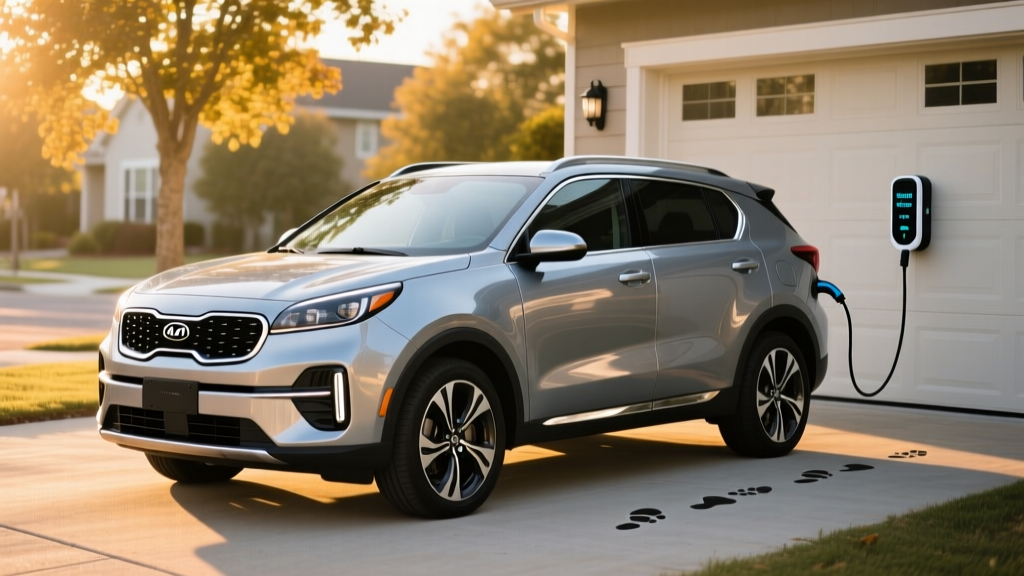
The midsize hybrid SUV segment is crowded, but the 2026 Kia Sportage Hybrid EX continues to stand out by pairing strong fuel economy with a practical cabin and a competitive starting price. For buyers weighing a hybrid against a plug-in hybrid or a full battery-electric vehicle, the Sportage HEV occupies a compelling middle ground: no charging cord required, meaningful fuel savings over a gas-only model, and none of the range anxiety that accompanies pure EVs on long road trips.
This guide breaks down everything you need to know about the Sportage Hybrid EX — EPA fuel economy, real-world MPG observations, powertrain specs, pricing, tax credit eligibility, battery warranty, and how it stacks up against the Sportage PHEV and rival hybrids.
HEV vs. PHEV: Which Sportage Hybrid Is Right for You?
Kia sells two electrified versions of the Sportage, and the distinction matters. The Sportage Hybrid (HEV) is a conventional hybrid — it uses a small battery charged by the engine and regenerative braking. You never plug it in. The Sportage Plug-In Hybrid (PHEV) carries a much larger battery that you charge from a wall outlet or public charger, enabling roughly 34 miles of electric-only driving before the gas engine kicks in.
| Feature | Sportage Hybrid (HEV) | Sportage Plug-In Hybrid (PHEV) |
|---|---|---|
| Plug-in charging required? | No — self-charging via engine + regen | Yes — Level 1 or Level 2 |
| EPA combined MPG / MPGe | 38 MPG combined (FWD) | 84 MPGe (elec+gas) / 35 MPG (gas only) |
| Electric-only range | N/A | ~34 miles |
| Battery capacity | ~1.49 kWh (small buffer) | 13.8 kWh usable |
| Combined horsepower | 231 hp | 268 hp |
| Starting MSRP (approx.) | ~$32,690 (LX) | ~$40,490 (X-Line) |
| Federal tax credit (§30D) | Not eligible | Not eligible (PHEV battery <16 kWh for full credit under current sourcing rules; verify with IRS) |
If you don't have access to home or workplace charging, the HEV is the clear choice — it delivers strong efficiency with zero lifestyle change. If you can charge nightly and most of your daily driving is under 30 miles, the PHEV lets you commute on electricity alone while keeping a gas engine for weekend road trips.
Fuel Economy: EPA Ratings and Real-World MPG
The 2026 Sportage Hybrid's EPA fuel economy ratings vary by drivetrain. Here's the breakdown, sourced from fueleconomy.gov:
| Drivetrain | City MPG | Highway MPG | Combined MPG |
|---|---|---|---|
| FWD (EX, LX, SX) | 42 | 44 | 43 |
| AWD (EX AWD, SX-Prestige) | 38 | 38 | 38 |
Real-World MPG: What to Actually Expect
Hybrids tend to exceed their EPA city estimates because regenerative braking recaptures energy in stop-and-go traffic — the exact scenario where gas cars waste the most fuel. In mixed suburban driving with moderate temperatures, owners frequently report 40–45 MPG in the FWD model.
However, highway-heavy driving at 75–80 mph can pull the FWD model down to 36–39 MPG, since the aerodynamic penalty of an SUV shape is more pronounced at higher speeds and regen opportunities are fewer. AWD models typically land 2–4 MPG below the FWD in real-world use. Cold weather (below 32°F) can reduce efficiency by 5–10% as the engine runs longer to heat the cabin and the battery's charge/discharge efficiency drops.
Powertrain and Performance Specs
The Sportage Hybrid pairs a 1.6-liter turbocharged four-cylinder engine with a 47.7 kW (64 hp) electric motor, routed through a 6-speed automatic transmission. Total system output is 231 horsepower and 258 lb-ft of torque. That's a meaningful step up from many rival hybrids and gives the Sportage confident highway merging and passing power.
| Specification | 2026 Sportage Hybrid |
|---|---|
| Engine | 1.6L turbocharged I-4 |
| Electric motor | 47.7 kW (64 hp) |
| Combined output | 231 hp / 258 lb-ft |
| Transmission | 6-speed automatic |
| Drivetrain | FWD or AWD |
| 0–60 mph (est.) | ~7.3 seconds (FWD) |
| Towing capacity | 2,000 lbs |
| Cargo volume (behind rear seats) | 39.5 cu ft |
| Cargo volume (seats folded) | 73.7 cu ft |
The AWD system is an electronically controlled coupling type — it sends torque rearward when slip is detected. It's adequate for rain, light snow, and gravel roads, but it's not a dedicated off-road system. If you need serious all-weather traction, consider the Sportage X-Pro gas trim or a different platform entirely.
Pricing, Trims, and Tax Credit Eligibility
The 2026 Sportage Hybrid is available in several trims. Pricing below reflects approximate MSRPs including destination charge:
- LX (FWD): ~$32,690
- EX (FWD): ~$34,290
- EX (AWD): ~$35,790
- SX-Prestige (AWD): ~$39,090
Federal Tax Credit: Does the Sportage Hybrid Qualify?
No. The conventional Sportage Hybrid (HEV) does not qualify for the federal §30D Clean Vehicle Credit. That credit applies only to plug-in electric vehicles (BEVs and qualifying PHEVs) that meet battery sourcing, MSRP caps, and buyer income limits set by the IRS. Since the HEV has no plug and a battery far too small to meet the 7 kWh minimum threshold, it's ineligible.
Some states offer their own hybrid purchase incentives or reduced registration fees — check your state's energy office or department of revenue for current programs. These vary widely and change frequently, so always verify with official state sources.
For the Sportage PHEV, federal credit eligibility is complicated under current §30D rules. The PHEV's 13.8 kWh battery and critical-mineral/battery-component sourcing requirements may limit or eliminate the credit. Consult the IRS Clean Vehicle Credit page and a tax professional before counting on any credit amount.
Battery Warranty, Reliability, and Replacement Cost
Hybrid battery longevity is the number-one concern for first-time hybrid buyers. Here's the reality: modern hybrid batteries rarely fail prematurely, and Kia backs the Sportage Hybrid's battery with one of the best warranties in the industry.
- 10 years / 100,000 miles (original owner, powertrain + hybrid battery)
- 5 years / 60,000 miles (subsequent owners, in most states)
- California and states adopting CARB emissions rules: 10 years / 150,000 miles for hybrid/emissions components
The Sportage Hybrid's ~1.49 kWh lithium-ion battery is small and operates within a narrow state-of-charge window — the hybrid system never fully charges or fully depletes it, which dramatically reduces degradation stress. This is fundamentally different from a full EV battery that cycles through a wider range daily.
What Does Replacement Cost?
If the hybrid battery does need replacement outside of warranty, expect a dealer-installed unit to cost between $2,500 and $4,500 including labor. Independent hybrid specialists may offer refurbished units for less. However, given Kia's 10-year/100,000-mile coverage and the proven durability of small hybrid batteries, most owners will never face this expense. Data from long-running Kia and Hyundai hybrid models (Niro, Tucson, Sonata) shows battery failure rates well under 5% within the warranty period.
For general reliability, the Sportage Hybrid carries over the conventional powertrain architecture Kia has refined since the 2023 model-year redesign. The 1.6L turbo engine and 6-speed automatic are shared across multiple Kia/Hyundai models with no widespread failure patterns reported by NHTSA or major reliability surveys as of early 2026.
Sportage Hybrid EX vs. the Competition
The Sportage Hybrid EX competes directly with the Toyota RAV4 Hybrid, Honda CR-V Hybrid, and Hyundai Tucson Hybrid. Here's how the key numbers compare:
| Model (AWD) | Combined MPG | Horsepower | Starting MSRP (AWD hybrid) | Cargo (cu ft) |
|---|---|---|---|---|
| Kia Sportage Hybrid EX AWD | 38 | 231 | ~$35,790 | 39.5 |
| Toyota RAV4 Hybrid XLE AWD | 39 | 219 | ~$35,525 | 37.5 |
| Honda CR-V Hybrid Sport AWD | 37 | 204 | ~$36,350 | 36.3 |
| Hyundai Tucson Hybrid SEL AWD | 37 | 231 | ~$35,275 | 38.7 |
The Sportage Hybrid leads in horsepower and cargo space, ties the Tucson Hybrid (its corporate cousin), and trails the RAV4 Hybrid by 1 MPG combined. The RAV4's slight efficiency edge comes from its CVT-based hybrid system, which is optimized for low-rpm cruising but feels less engaging than the Sportage's 6-speed automatic. If driving feel matters to you, the Kia/Hyundai powertrain is the more satisfying choice.
Who Should Buy the Sportage Hybrid EX — and Who Shouldn't?
Choose the Sportage Hybrid EX if:
- You want 38+ MPG combined without ever plugging in
- You need AWD for snow/rain but don't want a truck-based SUV
- You value cargo space (39.5 cu ft beats most rivals)
- You want strong acceleration (231 hp) for highway merging
- You plan to own the vehicle 8–10+ years (Kia's warranty coverage)
- You take frequent long road trips where EV charging infrastructure is sparse
Look elsewhere if:
- You can charge at home and want pure-electric commuting (consider the Sportage PHEV or a BEV)
- You want the absolute highest MPG — the RAV4 Hybrid AWD edges it by 1 MPG
- You're hoping for a federal tax credit (HEVs don't qualify under §30D)
- You need more than 2,000 lbs towing capacity
- You prefer a CVT's seamless feel over a stepped automatic
- No home charging + long commutes? → Sportage Hybrid HEV (this vehicle)
- Home charging + short daily commute + road trips? → Sportage PHEV (34 mi electric-only, then gas)
- Home charging + mostly under 250 mi/day + want lowest running cost? → Full BEV (e.g., EV6, Ioniq 5)
- Budget under $30K + short commute? → Gas-only Sportage or a used hybrid
Frequently Asked Questions
How many MPG does the 2026 Kia Sportage Hybrid EX get?
The FWD Sportage Hybrid is EPA-rated at 42 city / 44 highway / 43 combined MPG. The AWD EX model is rated at 38 city / 38 highway / 38 combined. In real-world suburban driving, FWD owners commonly see 40–45 MPG; AWD owners typically see 35–40 MPG depending on driving style and climate.
Does the Sportage Hybrid need to be plugged in?
No. The Sportage Hybrid (HEV) is a self-charging conventional hybrid. Its small battery is charged by the gasoline engine and by regenerative braking during deceleration. You simply fill it with gas like any other car. If you want plug-in capability, look at the separate Sportage PHEV model.
Is the Sportage Hybrid reliable?
Kia's 1.6L turbo hybrid powertrain has been in production since 2023 across multiple models (Sportage, Tucson, Sorento) with no widespread failure patterns reported by NHTSA or owner forums. The hybrid battery is covered for 10 years/100,000 miles. As with any turbocharged engine, following the manufacturer's oil-change intervals is important for long-term durability.
What is the hybrid battery replacement cost?
Out-of-warranty replacement runs approximately $2,500–$4,500 at a Kia dealer, including labor. However, the 10-year/100,000-mile warranty covers the vast majority of ownership periods, and small hybrid batteries have very low failure rates due to their shallow cycling design.
Does the Kia Sportage Hybrid qualify for any tax credit?
The conventional Sportage Hybrid (HEV) does not qualify for the federal §30D Clean Vehicle Credit, which requires plug-in capability and minimum battery capacity. Some states offer separate hybrid incentives — check your state energy office for current programs. The Sportage PHEV may qualify for partial federal credit depending on battery sourcing rules; verify current eligibility on irs.gov.
How does the Sportage Hybrid compare to a full EV?
A BEV like the Kia EV6 offers lower per-mile energy costs (~$0.04/mi on home electricity vs ~$0.08/mi on gas for the hybrid), zero tailpipe emissions, and minimal maintenance. However, a BEV requires home charging access, costs $10,000–$15,000 more upfront, and adds planning complexity on road trips over 250 miles. The Sportage Hybrid is the pragmatic choice if charging access is uncertain or if you regularly drive in areas with sparse DC fast-charging infrastructure.
What's the difference between the Sportage Hybrid EX and SX-Prestige?
The EX trim includes synthetic leather seats, a 12.3-inch infotainment display, wireless Apple CarPlay/Android Auto, heated front seats, and Kia's full suite of ADAS features (forward collision avoidance, lane keeping, adaptive cruise). The SX-Prestige adds a panoramic sunroof, ventilated front seats, heated steering wheel, Harman Kardon audio, and a hands-free power liftgate. Both use the identical 231 hp hybrid powertrain.