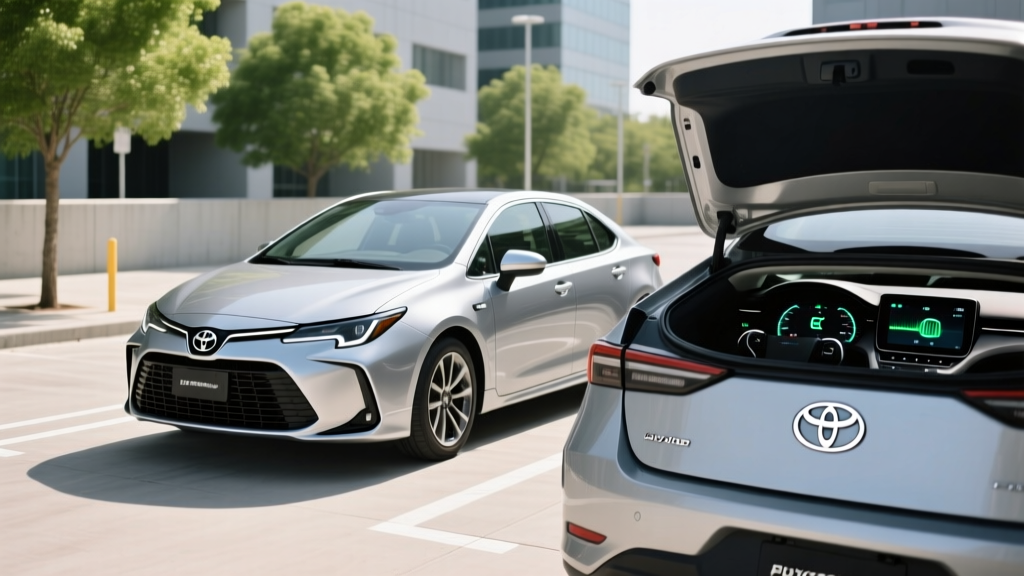
The Toyota Corolla Hybrid occupies a specific lane in the electrified-car market: maximum fuel efficiency with zero lifestyle change. You never plug it in, never hunt for a charger, and never worry about range. For 2026, Toyota continues to refine this formula with its fifth-generation hybrid system, all-wheel-drive availability, and a starting price that undercuts most compact competitors. But with 138 combined horsepower, the question buyers ask is whether that output is enough — and how the Corolla Hybrid stacks up against plug-in hybrids and full EVs on cost, efficiency, and daily usability.
This guide breaks down the 2026 Corolla Hybrid's powertrain specs, real-world fuel economy, battery longevity, and ownership economics so you can decide if it's the right electrified vehicle for your commute.
Corolla Hybrid Horsepower and Powertrain Specs
The 2026 Toyota Corolla Hybrid pairs a 1.8-liter four-cylinder Atkinson-cycle gasoline engine with Toyota's latest hybrid transaxle. Here is how the powertrain breaks down:
| Specification | 2026 Corolla Hybrid (FWD) | 2026 Corolla Hybrid (AWD) |
|---|---|---|
| Gas Engine | 1.8L 4-cyl Atkinson-cycle | 1.8L 4-cyl Atkinson-cycle |
| Gas Engine Output | 97 hp / 105 lb-ft torque | 97 hp / 105 lb-ft torque |
| Front Electric Motor | 83 hp / 155 lb-ft torque | 83 hp / 155 lb-ft torque |
| Rear Electric Motor (AWD) | N/A | 41 hp / 52 lb-ft torque |
| Combined Net Horsepower | 138 hp | 138 hp |
| Transmission | eCVT (planetary gearset) | eCVT (planetary gearset) |
| 0–60 mph | ~9.0 seconds | ~9.3 seconds |
| Hybrid Battery | ~1.0 kWh lithium-ion | ~1.0 kWh lithium-ion |
The 138 combined horsepower figure is a net system output — it reflects the maximum combined power the engine and motor(s) can deliver simultaneously, not a simple addition of the two. Toyota's hybrid synergy drive uses a planetary gearset rather than a traditional belt-and-pulley CVT, meaning there are no fixed gear ratios and no rubber band effect. Power delivery is seamless, if unhurried.
The AWD variant adds a dedicated rear-mounted electric motor that activates during acceleration from stop, low-traction conditions, and cornering. It does not provide full-time all-wheel drive but engages frequently enough to improve confidence in rain and light snow. The trade-off is a slight reduction in fuel economy — covered below.
EPA Fuel Economy and Real-World MPG
The Corolla Hybrid's headline number is its EPA-rated efficiency. Here is the official breakdown from fueleconomy.gov:
| Drivetrain | City MPG | Highway MPG | Combined MPG |
|---|---|---|---|
| FWD (LE) | 53 | 46 | 50 |
| AWD (LE / SE) | 51 | 44 | 48 |
Those numbers are outstanding for a compact sedan, but real-world results often tell a more nuanced story — and in the Corolla Hybrid's case, usually a better one.
Real-World MPG vs. EPA Estimates
Conventional hybrids like the Corolla Hybrid frequently exceed their EPA city ratings in actual driving. The reason is physics: the EPA city cycle includes idle time and low-speed stop-and-go, conditions where the Corolla's hybrid system excels by running on battery power at stops and low speeds, recapturing energy through regenerative braking, and shutting off the gas engine entirely when it isn't needed.
In mixed urban and suburban driving, owners commonly report 52–56 MPG in warm weather. Highway driving at sustained 70–75 mph yields closer to 42–45 MPG — slightly below the EPA highway sticker — because the gasoline engine carries the full load at constant speed with less regenerative benefit.
Cold weather impacts the Corolla Hybrid less severely than a full EV, but you should expect a 5–10% efficiency drop in freezing temperatures. The engine runs more frequently to provide cabin heat and maintain battery temperature, reducing electric-only operation at low speeds.
HEV vs. PHEV vs. EV: Which Fits Your Life?
The Corolla Hybrid is a conventional hybrid (HEV) — it generates all its own electricity through the gasoline engine and regenerative braking. You never plug it in. This distinguishes it from plug-in hybrids and full battery electric vehicles in important ways.
| Factor | Corolla Hybrid (HEV) | Typical PHEV (e.g., Prius Prime) | Full EV (e.g., Tesla Model 3) |
|---|---|---|---|
| Plug-in Required? | No | Yes (for full benefit) | Yes |
| Electric-Only Range | ~1 mile at low speed | 35–44 miles | 250–350+ miles |
| Total Range | ~550 miles | ~580 miles (combined) | 250–350 miles |
| Fuel/Charging Cost (per mile) | ~$0.07 (at $3.50/gal) | ~$0.04 electric / $0.08 gas | ~$0.04 (home charging) |
| Home Charging Setup | None needed | Level 2 recommended | Level 2 strongly recommended |
| Federal Tax Credit (§30D) | Not eligible | Up to $7,500 (if qualified) | Up to $7,500 (if qualified) |
| Best For | No charging access, long commutes | Short daily commute + home charging | Home charging + moderate daily miles |
The Corolla Hybrid makes the most sense for buyers who want EV-like city efficiency without any charging infrastructure. If you have a garage and a short commute (under 40 miles round-trip), a PHEV like the Toyota Prius Prime can cover your daily driving on electricity alone — then switch to hybrid mode for road trips. A full EV offers the lowest per-mile operating cost but requires reliable home or workplace charging.
Does the Corolla Hybrid Qualify for Any Tax Credit?
The conventional Corolla Hybrid does not qualify for the federal §30D Clean Vehicle Credit. That credit applies only to plug-in vehicles (PHEVs and BEVs) meeting battery-sourcing, MSRP, and buyer income requirements.
However, the Corolla Hybrid's lower purchase price partially offsets the lack of a tax credit. At roughly $24,000 MSRP, it costs $4,000–$8,000 less than many qualifying PHEVs and EVs — meaning you start saving from day one without navigating IRS eligibility rules.
Pricing, Trims, and Value
The 2026 Toyota Corolla Hybrid is available in several trims, all built on the LE-grade hybrid powertrain:
- Corolla Hybrid LE (FWD): ~$24,025 MSRP — base trim with 8-inch touchscreen, wireless Apple CarPlay/Android Auto, Toyota Safety Sense 3.0
- Corolla Hybrid LE (AWD): ~$25,425 MSRP — adds rear electric motor for all-wheel traction
- Corolla Hybrid SE (AWD): ~$27,625 MSRP — sport-tuned suspension, 18-inch alloy wheels, paddle shifters, smart key
- Corolla Hybrid XLE (FWD): ~$28,425 MSRP — SofTex seats, 10.5-inch display, wireless charging, ambient lighting
Destination charges add approximately $1,095. All trims include Toyota Safety Sense 3.0 as standard: pre-collision braking with pedestrian detection, full-speed adaptive cruise control, lane departure alert with steering assist, lane tracing assist, and automatic high beams.
Battery Longevity, Warranty, and Replacement Cost
Battery durability is consistently the top concern among first-time hybrid buyers. The Corolla Hybrid uses a relatively small lithium-ion hybrid battery pack (~1.0 kWh) located under the rear seat. Because it is a conventional hybrid, the battery operates within a narrow state-of-charge window (roughly 40–80%), which significantly reduces degradation stress compared to full EVs that regularly cycle between 10% and 90%+.
Toyota Hybrid Battery Warranty: 10 years / 150,000 miles (whichever comes first), covering defects and capacity loss below a functional threshold. This applies nationwide and is transferable to subsequent owners.
In practice, Toyota's hybrid battery packs have demonstrated exceptional longevity. Data from fleet operators and long-term owners shows that many Prius and Corolla Hybrid battery packs exceed 200,000 miles without significant capacity loss. The narrow SoC window, active thermal management, and conservative charge/discharge rates all contribute to this durability.
Battery Replacement Cost
If a hybrid battery does fail outside warranty, replacement costs for the Corolla Hybrid typically range from $2,000 to $4,000 for a new OEM battery pack, including labor. Refurbished or reconditioned packs are available for $1,000–$2,000. Individual module replacement (rather than the full pack) can reduce costs further. Given the 10-year/150,000-mile warranty and the track record of Toyota hybrid batteries, most owners will never face this expense.
Who Should Buy the Corolla Hybrid?
Pros
- 50 MPG combined EPA — among the best of any non-plug-in vehicle
- No charging infrastructure required whatsoever
- Low starting price (~$24,000) with strong standard safety tech
- AWD available for under $26,000
- Proven hybrid reliability with 10-year battery warranty
- Strong resale value and low depreciation
Cons
- 138 hp means modest acceleration (0–60 in ~9 seconds)
- No electric-only driving beyond very low-speed crawling
- No federal tax credit eligibility
- Rear seat and trunk space tighter than some compact rivals
- Highway MPG drops to low-to-mid 40s at sustained 75 mph
- Cabin noise noticeable under hard acceleration
Choose the Corolla Hybrid If:
You want maximum fuel savings with zero changes to your routine. You live in an apartment without charging access, drive 15,000+ miles per year, or simply want a reliable commuter that costs pennies per mile. The Corolla Hybrid is also ideal as a second car for a household that already owns an EV for daily use but needs a long-range option for road trips.
Look at a PHEV or EV Instead If:
You have home charging and a short commute — a PHEV like the Prius Prime (44 miles electric-only, up to $7,500 tax credit if you qualify) can eliminate gasoline use for daily driving. Or if you want stronger acceleration, zero tailpipe emissions, and the lowest per-mile cost, a full EV like the Chevrolet Equus EV or Tesla Model 3 delivers a fundamentally different driving experience — at a higher upfront price and with charging logistics to manage.
Corolla Hybrid vs. the Competition
The Corolla Hybrid competes in a small but growing segment of conventional hybrid sedans:
| Vehicle | Combined HP | EPA Combined MPG | Starting MSRP | AWD Available |
|---|---|---|---|---|
| Toyota Corolla Hybrid | 138 hp | 50 MPG | ~$24,025 | Yes |
| Honda Civic Hybrid | 200 hp | 49 MPG | ~$29,845 | No |
| Hyundai Elantra Hybrid | 139 hp | 54 MPG | ~$27,350 | No |
The Corolla Hybrid undercuts both the Civic Hybrid and Elantra Hybrid on price. The Civic Hybrid offers substantially more horsepower (200 hp) for buyers who prioritize acceleration but costs nearly $6,000 more. The Elantra Hybrid edges out the Corolla on EPA MPG (54 combined) but lacks AWD and has a higher entry price. For buyers prioritizing value and all-weather capability, the Corolla Hybrid AWD remains the segment's only option under $26,000.
Frequently Asked Questions
How many MPG does the Toyota Corolla Hybrid get?
The 2026 Corolla Hybrid FWD is EPA-rated at 53 city / 46 highway / 50 combined MPG. The AWD variant rates 51 city / 44 highway / 48 combined. In real-world city driving, many owners report exceeding the EPA city rating, achieving 52–56 MPG in warm weather. Highway fuel economy at 70–75 mph typically runs 42–45 MPG.
How much horsepower does the Corolla Hybrid have?
The 2026 Corolla Hybrid produces 138 combined net horsepower from its 1.8-liter gasoline engine and electric motor(s). The FWD model uses a single front motor; the AWD model adds a 41-hp rear motor, though the combined system output remains 138 hp. Acceleration is adequate for commuting and merging but not sporty — expect 0–60 mph in approximately 9.0 seconds (FWD) or 9.3 seconds (AWD).
Do you have to plug in the Corolla Hybrid?
No. The Corolla Hybrid is a conventional hybrid (HEV), not a plug-in hybrid. It charges its own small battery pack through the gasoline engine and regenerative braking. You refuel it exclusively at a gas station, just like any conventional car.
Is the Corolla Hybrid reliable, and what is the battery replacement cost?
Toyota's hybrid systems are among the most proven in the industry, with decades of real-world data from millions of Prius, Camry Hybrid, and Corolla Hybrid vehicles. The hybrid battery is covered by a 10-year/150,000-mile warranty. If replacement is ever needed outside warranty, expect $2,000–$4,000 for a new OEM pack. Most Toyota hybrid batteries last well beyond 200,000 miles.
Does the Corolla Hybrid qualify for a federal tax credit?
No. The IRS §30D Clean Vehicle Credit applies only to plug-in electric vehicles (PHEVs and BEVs) that meet battery sourcing, MSRP caps, and buyer income limits. The conventional Corolla Hybrid is not eligible. However, its lower purchase price (~$24,000) means you pay less upfront compared to most qualifying PHEVs and EVs.
How does the Corolla Hybrid compare to a PHEV like the Prius Prime?
The Prius Prime is a plug-in hybrid with 44 miles of electric-only range, 220 combined horsepower, and potential eligibility for up to $7,500 in federal tax credits. It makes more sense if you have home charging and a short daily commute. The Corolla Hybrid costs less upfront, requires no charging infrastructure, and is simpler to own — ideal if you lack a garage or drive long distances daily.
Is the Corolla Hybrid AWD system full-time?
No. The AWD system uses a rear electric motor that activates on demand — during hard acceleration, slippery conditions, and cornering. It improves traction in rain and light snow but does not provide the full-time all-wheel-drive capability of a traditional AWD SUV. For most drivers in moderate climates, it provides meaningful confidence without the fuel economy penalty of a mechanical AWD system.