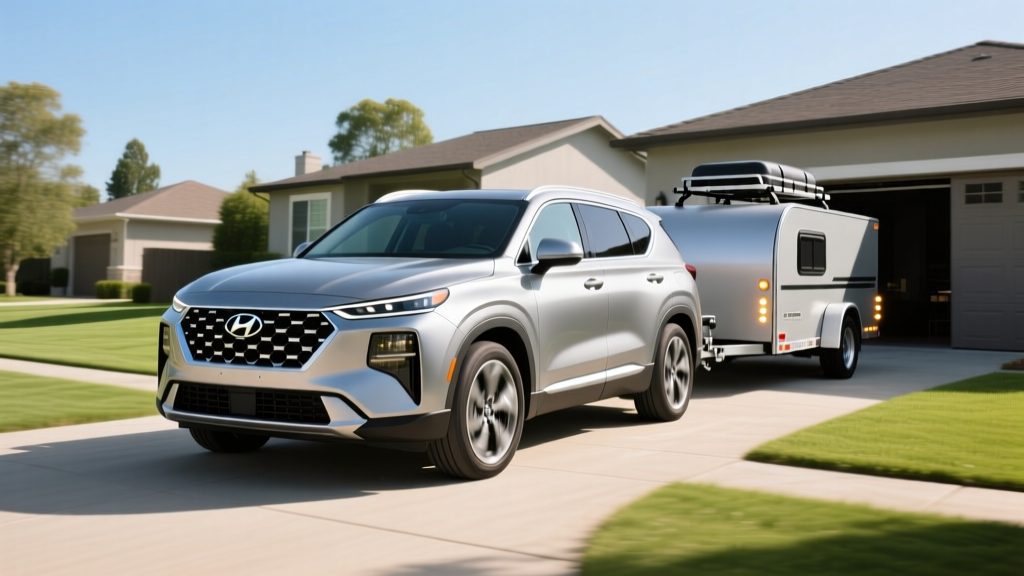
The 2025 Hyundai Santa Fe Hybrid sits in a narrow but compelling segment: a three-row midsize SUV that runs on regular unleaded, tows a small boat or camper, and still returns mid-30s MPG in daily driving. With its bold boxy redesign and standard H-Tex seating, Hyundai positioned this hybrid as an adventure-ready family hauler — but can it actually pull its weight? We tested the specs, parsed the EPA data, and mapped out what real-world ownership looks like for buyers cross-shopping against a RAV4 Hybrid, Highlander Hybrid, or a full battery-electric SUV.
2025 Hyundai Santa Fe Hybrid Towing Capacity: By the Numbers
The headline figure buyers search for is straightforward: the 2025 Hyundai Santa Fe Hybrid is rated to tow up to 3,500 pounds when properly equipped with the factory tow prep package. This matches the non-hybrid gas variant and exceeds most hybrid competitors in the segment.
| Spec | Value |
|---|---|
| Max Towing Capacity | 3,500 lbs (with tow prep package) |
| Engine | 1.6L turbocharged 4-cylinder |
| Electric Motor | 47.7 kW (64 hp) permanent-magnet synchronous |
| Combined System Output | 232 hp / 271 lb-ft torque |
| Transmission | 6-speed automatic (no CVT) |
| Drivetrain | Standard HTRAC AWD |
| Payload Capacity | ~1,100 lbs (varies by trim) |
| Tongue Weight Max | 350 lbs (10% of tow rating) |
A few practical notes from the spec sheet: the tow prep package includes an upgraded radiator, transmission oil cooler, and trailer pre-wiring — it's a factory option, not a dealer add-on, so confirm it's on the build sheet before purchase. The HTRAC all-wheel-drive system is standard on all hybrid trims, which helps with trailer stability but does cost you roughly 1 MPG versus a theoretical FWD configuration Hyundai doesn't offer in the U.S.
HEV vs PHEV: Which Santa Fe Hybrid Are You Buying?
Hyundai sells two electrified Santa Fe variants for 2025, and confusing them at the dealership is the single most common buyer mistake. Here's the clean distinction:
Conventional Hybrid (HEV)
- No plug required. Regenerative braking and the gas engine charge the 1.5 kWh battery.
- EPA MPG: 35 city / 34 highway / 34 combined (SEL Premium trim; Blue trim hits 36 combined).
- Total range: ~540 miles on a 16.1-gallon tank.
- Towing: 3,500 lbs.
- Price: Starts at $39,215 (SEL Premium).
Plug-in Hybrid (PHEV)
- Plugs in to a Level 2 home charger (J1772 connector) for ~30 miles electric-only.
- Electric-only range: 30 miles EPA (18.1 kWh usable battery).
- Combined MPGe: 76 MPGe; gas-only mode ~33 MPG combined.
- Total combined range: ~430 miles (electric + gas).
- Towing: 3,500 lbs (same rating, slightly heavier curb weight).
- Price: Starts at $44,515 (Limited trim only).
If you don't have access to a Level 2 charger at home or work, the PHEV's 18.1 kWh battery becomes dead weight — you're paying a $5,300 premium for electric range you'll never use. The HEV is the correct choice for apartment dwellers, street-parkers, and anyone without a dedicated 240V circuit.
Fuel Economy Breakdown: EPA vs Real-World MPG
Hyundai's hybrid powertrain uses a conventional 6-speed automatic rather than the e-CVT found in Toyota's hybrid system. The result is a more natural driving feel, but it also means the Santa Fe Hybrid doesn't quite match Toyota's city-dominant efficiency profile. Here's the official EPA data from fueleconomy.gov:
| Trim | City | Highway | Combined | Annual Fuel Cost* |
|---|---|---|---|---|
| Blue (base HEV) | 36 | 35 | 36 | $1,650 |
| SEL Premium (HEV) | 35 | 34 | 34 | $1,750 |
| Limited (PHEV, gas mode) | 33 | 33 | 33 | $1,800 |
| Limited (PHEV, EV+gas) | 76 MPGe combined | $1,250 | ||
*Based on 15,000 miles/year at $3.50/gallon regular unleaded. Your mileage will vary with towing.
Powertrain Deep Dive: 232 HP Without the CVT Drone
The Santa Fe Hybrid pairs a 1.6-liter turbocharged inline-four (178 hp, 195 lb-ft on its own) with a 47.7 kW electric motor sandwiched between the engine and the 6-speed automatic. Combined output lands at 232 hp and 271 lb-ft of torque. That torque figure matters more than horsepower for towing — it's available low in the rev range thanks to the electric motor's instant delivery.
The 0-60 MPH time is approximately 7.4 seconds for the HEV and 7.2 seconds for the PHEV (the larger battery adds weight but the electric motor can deliver more sustained assist). Neither will win stoplight races, but both merge onto highways with confidence even when loaded.
One ownership note: Hyundai's hybrid system is a parallel architecture, meaning the engine and motor can both drive the wheels simultaneously. This is fundamentally different from Toyota's series-parallel system. In practice, it means smoother highway cruising but slightly less city efficiency.
PHEV Charging: What You Need Before You Buy
If you're considering the PHEV variant, here's the charging math:
| Level | Power | 0-100% Time | Cost to Install |
|---|---|---|---|
| Level 1 (120V outlet) | 1.4 kW | ~13 hours | $0 (existing outlet) |
| Level 2 (240V, 32A) | 7.2 kW (onboard charger) | ~2.5 hours | $500–$2,000 |
| DC Fast Charge | Not supported | N/A | N/A |
The Santa Fe PHEV does not support DC fast charging — a notable limitation if you were hoping to top up on road trips. The 7.2 kW onboard charger is adequate for overnight replenishment but means a midday top-up takes over two hours. For most PHEV owners, a Level 2 home charger (like a ChargePoint Home Flex or Emporia Vue) installed on a 40A circuit is the only practical setup.
Pricing, Trims & Federal Tax Credit Eligibility
Here's where the HEV vs PHEV decision gets financial:
| Trim | Type | MSRP | Federal Credit | Effective Price |
|---|---|---|---|---|
| Blue | HEV | $37,915 | $0 | $37,915 |
| SEL Premium | HEV | $39,215 | $0 | $39,215 |
| Limited | HEV | $43,315 | $0 | $43,315 |
| Limited | PHEV | $44,515 | Up to $3,750* | ~$40,765 |
Tax credit reality check: Under current IRS §30D rules, the Santa Fe PHEV may qualify for a partial federal tax credit — but not the full $7,500. The PHEV's battery is below 16 kWh gross capacity, and critical-mineral and battery-component sourcing requirements further reduce eligibility. The conventional HEV qualifies for no federal tax credit under §30D (which applies only to plug-in vehicles). Always verify current-year rules at IRS.gov and consult a tax professional — income caps ($150K single / $300K joint) and point-of-sale transfer rules apply.
Some states (California, Colorado, New York, among others) offer additional rebates for PHEVs. Check your state energy office or AFDC for current local incentives.
Battery Warranty, Reliability & Replacement Cost
Regarding reliability: Hyundai's 1.6T hybrid powertrain is in its second generation (shared with the Tucson Hybrid and Kia Sorento Hybrid). Early first-generation units (2022-2023 Tucson) had scattered reports of hybrid system software glitches and inverter coolant leaks, most addressed under warranty via TSBs. The second-generation system in the 2025 Santa Fe has not shown systemic issues in early ownership data.
Battery replacement cost — the question every hybrid buyer asks — is estimated at $3,500–$5,500 for the HEV's 1.5 kWh pack and $8,000–$12,000 for the PHEV's 18.1 kWh pack (parts + labor, at dealer rates). However, modern lithium-ion hybrid batteries rarely require full replacement within the warranty period; most degradation issues involve individual cell modules, which can be serviced for $500–$1,500.
Who Should Buy the Santa Fe Hybrid — And Who Shouldn't
Pros
- 3,500-lb towing beats most hybrid SUV competitors
- 34-36 MPG combined on regular unleaded
- Standard HTRAC AWD (no FWD penalty trim)
- Conventional 6-speed auto — no CVT rubber-band feel
- 10yr/100k battery warranty
- Three-row seating with usable third row
- Boxy design maximizes cargo volume (40.5 cu ft behind 2nd row)
Cons
- No DC fast charging on PHEV variant
- PHEV only available in top Limited trim ($44,515+)
- Real-world highway MPG drops below 30 when towing
- HEV receives no federal tax credit
- Only 30 miles electric-only range on PHEV (short for the price premium)
- No spare tire — tire-inflation kit only (costs you when towing remote areas)
Choose the Santa Fe HEV if:
- You tow 2,000-3,500 lbs regularly (jet ski, small camper, utility trailer)
- You lack Level 2 charging access at home
- You want three rows and AWD under $45K without going full EV
- Your annual mileage is 12,000-18,000 miles and fuel savings matter
Choose the Santa Fe PHEV if:
- You have a Level 2 charger and your daily commute is under 25 miles round-trip
- You want to drive electric on weekdays and tow on weekends
- You qualify for the partial federal credit and state rebates
Choose a full EV (Kia EV9, Rivian R1S) instead if:
- You have reliable home + destination charging and never tow over 3,000 lbs
- You want zero tailpipe emissions and lower per-mile energy cost
- You can absorb the higher purchase price ($55K-$80K) for lower operating cost
Frequently Asked Questions
Can the 2025 Hyundai Santa Fe Hybrid really tow 3,500 pounds?
Yes, with the factory tow prep package installed. This includes an upgraded cooling system and trailer pre-wiring. Confirm it's on your build sheet — not all dealer inventory is equipped. The rating applies to both the HEV and PHEV variants, though the PHEV's additional ~200 lbs of battery weight slightly reduces payload capacity.
How many MPG does the Santa Fe Hybrid actually get in real driving?
Expect 33-35 MPG combined in the HEV during normal suburban driving — close to the EPA sticker. Highway-only trips at 75+ MPH drop to 29-31 MPG. Towing drops efficiency to 16-19 MPG depending on trailer weight and terrain. The PHEV achieves 76 MPGe when regularly charged, but only 33 MPG if you never plug it in.
Does the Santa Fe Hybrid qualify for the $7,500 federal tax credit?
No. The conventional HEV qualifies for $0 under §30D (it's not a plug-in vehicle). The PHEV may qualify for a partial credit — typically up to $3,750 based on battery capacity and sourcing rules — subject to buyer income caps ($150K single / $300K joint) and point-of-sale transfer availability. Check current rules at IRS.gov before purchase.
What's the battery replacement cost if it fails?
Under normal conditions, Hyundai's 10-year/100,000-mile hybrid battery warranty covers defects and significant capacity loss. Out-of-pocket replacement is estimated at $3,500-$5,500 for the HEV pack and $8,000-$12,000 for the PHEV pack. However, full pack replacement is rare — most issues involve individual modules serviceable for $500-$1,500.
Is the Santa Fe Hybrid more reliable than the gas-only version?
Early data suggests comparable reliability. Hyundai's second-generation 1.6T hybrid system has fewer reported issues than the first generation. The hybrid eliminates the conventional starter motor and uses regenerative braking to reduce brake wear — two fewer things to fail. The main risk factor is the hybrid inverter, which is expensive but covered under the hybrid-system warranty (10yr/100k).
Can I install a hitch myself and still tow 3,500 lbs?
No. The 3,500-lb rating requires the factory tow prep package with upgraded cooling. An aftermarket hitch alone does not provide the transmission oil cooler or radiator capacity needed for sustained towing. You'll also need a brake controller for any trailer over 1,500 lbs (required by law in most states).