If you're researching a Kia Sorento Hybrid lease, you've likely noticed something confusing: Kia sells two electrified Sorentos — a conventional hybrid (HEV) and a plug-in hybrid (PHEV) — and they behave very differently in daily life, at the pump, and on a lease balance sheet. One never needs a plug; the other can drive 32 miles on electricity alone but demands a home charger to justify its premium. This guide untangles both powertrains with exact EPA data, real-world MPG expectations, 2026 lease pricing realities, and the battery-warranty details that matter when you hand the vehicle back at lease end.
HEV vs PHEV: Which Sorento Are You Actually Leasing?
Conventional Hybrid (Sorento HEV)
The Sorento HEV pairs a 1.6-liter turbocharged four-cylinder with a 47.7 kW electric motor integrated into a 6-speed automatic transmission. A small 1.49 kWh lithium-ion battery captures energy from regenerative braking and the engine — you never plug it in. It operates exactly like a gas car at the pump, but the hybrid system slashes fuel consumption, especially in stop-and-go city driving.
Plug-In Hybrid (Sorento PHEV)
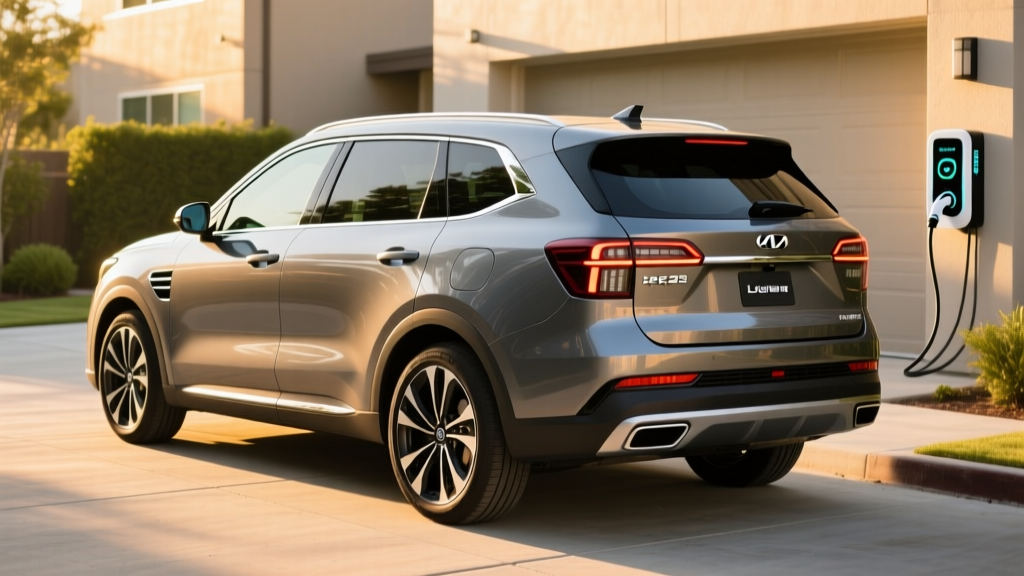
The Sorento PHEV uses the same 1.6L turbo engine but pairs it with a much larger 90.9 kW motor and a 13.8 kWh usable battery. You plug it in (Level 1 or Level 2 — no DC fast charging). A full charge delivers an EPA-rated 32 miles of electric-only driving before the gasoline engine seamlessly engages, turning it into a conventional hybrid for the remaining 400+ miles of total range.
Fuel Economy: EPA Numbers and Real-World MPG
| Powertrain | City | Highway | Combined | MPGe (PHEV EV mode) |
|---|---|---|---|---|
| Sorento HEV (FWD) | 36 mpg | 35 mpg | 35 mpg | — |
| Sorento HEV (AWD) | 34 mpg | 34 mpg | 34 mpg | — |
| Sorento PHEV (AWD) | 34 mpg* | 33 mpg* | 33 mpg* | 79 MPGe |
*PHEV MPG figures apply after the battery is depleted and the vehicle operates as a hybrid.
Real-World MPG: What Owners Actually See
Hybrids routinely beat their EPA city estimates in practice because regenerative braking recovers more energy in traffic than the test cycle assumes. Sorento HEV owners frequently report 36–38 mpg in city driving, while highway-heavy commutes at 75+ mph tend to drop to 31–33 mpg. Cold weather (below 30°F) knocks efficiency down roughly 8–12% due to cabin heating demands and reduced battery efficiency.
For the PHEV, real-world electric range hovers around 28–30 miles in mixed driving with climate control running, and drops to 22–25 miles in freezing temperatures. If your daily commute falls under 30 miles round-trip and you charge nightly, you may visit a gas station only on road trips.
Powertrain Specs: Horsepower, Battery, and Charging
| Specification | Sorento HEV | Sorento PHEV |
|---|---|---|
| Engine | 1.6L Turbo I-4 | 1.6L Turbo I-4 |
| Electric Motor | 47.7 kW (64 hp) | 90.9 kW (122 hp) |
| Combined Horsepower | 232 hp | 261 hp |
| Combined Torque | 258 lb-ft | 258 lb-ft |
| Transmission | 6-speed automatic | 6-speed automatic |
| Drivetrain (standard) | FWD (AWD optional) | AWD (standard) |
| Battery Capacity | 1.49 kWh | 13.8 kWh (usable) |
| Battery Chemistry | Lithium-ion (NMC) | Lithium-ion (NMC) |
| EV-Only Range | — | 32 miles (EPA) |
| Total Range | ~530 miles | ~430 miles (EV + gas) |
| Level 1 Charge (120V) | Self-charging | ~12 hours (0–100%) |
| Level 2 Charge (240V) | Self-charging | ~3.5 hours (0–100%) |
| DC Fast Charge | Not applicable | Not available |
| 0–60 mph | ~7.7 sec | ~7.0 sec |
| Towing Capacity | 2,000 lbs | 2,000 lbs |
A critical detail for PHEV lease shoppers: the Sorento PHEV does not support DC fast charging. Its maximum charge rate is roughly 3.3 kW on a Level 2 (240V) outlet. That means public fast-charging stations are irrelevant — this vehicle is designed to charge overnight at home. If you can't install a Level 2 charger or lack access to a 240V outlet, the PHEV's electric range advantage largely evaporates, and you're paying a premium for a battery you can't usefully recharge.
2026 Lease Pricing: What You'll Actually Pay Monthly
Kia's lease offers rotate monthly and vary by region, but here's the landscape as of early 2026 based on typical manufacturer-supported lease programs and third-party aggregators:
Sorento HEV Lease Expectations
- MSRP range: $38,290 (S trim) to $45,690 (SX Prestige)
- Typical advertised lease: $379–$449/month, 36 months, $2,500–$3,500 due at signing
- Residual value: ~56–59% at 36 months (moderate for a hybrid SUV)
- Money factor: Equivalent to ~5.5–6.5% APR on manufacturer-backed leases
Sorento PHEV Lease Expectations
- MSRP range: $50,490 (EX) to $54,790 (SX Prestige)
- Typical advertised lease: $479–$569/month, 36 months, $3,000–$4,000 due at signing
- Residual value: ~52–55% at 36 months
- Money factor: Similar to HEV, though Kia occasionally subsidizes PHEV leases to move inventory
Leasing an electrified vehicle has a distinct advantage: you never face battery replacement costs. The hybrid battery is warrantied for the full lease term and beyond, and any degradation is Kia's problem, not yours. The trade-off is that you build no equity and face mileage penalties (typically 10,000–12,000 miles/year on standard leases).
Federal and State Tax Credits: What Applies on a Lease?
§30D Federal Tax Credit — Lease Loophole Explained
Under IRS §30D rules, the $7,500 federal EV tax credit applies only to purchases, not leases — and only the Sorento PHEV qualifies (the HEV does not meet the plug-in requirement). However, there's a critical nuance for leases:
- Under the IRS's "commercial vehicle" interpretation (§45W), the leasing company (Kia Finance) may claim the $7,500 credit and pass it through as a lease cash incentive that reduces your monthly payment.
- Whether Kia passes this through varies by month and region. Always ask the dealer: "Is Kia's lease cash factoring in the commercial clean vehicle credit?"
- Income caps (§30D): $150K single / $300K joint for purchases — do not apply to the lease pass-through.
- MSRP cap: $80,000 for SUVs — both Sorento PHEV trims qualify.
- Battery sourcing requirements: Kia has adjusted PHEV battery supply chains for 2025–2026 models, but confirm current eligibility on the IRS's qualified vehicles list at irs.gov.
The Sorento HEV (non-plug-in hybrid) does not qualify for any federal tax credit or lease pass-through. Some states (e.g., California's CVRP program, Colorado's innovative motor vehicle credit) offer modest rebates for conventional hybrids — check your state energy office.
Battery Warranty, Reliability, and Replacement Costs
Kia's Hybrid Battery Warranty
Both the Sorento HEV and PHEV carry Kia's hybrid battery warranty:
- Coverage: 10 years / 100,000 miles (whichever comes first)
- What's covered: Battery capacity loss below ~70% of original capacity, cell/module failure, and related hybrid system components (inverter, motor, wiring)
- Transferable: Yes, to subsequent owners — relevant if you plan to buy out the lease
For a 36-month lease with typical mileage (30K–36K miles), you'll use less than a third of the warranty period. Battery degradation over 3 years is generally 3–6%, which has zero noticeable impact on daily driving.
Is the Sorento Hybrid Reliable?
Kia's 1.6L turbo-hybrid powertrain has been in production since 2020 across multiple models (Sorento, Tucson, Sportage). Common early issues (2021–2022 model years) included rough shifting in the hybrid transmission and occasional 12V auxiliary battery drain — both addressed via software updates. The 2025–2026 refresh improved transmission calibration significantly.
J.D. Power and Consumer Reports rate the 2025–2026 Sorento Hybrid as average to above-average for the midsize SUV segment. The hybrid system itself has proven more durable than Kia's earlier turbo-only engines, since the electric motor reduces load on the gasoline engine during acceleration.
Battery Replacement Cost (Out of Warranty)
If you buy out the lease and keep the vehicle past 100,000 miles:
- HEV battery replacement: ~$2,500–$3,500 (small 1.49 kWh pack)
- PHEV battery replacement: ~$6,000–$8,500 (larger 13.8 kWh pack)
These are dealer-estimated ranges; independent hybrid shops may offer refurbished packs for 30–40% less. Most hybrid batteries last 150,000–200,000 miles before significant degradation, making out-of-warranty replacement a low-probability event for most owners.
Who Should Lease the Sorento Hybrid — and Who Shouldn't?
Lease the Sorento HEV If:
- You want a 3-row SUV that gets 35 mpg without ever plugging in
- You lack home charging access (apartment, street parking)
- Your budget caps around $400–$450/month
- You drive 12K–15K miles/year with a mix of city and highway
- You want hybrid efficiency without PHEV complexity or price
Lease the Sorento PHEV If:
- Your daily commute is under 30 miles round-trip
- You can install a Level 2 (240V) charger at home
- You want near-EV daily driving with gas-engine road-trip freedom
- Your household income exceeds §30D purchase caps but you can benefit from the lease credit pass-through
- You value the 261 hp combined output and standard AWD
Consider a Full EV Instead If:
- You drive under 30 miles daily and rarely road-trip (the PHEV's gas engine is dead weight most days)
- You want access to HOV lane stickers (some states restrict these to BEVs only)
- You're ready to eliminate gas stations entirely — consider the Kia EV9 or Hyundai Ioniq 5 for similar 3-row or crossover space
Stick With Gas If:
- You drive fewer than 8,000 miles/year (the hybrid premium won't pay back in fuel savings)
- You frequently tow over 2,000 lbs (neither hybrid variant increases towing capacity)
Decision Framework: HEV, PHEV, or Full EV?
| Your Situation | Best Choice | Why |
|---|---|---|
| No home charging, mixed commute | Sorento HEV | 35 mpg with zero infrastructure needed |
| Home charger + short commute | Sorento PHEV | 32 mi electric daily, gas for road trips |
| Home charger + mostly city, rare long trips | Full EV (e.g., Kia EV9) | Lower per-mile cost, no oil changes, more cargo space |
| High annual mileage (18K+) | Sorento HEV | Hybrid savings compound; no PHEV charge time penalty |
| Want lowest monthly payment | Sorento HEV S trim | ~$379/mo vs ~$479/mo for PHEV |
Frequently Asked Questions
How many MPG does the Kia Sorento Hybrid get?
The 2026 Sorento HEV is EPA-rated at 36 city / 35 highway / 35 combined (FWD) or 34 combined (AWD). Real-world city driving often yields 36–38 mpg thanks to regenerative braking, while sustained highway speeds above 75 mph may return 31–33 mpg.
How far can the Sorento PHEV go on electric only?
The EPA rates the Sorento PHEV at 32 miles of electric-only range. In real-world conditions with climate control active, expect 28–30 miles in moderate weather and 22–25 miles in freezing temperatures. The gasoline engine engages seamlessly once the battery is depleted.
Does the Kia Sorento Hybrid qualify for any tax credit?
The conventional Sorento HEV does not qualify for the federal §30D tax credit (it's not a plug-in vehicle). The Sorento PHEV qualifies for up to $7,500 on a purchase, subject to income limits ($150K single / $300K joint), MSRP caps, and battery sourcing rules. On a lease, the leasing company may claim the commercial vehicle credit and pass savings through as lease cash — confirm with your dealer. Always verify current eligibility at irs.gov.
Is the Kia Sorento Hybrid reliable?
The 2025–2026 Sorento Hybrid earns average to above-average reliability ratings. Kia's 1.6L turbo-hybrid system has been in production since 2020 and has proven durable. The hybrid battery is covered by a 10-year/100,000-mile warranty. Early model years (2021–2022) had minor transmission software issues that have since been resolved.
What does a hybrid battery replacement cost?
Out of warranty, the Sorento HEV battery costs approximately $2,500–$3,500 to replace, while the PHEV battery runs $6,000–$8,500. However, most hybrid batteries last 150,000–200,000 miles, and Kia's 10-year/100,000-mile warranty covers the entire lease period and well beyond.
Do I need to plug in the Sorento Hybrid?
No — the conventional Sorento HEV charges its small battery entirely through regenerative braking and the gasoline engine. You fuel it like any other car. Only the Sorento PHEV requires (and benefits from) plugging in.
Is it better to lease or buy the Sorento Hybrid?
Leasing makes sense if you want the latest tech, don't want to worry about battery longevity, and drive under 12,000 miles/year. Buying makes more sense if you plan to keep the vehicle 7+ years (the hybrid fuel savings compound over time) or if you exceed typical lease mileage limits. For the PHEV specifically, purchasing lets you claim the §30D credit directly (if eligible), which can offset the higher MSRP.
Can the Sorento PHEV DC fast charge?
No. The Sorento PHEV supports Level 1 (120V, ~12 hours for a full charge) and Level 2 (240V, ~3.5 hours) charging only. There is no DC fast-charge port. This is typical for PHEVs — the battery is small enough that overnight Level 2 charging is sufficient.