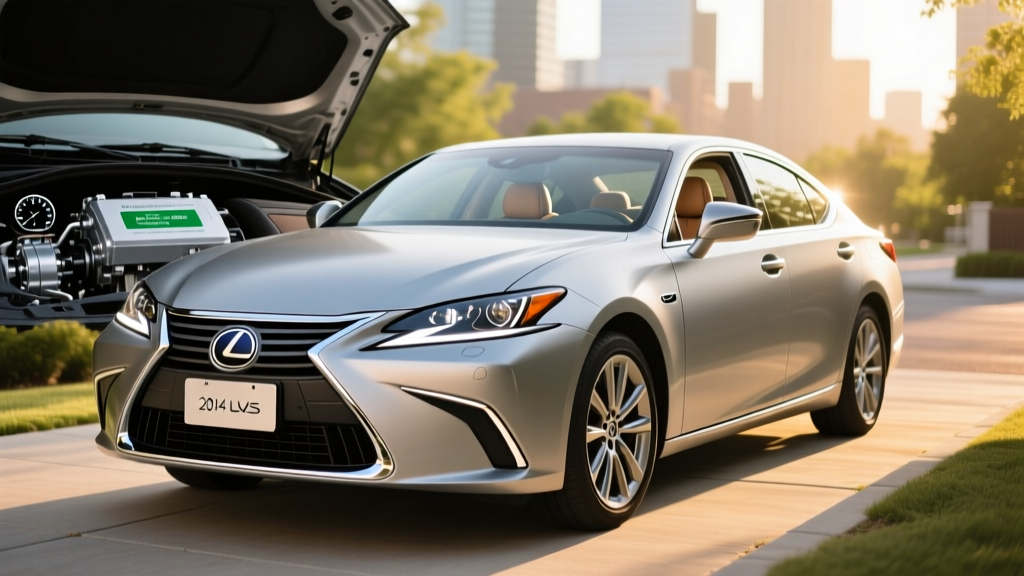
The 2014 Lexus ES 300h occupies a specific niche in the used-car market: a midsize luxury sedan that sips fuel like a compact while delivering the quiet, cushioned ride Lexus built its reputation on. As a conventional hybrid (HEV) — not a plug-in — it requires zero change to your fueling habits. You simply fill up with gas and let Toyota's proven Hybrid Synergy Drive system handle the rest. With the 2014 model now over a decade old, the question for today's buyer isn't whether it was good when new — it was — but whether a used ES 300h remains a smart purchase in 2026, especially with its high-voltage battery aging into its second decade.
This guide covers the exact numbers that matter: real-world MPG versus EPA estimates, powertrain specs, battery warranty status, estimated replacement costs, and how the ES 300h stacks up against both modern hybrids and full EVs for today's buyers.
What Is the 2014 Lexus ES 300h? HEV vs. PHEV Clarity
Let's clear up a common point of confusion right away. The 2014 Lexus ES 300h is a conventional hybrid electric vehicle (HEV). It does not plug in. There is no electric-only driving range to deplete, no charging cable to manage, and no Level 2 home charger to install. The car's 1.6 kWh nickel-metal hydride (NiMH) battery pack charges exclusively through regenerative braking and the gasoline engine.
HEV vs. PHEV: What's the Difference?
| Feature | HEV (2014 ES 300h) | PHEV (e.g., 2026 Toyota RAV4 Prime) |
|---|---|---|
| Plugs in? | No | Yes (Level 1 or Level 2) |
| Battery size | ~1.6 kWh (NiMH) | ~18.1 kWh (lithium-ion) |
| Electric-only range | None (EV assist only at low speeds) | ~42 miles EPA |
| Fueling | Gas station only | Gas station + plug-in charging |
| Federal tax credit | No | Potentially (subject to §30D rules) |
| Ideal for | Drivers without home charging access | Drivers with home charging who want EV-like daily commuting |
If you're looking for a plug-in Lexus from this era, you won't find one in the ES lineup. Lexus didn't offer a PHEV variant of the ES in 2014 — or any year since, as of 2026. The brand's plug-in offerings remain limited to newer models like the NX 450h+ and RX 450h+.
2014 Lexus ES 300h Fuel Economy: EPA Ratings and Real-World MPG
The headline number for the ES 300h has always been its fuel efficiency, and the EPA figures remain impressive for a 3,500-pound luxury sedan.
| Metric | EPA Rating |
|---|---|
| City | 40 MPG |
| Highway | 39 MPG |
| Combined | 40 MPG |
| Fuel tank capacity | 17.2 gallons |
| Total range (est.) | ~688 miles |
Source: EPA Fuel Economy
Real-World MPG: What Owners Actually Report
Hybrid vehicles, particularly Toyota/Lexus systems, often exceed their EPA city ratings in stop-and-go traffic because regenerative braking recaptures energy that a gas car wastes as heat. On the highway, the advantage narrows because the electric motor assists less at sustained speeds.
Based on owner-reported data aggregated on FuelEconomy.gov and long-term ownership forums, real-world figures for the 2014 ES 300h cluster around:
- City driving: 38–43 MPG (many owners exceed the 40 MPG EPA city rating)
- Highway driving (70–75 mph): 35–38 MPG (slightly below EPA highway due to aerodynamic drag at speed)
- Mixed commuting: 37–41 MPG
- Cold weather (below 30°F): 33–36 MPG (engine runs more frequently for cabin heat and battery warming)
A 2014 ES 300h with 120,000+ miles may see a 1–3 MPG drop from its original performance if the hybrid battery has degraded moderately. The system compensates by relying more on the gas engine, but the decline is gradual, not catastrophic.
Powertrain and Performance Specs
| Specification | 2014 Lexus ES 300h |
|---|---|
| Engine | 2.5L inline-4 Atkinson cycle |
| Engine horsepower | 156 HP @ 5,700 RPM |
| Electric motor output | 105 kW (141 HP) |
| Net combined system HP | 200 HP |
| Transmission | ECVT (electronically controlled continuously variable) |
| Drivetrain | Front-wheel drive |
| 0–60 mph | ~8.1 seconds |
| Curb weight | ~3,680 lbs |
| Hybrid battery | 1.6 kWh NiMH (nickel-metal hydride) |
| Drive modes | EV, Eco, Normal, Sport |
The 200 HP combined output is adequate for highway merging and passing, though this is not a sport sedan. The ECVT delivers smooth, linear acceleration without the rubber-band feel that plagues some CVT-equipped cars. In EV mode, the car can creep at very low speeds (under ~25 mph, for roughly a mile) on electric power alone — useful for parking lots and dead-stop traffic, but not a substitute for true electric-only range.
Hybrid Battery Health: Warranty, Degradation, and Replacement Cost
Battery Warranty Status (2026)
The 2014 Lexus ES 300h originally shipped with a hybrid battery warranty of 8 years / 100,000 miles (extended to 10 years / 150,000 miles in California and states that follow CARB emissions standards). As of 2026, all factory hybrid battery warranties on 2014 models have expired regardless of mileage, since the vehicle is now 12 model years old.
Any hybrid battery failure is now an out-of-pocket expense unless you purchased an extended powertrain warranty before the original coverage lapsed.
How Long Do ES 300h Hybrid Batteries Last?
Toyota/Lexus NiMH hybrid batteries have proven remarkably durable in real-world use. Data from fleet operators, taxi services, and high-mileage owner communities show that these packs commonly reach 150,000–200,000 miles before significant degradation forces a replacement. Some exceed 250,000 miles with moderate capacity loss.
The NiMH chemistry in the 2014 ES 300h is less energy-dense than modern lithium-ion packs but is also less prone to the thermal runaway risks and faster degradation curves associated with some early lithium chemistries. NiMH degrades slowly and predictably — you'll notice gradually worsening MPG before the system throws a hybrid system warning.
Battery Replacement Cost
If your 2014 ES 300h's hybrid battery does fail, here's what to budget:
- New OEM battery (Lexus dealer): $3,500–$5,000 installed
- Remanufactured battery (specialty hybrid shops): $1,800–$2,800 installed
- Used/salvage battery: $800–$1,500 (risky — unknown remaining life)
- Individual cell replacement (reconditioning): $500–$1,200 at hybrid specialists
Remanufactured batteries from reputable suppliers like Green Bean Battery or Dorman have become a popular middle ground, often carrying their own 3–5 year warranties. For a car with a current market value of $10,000–$16,000 depending on mileage and condition, a $2,000–$3,000 battery replacement is often economically justifiable — especially compared to buying a newer vehicle.
Who Should Buy the 2014 ES 300h vs. a Modern EV or PHEV?
Reasons to Choose the 2014 ES 300h
- No charging infrastructure needed — ideal for apartment dwellers or street parkers
- 40 MPG combined still beats most 2026 gas-only midsize sedans
- Lexus build quality: excellent NVH, solid interior materials, smooth ride
- Low entry price: $10,000–$16,000 used vs. $40,000+ for a new EV
- Proven Toyota Hybrid Synergy Drive with massive repair-network knowledge
- No range anxiety — fill up at any gas station in 3 minutes
Reasons to Look Elsewhere
- Hybrid battery warranty expired — replacement is your financial risk
- No federal tax credit available (used or new)
- Outdated infotainment: no Apple CarPlay, no Android Auto, clunky joystick controller
- No DC fast charging capability (not applicable — HEV, but a limitation vs. PHEV/EV)
- Safety tech is basic: no automatic emergency braking, no lane-keeping assist
- NiMH battery is heavier and less efficient than modern lithium-ion systems
The Decision Framework
Choose the 2014 Lexus ES 300h if: You want a comfortable, fuel-efficient luxury sedan without changing your fueling routine, you lack access to home or workplace charging, your budget is under $16,000, and you're comfortable with the risk of an eventual $2,000–$4,000 battery replacement.
Choose a modern PHEV (e.g., 2026 Toyota Prius Prime, Hyundai Tucson PHEV) if: You have Level 2 home charging access, want 30–45 miles of daily electric-only commuting, and want current safety tech and infotainment while keeping a gas engine for road trips.
Choose a full BEV (e.g., 2026 Tesla Model 3, Hyundai Ioniq 6) if: You have reliable home charging, your daily driving is under 250 miles, you want to eliminate gas entirely, and you're eligible for the federal §30D tax credit (up to $7,500 with point-of-sale transfer, subject to IRS income, MSRP, and battery-sourcing requirements).
Pricing and Tax Credit Eligibility
The 2014 Lexus ES 300h originally carried an MSRP starting around $39,730 (including destination). In the 2026 used market, expect to pay:
- 80,000–100,000 miles: $13,000–$16,000
- 100,000–140,000 miles: $10,500–$13,500
- 140,000+ miles: $8,500–$11,000
Tax Credit Reality
The 2014 ES 300h does not qualify for any federal EV or plug-in hybrid tax credit. As a conventional HEV, it was never eligible for the §30D new clean vehicle credit, and it does not qualify for the Used Clean Vehicle Credit (which applies only to qualifying used BEVs and PHEVs under $25,000, per current IRS rules).
Some states and municipalities have offered hybrid-specific incentives in the past, but most have phased out or redirected funding toward plug-in vehicles. Check your state's energy office or Alternative Fuels Data Center for any remaining local programs, though expectations should be low.
Reliability and Ownership Costs
The 2014 ES 300h benefits from Lexus's reputation for long-term reliability, and the hybrid system is one of the most proven in the industry. The 2.5L 2AR-FXE Atkinson-cycle engine is under-stressed and known to exceed 250,000 miles with basic maintenance. The ECVT has no traditional belts, clutches, or torque converter to wear out.
Key reliability considerations for a 12-year-old example:
- Hybrid battery: The primary risk. Budget $2,000–$4,000 as a contingency.
- Brake wear: Regenerative braking significantly extends pad life. Original brakes often last 80,000–100,000 miles.
- 12V auxiliary battery: Like any car, this lead-acid battery needs replacement every 4–6 years (~$150–$250).
- Inverter/cooling system: The hybrid inverter coolant pump can fail around 120,000–150,000 miles (~$400–$700 repair).
- ECVT fluid: Toyota recommends inspection but not scheduled replacement; many owners change it at 100,000 miles preventively (~$150–$200).
Insurance costs are typically moderate for a 2014 luxury sedan — expect $100–$160/month depending on your profile and state. No EV-specific insurance surcharges apply since this is a conventional hybrid.
Frequently Asked Questions
How many MPG does the 2014 Lexus ES 300h hybrid get?
The EPA rates the 2014 ES 300h at 40 MPG city, 39 MPG highway, and 40 MPG combined. In real-world driving, many owners report 38–43 MPG in mixed use, with city driving often exceeding the EPA rating thanks to regenerative braking. Cold weather and sustained high-speed highway driving can reduce efficiency to the low-to-mid 30s.
Does the 2014 Lexus ES 300h plug in?
No. The ES 300h is a conventional hybrid (HEV), not a plug-in hybrid (PHEV). It charges its small 1.6 kWh NiMH battery through regenerative braking and the gasoline engine. You never plug it in — you simply fill up at a gas station like any other car.
How far can the 2014 ES 300h drive on electric power alone?
Effectively, it cannot serve as an electric vehicle. In EV mode, the car can travel roughly 1 mile at speeds under 25 mph before the gas engine kicks in. This is useful for creeping through parking garages or stop-and-go traffic, but it is not a meaningful electric-only range. If electric-only commuting matters to you, you need a PHEV or BEV.
Is the 2014 Lexus ES 300h reliable, and what does a hybrid battery replacement cost?
Yes — the ES 300h is considered one of the most reliable luxury sedans of its era, thanks to the proven Toyota Hybrid Synergy Drive. The NiMH battery typically lasts 150,000–200,000+ miles. If replacement is needed, expect to pay $1,800–$2,800 for a remanufactured pack or $3,500–$5,000 for a new OEM unit at a Lexus dealer. The original 8-year/100,000-mile hybrid warranty has expired on all 2014 models.
Does the 2014 Lexus ES 300h qualify for any tax credit?
No. As a conventional hybrid (not a plug-in), the ES 300h has never qualified for the federal §30D clean vehicle tax credit, and it is not eligible for the Used Clean Vehicle Credit either. There are no current federal incentives for purchasing a used conventional hybrid. Some state-level programs may offer minor benefits — check the Alternative Fuels Data Center for your area.
How does the 2014 ES 300h compare to a 2026 Toyota Camry Hybrid?
The 2026 Camry Hybrid (a conventional HEV like the ES 300h) achieves up to 52 MPG combined — a significant 12 MPG improvement over the ES 300h, thanks to a newer lithium-ion battery, more efficient engine, and lighter platform. However, a used 2014 ES 300h costs $10,000–$16,000 versus $30,000+ for a new Camry Hybrid, and the Lexus offers a quieter cabin, more premium materials, and a smoother ride. The tradeoff is older safety tech, no modern infotainment, and the hybrid battery replacement risk.
Should I buy the 2014 ES 300h or a used Tesla Model 3?
This depends entirely on your charging situation. If you have Level 2 home charging and drive under 250 miles daily, a used 2020–2022 Tesla Model 3 (typically $20,000–$28,000) offers far lower fueling costs, stronger acceleration, modern Autopilot (SAE Level 2 driver-assist), and over-the-air updates. If you lack reliable charging access, drive long highway routes frequently, or want to stay under $15,000, the ES 300h is the safer financial choice with zero infrastructure requirements.
Final Assessment: Is the 2014 ES 300h Worth It in 2026?
The 2014 Lexus ES 300h remains a rational used-car purchase for a specific buyer: someone who values luxury, comfort, and strong fuel economy but cannot or will not adopt plug-in charging. At $10,000–$16,000, it delivers 40 MPG, a refined ride, and proven mechanical reliability — attributes that haven't aged out of relevance.
The critical risk is the hybrid battery. With factory warranties expired, every used ES 300h buyer should budget a $2,000–$4,000 contingency or seek a vehicle with a recently replaced pack (ask for receipts). A pre-purchase inspection at a hybrid-specialist shop — not just a general mechanic — is strongly recommended before purchase. They can pull the battery's State of Health (SoH) data and identify cell imbalances before they become expensive failures.
For buyers with home charging access and a higher budget, a modern PHEV or BEV will deliver lower operating costs and current technology. But for the plug-free buyer who wants a comfortable, efficient luxury sedan without breaking the bank, the 2014 ES 300h still makes a compelling case — twelve years after it rolled off the line.