If you have been searching for the Kia Niro Plug-In Hybrid and encountering European pricing—perhaps queries like the Kia Niro plug-in hybrid τιμή Ελλάδα 2025 (price in Greece)—you are not alone. The Niro PHEV is sold across multiple global markets, but US-spec pricing, tax-credit eligibility, and EPA ratings differ significantly from European WLTP figures. This guide breaks down exactly what American buyers need to know about the 2025–2026 Kia Niro Plug-In Hybrid, including real-world MPG, electric-only range, charging logistics, and whether the PHEV or conventional HEV version fits your lifestyle.
HEV vs PHEV: Which Niro Is Which?
Kia Niro HEV (Conventional Hybrid)
The standard Niro Hybrid pairs a 1.6L gasoline engine with a small electric motor and a ~1.56 kWh battery. It never needs to be plugged in—the battery charges through regenerative braking and the engine. Think of it as a more efficient gas car that you fuel normally.
Kia Niro PHEV (Plug-In Hybrid)
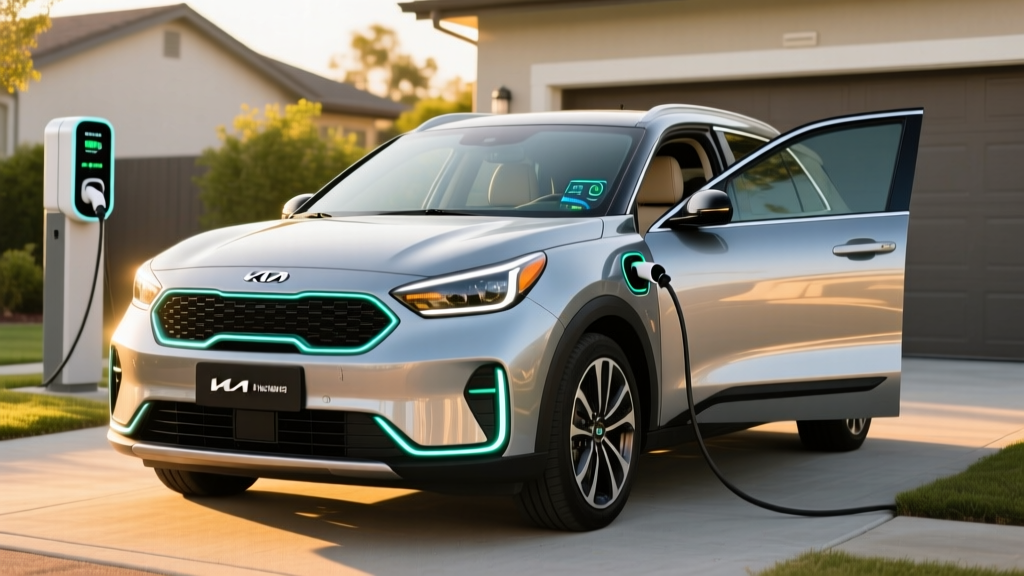
The Niro Plug-In Hybrid uses a larger 11.1 kWh battery and a more powerful 83-hp electric motor alongside the same 1.6L engine. You plug it in to get up to 33 miles of pure electric driving before the gasoline engine engages. It operates as an EV for short commutes and a hybrid for longer trips.
The distinction matters for your wallet, your commute, and your tax situation. If you can charge at home and your daily round trip is under 30 miles, the PHEV effectively becomes an EV most days. If you lack home charging access, the conventional HEV delivers strong efficiency without any plug-in logistics.
2025–2026 Kia Niro PHEV: Core Specifications
| Specification | 2025 Kia Niro PHEV |
|---|---|
| Powertrain | 1.6L GDI 4-cyl + 83-hp electric motor |
| Combined Horsepower | 180 hp / 195 lb-ft torque |
| Transmission | 6-speed dual-clutch automatic (DCT) |
| Battery Capacity | 11.1 kWh (lithium-ion polymer) |
| EPA Electric-Only Range | 33 miles |
| Total Combined Range | ~430 miles (electric + gasoline) |
| EPA MPGe (electric mode) | 108 MPGe combined |
| EPA MPG (hybrid mode) | 48 MPG combined (49 city / 47 highway) |
| Level 2 Charging Time (0–100%) | ~2 hours 45 minutes at 3.3 kW |
| DC Fast Charging | Not available |
| 0–60 mph | ~7.2 seconds |
| Cargo Volume | 19.4 cu ft (rear seats up) / 54.5 cu ft (folded) |
| Base MSRP (S trim) | $34,390 |
| Battery Warranty | 10 years / 100,000 miles |
Sources: EPA Fuel Economy, Kia USA.
Real-World MPG and Electric Range: What to Actually Expect
EPA Electric Range: 33 miles
Real-World Expectation: 28–32 miles in mild weather; 22–26 miles in freezing temperatures or sustained highway speeds above 70 mph.
The Niro PHEV's 33-mile EPA electric range is achievable in mixed suburban driving at moderate temperatures (55–80°F). In practice, owners report consistently hitting 30–32 miles on a full charge during spring and fall. Winter cold reduces lithium-ion battery performance—expect a 15–25% range reduction when temperatures drop below 30°F, bringing electric-only range to roughly 24–28 miles.
Once the battery depletes and the gasoline engine takes over, the Niro PHEV operates as a conventional hybrid. The EPA rates it at 48 MPG combined in hybrid mode. Real-world city driving often exceeds this—many owners report 50–54 MPG in stop-and-go traffic where regenerative braking is most effective. Highway cruising at 75+ mph typically yields 42–45 MPG, slightly below the EPA highway estimate of 47 MPG.
Charging the Niro PHEV: What You Need at Home
| Charging Level | Power | Time (0–100%) | Notes |
|---|---|---|---|
| Level 1 (120V outlet) | ~1.4 kW | ~7–8 hours | Included cord; overnight top-up works |
| Level 2 (240V) | 3.3 kW | ~2 hours 45 min | Requires J1772 home charger or public station |
| DC Fast Charging | N/A | N/A | Niro PHEV does not support DC fast charging |
The Niro PHEV uses a standard J1772 connector for Level 1 and Level 2 AC charging. It does not support DC fast charging—this is typical for plug-in hybrids, whose smaller batteries do not require rapid replenishment. A full Level 2 charge in under three hours means you can easily top up during a workday or between errands.
For home charging, a basic Level 2 wall unit (16A–32A) costs $300–$600 for the equipment. Professional installation by a licensed electrician typically runs $500–$1,500 depending on your panel capacity and the distance from your electrical panel to the charging location. Most Niro PHEV owners find the included Level 1 cord sufficient for overnight charging, since the 11.1 kWh battery replenishes fully in about 7–8 hours on a standard 120V outlet.
Pricing, Trims, and Tax Credit Eligibility
The 2025 Kia Niro PHEV starts at $34,390 for the base S trim (including destination charge). Higher trims include:
- S trim: $34,390
- X Line trim: ~$36,090
- EX trim: ~$37,490
- SX Touring trim: ~$40,790
Federal Tax Credit (§30D) — Key Points
- The Niro PHEV may qualify for up to $3,750 of the federal plug-in vehicle tax credit, depending on battery component and critical-mineral sourcing requirements under current IRS rules.
- The full $7,500 credit requires meeting both critical-mineral and battery-component thresholds. Most Kia/Hyundai PHEVs currently qualify for the $3,750 partial credit due to sourcing rules.
- MSRP cap: The Niro PHEV is classified as a sedan/wagon (not an SUV), so the MSRP cap is $55,000. All trims qualify.
- Income cap: Modified AGI must not exceed $150,000 (single), $225,000 (head of household), or $300,000 (joint).
- Point-of-sale transfer: As of 2024, eligible buyers can transfer the credit to the dealer for an immediate price reduction at purchase.
- Always verify current eligibility on IRS.gov before purchasing—sourcing requirements change annually.
Compared to European pricing—where the Kia Niro PHEV τιμή Ελλάδα (price in Greece) typically starts around €36,000–€38,000 (~$39,000–$41,000 USD before local incentives)—the US MSRP is competitive, especially after applying the partial federal credit and any applicable state incentives.
Reliability and Battery Longevity
Kia PHEV Battery Warranty: 10 years / 100,000 miles (whichever comes first), covering defects and capacity loss below a specified threshold (typically 70% state of health).
Hybrid System Warranty: 10 years / 100,000 miles on hybrid-specific components including the electric motor, inverter, and onboard charger.
Estimated Out-of-Warranty Battery Replacement: $3,500–$5,500 including labor, based on current Kia PHEV battery pricing. The 11.1 kWh pack is significantly smaller—and less expensive to replace—than a full EV battery.
Kia's hybrid and PHEV powertrains have demonstrated strong reliability in owner surveys and long-term testing. The 1.6L GDI engine and 6-speed DCT are well-proven across the Kia/Hyundai lineup. The lithium-ion polymer battery pack is liquid-cooled, which helps manage thermal stress and slow degradation over time.
For context, PHEV batteries experience less cycling stress than full EV batteries because they operate within a narrower state-of-charge window (the system reserves a buffer at the top and bottom). Many Kia/Hyundai PHEV owners report minimal degradation—often 90%+ state of health—after 5–6 years of daily use. The 10-year/100,000-mile warranty provides substantial protection against premature failure.
Niro HEV vs PHEV vs Full EV: Which Fits Your Life?
Choose the Niro HEV (Conventional Hybrid) If:
- You cannot install a home charger (apartment, street parking, no garage outlet)
- You want maximum simplicity—just fuel up and drive
- Your budget is tighter (HEV starts ~$28,000 vs PHEV at ~$34,390)
- You drive mostly longer trips where electric-only range offers little benefit
Choose the Niro PHEV If:
- You have access to home or workplace Level 1/Level 2 charging
- Your daily round-trip commute is 30 miles or less
- You want EV-like daily driving with gasoline backup for road trips
- You qualify for the partial federal tax credit, narrowing the price gap with the HEV
Choose a Full EV (e.g., Kia EV6, Hyundai Ioniq 5) If:
- You want zero gasoline use and are ready for full electric ownership
- You have reliable home charging and access to DC fast charging for road trips
- You want the full $7,500 federal credit (available on qualifying EVs)
- Your budget accommodates a higher purchase price offset by lower operating costs
| Cost Factor (5 years / 75,000 mi) | Niro HEV | Niro PHEV | Compact EV (e.g., EV6) |
|---|---|---|---|
| Purchase Price (base) | $28,090 | $34,390 | $42,600 |
| Federal Tax Credit | $0 | Up to $3,750 | Up to $7,500 |
| Fuel / Electricity (est.) | $6,800 | $3,200 | $2,900 |
| Maintenance (est.) | $2,800 | $2,400 | $1,600 |
| 5-Year Total (approx.) | $37,690 | $36,240 | $39,600 |
Estimates assume $3.50/gal gasoline, $0.14/kWh electricity, 70% electric-mode driving for PHEV, and 15,000 miles/year. Actual costs vary by region, driving habits, and electricity rates. Source: EPA Fuel Cost Calculator.
Pros and Cons at a Glance
Pros
- 33-mile electric range covers most daily commutes
- 48 MPG in hybrid mode once battery is depleted
- 10-year / 100,000-mile battery and powertrain warranty
- No range anxiety—430+ miles total range with gas tank
- Competitive pricing after partial tax credit
- Spacious crossover with 54.5 cu ft cargo volume
- Level 1 overnight charging is sufficient for the small battery
Cons
- No DC fast charging capability
- Electric range drops to ~24 miles in cold weather
- Only partial ($3,750) federal tax credit vs $7,500 for full EVs
- Higher starting price than the conventional Niro HEV (~$6,300 premium)
- 3.3 kW onboard charger is slow compared to some PHEV competitors
- All-wheel drive is not available
Frequently Asked Questions
How many MPG does the Kia Niro Plug-In Hybrid get?
The EPA rates the Niro PHEV at 108 MPGe when operating in electric mode and 48 MPG combined (49 city / 47 highway) when running as a conventional hybrid after the battery depletes. In real-world city driving, many owners exceed 50 MPG in hybrid mode thanks to aggressive regenerative braking.
How far can the Niro PHEV go on electric only?
The EPA rates it at 33 miles of electric-only range. Expect 28–32 miles in mild conditions and 22–26 miles in freezing weather or sustained highway driving. For most commuters with a sub-30-mile round trip, this covers daily driving entirely on electricity.
Does the Kia Niro PHEV qualify for a federal tax credit?
It may qualify for up to $3,750 under IRS §30D, depending on current battery-sourcing requirements. The full $7,500 credit requires meeting both critical-mineral and battery-component thresholds, which most Kia PHEVs do not currently satisfy. Verify on IRS.gov before purchasing. The credit can be transferred to the dealer at point of sale for an immediate price reduction.
Is the Niro PHEV reliable, and what does battery replacement cost?
Kia's hybrid powertrains have strong reliability records. The PHEV battery is covered by a 10-year / 100,000-mile warranty. Out-of-warranty replacement is estimated at $3,500–$5,500—significantly less than a full EV battery due to the smaller 11.1 kWh pack. The liquid-cooled battery management system helps ensure longevity.
How does US pricing compare to the Kia Niro PHEV price in Greece or Europe?
European pricing (Kia Niro plug-in hybrid τιμή Ελλάδα 2025) typically starts around €36,000–€38,000 before local incentives, roughly $39,000–$41,000 USD. The US base MSRP of $34,390 is notably lower, and after the potential $3,750 federal credit, the effective price drops to approximately $30,640—making the US market one of the most affordable for this model.
Do I need to install a Level 2 charger at home for the Niro PHEV?
No. The included Level 1 (120V) charging cord can fully replenish the 11.1 kWh battery overnight in 7–8 hours. A Level 2 (240V) charger reduces that to under 3 hours, which is convenient if you need multiple full charges per day or want faster top-ups. Most PHEV owners find Level 1 sufficient given the small battery.
Should I buy the Niro PHEV or a full EV like the Kia EV6?
If you have home charging and want zero gasoline, a full EV offers lower operating costs, stronger performance, and potentially the full $7,500 federal credit. If you lack reliable charging infrastructure, frequently take long road trips, or want a lower purchase price, the Niro PHEV provides the best of both worlds—electric commuting with unlimited gasoline range.