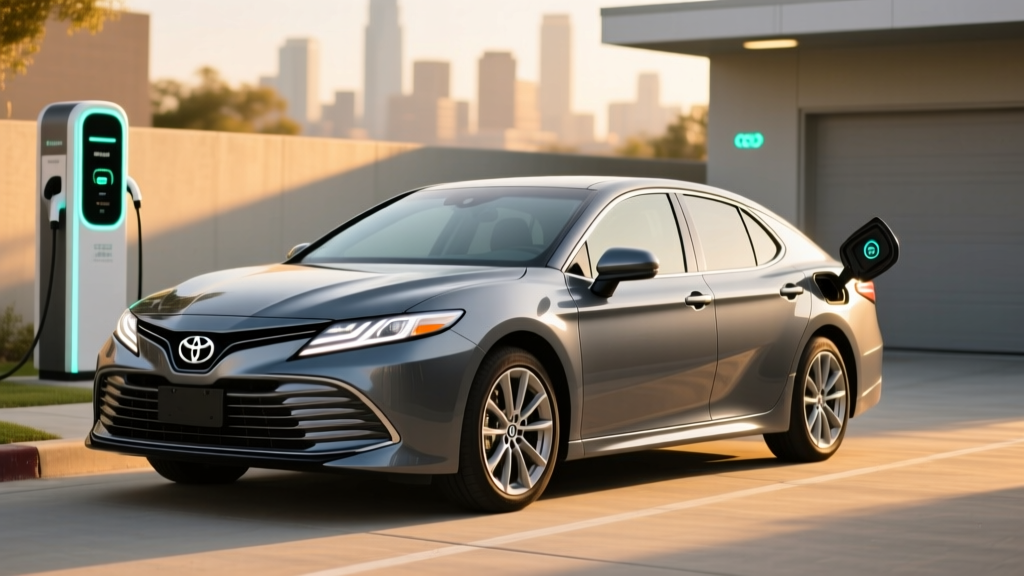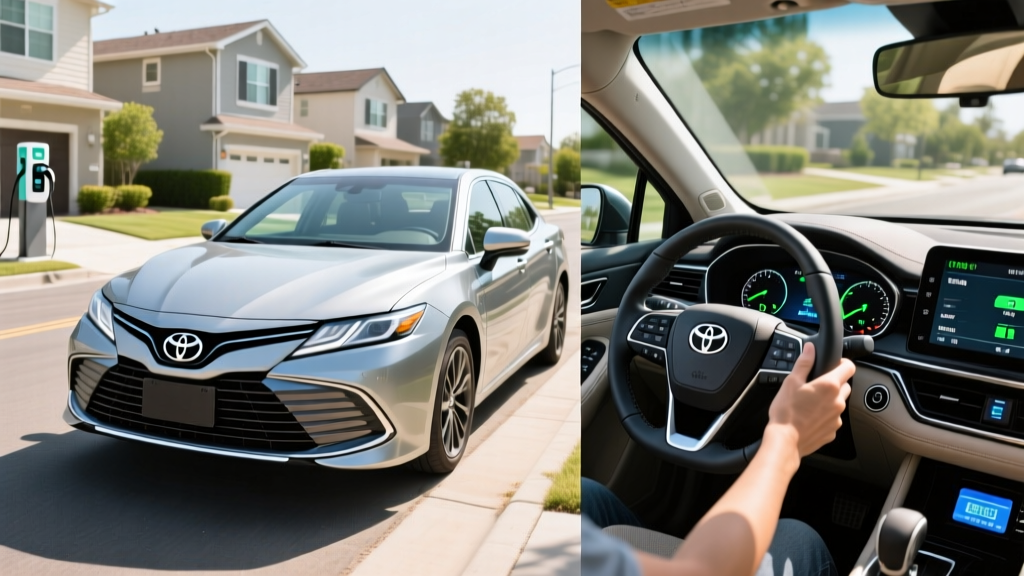
The 2021 Toyota Camry Hybrid SE occupies a specific niche in the midsize sedan market: it's the sportiest trim in Toyota's hybrid lineup, pairing a 2.5-liter four-cylinder engine with an electric motor for a combined 208 horsepower while returning EPA-estimated 44 city / 47 highway / 46 combined MPG. Now available exclusively on the used market, the Camry Hybrid SE remains a compelling choice for buyers who want hybrid efficiency without plug-in complexity or range anxiety.
This guide covers everything a 2026 used-car buyer needs to know — from verified fuel economy data and powertrain specs to battery longevity, replacement costs, and how the Camry Hybrid SE stacks up against PHEVs and full EVs in today's market.
HEV vs PHEV: What the Camry Hybrid Actually Is
The 2021 Camry Hybrid SE is a conventional hybrid electric vehicle (HEV), not a plug-in hybrid. This distinction matters enormously for ownership expectations:
| Feature | HEV (Camry Hybrid SE) | PHEV (e.g., Prius Prime) | BEV (e.g., Tesla Model 3) |
|---|---|---|---|
| Plugs in to charge? | No — self-charging via regen & engine | Yes — Level 1/2 charging | Yes — Level 1/2/DC fast charging |
| Electric-only range | ~1 mile at low speed | 25–44 miles typical | 250–360+ miles |
| Battery size | 1.6 kWh (NiMH) | 13–18 kWh (Li-ion) | 50–82 kWh (Li-ion) |
| Federal tax credit (§30D) | Not eligible | Up to $7,500 (if new, sourcing rules met) | Up to $7,500 (if new, sourcing rules met) |
| Home charging install needed? | No | Recommended (Level 2) | Essential (Level 2) |
| Gas engine? | Yes — primary + regenerative | Yes — backup after EV range | No |
The Camry Hybrid's 1.6 kWh nickel-metal hydride (NiMH) battery is small by electrified-vehicle standards. It cannot be plugged in and does not offer meaningful electric-only driving. Instead, the hybrid system continuously blends engine and motor power, using regenerative braking to recapture energy during deceleration. You fuel it like any conventional car — the efficiency gains come from the powertrain's intelligence, not from grid electricity.
Fuel Economy: EPA Ratings and Real-World MPG
The EPA rates the 2021 Camry Hybrid SE at 44 city / 47 highway / 46 combined MPG. These figures apply specifically to the SE trim with its 18-inch alloy wheels; the LE and XLE trims with smaller wheels achieve slightly higher ratings of 51/53/52 MPG combined.
| Camry Hybrid Trim | City MPG | Highway MPG | Combined MPG |
|---|---|---|---|
| LE / XLE | 51 | 53 | 52 |
| SE / XSE | 44 | 47 | 46 |
Real-world expectations: Toyota's hybrid system excels in stop-and-go city driving where regenerative braking and electric-motor assist do the heavy lifting. Many owners report exceeding the EPA city estimate by 2–4 MPG in heavy traffic. Highway driving at sustained 75+ MPH yields closer to 40–43 MPG, as aerodynamic drag and the Atkinson-cycle engine's efficiency curve work against it. In cold weather (below 30°F), expect a 5–10% reduction as the engine runs more frequently to maintain cabin heat and battery temperature.
13.2-gallon fuel tank × 46 MPG combined = ~607 miles per tank
Real-world mixed driving: expect 540–580 miles between fill-ups. Pure highway road trips: ~530 miles. City-heavy commutes: 620+ miles is achievable.
Powertrain Specs: 208 HP Hybrid System
| Specification | 2021 Camry Hybrid SE |
|---|---|
| Engine | 2.5L 4-cylinder Atkinson-cycle (176 hp, 163 lb-ft) |
| Electric motor | Permanent-magnet synchronous (118 hp, 149 lb-ft) |
| Net combined output | 208 hp |
| Transmission | ECVT (electronically controlled continuously variable) |
| Drivetrain | Front-wheel drive (AWD-e available on SE) |
| 0–60 mph | ~7.5 seconds |
| Hybrid battery | 1.6 kWh NiMH (245V nominal) |
| Fuel tank | 13.2 gallons |
| Curb weight | ~3,572 lbs |
The SE trim's sport tuning includes a stiffer suspension calibration, paddle shifters for simulated gear ratios, and a unique Sport drive mode that sharpens throttle response. The AWD-e variant adds a rear-axle electric motor (40 hp) that engages automatically under acceleration and low-traction conditions — a rare feature in the midsize hybrid sedan segment. Note that AWD-e reduces EPA ratings slightly to 44/43/44 MPG.
Battery Longevity, Warranty, and Replacement Cost
Toyota Hybrid Battery Warranty: 10 years / 150,000 miles (whichever comes first) in states that follow California emissions standards; 8 years / 100,000 miles in other states. For a 2021 model, coverage extends to approximately 2031 or 150K miles in CARB states.
Hybrid System Components Warranty: 8 years / 100,000 miles nationwide — covers the inverter, converter, and ECU.
Toyota's NiMH hybrid batteries have an exceptional longevity track record. Data from fleet operators and Consumer Reports reliability surveys show that Camry and Prius hybrid batteries routinely exceed 150,000 miles with minimal degradation. Unlike full EV batteries where 10–15% capacity loss is normal over 100K miles, the Camry's small NiMH pack is never deeply cycled — the hybrid system keeps it in a narrow state-of-charge window (roughly 40–80%) to maximize lifespan.
Replacement cost if out of warranty: A new OEM hybrid battery from Toyota runs approximately $2,500–$3,500 installed at a dealership. Refurbished or aftermarket NiMH modules are available for $1,200–$1,800 installed through independent hybrid specialists. Individual cell replacement (if only a few modules have degraded) can cost as little as $300–$600. For a 2021 model purchased in 2026 with under 75,000 miles, the battery will almost certainly remain under warranty for years to come.
Pricing and Tax Credit Reality
The 2021 Camry Hybrid SE originally carried an MSRP of approximately $29,570 (including destination). With the AWD-e option, that rose to roughly $31,040. As a used vehicle in 2026, expect pricing between $19,000–$26,000 depending on mileage, condition, and regional demand.
Federal tax credit status: The Camry Hybrid SE does not qualify for the IRS §30D clean vehicle credit. That credit is reserved for plug-in electric vehicles (PHEVs and BEVs) with battery capacities of at least 7 kWh. The Camry Hybrid's 1.6 kWh NiMH pack falls well short of this threshold.
However, if purchasing from a dealer as a qualified used vehicle under $25,000, the §25E used clean vehicle credit could apply — but only if the vehicle is a PHEV or BEV. Conventional HEVs like the Camry Hybrid are excluded from both new and used federal EV tax credits. Some states offer their own incentives for hybrid purchases, but these vary by jurisdiction and change frequently — check your state's energy office or DMV for current programs.
Camry Hybrid SE vs PHEV vs Full EV: Which Fits You?
Choose the 2021 Camry Hybrid SE if:
- You have no access to home or workplace charging
- You want 46+ MPG without changing your fueling habits
- Your budget is $20,000–$26,000 for a reliable used sedan
- You drive 12,000–20,000 miles/year and want to minimize fuel cost
- You live in an apartment or street-park and can't install a charger
Consider a PHEV (e.g., used Prius Prime) instead if:
- You have Level 2 charging access at home
- Your daily commute is under 25 miles (you could drive mostly electric)
- You want some EV experience without range anxiety on longer trips
Consider a full BEV (e.g., used Model 3 or Bolt) instead if:
- You have reliable home Level 2 charging
- Your daily driving is under 200 miles with predictable routes
- You want the lowest per-mile fuel cost and minimal maintenance
- You qualify for the §25E used EV credit ($4,000 on qualifying vehicles under $25K)
The Camry Hybrid SE's advantage is simplicity: no charging infrastructure needed, no range planning, no cold-weather range loss beyond what any gasoline car experiences. Its disadvantage is that you'll always pay for gasoline, even on short city trips where a PHEV or BEV would run on electricity alone at roughly one-third the per-mile energy cost.
Pros and Cons
Pros
- 46 MPG combined EPA — excellent for a sporty midsize sedan
- No plug-in charging required; zero lifestyle change from a gas car
- Proven Toyota hybrid reliability with 10yr/150K battery warranty (CARB states)
- SE sport suspension and paddle shifters add engagement
- AWD-e option available for snow-belt buyers
- Strong resale value; low battery replacement risk
Cons
- No federal or state EV tax credit eligibility
- SE's 18" wheels reduce MPG by 6 MPG vs LE trim
- ECVT drone under hard acceleration (common to Toyota hybrids)
- 1.6 kWh battery = virtually no electric-only driving
- Rear seat and trunk space slightly reduced vs gas Camry (battery placement)
- Infotainment (2021 generation) feels dated vs 2025+ competitors
Frequently Asked Questions
How many MPG does the 2021 Camry Hybrid SE actually get?
The EPA rates it at 44 city / 47 highway / 46 combined. In real-world driving, city-heavy commuters often see 47–50 MPG thanks to regenerative braking, while sustained 75 MPH highway driving drops to roughly 40–43 MPG. Cold weather (below 30°F) typically reduces economy by 5–10% across all conditions.
Does the Camry Hybrid need to be plugged in?
No. The 2021 Camry Hybrid SE is a conventional hybrid (HEV), not a plug-in hybrid (PHEV). It charges its small battery entirely through regenerative braking and the gasoline engine. You never plug it in — just fill the 13.2-gallon tank with regular 87-octane fuel.
Is the 2021 Camry Hybrid reliable, and what does battery replacement cost?
Toyota's hybrid system is among the most reliable powertrains in the industry. The NiMH battery is warranted for 10 years/150,000 miles in CARB states and 8 years/100,000 miles elsewhere. Out-of-warranty replacement runs $2,500–$3,500 for a new OEM pack, or $1,200–$1,800 for a refurbished unit. Most Camry hybrid batteries exceed 150,000 miles without issue.
Does the 2021 Camry Hybrid SE qualify for any tax credit?
No. Federal clean vehicle credits (§30D for new, §25E for used) require a battery capacity of at least 7 kWh and plug-in capability. The Camry Hybrid's 1.6 kWh NiMH battery disqualifies it. Some state-level incentives may apply — check your local energy office for current programs.
Should I buy the Camry Hybrid SE or a PHEV like the Prius Prime?
It depends on charging access. If you can install a Level 2 home charger and your daily commute is under 25 miles, a PHEV like the Prius Prime lets you drive mostly on electricity (25–44 miles EV range) with a gas backup for longer trips. If you lack charging access — apartment living, street parking, or no electrical panel capacity — the Camry Hybrid SE delivers strong MPG with zero infrastructure changes.
What's the difference between the Camry Hybrid SE and XSE?
The XSE adds a 9-inch touchscreen (vs 7-inch on SE), leather-trimmed heated front seats, ambient interior lighting, a panoramic glass roof option, and dual-zone climate control. Both share the same 208 hp powertrain and 44/47/46 MPG rating. The XSE typically commands a $2,000–$3,000 premium on the used market.
How does the AWD-e system work on the Camry Hybrid SE?
The AWD-e adds an independent 40 hp electric motor to the rear axle — no mechanical driveshaft connects it to the engine. It engages automatically during acceleration from stop and in low-traction conditions (rain, snow), then disengages at steady cruising speed to preserve efficiency. EPA ratings drop to 44/43/44 MPG. It's not a true off-road system but provides meaningful traction improvement in winter conditions.