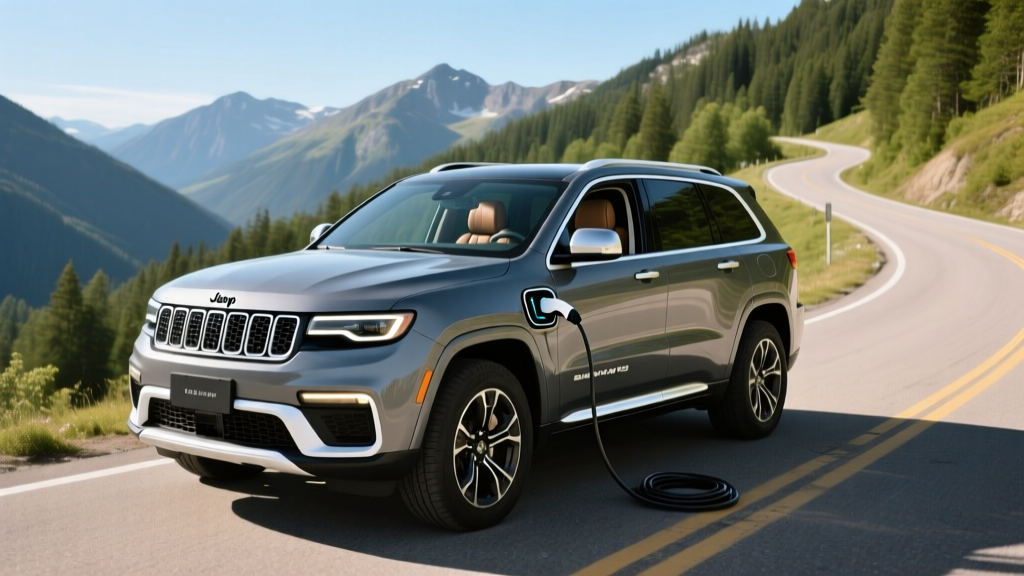
Quick Verdict: The Grand Cherokee 4xe in 2026
The 2026 Jeep Grand Cherokee 4xe remains one of the few plug-in hybrid SUVs that pairs genuine off-road capability with daily electric commuting. With 25 miles of EPA-rated electric-only range, 375 combined horsepower, and a 56 MPGe combined rating, it targets buyers who want electric weekday driving without sacrificing weekend trail or towing capability. But at a starting MSRP of $60,495, and with a real-world electric range that can dip below 20 miles in cold weather or highway driving, the 4xe demands a clear-eyed look at whether its PHEV powertrain fits your routine — or whether a conventional hybrid, full EV, or gas model serves you better.
| Spec | Value |
|---|---|
| Powertrain | 2.0L turbo I-4 + 2 electric motors + 8-speed auto |
| Combined Horsepower | 375 hp / 470 lb-ft torque |
| Battery (usable) | 17.3 kWh, NMC lithium-ion |
| EPA Electric Range | 25 miles |
| EPA MPGe (elec + gas) | 56 MPGe combined |
| EPA MPG (gas only) | 23 city / 24 hwy / 23 combined |
| Total Combined Range | |
| Level 2 Charge Time (0-100%) | ~2 hours at 7.4 kW |
| DC Fast Charging | Not supported |
| 0-60 mph | 6.0 seconds |
| Max Towing | 6,000 lbs |
| Base MSRP (4xe base) | $60,495 |
| Federal Tax Credit (§30D) | Up to $3,750 (sourcing dependent) |
| Battery Warranty | 8 years / 100,000 miles |
Sources: EPA fueleconomy.gov, Jeep.com 2026 Grand Cherokee 4xe
HEV vs. PHEV: What the Grand Cherokee Actually Offers
Jeep sells the Grand Cherokee with two distinct electrified options, and confusing them is a common buyer mistake:
| Feature | Conventional Hybrid (HEV) | 4xe Plug-In Hybrid (PHEV) |
|---|---|---|
| Needs to plug in? | No — self-charging via regen & engine | Yes — plug in for electric range |
| Electric-only driving | Brief low-speed assist only | 25 miles EPA at full highway speed |
| Battery size | ~1.8 kWh (small buffer) | 17.3 kWh usable |
| EPA Combined | ~24 MPG combined | 56 MPGe / 23 MPG gas-only |
| Starting MSRP | ~$42,000 (est.) | $60,495 |
| Federal tax credit | None | Up to $3,750 (§30D, sourcing dependent) |
| Best for | Drivers who can't charge at home | Drivers with home charging + short commutes |
The conventional HEV is a mild-electrification play: a small battery captures regenerative braking energy and assists the gas engine, improving MPG slightly without any plug. The 4xe PHEV is a fundamentally different proposition — a large traction battery and twin electric motors let you drive 25 miles on electricity alone before the 2.0L turbo engine takes over. If you can charge at home and your daily round-trip commute is under 25 miles, you may go weeks without burning fuel.
Electric Range, MPGe, and Real-World MPG
EPA Electric Range: 25 miles
Real-world expectation: 18–22 miles in mixed driving; as low as 15–17 miles in sustained cold weather (below 32°F) or at highway speeds above 70 mph. In warm city driving with regen, some owners report reaching 27–28 miles.
| Mode | City | Highway | Combined |
|---|---|---|---|
| Charge-depleting (MPGe) | 59 MPGe | 54 MPGe | 56 MPGe |
| Charge-sustaining (gas only) | 23 MPG | 24 MPG | 23 MPG |
The dual rating matters. When the battery is charged, the 4xe operates in electric or blended mode and achieves 56 MPGe. Once the battery depletes (after ~25 miles), the SUV reverts to gas-only operation at 23 MPG combined — which is competitive for a 5,100-lb body-on-frame-style SUV but not class-leading among midsize crossovers.
Real-world MPG note: PHEVs reward consistent charging. If you plug in nightly and commute 20 miles round-trip, your observed fuel consumption may approach zero on weekdays. If you never plug in, you're carrying 17.3 kWh of battery weight for no benefit, and 23 MPG is what you'll see. Hybrids often exceed EPA city estimates in stop-and-go traffic thanks to regenerative braking — expect 24–26 MPG city in gas-only mode if you drive gently.
Powertrain and Performance
The 4xe powertrain pairs a 2.0-liter turbocharged inline-four (270 hp alone) with two electric motor-generators integrated into the 8-speed automatic transmission. Combined output is 375 horsepower and 470 lb-ft of torque — more torque than the V-8 Grand Cherokee of the prior generation. The result is a 0-60 mph time of approximately 6.0 seconds, which feels genuinely brisk in a vehicle this size.
Three drive modes manage the powertrain:
- Electric: Pure battery-electric driving up to ~87 mph; engine stays off unless you floor the accelerator.
- Hybrid: The default mode — blends electric and gas for optimal efficiency.
- eSave: Preserves battery charge for later use (e.g., saving electric miles for a city zone after a highway stretch).
The 4xe retains Jeep's Quadra-Trac II 4WD system and available air suspension, meaning it's rated for 6,000 lbs of towing and can handle moderate off-road trails in electric mode at low speeds. No other PHEV in this price bracket matches that combination.
Charging: Level 2 Only, No DC Fast Charge
The Grand Cherokee 4xe uses a standard J1772 connector for AC charging. Here's what to expect:
| Level | Power (kW) | Time (0-100%) | Miles of Range Added per Hour |
|---|---|---|---|
| Level 1 (120V outlet) | ~1.4 kW | ~12 hours | ~4 miles/hr |
| Level 2 (240V, 32A) | 7.4 kW | ~2 hours | ~12 miles/hr |
| DC Fast Charge | Not supported — J1772 AC inlet only | ||
The lack of DC fast charging is a notable limitation for road trips. However, for a PHEV with a 17.3 kWh battery, the use case is home charging: plug in when you arrive, and 2 hours later you're full. A Level 2 home charger (240V, 32-amp circuit) is strongly recommended. Installation typically costs $500–$1,500 depending on panel proximity and local permit requirements — budget $1,200 on average for a quality Level 2 unit plus electrician labor.
kW vs. kWh reminder: The onboard charger is rated at 7.4 kW (power — how fast energy flows). The battery holds 17.3 kWh (energy — total capacity). At 7.4 kW, filling 17.3 kWh takes roughly 2.3 hours, minus taper near full charge.
Pricing, Trims, and Federal Tax Credit Eligibility
The 2026 Grand Cherokee 4xe is offered across multiple trims:
- 4xe (base): $60,495
- 4xe Trailhawk: ~$66,495
- 4xe Overlook: ~$68,495
- 4xe Summit Reserve: ~$75,495
Federal §30D Tax Credit — Eligibility Checklist (2026 rules):
- MSRP cap for SUVs: $80,000 — all 4xe trims qualify on price ✓
- Buyer income cap: $150K single / $300K joint (MAGI) — verify against your tax return
- Battery critical-mineral sourcing: partial credit ($3,750) likely; full $7,500 depends on 2026 sourcing thresholds — check IRS.gov for current VIN-specific eligibility
- Point-of-sale transfer: available — you can apply the credit as a down-payment reduction at the dealer
- Must be new, for personal use, primarily in the U.S.
Note: PHEV credit is generally lower than full BEV credit due to smaller battery capacity. Verify your specific VIN on the IRS clean vehicle credit lookup before purchase. Tax rules change — consult a tax professional.
Battery Warranty, Reliability, and Replacement Cost
High-Voltage Battery Warranty: 8 years / 100,000 miles (whichever comes first), with a capacity-retention threshold of 70%. If the battery degrades below 70% of original capacity within the warranty period, Jeep will repair or replace it at no cost.
Powertrain Warranty: 5 years / 60,000 miles
Stellantis (Jeep's parent) has been building the 4xe powertrain since 2021, first in the Wrangler 4xe and then the Grand Cherokee 4xe. Long-term reliability data for the Grand Cherokee variant is still maturing, but the Wrangler 4xe — which shares the core 2.0L + dual-motor architecture — has accumulated hundreds of thousands of fleet and consumer miles. Known issues include occasional software glitches in the hybrid control module and thermal-management complaints in extreme heat, but no widespread battery-pack failures.
Battery replacement cost: If out of warranty, a Grand Cherokee 4xe battery pack replacement runs approximately $12,000–$16,000 including labor. However, PHEV batteries experience less stress than full BEV packs (smaller depth-of-discharge cycles, less frequent 100% charges) and typically retain 85–90% capacity after 8 years of normal use. Most owners will never face an out-of-pocket replacement.
General reliability: The Grand Cherokee (all powertrains) scores average to slightly below average in J.D. Power and Consumer Reports reliability surveys, largely due to infotainment and electrical gremlins rather than powertrain failures. The 4xe-specific components have held up comparably to the gas-only V-6 model.
Who Should Buy the Grand Cherokee 4xe?
Choose the Grand Cherokee 4xe PHEV if:
- You can install a Level 2 charger at home and your daily commute is ≤25 miles round-trip
- You need towing capacity (6,000 lbs) or off-road ability that most EVs can't match
- You want to reduce fuel consumption without range anxiety on long road trips
- You value the 375-hp torque fill and near-silent electric driving around town
Choose a full BEV (e.g., Rivian R1S, Tesla Model X) if:
- You want zero tailpipe emissions and 300+ miles of range
- You have reliable home and destination charging
- You don't need body-on-frame towing or serious off-road clearance
Choose the conventional Grand Cherokee HEV if:
- You can't charge at home (apartment, street parking, no garage)
- You want a lower purchase price (~$18,000 less than the 4xe)
- Your priority is simple MPG improvement without plug-in logistics
Choose the gas-only Grand Cherokee if:
- You drive mostly highway miles where PHEV electric range provides minimal benefit
- Upfront cost is your primary concern
Pros
- 25-mile electric range covers most commutes
- 375 hp / 470 lb-ft — strongest torque in the segment
- 6,000-lb towing + real off-road capability
- No range anxiety — gas engine covers long trips
- 8-year/100K-mile battery warranty
Cons
- $60,495 starting price is steep
- No DC fast charging
- Gas-only MPG (23 combined) is mediocre when battery depletes
- Real-world electric range drops to ~17 miles in cold weather
- Federal tax credit likely $3,750, not $7,500
- Reliability ratings are average, not class-leading
Frequently Asked Questions
How many MPG does the Jeep Grand Cherokee 4xe get?
The EPA rates it at 56 MPGe combined when operating with a charged battery (electric + gas blended). Once the battery depletes after ~25 miles, it operates as a conventional hybrid at 23 city / 24 highway / 23 combined MPG. Your actual fuel consumption depends entirely on how often you charge — nightly chargers on short commutes may use almost no gasoline on weekdays.
How far can the Grand Cherokee 4xe go on electric only?
The EPA rates it at 25 miles of electric-only range. In real-world driving, expect 18–22 miles in mixed conditions, 15–17 miles in cold weather or sustained highway speeds above 70 mph, and up to 27–28 miles in warm city driving with regenerative braking. The electric motor can propel the SUV up to ~87 mph before the engine must engage.
Does the Grand Cherokee 4xe qualify for a federal tax credit?
It may qualify for up to $3,750 under the IRS §30D clean vehicle credit, depending on battery-critical-mineral sourcing requirements for the 2026 tax year. The full $7,500 is unlikely due to partial sourcing compliance. Buyer income must not exceed $150K (single) or $300K (joint), and the MSRP must be under $80,000 (all 4xe trims qualify). The credit can be transferred at the point of sale as a down-payment reduction. Always verify your specific VIN on IRS.gov before purchasing.
Is the Grand Cherokee 4xe reliable, and what does a battery replacement cost?
The 4xe powertrain has been in production since 2021 (Wrangler 4xe) with no widespread battery failures reported. The high-voltage battery is warranted for 8 years / 100,000 miles at a 70% capacity-retention threshold. Out-of-warranty battery replacement costs approximately $12,000–$16,000, but most PHEV batteries retain 85–90% capacity after 8 years. Overall vehicle reliability is average — expect occasional infotainment or sensor issues rather than powertrain problems.
Should I get the PHEV, a conventional hybrid, or a full EV?
If you can charge at home and commute under 25 miles daily but need towing and off-road capability, the 4xe PHEV is ideal. If you can't charge at home, the conventional Grand Cherokee HEV is simpler and $18,000 cheaper. If you want zero emissions, 300+ mile range, and don't need serious towing, a full BEV like the Rivian R1S or Hyundai Ioniq 5 (for smaller needs) offers lower running costs and a smoother driving experience.
Can the Grand Cherokee 4xe DC fast charge?
No. The 4xe has a J1772 AC inlet only and supports Level 2 charging at up to 7.4 kW (full charge in ~2 hours). There is no DC fast-charge port. For a PHEV with a 17.3 kWh battery designed for overnight home charging, this is standard — but it means no quick top-ups on road trips.
How much does it cost to charge the Grand Cherokee 4xe at home?
Filling the 17.3 kWh battery from empty at the U.S. average residential electricity rate of ~$0.17/kWh costs approximately $2.94. That buys you ~25 miles of electric driving, or roughly $0.12 per mile — compared to $0.22–$0.28 per mile on gasoline at $3.50/gallon and 23 MPG. Over a year of weekday electric commuting (250 days × 20 miles), you'd spend ~$588 on electricity vs. ~$1,100 on gasoline.
Always verify current pricing, tax credit eligibility, and specifications on Jeep.com and fueleconomy.gov before purchasing. Rules and specs may change for the 2026 model year.