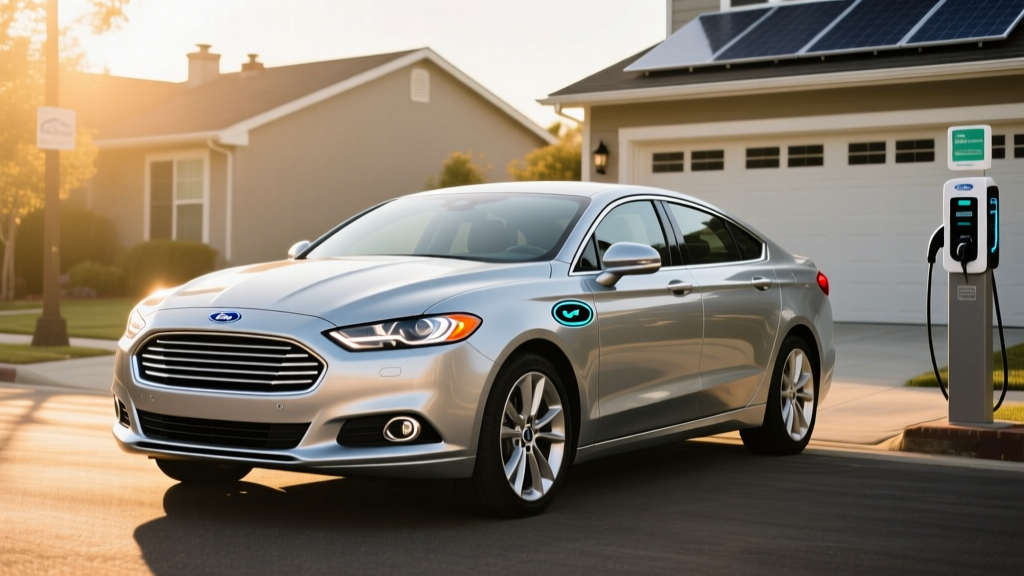
The 2015 Ford Fusion Hybrid remains one of the most-searched used hybrid cars more than a decade after its release — and for good reason. With an EPA-estimated 42 MPG combined, a comfortable midsize sedan cabin, and a hybrid powertrain that has proven remarkably durable, it represents a compelling entry point for buyers who want hybrid fuel savings without the premium of a new vehicle. But buying a decade-old hybrid raises specific questions: How does the battery hold up? What does replacement cost? And how does it compare to modern hybrids and plug-in hybrids on the market today?
This guide covers everything you need to know about the 2015 Ford Fusion Hybrid as a used purchase in 2026, including real-world fuel economy data, battery longevity, ownership costs, and how it stacks up against newer alternatives.
2015 Ford Fusion Hybrid: Powertrain and Performance Specs
The 2015 Fusion Hybrid pairs a 2.0-liter Atkinson-cycle four-cylinder gasoline engine with an electric motor and a 1.4 kWh lithium-ion battery pack. Unlike a plug-in hybrid (PHEV), this is a conventional hybrid electric vehicle (HEV) — it never needs to be plugged in. The battery recharges through regenerative braking and the gasoline engine.
| Specification | Value |
|---|---|
| Engine | 2.0L Atkinson-cycle I-4 |
| Engine HP | 141 hp @ 6,000 rpm |
| Electric Motor | 88 kW (118 hp) AC synchronous |
| Combined System Output | 188 hp (net) |
| Hybrid Battery | 1.4 kWh lithium-ion (air-cooled) |
| Transmission | eCVT (planetary gearset) |
| Drivetrain | Front-wheel drive |
| 0–60 mph | ~8.3 seconds |
| EPA Fuel Economy | 44 city / 41 highway / 42 combined MPG |
| Fuel Tank | 13.5 gallons |
| Total Range | ~567 miles |
The eCVT is not a traditional belt-and-pulley CVT. It uses a planetary gearset to blend power from the engine and motor, which means no shifting sensations and no belt to wear out — a key reliability advantage over some competitors from this era.
Fuel Economy: EPA Ratings vs. Real-World MPG
The EPA rates the 2015 Fusion Hybrid at 44 MPG city, 41 MPG highway, and 42 MPG combined. That city-leading number is typical of conventional hybrids, which rely heavily on electric-motor assist at low speeds and in stop-and-go traffic.
| Driving Condition | EPA MPG | Real-World Expectation |
|---|---|---|
| City | 44 MPG | 40–46 MPG (hybrids often beat EPA in city) |
| Highway | 41 MPG | 36–40 MPG (aero drag, sustained speed) |
| Combined | 42 MPG | 38–43 MPG |
| Cold Weather (below 32°F) | — | 33–38 MPG (engine runs more for heat) |
According to fueleconomy.gov, real-world Fusion Hybrid drivers report averages between 38 and 44 MPG. City-heavy commuters often exceed the EPA combined estimate, while highway-dominant drivers should expect numbers in the high 30s. Cold weather significantly impacts hybrid efficiency because the gasoline engine must run more frequently to provide cabin heat, reducing electric-only driving time.
For context, the average 2015 midsize gasoline sedan achieved around 26–28 MPG combined. The Fusion Hybrid's 42 MPG combined translates to roughly $550–$650 in annual fuel savings over a comparable gas-only Fusion (at 15,000 miles/year and $3.20/gallon).
Conventional Hybrid (HEV) vs. Plug-In Hybrid (PHEV): What the Fusion Offers
The 2015 Fusion was also sold as the Fusion Energi, a plug-in hybrid variant. Understanding the difference is critical for used buyers.
| Fusion Hybrid (HEV) | Fusion Energi (PHEV) | |
|---|---|---|
| Plug-in charging? | No — never plugs in | Yes — Level 1 (120V) or Level 2 (240V) |
| Electric-only range | ~1 mile at low speed | ~19 miles (EPA) |
| Battery size | 1.4 kWh | 7.6 kWh |
| Total range | ~567 miles | ~550 miles (electric + gas) |
| MPG (after battery depleted) | 42 combined | 38 combined |
| MPGe (electric mode) | N/A | 88 MPGe |
| Federal tax credit (original) | None | ~$3,750 (expired for new purchases) |
The conventional Fusion Hybrid is the better choice if you lack access to a charging outlet and want maximum simplicity. The Energi PHEV makes sense only if you have reliable home charging and a short commute that can be completed on electric power alone. However, the Energi's larger battery adds weight, reducing its gas-only MPG to 38 combined once the electric range is depleted.
Battery Longevity, Warranty, and Replacement Costs
The single biggest concern for any used hybrid buyer is the traction battery. The 2015 Fusion Hybrid's 1.4 kWh lithium-ion pack is air-cooled and relatively small, which actually works in its favor — smaller batteries experience less thermal stress, and Ford's hybrid system is conservative with charge/discharge cycles.
Ford warranted the 2015 Fusion Hybrid battery for 8 years / 100,000 miles (10 years / 150,000 miles in California Air Resources Board states including CA, CT, MA, ME, MD, NJ, NY, OR, RI, VT, WA). For a 2015 model, original factory coverage has now expired in most cases as of 2023–2025, depending on mileage.
Real-world battery lifespan data: The 2015 Fusion Hybrid uses a hybrid architecture shared with the C-Max Hybrid and Lincoln MKZ Hybrid. Fleet and taxi data from these platforms show the 1.4 kWh lithium-ion battery routinely lasting 150,000–200,000+ miles before significant degradation. Because the battery is so small and the system never deeply cycles it (Ford's software maintains a narrow state-of-charge window), degradation is gradual rather than sudden.
Battery replacement cost (2026 estimates):
- Remanufactured hybrid battery module: $1,800–$2,800 installed
- New OEM battery from Ford: $3,000–$4,200 installed (if still available)
- Individual cell/module repair by hybrid specialist: $800–$1,500
The good news: unlike a full EV with a 75+ kWh battery costing $10,000–$20,000 to replace, the Fusion Hybrid's small battery keeps replacement costs manageable. Many independent hybrid shops now offer module-level repairs rather than full-pack replacements.
Reliability, Safety, and Common Issues
The 2015 Fusion Hybrid rates well for long-term reliability. The eCVT planetary gearset has no wear-prone belts or clutches, and the Atkinson-cycle engine runs under less stress than a conventional engine. The NHTSA gave the Fusion Hybrid a 5-star overall safety rating, and the IIHS named it a Top Safety Pick.
Common issues reported by owners:
- 12V auxiliary battery drain: The conventional 12V battery (which boots the hybrid system) can fail every 3–5 years. If the car won't start, this is usually the culprit — not the hybrid battery.
- Brake actuator recall: Ford issued a recall for certain 2013–2018 Fusion Hybrids related to the brake system. Verify recall completion on NHTSA.gov using the VIN.
- Coolant leak (inverter): Some owners report coolant seepage around the power electronics cooling system at higher mileages. Inspect for crusty residue near the inverter.
- Regenerative braking feel: The transition between regen and friction braking can feel abrupt — this is normal for this generation, not a defect.
Used Pricing and Tax Credit Eligibility
As of early 2026, the 2015 Ford Fusion Hybrid trades in the used market between $8,500 and $14,000, depending on mileage, condition, and trim (S, SE, Titanium). The original MSRP ranged from approximately $26,995 to $33,195.
Under IRS §25E (Previously Owned Clean Vehicle Credit), you may qualify for up to $4,000 or 30% of the sale price (whichever is less) when purchasing a used 2015 Fusion Hybrid from a licensed dealer, provided:
- The sale price is $25,000 or less (the Fusion Hybrid easily qualifies)
- Your modified adjusted gross income is ≤ $75,000 (single), $112,500 (head of household), or $150,000 (joint)
- The vehicle is purchased from a licensed dealer (private-party sales do not qualify)
- The vehicle model year is at least two years older than the current year (2015 qualifies for 2026)
- You have not claimed the used-vehicle credit for another vehicle in the past 3 years
At a typical $11,000 purchase price, the credit would be $3,300 (30% of $11,000). This can be applied as a point-of-sale reduction through a participating dealer. Always consult a tax professional and verify current IRS rules, as credit parameters may change.
Important: The original §30D new vehicle credit that applied to the Fusion Energi PHEV is not relevant for used purchases. The used-vehicle credit (§25E) is the applicable provision, and it covers both HEVs and PHEVs — meaning the conventional Fusion Hybrid qualifies.
2015 Fusion Hybrid vs. Modern Alternatives: What Has Changed
Ten years of hybrid development have moved the needle, but not as dramatically as you might expect. Here's how the 2015 Fusion Hybrid compares to current benchmarks:
| Vehicle | EPA Combined MPG | Combined HP | 2026 Used Price Range |
|---|---|---|---|
| 2015 Ford Fusion Hybrid | 42 MPG | 188 hp | $8,500–$14,000 |
| 2015 Toyota Camry Hybrid | 41 MPG | 200 hp | $9,000–$14,500 |
| 2015 Honda Accord Hybrid | 47 MPG | 196 hp | $9,500–$15,000 |
| 2017 Hyundai Sonata Hybrid | 40 MPG | 193 hp | $10,000–$15,500 |
The 2015 Accord Hybrid edges ahead on fuel economy, while the Camry Hybrid is known for slightly better long-term resale. The Fusion Hybrid's advantage is its driving dynamics — it was widely regarded as the best-handling midsize hybrid sedan of its generation, with a more planted feel and better steering feedback than its competitors.
Who Should Buy the 2015 Ford Fusion Hybrid?
- You want 40+ MPG without plugging in
- You need a spacious midsize sedan with a usable trunk (12.2 cu ft)
- Your budget is under $15,000
- You commute in city/suburban traffic where hybrid efficiency shines
- You want a comfortable, quiet highway cruiser
- You qualify for the §25E used-vehicle credit
- You want electric-only commuting (consider a PHEV or BEV)
- You need AWD (not available on the 2015 Fusion Hybrid)
- You want the latest infotainment and ADAS features
- You drive mostly highway miles (a diesel or efficient gas car may close the gap)
- You need cargo flexibility (the hybrid battery reduces trunk space vs. the gas Fusion)
Frequently Asked Questions
How many MPG does the 2015 Ford Fusion Hybrid actually get?
The EPA rates it at 44 city / 41 highway / 42 combined MPG. Real-world owners report 38–44 MPG depending on driving mix. City-heavy drivers often exceed the combined rating; highway-dominant and cold-weather driving reduces it to the mid-to-high 30s.
Does the 2015 Fusion Hybrid need to be plugged in?
No. The Fusion Hybrid is a conventional hybrid (HEV). It charges its own 1.4 kWh battery through regenerative braking and the gasoline engine. You simply fill it with gas like any other car. The Fusion Energi is the plug-in variant — do not confuse the two.
Is the 2015 Fusion Hybrid reliable, and what does a battery replacement cost?
The hybrid system has proven very reliable, with many examples exceeding 200,000 miles on the original battery. If replacement is needed, expect $1,800–$2,800 for a remanufactured unit or $3,000–$4,200 for new OEM. Module-level repairs can cost as little as $800–$1,500.
Does the 2015 Fusion Hybrid qualify for any tax credit in 2026?
Yes — as a used purchase from a licensed dealer, it may qualify for the IRS §25E Previously Owned Clean Vehicle Credit: up to $4,000 or 30% of the sale price (whichever is less), subject to income limits and the $25,000 sale-price cap. At typical used prices, most buyers would receive approximately $2,500–$3,500.
Hybrid vs. PHEV vs. EV — which should I choose?
HEV (like this Fusion Hybrid): Best if you can't charge at home and want maximum simplicity. No plug, no range anxiety, just better MPG.
PHEV: Best if you have home charging and a short commute (under 25 miles). You drive electric daily and use gas for longer trips.
Full EV (BEV): Best if you have reliable home or workplace charging, drive under 250 miles daily, and want the lowest per-mile fuel cost and minimal maintenance. Higher upfront cost but lowest total cost of ownership over 5+ years.
How does the Fusion Hybrid's trunk space compare to the gas model?
The hybrid battery sits behind the rear seats, reducing trunk capacity to 12.2 cubic feet versus 16.0 cu ft in the gasoline Fusion. The trunk pass-through is also narrower. If you regularly carry large cargo, this is a meaningful compromise.