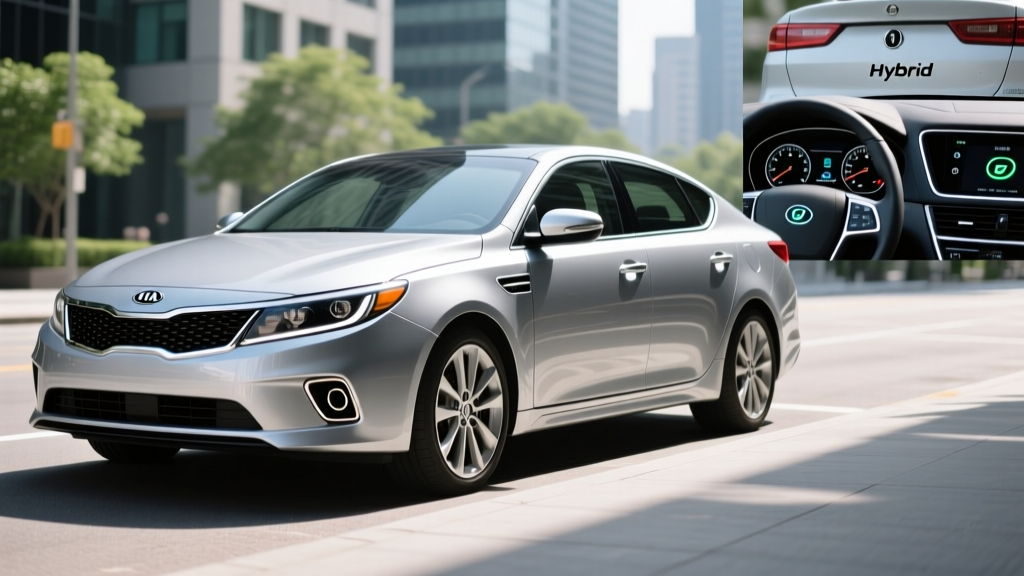
The 2012 Kia Optima Hybrid EX was Kia's first serious entry into the midsize hybrid sedan segment, going head-to-head with the Toyota Camry Hybrid and Ford Fusion Hybrid. Over a decade later, it remains a popular choice on the used market for buyers who want hybrid fuel economy without the complexity of plug-in charging. If you're researching the 2012 Kia Optima Hybrid EX as a potential used purchase, this guide covers every number that matters — from EPA MPG to battery replacement cost — so you can buy with confidence.
2012 Kia Optima Hybrid EX: Key Specifications
| Spec | Value |
|---|---|
| Powertrain Type | Conventional Hybrid (HEV) — no plug-in |
| Engine | 2.4L 4-cylinder Atkinson-cycle (169 hp) |
| Electric Motor | 35 kW (47 hp) |
| Combined System Output | 206 hp / 195 lb-ft torque |
| Transmission | 6-speed automatic |
| Hybrid Battery | 1.43 kWh lithium-polymer (Li-Po) |
| EPA MPG (City / Hwy / Combined) | 35 / 39 / 36 |
| Fuel Tank | 17.2 gallons |
| 0–60 mph | ~8.8 seconds |
| Original MSRP (2012) | ~$27,700 (EX trim, incl. destination) |
| Typical Used Price (2026) | $6,000–$10,500 (depending on mileage/condition) |
HEV vs PHEV: Where the Optima Hybrid Fits
Before diving into fuel economy, it's essential to understand what the 2012 Optima Hybrid is — and what it isn't.
| Feature | 2012 Optima Hybrid (HEV) | Plug-In Hybrid (PHEV) Example | Full EV (BEV) |
|---|---|---|---|
| Plug-in Charging Required? | No — self-charging via regen & engine | Yes — must plug in for EV range | Yes — must plug in to drive |
| Electric-Only Range | ~1 mile at very low speeds | 20–50 miles typical | 200–400+ miles |
| Fuel Required | Gasoline | Gasoline + electricity | Electricity only |
| Federal Tax Credit (New) | None | Up to $7,500 (§30D, if eligible) | Up to $7,500 (§30D, if eligible) |
| Best For | Drivers without home charging access | Short commutes + road trip flexibility | Home charging + low running costs |
The 2012 Optima Hybrid EX is a conventional hybrid (HEV). It charges its small 1.43 kWh battery through regenerative braking and the gasoline engine. You never plug it in. Kia did not offer a plug-in variant of this generation — the Optima PHEV didn't arrive until the 2017 model year with a 9.8 kWh battery and 27 miles of electric-only range.
Fuel Economy: EPA Ratings vs Real-World MPG
| Driving Condition | EPA Rating | Real-World Expectation |
|---|---|---|
| City | 35 MPG | 33–38 MPG (hybrids often beat EPA in city) |
| Highway | 39 MPG | 35–39 MPG (sustained 75+ mph drops efficiency) |
| Combined | 36 MPG | 34–37 MPG typical mixed driving |
Like most conventional hybrids, the Optima Hybrid EX tends to perform best in stop-and-go city driving, where regenerative braking recaptures energy and the electric motor handles low-speed propulsion. In real-world ownership, many drivers report seeing 34–37 MPG combined, which aligns closely with the EPA estimate.
Cold-weather note: Expect a 5–10% fuel economy drop in freezing temperatures. The engine runs more often to maintain cabin heat and battery temperature, reducing electric-motor assist time. Owners in northern climates typically see 31–34 MPG combined in winter months.
With a 17.2-gallon tank and 36 MPG combined, the Optima Hybrid delivers roughly 619 miles of total range between fill-ups — competitive with its segment rivals and significantly better than the gas-only Optima's ~470-mile range.
Powertrain Deep Dive: How the Hybrid System Works
The 2012 Optima Hybrid uses a parallel hybrid architecture combining:
- 2.4-liter Atkinson-cycle 4-cylinder engine: 169 hp and 155 lb-ft of torque. The Atkinson cycle sacrifices some low-end power for greater thermal efficiency — a hallmark of hybrid-optimized engines.
- 35 kW (47 hp) electric motor: Mounted between the engine and transmission, it provides launch assist, electric-only crawling at low speeds, and regenerative braking.
- 6-speed automatic transmission: Unlike the Toyota Camry Hybrid's CVT (eCVT), Kia chose a conventional 6-speed automatic. This gives more natural shift feel but slightly less seamless electric-to-gas transitions.
- 1.43 kWh lithium-polymer battery pack: Located behind the rear seats, it's compact but cuts into trunk space (9.9 cu ft vs 15.4 cu ft in the gas Optima).
The combined system output of 206 hp is competitive for the era, though the transition between electric and gas power can feel less refined than Toyota's Hybrid Synergy Drive. Some owners report a brief hesitation during initial acceleration as the system engages the engine — a characteristic of early parallel-hybrid designs.
Battery Longevity, Warranty, and Replacement Cost
Original Hybrid Battery Warranty
- Coverage: 10 years / 100,000 miles (whichever comes first)
- What's covered: Defects and capacity loss below functional thresholds
- Transferable? No — Kia's 10-year powertrain/hybrid warranty applies to the original owner only. Second owners receive 5 years / 60,000 miles of powertrain coverage.
For a 2012 model in 2026, the original 10-year/100,000-mile hybrid battery warranty has expired by age (the warranty window closed in 2022 at the latest). This means any battery failure is now an out-of-pocket expense.
Battery replacement cost: A new OEM hybrid battery pack for the 2012 Optima Hybrid typically runs $2,500–$4,000 including parts and labor at a Kia dealership. Independent hybrid specialists may offer refurbished or reconditioned packs for $1,500–$2,500. Individual cell module replacement (if only a few cells have degraded) can cost $500–$1,200, but requires a technician with hybrid battery diagnostic equipment.
Real-world longevity data: Kia's lithium-polymer hybrid batteries in this generation have proven moderately durable. Many examples reach 120,000–150,000 miles without major degradation, though capacity loss becomes noticeable after 10+ years regardless of mileage. Signs of a failing hybrid battery include:
- Reduced fuel economy (2–5 MPG drop from baseline)
- More frequent engine engagement at low speeds
- Hybrid system warning light on the dash
- Reduced regenerative braking strength
Pre-purchase tip: Before buying a used 2012 Optima Hybrid, have a hybrid-qualified mechanic perform a battery state-of-health (SoH) check using an OBD-II scanner with hybrid battery diagnostics. This reveals individual cell voltage balance and overall capacity — critical data that a standard pre-purchase inspection won't catch.
Tax Credits and Used Purchase Economics
The 2012 Kia Optima Hybrid EX does not qualify for any current federal tax credit. Here's why:
- The federal §30D new clean vehicle credit applies only to new vehicle purchases, and the Optima Hybrid (as a conventional HEV) never qualified even when new — the credit requires plug-in capability with a minimum 4 kWh battery for PHEVs or full BEVs.
- The used clean vehicle credit (up to $4,000 or 30% of sale price, whichever is less) applies only to used BEVs and PHEVs — not conventional hybrids. Source: IRS Used Clean Vehicle Credit.
That said, at a 2026 used price of $6,000–$10,500, the Optima Hybrid EX remains an affordable entry into hybrid ownership. The real economic advantage is at the pump:
| Annual Fuel Cost Comparison (12,000 miles/year) | |||
|---|---|---|---|
| Vehicle | MPG Combined | Gallons Used | Annual Cost (@ $3.40/gal) |
| 2012 Kia Optima Hybrid EX | 36 | 333 | $1,132 |
| 2012 Kia Optima (gas, 2.4L) | 26 | 462 | $1,571 |
| Annual savings (Hybrid vs Gas) | — | ~$439/year | |
Over five years of ownership, the hybrid saves roughly $2,200 in fuel costs compared to its gas-only sibling — a meaningful offset against the used purchase price, though not enough to match the per-mile savings of a modern EV charged on off-peak electricity rates.
Reliability and Common Issues
The 2012 Optima Hybrid's overall reliability is average to slightly below average for its class. Key areas to watch:
- Hybrid system: Generally reliable, but early-production units (2011–2012) had some reports of hybrid control module failures and battery cooling fan issues.
- Transmission: The 6-speed automatic in this generation has drawn complaints for rough shifts and occasional shudder during engine-motor transitions. Kia issued software updates to address this — confirm any used example has had TSB updates applied.
- Brakes: Regenerative braking extends pad life significantly. Many owners report 80,000+ miles on original brake pads.
- Trunk space: The hybrid battery pack reduces cargo volume to 9.9 cu ft — a significant compromise vs the gas model's 15.4 cu ft. If you need trunk space for luggage or groceries, test-pack before buying.
For safety context, the 2012 Optima earned a Top Safety Pick from the IIHS and a 5-star overall rating from NHTSA.
Who Should Buy the 2012 Optima Hybrid EX — And Who Shouldn't
Choose the Optima Hybrid EX if:
- You want hybrid MPG without plug-in charging infrastructure
- Your budget is under $11,000 for a used hybrid sedan
- You drive 10,000–15,000 miles/year and want lower fuel costs
- You prefer a conventional automatic transmission over a CVT
- You don't need large trunk cargo space
Skip the Optima Hybrid EX if:
- You want plug-in electric-only range (look at a used Prius Prime or Optima PHEV instead)
- Trunk space is a priority — the battery eats 5.5 cu ft
- You want the smoothest hybrid transition (Toyota Camry Hybrid is more refined)
- You're seeking federal tax credits (only BEVs/PHEVs qualify)
- You want a warranty-covered battery (the original coverage has expired)
HEV vs PHEV vs EV: Which Fits You?
- Choose a conventional hybrid (like this Optima) if you lack reliable home or workplace charging and want zero behavior change from a gas car.
- Choose a PHEV if you have home Level 2 charging and a commute under 30 miles — you'll drive mostly electric on weekdays and use gas only for road trips.
- Choose a full EV if you have home charging, want the lowest per-mile cost (~$0.04/mile on off-peak rates), and your daily driving is under 250 miles.
Frequently Asked Questions
How many MPG does the 2012 Kia Optima Hybrid EX get?
The EPA rates it at 35 city / 39 highway / 36 combined. Real-world owners typically see 34–37 MPG combined in mixed driving, with city driving often exceeding the EPA estimate thanks to regenerative braking.
Does the 2012 Optima Hybrid need to be plugged in?
No. It is a conventional hybrid (HEV), not a plug-in hybrid. The battery charges through regenerative braking and the gasoline engine. You fuel it like any regular car.
How far can the Optima Hybrid drive on electric power alone?
Effectively less than 1 mile, and only at very low speeds (under 25 mph) with gentle throttle input. It is not designed for meaningful electric-only driving — that requires a PHEV or BEV.
How much does it cost to replace the hybrid battery?
A new OEM battery pack costs $2,500–$4,000 at a dealership. Refurbished packs from independent hybrid specialists run $1,500–$2,500. Individual cell module repairs can cost $500–$1,200.
Does the 2012 Optima Hybrid qualify for any tax credit?
No. It does not qualify for the federal §30D new vehicle credit (it's not a plug-in) or the used clean vehicle credit (that applies only to BEVs and PHEVs). No state-level hybrid-specific credits remain active for this model year.
Is the 2012 Optima Hybrid reliable?
Reliability is average for its class. The hybrid system is generally durable, but the 6-speed automatic transmission and hybrid control module have drawn some complaints. A pre-purchase inspection by a hybrid-qualified technician is strongly recommended.
How does trunk space compare to the gas-only Optima?
The hybrid battery reduces trunk volume from 15.4 cu ft to 9.9 cu ft — a 36% reduction. This is the most significant practical compromise of the hybrid variant.