Quick Verdict: The 2026 Hyundai Santa Fe Hybrid at a Glance
The 2026 Hyundai Santa Fe Hybrid occupies a specific niche: three-row family SUV buyers who want meaningful fuel savings without plugging in or committing to full electric. Hyundai offers two electrified paths for the Santa Fe — a conventional hybrid (HEV) and a plug-in hybrid (PHEV) — each targeting different ownership patterns. The HEV delivers a straightforward 34-36 MPG combined with zero behavior change, while the PHEV adds roughly 30 miles of electric-only commuting before the gas engine takes over.
After examining EPA data, real-world owner reports, and Hyundai's powertrain specifications, the HEV variant emerges as the volume pick for most families. It avoids the PHEV's price premium and charging complexity while still cutting fuel costs by roughly 30-35% compared to the gas-only Santa Fe. The PHEV makes sense for a narrower buyer: someone with home charging access, a sub-30-mile commute, and access to the federal tax credit.
HEV vs PHEV: Which 2026 Santa Fe Electrified Model Fits You?
Before diving into specs, the distinction between these two powertrains matters enormously — they serve fundamentally different use cases and have different ownership requirements.
| Attribute | Santa Fe Hybrid (HEV) | Santa Fe Plug-In Hybrid (PHEV) |
|---|---|---|
| Plugs in? | No — self-charging via engine & regen | Yes — 13.8 kWh battery, Level 2 capable |
| Electric-only range | N/A (EV assist only) | ~30 miles EPA |
| Combined MPG/MPGe | 34-36 MPG | 79 MPGe (electric) / 33 MPG (gas-only) |
| Combined horsepower | 232 hp | 261 hp |
| Battery capacity | 1.49 kWh (small buffer) | 13.8 kWh usable |
| Starting MSRP (2026) | ~$39,500 | ~$48,500 |
| Federal tax credit | Not eligible (§30D) | Up to $7,500 if sourcing/income rules met |
The HEV requires no charging infrastructure, no behavior change, and no range planning. You fill it with gas and drive. The PHEV rewards you with silent, zero-tailpipe-emission commuting — but only if you charge it regularly. A PHEV that never plugs in is just a heavier, more expensive hybrid, and its fuel economy drops to roughly 33 MPG in gas-only operation.
Fuel Economy Breakdown: EPA Ratings and Real-World MPG
Hyundai's hybrid system pairs a 1.6-liter turbocharged four-cylinder engine with a 47.7 kW electric motor, routed through a six-speed automatic transmission. The combined output is 232 horsepower and 271 lb-ft of torque — enough for confident highway merging and adequate for a loaded three-row SUV.
| Trim / Configuration | City MPG | Highway MPG | Combined MPG |
|---|---|---|---|
| HEV FWD (SEL Premium) | 36 | 35 | 36 |
| HEV AWD (Limited) | 34 | 33 | 34 |
| PHEV AWD (all trims, charged) | 79 MPGe combined (electric+gas) | ||
| PHEV AWD (battery depleted) | 33 | 33 | 33 |
Source: EPA / fueleconomy.gov
Hyundai's hybrid system excels in city driving, where regenerative braking and electric-motor assist do the heavy lifting. In stop-and-go urban traffic, owners consistently report matching or slightly exceeding the EPA city figure — 37-38 MPG is common. Highway driving tells a different story: at sustained 75-80 mph speeds, the turbo engine carries more of the load, and real-world highway MPG typically falls to 30-32 MPG. If your commute is predominantly urban, expect to beat the combined EPA number. If you're a highway-heavy driver, expect to fall 2-4 MPG short.
For the PHEV, the 30-mile electric-only range is EPA-rated and assumes moderate temperatures and mixed driving. In practice, cold weather (below 40°F) reduces electric range by 15-25% due to cabin heating demands and battery chemistry limitations. Summer highway driving at 70+ mph also shortens electric range to roughly 24-26 miles. For a 25-mile round-trip commute in mild weather, the PHEV can cover it entirely on electrons.
Powertrain and Performance Specifications
| Specification | HEV | PHEV |
|---|---|---|
| Engine | 1.6L turbo I4 | 1.6L turbo I4 |
| Electric motor | 47.7 kW (64 hp) | 74 kW (99 hp) |
| Combined output | 232 hp / 271 lb-ft | 261 hp / 271 lb-ft |
| Transmission | 6-speed automatic | 6-speed automatic |
| Drivetrain | FWD or AWD | AWD standard |
| 0-60 mph (est.) | ~7.8 sec | ~7.2 sec |
| Towing capacity | 2,000 lbs | 2,000 lbs |
| Battery chemistry | Lithium-ion (NMC) | Lithium-ion (NMC) |
| Battery capacity | 1.49 kWh | 13.8 kWh |
The PHEV's larger 74 kW motor and 13.8 kWh battery give it noticeably stronger low-speed acceleration and the ability to sustain electric-only driving at highway speeds up to about 75 mph. The HEV's smaller motor provides assist during acceleration and enables low-speed electric creep, but the gas engine is almost always running.
PHEV Charging Details
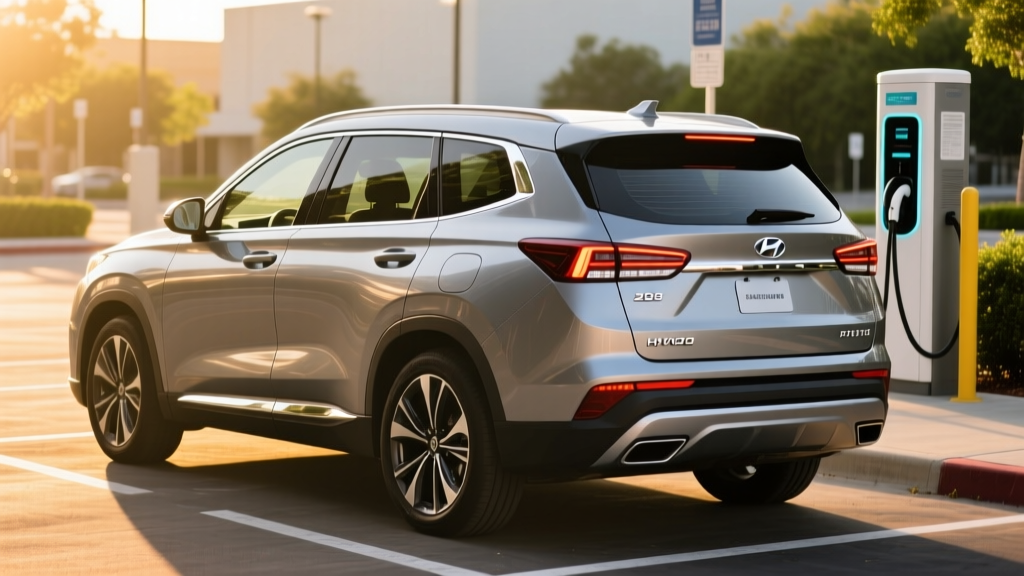
The Santa Fe PHEV charges via a J1772 connector (AC only — no DC fast charging capability). On a standard 120V household outlet (Level 1), a full charge takes approximately 12 hours. On a 240V Level 2 home charger at 7.2 kW, the 13.8 kWh battery charges from empty to full in roughly 2 hours. This is practical for overnight top-ups but means you cannot quickly recharge during a road trip — once the battery is depleted, you're driving a 33-MPG hybrid until you plug in again.
Pricing, Trims, and Tax Credit Eligibility
The 2026 Santa Fe Hybrid lineup spans three trims for the HEV and two for the PHEV:
| Model / Trim | MSRP | Federal Tax Credit | Effective Price (if eligible) |
|---|---|---|---|
| HEV SEL Premium (FWD) | $39,500 | $0 (not eligible) | $39,500 |
| HEV SEL Premium (AWD) | $41,500 | $0 | $41,500 |
| HEV Limited (AWD) | $45,200 | $0 | $45,200 |
| PHEV SEL (AWD) | $48,500 | Up to $7,500* | ~$41,000 |
| PHEV Limited (AWD) | $52,900 | Up to $7,500* | ~$45,400 |
*Federal §30D tax credit eligibility is not guaranteed. Under current IRS rules, the PHEV must meet critical-mineral and battery-component sourcing requirements, the buyer must fall under income caps ($150K single / $300K joint modified AGI), and the vehicle MSRP must not exceed $80,000 for SUVs. The credit can now be transferred to the dealer at point of sale as an instant discount. Always verify current eligibility on IRS.gov before purchasing. Conventional HEVs do not qualify for §30D.
- Vehicle MSRP under $80,000 (SUV cap) ✓
- Buyer modified AGI: ≤$150K (single) or ≤$300K (joint)
- Battery critical minerals: ≥40% from US/FTA partners (2026 requirement)
- Battery components: ≥80% manufactured in North America (2026 requirement)
- No excluded foreign entity of concern (FEOC) battery materials
- Vehicle assembled in North America
Hyundai has historically sourced batteries for US-market PHEVs from suppliers that may or may not meet all critical-mineral thresholds. Confirm the specific VIN's eligibility via the dealer or the IRS VIN-lookup tool before assuming you'll receive the full $7,500.
Battery Warranty, Reliability, and Replacement Costs
Hybrid battery longevity remains the single most common concern for first-time hybrid buyers. Hyundai addresses this with one of the strongest warranties in the segment.
- Hybrid battery: 10 years / 100,000 miles (whichever comes first)
- Hybrid system components (motor, inverter, control unit): 10 years / 100,000 miles
- Powertrain warranty (engine, transmission): 10 years / 100,000 miles
- New vehicle limited warranty: 5 years / 60,000 miles
For reference, most competitors offer 8 years / 100,000 miles on hybrid batteries. Hyundai's 10-year coverage is a genuine differentiator, particularly for second owners who benefit from the transferable portion (5 years / 60,000 miles for subsequent owners on some components — verify with your dealer).
Real-World Reliability and Degradation
Modern lithium-ion hybrid batteries rarely fail catastrophically. The more common pattern is gradual capacity loss — and for a conventional HEV with a 1.49 kWh battery, even 20% degradation has minimal impact on fuel economy because the battery serves as a short-term energy buffer, not a primary propulsion source. The Santa Fe HEV's battery cycles shallowly (typically staying between 40-60% state of charge), which dramatically extends cell life.
For the PHEV, the 13.8 kWh battery sees deeper cycles, but Hyundai's thermal management system and conservative buffer (the usable capacity is less than the gross capacity) protect against accelerated degradation. Based on industry data from similar Hyundai/Kia PHEV platforms, expect 5-10% capacity loss over 5 years and 60,000 miles — reducing electric-only range from 30 miles to roughly 27-28 miles.
Battery Replacement Cost
Out-of-warranty hybrid battery replacement for the Santa Fe HEV typically runs $2,500-$4,000 including labor, based on current Hyundai parts pricing. The PHEV's larger battery is more expensive: $5,500-$8,000 depending on the pack configuration and labor rates. However, given Hyundai's 10-year/100,000-mile warranty and the conservative operating parameters, the vast majority of owners will never face this expense. Most hybrid batteries outlast the vehicle's economic life.
Who Should Choose the Santa Fe Hybrid vs. a Full EV or Gas SUV?
The Santa Fe HEV, PHEV, full EV, and gas-only model each serve different buyers. Here's a practical decision framework:
Choose the Santa Fe HEV if:
- You lack access to home or workplace charging
- You want a three-row SUV under $45,000 with strong fuel economy
- Your driving is a mix of city and highway with no single dominant pattern
- You want zero behavior change — fill up and go
- You plan to keep the vehicle 8-10+ years (warranty coverage matters)
Choose the Santa Fe PHEV if:
- You can install a Level 2 charger at home (garage or driveway with 240V access)
- Your daily round-trip commute is under 30 miles
- You qualify for the full or partial §30D federal tax credit
- You want electric commuting for daily driving but gas flexibility for road trips
- You value the extra 29 hp from the larger electric motor
Choose a full EV (e.g., Hyundai Ioniq 5, Kia EV9) if:
- You have reliable home charging and your daily driving is under 250 miles
- You want the lowest per-mile fuel cost (electricity at $0.14/kWh ≈ $0.04/mile vs. gas at $3.50/gal and 34 MPG ≈ $0.10/mile)
- You want minimal maintenance (no oil changes, no engine air filters, reduced brake wear from regen)
- You don't need a third row frequently (or can opt for the three-row Kia EV9)
Stick with the gas Santa Fe (2.5T) if:
- Your budget is strictly under $38,000
- You drive fewer than 8,000 miles per year (fuel savings won't offset the hybrid premium)
- You prioritize maximum towing capacity (3,500 lbs vs. 2,000 lbs for hybrids)
5-Year Ownership Cost Snapshot
Assuming 15,000 miles/year, $3.50/gallon regular unleaded, and $0.14/kWh for home electricity:
| Cost Factor | Gas Santa Fe 2.5T AWD (24 MPG) | Santa Fe HEV AWD (34 MPG) | Santa Fe PHEV AWD (50% electric) |
|---|---|---|---|
| Annual fuel cost | $2,188 | $1,544 | ~$1,050 |
| 5-year fuel cost | $10,938 | $7,720 | $5,250 |
| 5-year fuel savings vs. gas | — | $3,218 | $5,688 |
| Maintenance (est. 5 yr) | $3,200 | $2,800 | $2,600 |
The HEV pays back its ~$2,500 price premium over the gas model in roughly 4 years through fuel savings alone. The PHEV's economics depend heavily on tax credit eligibility: with the full $7,500 credit, the PHEV effectively costs less than the HEV Limited while offering lower operating costs. Without the credit, the PHEV's payback period extends to 7+ years, making it a harder financial case.
Pros
- 36 MPG combined (HEV FWD) — best in the three-row SUV class
- 10-year / 100,000-mile hybrid battery warranty
- No charging infrastructure required (HEV)
- Real third-row seating for occasional use
- Standard AWD available on all trims
- Strong safety ratings (IIHS Top Safety Pick+)
Cons
- HEV not eligible for federal tax credit
- PHEV has no DC fast charging
- Third row is tight for adults on long trips
- 2,000-lb towing capacity (gas model tows 3,500 lbs)
- Highway MPG drops to ~30-32 in real-world driving
- PHEV cargo space reduced by battery pack
Frequently Asked Questions
How many MPG does the 2026 Hyundai Santa Fe Hybrid get?
The HEV is rated at 36 city / 35 highway / 36 combined (FWD) and 34 city / 33 highway / 34 combined (AWD) by the EPA. Real-world city driving often exceeds these figures, while sustained highway driving at 75+ mph typically yields 30-32 MPG.
How far can the Santa Fe PHEV go on electric only?
The EPA rates the Santa Fe PHEV at approximately 30 miles of electric-only range. In mild weather with moderate speeds, you can expect 28-30 miles. In cold weather (below 40°F) or at sustained highway speeds, expect 22-26 miles before the gas engine engages.
Does the Santa Fe Hybrid qualify for a tax credit?
The conventional HEV does not qualify for any federal tax credit under §30D. The PHEV may qualify for up to $7,500, but eligibility depends on battery sourcing requirements, buyer income limits, and MSRP caps. Verify the specific VIN's eligibility on IRS.gov before purchasing. Some states offer additional rebates for PHEVs — check your state's energy office or AFDC state incentive database.
Is the hybrid battery reliable, and what does replacement cost?
Hyundai's hybrid batteries are proven and conservatively managed. The 10-year / 100,000-mile warranty covers defects and significant capacity loss. Out-of-warranty replacement costs $2,500-$4,000 for the HEV and $5,500-$8,000 for the PHEV, but most batteries outlast the vehicle. Shallow cycling in the HEV means degradation is minimal over a typical ownership period.
Should I get the hybrid or the plug-in hybrid?
Choose the HEV if you lack home charging, want a lower purchase price, or drive a mix of city and highway miles. Choose the PHEV if you can charge at home, have a commute under 30 miles round-trip, and qualify for the federal tax credit. The PHEV without regular charging is a worse value than the HEV.
Can the Santa Fe PHEV DC fast charge?
No. The Santa Fe PHEV only accepts AC charging via a J1772 connector at up to 7.2 kW (Level 2). A full charge takes about 2 hours on Level 2 or 12 hours on a standard 120V outlet. This is typical for PHEVs — DC fast charging is generally reserved for full battery electric vehicles.
How does the Santa Fe Hybrid compare to the Toyota Highlander Hybrid?
The Highlander Hybrid achieves 35-36 MPG combined (AWD) and starts around $42,000 — slightly higher than the Santa Fe HEV. The Toyota offers more third-row space and a higher tow rating (3,500 lbs). The Santa Fe counters with a longer warranty (10 years vs. Toyota's 10-year/150,000-mile hybrid battery but 3-year/36,000-mile base), more standard tech features, and a boxier design with better cargo access. Both are strong choices; the decision often comes down to third-row frequency and brand preference.
Sources: EPA fueleconomy.gov, Hyundai Newsroom, IRS §30D Tax Credit, IIHS