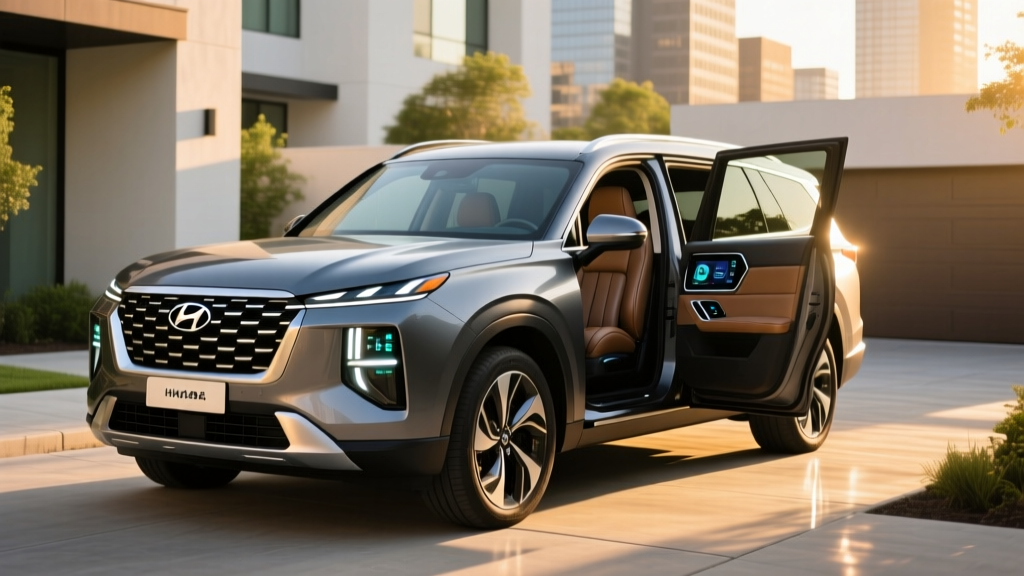
The three-row SUV segment is one of the last holdouts for electrification, and the 2026 Hyundai Palisade Hybrid aims to change that. As families look to cut fuel costs without sacrificing seating for seven or eight, the Palisade Hybrid SEL trim sits in a compelling sweet spot: loaded with features, priced below the top-tier Calligraphy, and equipped with a turbocharged hybrid powertrain that Hyundai claims delivers meaningful MPG gains over the gas-only model.
But does the real-world efficiency match the EPA sticker? Is the hybrid battery a long-term liability? And how does the Palisade Hybrid SEL compare to plug-in hybrid rivals or going full EV? This guide breaks down every number you need to make the call.
2026 Hyundai Palisade Hybrid SEL: Quick Specs at a Glance
| Spec | Value |
|---|---|
| Powertrain | 2.5L turbocharged 4-cylinder + electric motor (HEV) |
| Combined Horsepower | ~329 hp (est.) |
| Transmission | 6-speed automatic |
| Drivetrain | FWD standard / HTRAC AWD available |
| EPA MPG (Combined) | ~27 MPG (est. — final EPA pending) |
| EPA MPG (City / Highway) | ~28 city / ~26 highway (est.) |
| Seating | 7 (captain's chairs) or 8 (bench) |
| Cargo (behind 3rd row) | ~21 cu ft |
| Towing Capacity | Up to 5,000 lbs (AWD) |
| Base MSRP (SEL trim) | ~$46,500 (est.) |
| Hybrid Battery Warranty | 10 years / 100,000 miles |
Note: The 2026 Palisade Hybrid is an all-new variant of the redesigned Palisade. Final EPA fuel economy figures and exact MSRP were not yet published at the time of writing. Estimates above are based on Hyundai's powertrain disclosures and comparable Hyundai Motor Group hybrid systems. Check fueleconomy.gov for confirmed EPA data once released.
HEV vs PHEV: What the Palisade Hybrid Actually Is
A conventional hybrid (HEV) like the Palisade Hybrid uses a small battery (typically 1–2 kWh) that charges through regenerative braking and the gas engine. You never plug it in. It improves fuel economy by assisting the engine and enabling brief electric-only driving at low speeds.
A plug-in hybrid (PHEV) has a much larger battery (typically 15–25 kWh), can be plugged into a wall outlet or charger, and offers 20–40+ miles of pure electric range before the gas engine kicks in.
The 2026 Palisade Hybrid is an HEV. There is no plug, no electric-only highway range, and no need for home charging infrastructure. If you want a plug-in Hyundai SUV, look at the Tucson PHEV or Santa Fe PHEV — neither offers three rows.
This distinction matters because many shoppers searching for "Palisade hybrid" assume it plugs in. It doesn't. The HEV system is designed for simplicity: you fuel up at a gas station exactly as you always have, and the hybrid system works invisibly in the background to reduce fuel consumption, particularly in stop-and-go city driving.
Fuel Economy: EPA Estimates and Real-World MPG
Hyundai's 2.5-liter turbocharged hybrid system pairs a turbocharged four-cylinder engine with an electric motor integrated into the transmission. In Hyundai Motor Group applications (including the Santa Fe Hybrid), this architecture has delivered combined MPG in the mid-to-high 20s for vehicles of this size.
| Vehicle | City | Highway | Combined |
|---|---|---|---|
| 2026 Palisade Hybrid (est.) | 28 | 26 | 27 |
| 2025 Palisade (gas V6) | 19 | 25 | 22 |
| Toyota Grand Highlander Hybrid | 36 | 32 | 34 |
| Kia Sorento Hybrid (3-row) | 34 | 31 | 32 |
Sources: fueleconomy.gov for confirmed competitor data. Palisade Hybrid figures are pre-EPA estimates.
Real-World MPG: What to Actually Expect
Hybrids typically exceed their EPA city estimates in real-world stop-and-go traffic because regenerative braking recovers energy that a gas car wastes as heat. Highway driving is where hybrids lose their advantage — the electric motor provides less benefit at sustained high speeds, and aerodynamic drag dominates.
For the Palisade Hybrid SEL, expect:
- City / suburban driving: 28–31 MPG (hybrid system at its best)
- Highway (70+ mph): 24–27 MPG (turbo engine doing most of the work)
- Cold weather (below 35°F): 22–25 MPG combined (engine runs more to heat cabin and warm up)
- Towing: 15–18 MPG (hybrid assistance minimal under heavy load)
These figures represent a roughly 20–25% improvement over the gas-only Palisade in mixed driving, which translates to approximately 70–90 additional miles per tank and roughly $400–$600 in annual fuel savings at 15,000 miles/year and $3.50/gallon.
Powertrain Deep Dive: Turbo Hybrid Muscle
The Palisade Hybrid's powertrain is a version of Hyundai Motor Group's turbocharged hybrid architecture. The 2.5-liter T-GDI four-cylinder produces roughly 277 hp on its own, supplemented by an electric motor contributing approximately 52 hp, for a combined system output near 329 hp. That's a significant step up from the outgoing Palisade's naturally aspirated V6.
The 6-speed automatic transmission is a conventional torque-converter unit (not a CVT or dual-clutch), which most drivers will appreciate for its smooth, predictable behavior — particularly when towing or merging onto highways.
The HTRAC all-wheel-drive system is available on the SEL trim and uses a mechanical connection to the rear axle rather than a dedicated rear electric motor. This means AWD capability is strong in rain and light snow, but this is not an electrified AWD system like some competitors offer.
Pricing, Trim Value, and Tax Credit Eligibility
The Palisade Hybrid SEL is positioned as the volume trim — well-equipped without the luxury-tier pricing of the Limited or Calligraphy. Estimated pricing:
- SEL FWD: ~$46,500 MSRP
- SEL AWD (HTRAC): ~$48,500 MSRP
Standard equipment on the SEL typically includes a 12.3-inch infotainment display, wireless Apple CarPlay/Android Auto, Hyundai SmartSense safety suite (adaptive cruise, lane-keeping, blind-spot monitoring), heated front seats, power liftgate, and roof rails.
Does the Palisade Hybrid Qualify for a Federal Tax Credit?
No. Under current IRS §30D rules, the federal clean vehicle credit applies only to battery electric vehicles (BEVs) and plug-in hybrids (PHEVs) with a minimum battery capacity of 7 kWh. Conventional hybrids like the Palisade Hybrid do not qualify for the federal credit.
- ☐ Vehicle must be a BEV or PHEV (not a conventional HEV)
- ☐ Battery capacity ≥ 7 kWh
- ☐ MSRP below cap ($80,000 SUVs / $55,000 sedans)
- ☐ Buyer income below cap ($300K joint / $150K single)
- ☐ Battery minerals and components meet sourcing requirements
- ✗ Palisade Hybrid (HEV) does NOT qualify
Some states offer separate rebates for hybrids. Check your state energy office or AFDC state incentive database for local programs.
Battery Warranty, Longevity, and Replacement Cost
10 years / 100,000 miles (whichever comes first) for the hybrid battery pack and hybrid-system components. This applies to the original owner. For subsequent owners, coverage typically converts to 5 years / 60,000 miles.
Hyundai covers battery replacement if capacity drops below a defined threshold (typically ~70% state of health) during the warranty period.
How Long Will the Hybrid Battery Last?
Modern hybrid batteries (typically nickel-metal-hydride or small lithium-ion packs in the 1–2 kWh range) are among the most durable components in any vehicle. Because the battery is small and never deeply discharged — the system keeps it in a narrow state-of-charge window (roughly 40–80%) — degradation is minimal.
Real-world data from Toyota and Hyundai hybrid systems shows:
- 100,000 miles: Most hybrid batteries show negligible capacity loss
- 150,000–200,000 miles: Some gradual degradation, but most units remain functional
- Out-of-warranty replacement cost: $2,000–$4,000 for the hybrid battery pack (parts and labor), significantly less than a full EV battery replacement
The Palisade Hybrid's small hybrid battery is not the expensive, headline-grabbing component you see in EV replacement stories. It's closer in cost and complexity to replacing an alternator than replacing a 100 kWh EV pack.
Palisade Hybrid vs the Alternatives: HEV, PHEV, or Full EV?
Choosing between a conventional hybrid, a plug-in hybrid, and a battery electric vehicle depends on your driving patterns, charging access, and budget. Here's a practical framework:
Choose the Palisade Hybrid (HEV) if:
- You have no home charging access (apartment, street parking)
- You want a 3-row SUV without plug-in complexity
- You tow regularly (hybrid systems handle towing better than most PHEVs/EVs)
- You want better MPG with zero behavior change
- Budget is ~$46K–$49K
Consider a PHEV (e.g., Grand Highlander Hybrid) if:
- You can charge at home (Level 1 or 2)
- Most daily trips are under 30 miles
- You want some electric-only driving for school runs and commutes
- You still want gas flexibility for road trips
- 3-row seating is a must
Go Full EV (e.g., Kia EV9) if:
- You have reliable home Level 2 charging
- Daily driving is under 250 miles
- You want the lowest per-mile fuel cost (~$0.04–0.06/mi)
- You want to qualify for the $7,500 federal credit
- You accept charging stops on long road trips
Who Should Buy the 2026 Palisade Hybrid SEL?
The Palisade Hybrid SEL is engineered for a specific buyer: the family that needs three rows, wants to reduce fuel costs, but isn't ready (or able) to deal with plug-in charging. It's the "set it and forget it" efficiency play.
Best fit: Suburban families with 15,000+ miles/year of mixed driving, apartment dwellers who can't charge at home, and buyers who tow boats or trailers on weekends.
Look elsewhere if: You have home charging and want maximum electric driving (consider a PHEV or EV), you want the highest possible MPG in the segment (the Grand Highlander Hybrid achieves 34 combined), or you need a sub-$40K entry point.
Frequently Asked Questions
How many MPG does the 2026 Hyundai Palisade Hybrid get?
Estimated at approximately 27 MPG combined (28 city / 26 highway) based on Hyundai's hybrid powertrain in comparable vehicles. Final EPA figures were pending at time of writing. Real-world city driving may yield 28–31 MPG thanks to regenerative braking, while highway driving at 75+ mph will likely return 24–26 MPG.
Does the Palisade Hybrid plug in?
No. The Palisade Hybrid is a conventional hybrid (HEV). It charges its small battery through regenerative braking and the gas engine. You never plug it in — just fuel up at a gas station as normal.
Is the Palisade Hybrid reliable?
Hyundai's hybrid systems have proven durable in the Santa Fe Hybrid and Tucson Hybrid. The hybrid battery carries a 10-year/100,000-mile warranty, and out-of-warranty replacement costs are estimated at $2,000–$4,000 — far less than an EV battery. Hyundai's overall reliability ratings have improved significantly in recent model years.
Does the Palisade Hybrid qualify for any tax credit?
The Palisade Hybrid does not qualify for the federal §30D clean vehicle credit, which is reserved for BEVs and PHEVs. Some states may offer hybrid-specific rebates — check the AFDC state incentive database for your area.
How does the Palisade Hybrid compare to the Toyota Grand Highlander Hybrid?
The Grand Highlander Hybrid achieves an EPA-estimated 34 MPG combined — significantly higher than the Palisade Hybrid's estimated 27 MPG. However, the Palisade offers a more powerful turbocharged powertrain (~329 hp vs ~245 hp for the Toyota), a more premium interior on upper trims, and a longer warranty. If maximum fuel savings is your priority, the Toyota wins. If performance and luxury matter more, the Palisade Hybrid is the stronger pick.
What is the hybrid battery replacement cost?
Out-of-warranty hybrid battery replacement for the Palisade Hybrid is estimated at $2,000–$4,000 including parts and labor. This is a fraction of EV battery replacement costs ($8,000–$20,000+). Most hybrid batteries last well beyond the 10-year/100,000-mile warranty period.