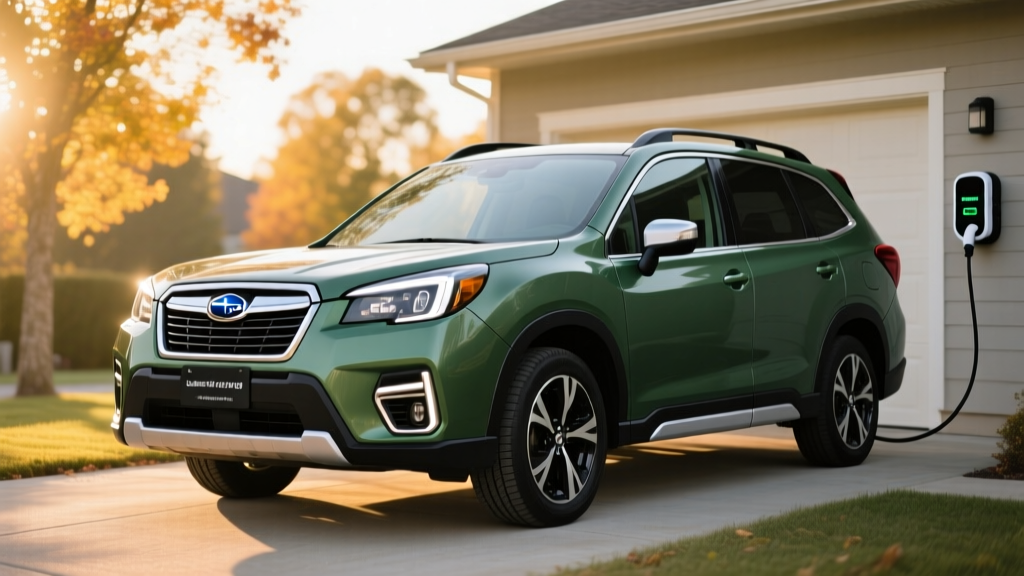
The 2026 Subaru Forester Hybrid returns to the lineup after a multi-year hiatus, pairing Subaru's proven symmetrical all-wheel drive with a Toyota-sourced hybrid powertrain. For compact SUV shoppers who need standard AWD, real cargo space, and fuel economy that undercuts the gas-only Forester by a wide margin, this is the model to watch. Below, we break down the exact 2026 Forester Hybrid MPG figures, the powertrain behind them, real-world expectations, and whether this hybrid or a plug-in alternative makes more sense for your driveway.
2026 Forester Hybrid MPG: The Official EPA Numbers
The 2026 Subaru Forester Hybrid is a conventional hybrid electric vehicle (HEV) — it does not plug in. It recovers energy through regenerative braking and uses a small battery to assist the gasoline engine, reducing fuel consumption without any change to your refueling habits. According to fueleconomy.gov, the EPA estimates are as follows:
| Metric | Value |
|---|---|
| City MPG | 35 MPG |
| Highway MPG | 34 MPG |
| Combined MPG | 35 MPG |
| Fuel Tank Capacity | 12.4 gallons |
| Total Estimated Range | ~434 miles |
For comparison, the gas-only 2026 Forester with the 2.5-liter boxer engine is rated at 26 city / 33 highway / 29 combined. That's a meaningful 6 MPG improvement in combined driving and a dramatic 9 MPG gain in city traffic, where the hybrid system does its best work.
Real-World MPG Expectations
EPA sticker: 35 MPG combined
Real-world city driving: 34–37 MPG (hybrids often exceed EPA in stop-and-go traffic due to regen braking and engine-off coasting)
Real-world highway driving (70–80 mph): 31–33 MPG (aerodynamic drag and sustained engine load reduce hybrid advantage at speed)
Cold-weather combined (below 30°F): 30–32 MPG (engine runs more often for cabin heat; battery chemistry is less efficient)
Subaru hybrids, like Toyota hybrids, tend to deliver EPA-matching or slightly better results in mixed suburban driving. Highway-heavy commutes will see the largest gap between sticker and reality.
HEV vs PHEV: Where the Forester Hybrid Fits
A common question from buyers is whether the Forester Hybrid is a plug-in. It is not. Here's the distinction:
| Feature | HEV (Forester Hybrid) | PHEV (e.g., Toyota RAV4 Prime) | BEV (e.g., Hyundai Ioniq 5) |
|---|---|---|---|
| Plugs in? | No | Yes | Yes |
| Electric-only range | None (motor assists engine) | 35–42 miles typical | 250–320 miles typical |
| Gas engine? | Yes | Yes | No |
| Fueling | Gas station only | Gas station + outlet/charger | Charger only |
| Federal tax credit (§30D) | Not eligible | Up to $7,500 (if eligible) | Up to $7,500 (if eligible) |
| Starting MSRP range | ~$33,000–$38,000 | ~$44,000–$50,000 | ~$42,000–$58,000 |
The Forester Hybrid is an HEV. It generates all its electricity onboard through the engine and regenerative braking. There is no plug, no charging cable, and no electric-only driving mode. If you want plug-in capability with Subaru AWD, you'd currently need to look at the Subaru Crosstrek PHEV (limited availability) or cross-shop the Toyota RAV4 Prime, which offers ~42 miles of electric-only range but starts near $45,000.
Powertrain Specs: What Powers the Forester Hybrid
Subaru leverages its partnership with Toyota for the hybrid system, pairing it with Subaru's signature horizontally opposed (boxer) engine and symmetrical AWD.
| Specification | Detail |
|---|---|
| Engine | 2.5L 4-cylinder boxer (Atkinson cycle) |
| Engine Horsepower | 163 hp |
| Electric Motor | Permanent-magnet synchronous, integrated in transaxle |
| Motor Output | ~88 kW (118 hp) |
| Combined Net Horsepower | 194 hp |
| Hybrid Battery | ~1.1 kWh lithium-ion (self-charging, not plug-in) |
| Drivetrain | Symmetrical All-Wheel Drive (standard) |
| Transmission | Lineartronic CVT (e-CVT hybrid variant) |
| 0–60 mph (est.) | ~8.5 seconds |
| Towing Capacity | 1,500 lbs |
The 194 combined horsepower is a solid bump over the gas-only Forester's 180 hp, and the electric motor's instant torque fills in the low-end gap that Subaru's naturally aspirated boxer engine is known for. Acceleration from stops feels noticeably more responsive than the non-hybrid model, even if 0–60 times aren't sporty by EV standards.
The 1.1 kWh battery pack is small by PHEV or BEV standards — it exists to buffer energy recovered during braking and deceleration, then redeploy it to assist the engine during acceleration. It never depletes to zero; the system manages state of charge automatically.
Pricing, Trims, and Tax Credit Eligibility
The 2026 Forester Hybrid is offered across multiple trim levels. Pricing below reflects Subaru's announced MSRP before destination charges:
| Trim | MSRP (est.) |
|---|---|
| Hybrid Premium | $33,495 |
| Hybrid Sport | $35,995 |
| Hybrid Limited | $38,495 |
| Hybrid Touring | $40,995 |
Federal Tax Credit: Not Eligible
Because the Forester Hybrid is a conventional HEV (not a plug-in), it does not qualify for the IRS §30D Clean Vehicle Credit. That credit — up to $7,500 — applies only to plug-in electric vehicles (PHEVs and BEVs) that meet battery sourcing, critical minerals, MSRP cap, and buyer income requirements.
Some states offer their own rebates for conventional hybrids, though these are increasingly rare as incentives shift toward plug-in vehicles. Check your state's energy or environmental agency website for current programs. A few utilities also offer rebates for hybrid purchases or reduced electricity rates if you later add a plug-in vehicle to your household.
Battery Warranty, Reliability, and Replacement Cost
Hybrid battery longevity is one of the most common concerns among first-time hybrid buyers. Here's what Subaru covers:
2026 Forester Hybrid Battery Warranty
- Hybrid battery warranty: 8 years / 100,000 miles (10 years / 150,000 miles in CARB states including CA, NY, MA, and others)
- Hybrid system components: 8 years / 100,000 miles
- Powertrain warranty: 5 years / 60,000 miles
- Capacity retention threshold: Warranty covers failure or capacity loss below ~60–70% of original
Subaru's hybrid system is derived from Toyota's Hybrid Synergy Drive architecture, which has an extensive real-world track record spanning over two decades. Toyota Prius and RAV4 Hybrid batteries routinely last 150,000–200,000+ miles before significant degradation. The Forester Hybrid's small 1.1 kWh pack undergoes shallow charge/discharge cycles (it never fully charges or fully depletes), which dramatically extends cell life compared to a BEV battery.
Replacement cost if out of warranty: A hybrid battery replacement for a Subaru/Toyota-sourced system typically runs $2,000–$4,000 including labor at a dealership. Independent hybrid specialists can sometimes refurbish or replace individual modules for $1,000–$2,000. Given the proven longevity of these systems, most owners will sell the vehicle long before a battery replacement is needed.
For reliability ratings, check IIHS for crash-test performance once the 2026 model year has been evaluated. Subaru's EyeSight driver-assistance system (standard on all trims) includes automatic emergency braking, lane-keep assist, and adaptive cruise control — all SAE Level 2 features requiring active driver supervision.
Who Should Buy the Forester Hybrid vs a PHEV or Full EV
Choose the Forester Hybrid (HEV) if:
- You don't have access to home or workplace charging (apartment, street parking, no garage outlet)
- You want better fuel economy with zero change to your refueling routine
- Standard AWD is non-negotiable for snow, mud, or mountain roads
- Your budget is under $40,000 and you don't want to stretch for a PHEV
- You drive 12,000–15,000 miles/year and want to save ~$400–$600/year in fuel vs the gas Forester
Choose a PHEV (e.g., RAV4 Prime, Tucson PHEV) if:
- You have a garage or driveway with a 120V or 240V outlet
- Your daily commute is under 40 miles round-trip (you could drive mostly on electricity)
- You want to qualify for the $7,500 federal tax credit (subject to IRS §30D eligibility)
- You still want a gas engine for long road trips without charging-planning
Choose a full BEV (e.g., Ioniq 5, EV6, Model Y) if:
- You can install a Level 2 home charger and your daily driving is under 250 miles
- You want the lowest per-mile "fuel" cost (electricity at $0.14/kWh ≈ $0.04/mile vs gas at $0.12–$0.15/mile)
- You want instant torque, one-pedal driving, and near-zero routine maintenance
- You qualify for the federal tax credit and state EV rebates, narrowing the price gap
Fuel Cost Savings: Forester Hybrid vs Gas Forester
At 35 MPG combined versus the gas Forester's 29 MPG combined, the hybrid saves meaningful fuel over time. Here's the math based on 15,000 miles/year and $3.50/gallon regular unleaded:
| Model | Combined MPG | Gallons/Year (15k mi) | Annual Fuel Cost |
|---|---|---|---|
| 2026 Forester (gas) | 29 MPG | 517 gal | $1,810 |
| 2026 Forester Hybrid | 35 MPG | 429 gal | $1,500 |
| Annual savings | 88 gal | ~$310/year |
Over a typical 5-year ownership period, that's roughly $1,550 in fuel savings. If gas prices rise to $4.50/gallon, savings grow to ~$2,000 over five years. The hybrid premium over a comparably equipped gas Forester is approximately $1,500–$2,000 depending on trim, meaning the fuel savings largely pay back the hybrid upcharge within 4–6 years at current fuel prices — and immediately if you value the added low-end torque and quieter low-speed driving.
Frequently Asked Questions
How many MPG does the 2026 Forester Hybrid get?
The EPA rates the 2026 Subaru Forester Hybrid at 35 city / 34 highway / 35 combined MPG. Real-world results vary: expect 34–37 MPG in city and suburban driving, 31–33 MPG on sustained highway trips, and 30–32 MPG in cold weather below 30°F.
Does the Forester Hybrid need to be plugged in?
No. The Forester Hybrid is a conventional HEV. It charges its own small battery through regenerative braking and the gasoline engine. You refuel only at gas stations, exactly like a conventional car.
Is the Forester Hybrid available with AWD?
Yes. Symmetrical all-wheel drive is standard on every 2026 Forester Hybrid trim — it is not optional and not FWD-based. This is one of the Forester Hybrid's key advantages over hybrid competitors that offer AWD only as an option or use a less capable rear-axle motor system.
How long will the hybrid battery last?
Based on the Toyota-derived hybrid system's track record, expect the battery to last 150,000–200,000+ miles before significant degradation. Subaru covers the hybrid battery for 8 years/100,000 miles (10 years/150,000 miles in CARB states). Out-of-warranty replacement typically costs $2,000–$4,000 at a dealer, less at independent hybrid shops.
Does the 2026 Forester Hybrid qualify for a federal tax credit?
No. The IRS §30D Clean Vehicle Credit applies only to plug-in vehicles (PHEVs and BEVs). The Forester Hybrid is a conventional HEV and is not eligible for the $7,500 federal credit. Some states or utilities may offer smaller hybrid incentives — check your local programs.
How does the Forester Hybrid compare to the Toyota RAV4 Hybrid?
The RAV4 Hybrid is rated at 39–41 MPG combined (depending on trim), giving it a ~5 MPG edge over the Forester Hybrid. However, the Forester offers more rear headroom, standard roof rails with higher load capacity, and Subaru's AWD system, which many owners consider more capable in deep snow and off-pavement conditions. The RAV4 Hybrid also starts slightly lower, around $32,000.
Can I tow with the Forester Hybrid?
Yes, but capacity is limited. The 2026 Forester Hybrid is rated for 1,500 lbs of towing capacity, which covers a small utility trailer, bike rack, or light camping gear. If you need to tow 3,000+ lbs, you'll need to look at larger SUVs — neither the Forester Hybrid nor most compact hybrid SUVs are designed for heavy towing.