Why a Hybrid Kia in 2026?
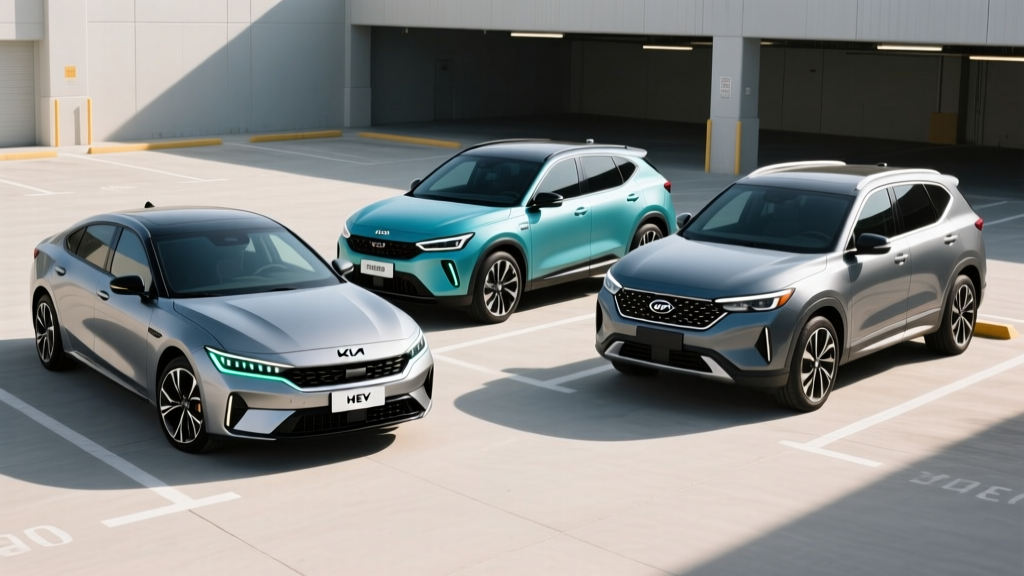
Kia's electrified lineup now spans three vehicle families with both conventional hybrid (HEV) and plug-in hybrid (PHEV) powertrains: the compact Niro, the midsize Sportage, and the three-row Sorento. For buyers not ready to commit to a full battery-electric vehicle — whether due to apartment living, frequent road trips, or limited charging access — a hybrid Kia offers a practical middle ground with EPA ratings reaching up to 53 MPG combined and PHEV electric-only ranges up to 33 miles.
This guide breaks down every hybrid Kia available for the 2026 model year with exact fuel economy figures, powertrain specs, pricing, tax credit eligibility, and real-world ownership considerations. We'll also clarify the critical differences between HEV and PHEV so you can choose the right powertrain for your driving pattern.
HEV vs PHEV: What Kia Buyers Need to Know
Conventional Hybrid (HEV)
- No plug required. The battery recharges through regenerative braking and the gasoline engine.
- Small battery: typically 1.3–1.8 kWh — enough to assist the engine and enable brief electric-only driving at low speeds.
- Best for: drivers who want maximum MPG without changing their fueling routine.
- Fuel economy: 35–53 MPG combined depending on model.
Plug-In Hybrid (PHEV)
- Plugs in to charge. A larger battery provides 30–33 miles of electric-only range before the gas engine engages.
- Larger battery: 11.2–13.8 kWh usable capacity, charges via Level 1 (120V) or Level 2 (240V).
- Best for: drivers with home charging who commute under 35 miles round-trip but still want road-trip flexibility.
- Fuel economy: 84–94 MPGe combined (electric + gas); 35–38 MPG once the battery is depleted.
Key distinction: A conventional hybrid Kia never needs to be plugged in. You fuel it like any gas car and the hybrid system handles the rest. A PHEV Kia operates as a short-range EV for daily commuting, then seamlessly switches to hybrid mode for longer drives. If you never plug in a PHEV, you're carrying extra battery weight for no benefit — making the HEV the smarter choice in that scenario.
Kia Niro Hybrid and Niro PHEV: Specs and MPG
The Niro is Kia's most efficient hybrid and the entry point into the lineup. Redesigned for its second generation, it's available as an HEV, a PHEV, and a full EV (the Niro EV, covered separately). For this guide, we focus on the hybrid variants.
| Specification | Niro HEV | Niro PHEV |
|---|---|---|
| Powertrain | 1.6L GDI I-4 + 32 kW electric motor | 1.6L GDI I-4 + 62 kW electric motor |
| Combined Horsepower | 139 hp | 180 hp |
| Transmission | 6-speed dual-clutch automatic | 6-speed dual-clutch automatic |
| Battery Capacity | 1.32 kWh (lithium-ion) | 11.1 kWh usable (lithium-ion polymer) |
| EPA MPG / MPGe | 53 city / 54 hwy / 53 combined | 94 MPGe combined; 48 MPG gas-only |
| Electric-Only Range (PHEV) | N/A | 33 miles |
| Total Combined Range | ~590 miles | ~560 miles (EV + gas) |
| Charging (Level 2, 240V) | N/A — no plug | ~2 hr 45 min (10–100%) |
| DC Fast Charging | N/A | Not supported |
| 0–60 mph | ~9.8 sec | ~7.4 sec |
| Starting MSRP | $28,590 (LX) | $35,990 (LX) |
| Federal Tax Credit (§30D) | Not eligible | Not currently eligible* |
*The Niro PHEV's battery sourcing has not met the critical-mineral and battery-component requirements under current IRS §30D rules. Verify eligibility at purchase, as sourcing requirements tighten annually through 2032.
Niro Real-World MPG vs. EPA
| Condition | Niro HEV (EPA: 53 combined) | Niro PHEV (EPA: 48 gas-only) |
|---|---|---|
| City driving (warm weather) | 54–58 MPG (hybrids excel in stop-and-go) | 49–52 MPG (after battery depleted) |
| Highway cruising (70 mph) | 47–50 MPG | 42–45 MPG |
| Cold weather (below 32°F) | 42–46 MPG (engine runs more for cabin heat) | 38–42 MPG gas-only; ~26 mi EV range |
| Mixed commuting with PHEV charging | N/A | Effective 100+ MPG if daily charge covers commute |
The Niro HEV consistently exceeds its EPA city rating in real-world stop-and-go driving because regenerative braking recaptures energy that a conventional car wastes as heat. Highway efficiency drops, as with all hybrids, because the engine does more of the work at sustained speeds. For the PHEV, cold weather reduces electric-only range by roughly 15–20% due to battery chemistry limitations and cabin heating demand.
Kia Sportage Hybrid and Sportage PHEV: Specs and MPG
The Sportage is Kia's best-selling crossover, and the hybrid variants deliver meaningful fuel savings over the gas-only model without sacrificing cargo space or available all-wheel drive. The Sportage PHEV pairs a more powerful electric motor with a 13.8 kWh battery for class-competitive electric-only range.
| Specification | Sportage HEV | Sportage PHEV |
|---|---|---|
| Powertrain | 1.6L turbo GDI I-4 + 44 kW motor | 1.6L turbo GDI I-4 + 72 kW motor |
| Combined Horsepower | 232 hp | 268 hp |
| Transmission | 6-speed automatic | 6-speed automatic |
| Drivetrain | AWD standard | AWD standard |
| Battery Capacity | 1.49 kWh (lithium-ion) | 13.8 kWh usable (lithium-ion polymer) |
| EPA MPG / MPGe | 38 city / 38 hwy / 38 combined | 84 MPGe combined; 38 MPG gas-only |
| Electric-Only Range (PHEV) | N/A | 34 miles |
| Total Combined Range | ~490 miles | ~430 miles (EV + gas) |
| Charging (Level 2, 240V) | N/A — no plug | ~2 hr 30 min (10–100%) |
| DC Fast Charging | N/A | Not supported |
| 0–60 mph | ~7.2 sec | ~6.2 sec |
| Starting MSRP | $31,590 (LX AWD) | $40,090 (X-Line) |
| Federal Tax Credit (§30D) | Not eligible | Not currently eligible* |
*As with the Niro PHEV, verify current §30D eligibility on irs.gov at the time of purchase. Battery-component and critical-mineral sourcing requirements change annually.
The Sportage HEV's 232 combined horsepower is a standout in the compact hybrid crossover segment — it's substantially more powerful than the Toyota RAV4 Hybrid (219 hp) and Honda CR-V Hybrid (204 hp). The PHEV variant pushes that to 268 hp, making it one of the quickest PHEV crossovers under $45,000.
Sportage Real-World MPG vs. EPA
| Condition | Sportage HEV (EPA: 38 combined) | Sportage PHEV (EPA: 38 gas-only) |
|---|---|---|
| City driving (warm weather) | 38–42 MPG | 39–42 MPG (after battery depleted) |
| Highway cruising (70 mph) | 34–36 MPG | 33–35 MPG |
| Cold weather (below 32°F) | 32–35 MPG | 30–33 MPG gas-only; ~27 mi EV range |
| Mixed commuting with PHEV charging | N/A | Effective 90+ MPG if daily charge covers commute |
Kia Sorento Hybrid and Sorento PHEV: Three-Row Specs and MPG
The Sorento is the only three-row SUV in Kia's hybrid lineup, making it a practical choice for families who need six-passenger seating without the fuel cost of a body-on-frame SUV. Both the HEV and PHEV come standard with all-wheel drive.
| Specification | Sorento HEV | Sorento PHEV |
|---|---|---|
| Powertrain | 1.6L turbo GDI I-4 + 44 kW motor | 1.6L turbo GDI I-4 + 72 kW motor |
| Combined Horsepower | 232 hp | 268 hp |
| Transmission | 6-speed automatic | 6-speed automatic |
| Drivetrain | AWD standard | AWD standard |
| Battery Capacity | 1.49 kWh (lithium-ion) | 13.8 kWh usable (lithium-ion polymer) |
| EPA MPG / MPGe | 36 city / 35 hwy / 35 combined | 79 MPGe combined; 35 MPG gas-only |
| Electric-Only Range (PHEV) | N/A | 32 miles |
| Total Combined Range | ~530 miles | ~460 miles (EV + gas) |
| Charging (Level 2, 240V) | N/A — no plug | ~2 hr 45 min (10–100%) |
| DC Fast Charging | N/A | Not supported |
| 0–60 mph | ~7.8 sec | ~6.7 sec |
| Starting MSRP | $39,590 (S AWD) | $51,990 (SX Prestige AWD) |
| Federal Tax Credit (§30D) | Not eligible | Not currently eligible* |
*Check irs.gov for current eligibility. PHEV tax credits require both MSRP compliance (under $80,000 for SUVs) and battery-sourcing compliance.
The Sorento PHEV's 32-mile electric-only range covers the average American one-way commute of ~16 miles with margin to spare, meaning many owners can complete daily school runs and grocery trips without burning a drop of gasoline — provided they charge at home nightly.
Battery Warranty, Reliability, and Replacement Costs
Kia Hybrid Battery Warranty Coverage
- Hybrid/EV battery warranty: 10 years / 100,000 miles (whichever comes first)
- Hybrid system components (motor, inverter, converter): 10 years / 100,000 miles
- Limited vehicle warranty: 5 years / 60,000 miles bumper-to-bumper
- Powertrain warranty: 10 years / 100,000 miles
Kia's hybrid battery warranty is among the longest in the industry, matching Hyundai's coverage and exceeding Toyota's 10-year/150,000-mile hybrid battery warranty on newer models. The warranty covers battery capacity loss below a specified threshold (typically 70% of original capacity) as well as defects in hybrid system components.
Hybrid Battery Lifespan and Replacement
Kia's hybrid batteries are designed to last the life of the vehicle under normal use. Real-world data from first-generation Niro and Optima Hybrid owners shows degradation of approximately 8–12% over 100,000 miles — well within warranty thresholds. The smaller HEV batteries (1.3–1.5 kWh) experience less stress because they operate in a narrow state-of-charge window (typically 40–60%), which reduces cycle wear.
If a hybrid battery does need replacement out of warranty:
- Niro HEV battery: $2,500–$3,500 (parts + labor)
- Niro PHEV battery: $6,000–$8,500 (parts + labor)
- Sportage/Sorento PHEV battery: $7,000–$9,500 (parts + labor)
These are dealer-installed OEM replacement estimates. Third-party refurbishment options may reduce costs by 30–40%. However, with Kia's 10-year/100,000-mile warranty and the proven longevity of lithium-ion hybrid batteries, most owners will never face this expense.
Reliability Track Record
Kia's hybrid powertrains have demonstrated solid reliability since the second-generation Niro launched. The 1.6L GDI engine paired with the dual-clutch or conventional automatic transmission is a proven combination shared across Hyundai-Kia's global lineup. According to IIHS, the Niro and Sportage have earned top safety ratings, and the hybrid components have not been associated with any major recall campaigns. The most commonly reported issues relate to infotainment software rather than powertrain hardware.
Pricing, Tax Credits, and Total Cost of Ownership
Federal Tax Credit Eligibility for Kia PHEVs
Under the Inflation Reduction Act's §30D Clean Vehicle Credit, qualifying new PHEVs can receive up to $7,500 in federal tax credits. However, eligibility depends on three factors that have tightened each year since 2023:
- MSRP cap: SUVs must have an MSRP under $80,000; sedans under $55,000
- Buyer income cap: Modified AGI must not exceed $150,000 (single), $225,000 (head of household), or $300,000 (joint)
- Battery sourcing: Increasing percentages of critical minerals and battery components must be sourced from the US or free-trade-agreement countries — this is where most Kia PHEVs currently fall short
- Point-of-sale transfer: If eligible, the credit can be applied at purchase rather than claimed on your tax return
Current status (2026): As of this writing, Kia's PHEV models do not appear on the fueleconomy.gov qualifying list for the full §30D credit due to battery-sourcing requirements. This can change as Kia adjusts its supply chain. Always verify on irs.gov or ask your dealer for the latest eligibility confirmation before purchase.
Conventional hybrid Kias (HEVs) have never qualified for the §30D federal tax credit, which is reserved for plug-in vehicles with a minimum battery capacity of 7 kWh.
5-Year Cost of Ownership Comparison
| Cost Category | Niro HEV ($28,590 MSRP) | Niro PHEV ($35,990 MSRP) | Niro EV ($39,600 MSRP) |
|---|---|---|---|
| Purchase price (after incentives) | $28,590 | $35,990 | $32,100 (est. after credit) |
| Fuel / electricity (5 years) | $5,200 (gas at $3.40/gal) | $2,800 (mix of electric + gas) | $2,600 (electric at $0.14/kWh) |
| Maintenance (5 years) | $2,400 | $2,100 | $1,200 |
| Insurance (5 years) | $7,500 | $7,800 | $8,100 |
| Estimated depreciation | $11,400 (40%) | $15,800 (44%) | $17,400 (44%) |
| Total 5-year cost | $55,090 | $64,490 | $61,400 |
The Niro HEV has the lowest total cost primarily because of its low purchase price and strong residual values. The PHEV costs more upfront but saves significantly on fuel if you charge daily. The Niro EV's advantage grows if you qualify for the full federal tax credit and have access to inexpensive home charging.
Hybrid vs PHEV vs EV: Which Kia Fits Your Life?
Choose a Kia HEV (Niro, Sportage, Sorento) if:
- You don't have access to home or workplace charging
- You want maximum MPG without any behavior change
- Your budget is under $35,000 (Niro HEV starts at $28,590)
- You drive more than 15,000 miles per year and want proven simplicity
- You frequently take long road trips and don't want to plan charging stops
Choose a Kia PHEV (Niro, Sportage, Sorento) if:
- You can install a Level 2 charger at home or have workplace charging
- Your daily round-trip commute is under 35 miles
- You want electric-only driving for errands but gas-engine flexibility for road trips
- You want more power (PHEV variants add 40–50 hp over HEV)
- You're not ready for a full EV but want to reduce gas consumption by 60–80%
Choose a Kia EV (Niro EV, EV6, EV9) if:
- You have reliable home charging (Level 2 recommended)
- Your daily driving is under 250 miles
- You want the lowest per-mile fuel cost and minimal maintenance
- You qualify for the federal tax credit (up to $7,500)
- You want the smoothest, quietest driving experience with instant torque
Frequently Asked Questions
How many MPG does a hybrid Kia get?
The 2026 Kia Niro HEV leads the lineup at an EPA-estimated 53 MPG combined (53 city / 54 highway). The Sportage HEV achieves 38 MPG combined, and the Sorento HEV achieves 35 MPG combined. In real-world city driving, hybrid Kias often match or slightly exceed their EPA ratings because regenerative braking recovers energy in stop-and-go traffic. Highway MPG tends to run 3–6 MPG below the EPA combined figure.
How far can a Kia PHEV go on electric only?
The 2026 Niro PHEV delivers an EPA-estimated 33 miles of electric-only range, the Sportage PHEV achieves 34 miles, and the Sorento PHEV provides 32 miles. In cold weather (below freezing), expect a 15–20% reduction — roughly 26–28 miles — due to reduced battery efficiency and cabin heating demand. Once the battery is depleted, the vehicle seamlessly switches to hybrid mode.
Does a Kia hybrid need to be plugged in?
No. Conventional hybrid (HEV) Kia models — the Niro HEV, Sportage HEV, and Sorento HEV — never need to be plugged in. Their small batteries recharge through regenerative braking and the gasoline engine. Only the PHEV models (Niro PHEV, Sportage PHEV, Sorento PHEV) benefit from plugging in, and they still drive normally as hybrids if you forget to charge.
Is a hybrid Kia reliable and what does battery replacement cost?
Kia's hybrid powertrains have demonstrated strong reliability since 2017. The hybrid battery is covered by a 10-year/100,000-mile warranty, and real-world degradation data shows approximately 8–12% capacity loss over 100,000 miles. Out-of-warranty replacement costs range from approximately $2,500–$3,500 for a Niro HEV battery to $7,000–$9,500 for a Sportage or Sorento PHEV battery. Most owners will never need a replacement.
Do hybrid Kias qualify for any tax credit?
Conventional hybrid (HEV) Kias do not qualify for the federal §30D Clean Vehicle Credit, which requires plug-in capability and a minimum 7 kWh battery. Kia's PHEV models may qualify for up to $7,500 depending on current battery-sourcing requirements, buyer income limits, and MSRP caps. As of 2026, most Kia PHEVs do not meet the full sourcing requirements. Check fueleconomy.gov and irs.gov for the latest eligibility. Some states offer additional rebates for PHEVs regardless of federal eligibility.
Can a Kia PHEV use DC fast charging?
No. Kia's current PHEV models support Level 1 (120V, ~1.4 kW) and Level 2 (240V, ~7.2 kW) charging only. A full Level 2 charge takes approximately 2.5–3 hours. DC fast charging is not available on any Kia PHEV — this feature is reserved for full battery-electric vehicles like the EV6 and EV9, which can charge at up to 240+ kW on compatible DC stations.
Should I get the HEV or PHEV version?
If you can charge at home and your daily driving is under 35 miles, the PHEV delivers dramatically lower fuel costs and the added benefit of electric-only acceleration (quieter, smoother, zero tailpipe emissions on short trips). If you can't charge at home, drive more than 40 miles daily, or want the lowest purchase price, the HEV is the better financial choice. The PHEV premium of $7,000–$12,000 over the HEV takes 5–8 years to recoup through fuel savings alone, depending on your electricity rate and driving pattern.
The Bottom Line
Kia's 2026 hybrid lineup offers a well-differentiated option for nearly every buyer profile. The Niro HEV at 53 MPG combined and under $29,000 is the efficiency bargain of the lineup. The Sportage HEV delivers 232 hp and 38 MPG in a practical AWD crossover. The Sorento PHEV gives families three rows, 32 miles of electric commuting, and road-trip freedom — all backed by Kia's industry-leading 10-year/100,000-mile hybrid battery warranty.
The deciding factor is charging access. If you can plug in at home, a Kia PHEV transforms your daily commute into an electric experience while eliminating range anxiety entirely. If you can't, the HEV variants deliver best-in-class fuel economy with zero lifestyle changes required.