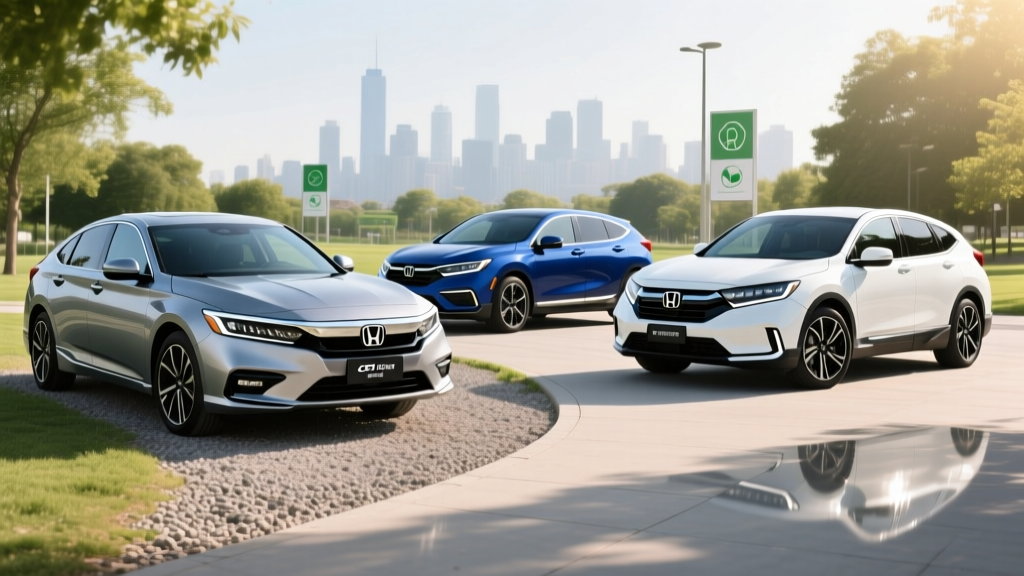
Honda's hybrid strategy in 2026 is refreshingly simple: no plug required, no range anxiety, and fuel economy that consistently beats EPA estimates in daily city driving. The automaker now offers its two-motor hybrid system across three of its highest-volume models — the Accord, CR-V, and Civic — giving buyers a clear path to 40+ MPG without changing how they refuel.
This guide breaks down every current hybrid Honda by the numbers: EPA and real-world MPG, powertrain output, battery warranty, pricing, and tax-credit eligibility. Whether you're cross-shopping against a full EV, a plug-in hybrid, or a conventional gas car, the data below will tell you exactly which hybrid Honda earns a spot in your driveway.
Hybrid Honda Lineup at a Glance: 2026 Specs
| Specification | Accord Hybrid | CR-V Hybrid | Civic Hybrid |
|---|---|---|---|
| Powertrain | 2.0L I-4 + 2-motor hybrid | 2.0L I-4 + 2-motor hybrid | 2.0L I-4 + 2-motor hybrid |
| Combined Horsepower | 204 hp | 204 hp | 200 hp |
| Drivetrain | FWD (AWD on Sport Touring) | FWD or AWD | FWD |
| EPA City / Hwy / Combined MPG | 51 / 44 / 48 | 43 / 36 / 40 (FWD) | 50 / 47 / 49 |
| Starting MSRP | $33,995 | $36,395 | $29,845 |
| Battery Warranty | 8 yr / 100,000 mi | 8 yr / 100,000 mi | 8 yr / 100,000 mi |
| Federal Tax Credit (§30D) | Not eligible | Not eligible | Not eligible |
Source: EPA fueleconomy.gov and Honda Newsroom. MPG figures reflect the most efficient trim in each lineup. AWD trims drop 1–3 MPG combined.
How Honda's Two-Motor Hybrid System Works
All three 2026 hybrid Honda models use the same fundamental architecture: a 2.0-liter Atkinson-cycle four-cylinder engine paired with a two-motor hybrid system. This is a conventional hybrid (HEV), not a plug-in hybrid (PHEV). That distinction matters enormously.
A conventional hybrid (HEV) like these Hondas generates all its electricity onboard — through regenerative braking and the gasoline engine. You never plug it in. The battery is small (roughly 1–2 kWh usable), and it exists to buffer energy, not to drive the car on electricity alone for meaningful distances.
A plug-in hybrid (PHEV) has a much larger battery (typically 12–20 kWh), can be plugged into a wall outlet or Level 2 charger, and offers 20–40 miles of electric-only driving before the gas engine kicks in. Honda does not currently sell a PHEV in the U.S. market.
A battery electric vehicle (BEV) like the Honda Prologue has no gasoline engine at all and relies entirely on a large battery pack (85+ kWh) charged from the grid.
In practice, Honda's system operates primarily as a series hybrid at low and moderate speeds: the engine spins a generator motor that produces electricity, which then powers the drive motor connected to the wheels. At highway speeds (roughly above 45–50 mph), a lockup clutch connects the engine directly to the wheels for efficiency. The result is a driving feel closer to an EV around town — smooth, responsive, quiet — with the seamless highway cruising of a conventional sedan or SUV.
Real-World MPG: How Hybrid Hondas Compare to EPA Stickers
EPA estimates for conventional hybrids tell only part of the story. Because the two-motor system recaptures braking energy and runs the engine at its most efficient RPM, hybrids routinely exceed their EPA city ratings in stop-and-go traffic. Highway MPG, where regenerative braking contributes less, tends to land closer to or slightly below the sticker number.
| Model | EPA Combined | Real-World City (Observed Range) | Real-World Highway (Observed Range) | Real-World Combined Estimate |
|---|---|---|---|---|
| Accord Hybrid | 48 MPG | 50–55 MPG | 40–44 MPG | 44–48 MPG |
| CR-V Hybrid (FWD) | 40 MPG | 41–45 MPG | 34–37 MPG | 37–40 MPG |
| Civic Hybrid | 49 MPG | 51–56 MPG | 43–47 MPG | 46–50 MPG |
These ranges reflect mixed-owner reports and independent testing from sources like Edmunds and long-term fleet data. Cold weather (below 35°F) reduces MPG by roughly 5–10% across all three models because the engine runs more frequently to provide cabin heat and because battery chemistry is less efficient at low temperatures.
The Accord Hybrid and Civic Hybrid are standouts. Both can deliver over 500 miles of total range on a single tank of regular unleaded — a practical advantage over most EVs on long road trips where charging infrastructure is sparse.
Pricing, Trims, and Tax-Credit Reality for Hybrid Hondas
One of the most common questions from buyers: does a hybrid Honda qualify for the federal EV tax credit? The short answer is no.
The IRS §30D Clean Vehicle Credit — up to $7,500 — applies exclusively to plug-in electric vehicles: battery electric vehicles (BEVs) and plug-in hybrids (PHEVs) that meet battery-capacity, critical-mineral sourcing, MSRP cap, and buyer income requirements. Conventional hybrids (HEVs) like the Accord Hybrid, CR-V Hybrid, and Civic Hybrid do not qualify because they cannot be plugged in and their battery capacity is far below the 4 kWh minimum threshold.
Always verify current rules at irs.gov, as credit parameters and eligible model lists are updated periodically.
Here's the 2026 pricing breakdown by trim:
2026 Accord Hybrid Trims & Pricing
- Sport Hybrid: $33,995 — 204 hp, FWD, 48 MPG combined
- Sport-L Hybrid: $35,395 — leather-trimmed seats, FWD
- Sport Touring Hybrid: $39,495 — AWD, Bose audio, full Honda Sensing suite
2026 CR-V Hybrid Trims & Pricing
- Sport Hybrid (FWD): $36,395 — 204 hp, 40 MPG combined
- Sport Hybrid (AWD): $37,895 — 37 MPG combined
- Sport Touring Hybrid (AWD): $41,795 — premium trim, hands-free liftgate
2026 Civic Hybrid Trims & Pricing
- Sport Hybrid: $29,845 — 200 hp, 49 MPG combined
- Sport Touring Hybrid: $32,845 — leather, Bose, wireless CarPlay/Android Auto
The hybrid powertrain is now the default offering on Accord and CR-V upper trims. Honda has effectively made the hybrid the recommended configuration, and the price premium over the base gas-only trims (where still offered) is typically $1,500–$2,500 — a gap that closes within 2–3 years of fuel savings for most drivers.
Battery Longevity, Warranty, and Replacement Costs
Battery durability is the number one concern for hybrid buyers, and it's an area where Honda has a strong track record. All 2026 hybrid Honda models carry the same battery warranty:
Coverage: 8 years or 100,000 miles (whichever comes first). In California Air Resources Board (CARB) states, coverage extends to 10 years or 150,000 miles for the hybrid battery and related emissions components.
What's covered: Defects in materials or workmanship, and capacity loss below a functional threshold that impairs hybrid system operation.
Real-world lifespan data: Honda's hybrid batteries use lithium-ion chemistry with conservative thermal management. Industry data from fleet operators and long-term owners suggests these packs routinely last 150,000–200,000+ miles before significant degradation. Unlike full EVs, the hybrid battery is small and operates within a narrow state-of-charge window (roughly 40–80%), which dramatically reduces cycle wear.
If replacement is needed out of warranty, a refurbished hybrid battery pack for a Honda Accord or CR-V typically costs between $2,000 and $4,000 installed at an independent hybrid specialist, or $4,000–$6,000 at a dealership using a new OEM unit. This is a fraction of the $10,000–$20,000 that a full EV battery replacement can cost, and most Honda hybrid owners will never face this expense.
Hybrid Honda vs PHEV vs Full EV: Which Fits Your Life?
Choosing between a conventional hybrid, a plug-in hybrid, and a battery electric vehicle comes down to three variables: your daily mileage, your access to charging, and your willingness to adapt your routine.
| Factor | Conventional Hybrid (HEV) | Plug-In Hybrid (PHEV) | Battery Electric (BEV) |
|---|---|---|---|
| Daily Plug-In Required? | No | Yes (to realize EV-range benefit) | Yes |
| Home Charging Needed? | No | Recommended (120V sufficient for overnight) | Essential (Level 2 strongly recommended) |
| Fuel Cost per Mile | ~$0.08–$0.10 | ~$0.04–$0.08 (mixed) | ~$0.03–$0.06 |
| Road-Trip Convenience | Excellent (gas stations everywhere) | Excellent (gas backup) | Requires route planning for DC charging |
| Federal Tax Credit | None | Up to $7,500 (if eligible) | Up to $7,500 (if eligible) |
| Best For | No home charging, long commutes, simplicity | Home charging + short daily commute + road trips | Home charging, mostly under 250 mi/day, lowest running cost |
Choose a hybrid Honda (HEV) if: You don't have reliable access to home or workplace charging, you drive more than 40 miles daily, you take regular road trips, or you want maximum simplicity with zero behavior change. The Civic Hybrid at ~$30K and 49 MPG combined is arguably the best value-per-MPG vehicle on the market.
Choose a PHEV (e.g., Toyota RAV4 Prime, Hyundai Tucson PHEV) if: You can charge at home, your daily commute is under 30 miles round-trip, and you still want gas-engine flexibility for road trips. You'll do most daily driving on electricity but won't face range anxiety.
Choose a full EV (e.g., Honda Prologue, Tesla Model Y, Hyundai Ioniq 5) if: You have Level 2 home charging, your typical daily driving is under 200 miles, and you want the lowest per-mile operating cost and zero tailpipe emissions. Factor in the potential $7,500 federal credit and state incentives.
Reliability Ratings and Ownership Costs
Honda's hybrid system has been in production since the early 2000s (starting with the original Insight and Civic Hybrid), and the current two-motor architecture has been refined since its introduction in the 2014 Accord Hybrid. This maturity shows in reliability data.
The 2026 Accord Hybrid and CR-V Hybrid both carry strong predicted reliability ratings from major evaluators. The hybrid powertrain eliminates the conventional transmission — there is no multi-speed automatic or CVT to fail — replacing it with the direct-drive two-motor system, which has fewer moving parts. Maintenance costs are lower than gas-only counterparts over time: no transmission fluid changes at typical intervals, and regenerative braking extends brake pad life significantly (many owners report 80,000+ miles on original pads).
Insurance premiums for hybrid Hondas are generally in line with their gas-only equivalents, unlike some EVs that carry 15–25% higher insurance rates. Total cost of ownership over five years, factoring in fuel savings, typically undercuts a comparable gas-only model by $3,000–$5,000 depending on local fuel prices and annual mileage.
Pros, Cons, and the Verdict on Honda's Hybrid Lineup
Pros
- Class-leading MPG — Civic Hybrid hits 49 combined, Accord 48 combined
- No plug-in required — zero behavior change from a gas car
- EV-like smoothness in city driving from the two-motor system
- 500+ miles of total range per tank (Accord and Civic)
- Proven hybrid reliability with 8-year/100K-mile battery warranty
- Lower maintenance costs vs gas-only (no conventional transmission)
- Civic Hybrid starts under $30K — best value in the lineup
Cons
- No federal tax credit eligibility (HEVs excluded from §30D)
- No electric-only driving mode for zero-emission short trips
- AWD availability limited (Sport Touring trim only on Accord)
- CR-V Hybrid highway MPG (36) trails some competitors
- Engine drone under hard acceleration (common to Atkinson-cycle hybrids)
- No PHEV option for buyers who want plug-in capability from Honda
The verdict: Honda's 2026 hybrid lineup represents the most practical, lowest-friction path to dramatically better fuel economy for buyers who aren't ready — or able — to plug in. The Civic Hybrid is a standout value proposition. The Accord Hybrid remains the midsize sedan benchmark. The CR-V Hybrid sacrifices some highway efficiency for SUV practicality. All three earn strong recommendations for their respective segments.
Frequently Asked Questions
How many MPG does a hybrid Honda get?
The 2026 Civic Hybrid leads at 50 city / 47 highway / 49 combined MPG. The Accord Hybrid achieves 51 / 44 / 48 MPG. The CR-V Hybrid (FWD) returns 43 / 36 / 40 MPG. In real-world city driving, expect to exceed EPA city estimates by 2–5 MPG thanks to regenerative braking. Highway driving typically matches or slightly underperforms the sticker.
Do I need to plug in a Honda hybrid?
No. All current Honda hybrids are conventional hybrids (HEVs). The system charges its own battery through regenerative braking and the gasoline engine. You refuel only at gas stations, exactly as you would with a non-hybrid car. Honda does not currently sell a plug-in hybrid in the U.S.
Is the Honda hybrid system reliable?
Yes. Honda's two-motor hybrid architecture has been in continuous production since 2014 and builds on hybrid experience dating to 2000. The system eliminates the conventional transmission entirely, reducing mechanical failure points. The hybrid battery is warranted for 8 years or 100,000 miles (10 years/150,000 miles in CARB states), and real-world data shows these packs commonly lasting 150,000–200,000+ miles.
How much does a Honda hybrid battery replacement cost?
Out-of-warranty replacement runs approximately $2,000–$4,000 for a refurbished pack at an independent hybrid shop, or $4,000–$6,000 for a new OEM pack at a Honda dealership. Most owners never need to replace the hybrid battery within the vehicle's normal lifespan.
Does a hybrid Honda qualify for any tax credit?
No. The federal §30D Clean Vehicle Credit applies only to plug-in vehicles (BEVs and PHEVs) that meet battery capacity, sourcing, MSRP, and income requirements. Conventional hybrids are excluded. Some states and utilities offer small rebates for hybrid purchases — check your local programs — but there is no federal incentive for HEVs as of 2026.
Hybrid vs EV: Should I buy a hybrid Honda or go fully electric?
If you lack home charging access, drive more than 200 miles in a day regularly, or simply want zero lifestyle change, a hybrid Honda is the right call. If you have Level 2 home charging, drive under 200 miles daily, and want the lowest operating cost plus tax-credit eligibility, a BEV like the Honda Prologue or Hyundai Ioniq 5 will save more over time. A PHEV splits the difference but Honda doesn't currently offer one in the U.S.