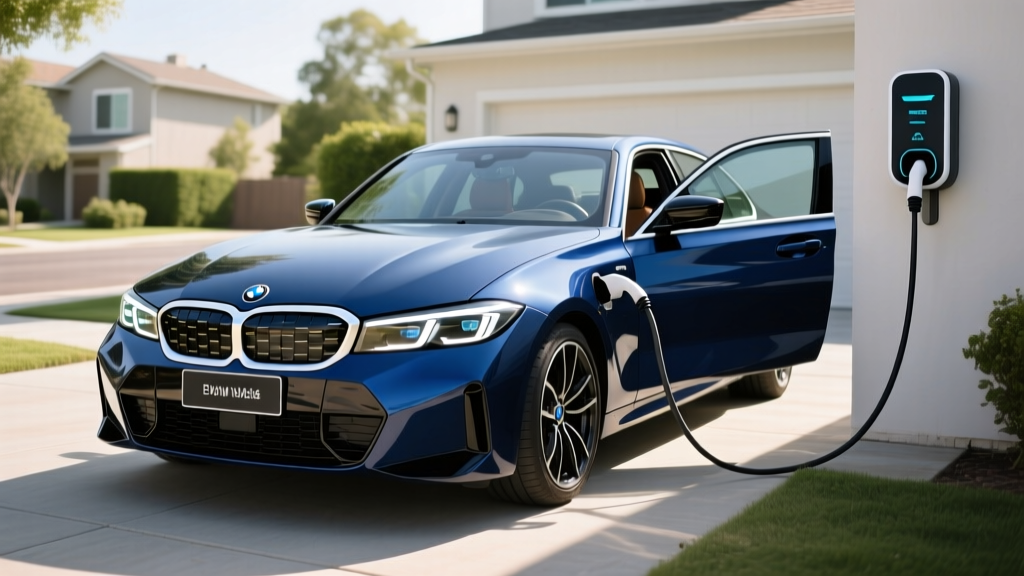
The BMW 3 Series has long been the benchmark sports sedan, and the BMW 330e plug-in hybrid occupies a specific niche: buyers who want electric daily commuting without surrendering the flexibility of a gasoline engine for longer trips. For 2026, the 330e continues with BMW's fifth-generation eDrive powertrain, pairing a turbocharged four-cylinder with an electric motor integrated into the transmission. The result is a sedan that can handle most weekday commutes on electricity alone while delivering genuine sports-sedan performance when the engine joins in.
This guide breaks down everything that matters for a PHEV purchase decision — electric-only range, real-world MPG, charging logistics, tax credit eligibility, and how the 330e stacks up against both full EVs and conventional hybrids.
HEV vs PHEV: Where the BMW 330e Fits
Before examining specs, it helps to clarify the powertrain categories, because confusion here leads to disappointed buyers.
| Feature | Conventional Hybrid (HEV) | Plug-In Hybrid (PHEV) | Battery Electric (BEV) |
|---|---|---|---|
| Plug-in charging | No — charges via regen & engine | Yes — has a larger battery you plug in | Yes — battery only, no gas engine |
| Electric-only range | 0–2 miles at low speed | 20–40 miles typical | 250–400+ miles |
| Gas engine | Yes (primary power) | Yes (backup + highway boost) | No |
| Example | Toyota Prius | BMW 330e | Tesla Model 3 |
The BMW 330e is a plug-in hybrid (PHEV). It has a gasoline engine and a larger battery than a conventional hybrid, giving it meaningful electric-only driving range. You can plug it in at home or at public Level 2 chargers to replenish that battery. If you never plug it in, it still functions as a conventional hybrid — but you'd be leaving its best feature on the table.
2026 BMW 330e Powertrain and Performance Specs
| Specification | 2026 BMW 330e (RWD) | 2026 BMW 330e xDrive |
|---|---|---|
| Engine | 2.0L turbocharged I-4 | 2.0L turbocharged I-4 |
| Engine output | 181 hp / 258 lb-ft | 181 hp / 258 lb-ft |
| Electric motor | 111 hp (integrated in transmission) | 111 hp (integrated in transmission) |
| Combined system output | 288 hp / 310 lb-ft | 288 hp / 310 lb-ft |
| Battery capacity (usable) | 19.5 kWh (lithium-ion NMC) | 19.5 kWh (lithium-ion NMC) |
| Transmission | 8-speed automatic (ZF) | 8-speed automatic (ZF) |
| 0–60 mph | 5.6 seconds | 5.5 seconds |
| Drivetrain | Rear-wheel drive | All-wheel drive |
| Base MSRP | $47,095 | $49,095 |
The electric motor sits inside the ZF 8-speed transmission housing, so the 330e doesn't sacrifice any gears or feel like a CVT-equipped hybrid. The combined 288 horsepower delivers brisk acceleration that outpaces the gas-only 330i (255 hp). BMW's XtraBoost function temporarily combines maximum engine and motor output for up to 10 seconds of full thrust — useful for highway merging.
Electric-Only Range and Total Range
EPA electric-only range: 22 miles (RWD) / 20 miles (xDrive)
Real-world expectation: 17–20 miles in mixed driving; 14–16 miles at sustained highway speeds or in cold weather below 40°F. Aggressive acceleration or climate-control use will pull range toward the lower end.
Total combined range (electric + gas): approximately 400 miles with a full tank and full battery.
Twenty-two EPA-rated electric miles is modest compared to rivals like the Toyota RAV4 Prime (42 miles) or the Jeep Wrangler 4xe (22 miles in a much heavier vehicle). For context, the average American commute is roughly 16 miles one way, per FHWA data, so the 330e can cover a short round-trip commute on electricity alone — but longer commutes will require the engine.
The 330e's range strength isn't electric-only distance; it's the seamlessness of the transition. When the battery depletes, the gasoline engine engages so smoothly that most drivers won't notice the switch without watching the instrument cluster.
Charging: Speeds, Connectors, and Home Setup
| Charging Method | Power | Time (0–100%) | Notes |
|---|---|---|---|
| Level 1 (120V household outlet) | ~1.4 kW | ~14 hours | Emergency/overnight trickle |
| Level 2 (240V home or public) | 3.7 kW (onboard charger limit) | ~5.5 hours | Standard home wallbox or public AC |
| DC Fast Charging | Not supported | N/A | No DC fast-charge capability |
A critical limitation: the 2026 BMW 330e does not support DC fast charging. The onboard AC charger is capped at 3.7 kW, meaning even a high-powered Level 2 public charger will only deliver 3.7 kW to the battery. This is typical for PHEVs with smaller batteries — DC fast charging hardware adds weight and cost that BMW has opted to avoid.
For most 330e owners, the practical charging routine is simple: plug into a Level 2 home wallbox overnight, wake up to a full battery every morning, and never think about it. At 3.7 kW, a full charge takes roughly 5.5 hours — easily achievable during an evening at home. A standard 120V outlet works but is painfully slow for daily use.
The charging connector is a standard J1772 for AC Level 1 and Level 2 charging — the universal connector for non-Tesla EVs and PHEVs in North America.
Fuel Economy: EPA MPG and Real-World Efficiency
| Metric | 330e RWD | 330e xDrive |
|---|---|---|
| MPGe (electric + gas combined) | 75 MPGe | 69 MPGe |
| EPA city (gas only, battery depleted) | 28 mpg | 27 mpg |
| EPA highway (gas only, battery depleted) | 34 mpg | 32 mpg |
| EPA combined (gas only, battery depleted) | 30 mpg | 29 mpg |
| Energy consumption (EV mode) | 37 kWh/100 mi | 40 kWh/100 mi |
Understanding PHEV fuel economy requires separating two scenarios:
- Battery charged daily, short commutes: You may use almost no gasoline during the week. Weekend road trips use gas. Annual fuel consumption could be 50–70% less than the gas-only 330i.
- Battery rarely charged: The 330e functions as a conventional hybrid with a weight penalty from the battery pack. Expect 28–32 mpg in real-world mixed driving — roughly comparable to the gas-only 330i (30 mpg combined), not dramatically better.
This is the central PHEV truth: you only save fuel if you plug in regularly. Per fueleconomy.gov, the 330e RWD rates at 75 MPGe when factoring in electric driving, but that number drops to 30 mpg combined once the battery is depleted.
In real-world testing, PHEVs driven by owners who charge daily and commute within electric range often report effective fuel consumption of 80–100+ MPGe. Conversely, owners who rarely charge report 26–29 mpg — slightly worse than the gas 330i due to the ~350 lbs of battery and motor weight.
Tax Credit and Incentive Eligibility
Under current IRS §30D rules, the BMW 330e faces significant hurdles for the federal tax credit:
- MSRP cap: Sedans must be under $55,000 MSRP. The 330e RWD base at $47,095 qualifies; loaded models or xDrive with options may exceed the cap.
- Battery sourcing: Critical minerals and battery components must meet escalating domestic-content thresholds. BMW's supply chain has not consistently met these requirements, making the 330e ineligible for the full $7,500 credit in recent model years.
- Buyer income caps: AGI must not exceed $150,000 (single) / $300,000 (joint).
- Point-of-sale transfer: If eligible, the credit can be transferred to the dealer at purchase for an upfront price reduction.
Bottom line: Do not count on the federal tax credit for the BMW 330e. Check the DOE tax credit database for current eligibility before purchasing. State-level incentives may still apply — check your state's energy office or DMV.
Battery Warranty, Reliability, and Replacement Cost
High-voltage battery warranty: 8 years / 80,000 miles (whichever comes first), covering defects and capacity loss below 70% of original capacity.
Powertrain warranty: 4 years / 50,000 miles.
Limited vehicle warranty: 4 years / 50,000 miles.
BMW's hybrid battery warranty is standard for the industry — 8 years and 80,000 miles is federally mandated as a minimum for emissions-related components, and most manufacturers apply it to PHEV batteries as well. The 70% capacity threshold means BMW will replace or repair the battery if it degrades to hold less than 70% of its original 19.5 kWh.
On reliability, BMW's turbocharged B48 four-cylinder engine has proven durable across millions of vehicles since its introduction. The ZF 8-speed transmission is widely regarded as one of the best automatic transmissions in the industry. The electric motor, with far fewer moving parts than an internal combustion engine, is generally trouble-free.
The main reliability concern for any PHEV is complexity: two powertrains, high-voltage systems, and additional cooling circuits mean more potential failure points than either a pure EV or a gas car. BMW's CPO (Certified Pre-Owned) program extends coverage and is worth considering for buyers planning long-term ownership beyond the warranty period.
If out-of-warranty battery replacement becomes necessary, expect a cost in the $8,000–$14,000 range for the high-voltage battery pack, based on current BMW parts pricing and independent shop labor rates. This is a worst-case scenario — most PHEV batteries outlast the vehicles they're installed in, with gradual capacity loss rather than sudden failure.
Who Should Choose the BMW 330e?
Reasons to Choose the 330e
- Short daily commute (under 20 miles) that can run entirely on electricity
- Access to home charging (garage or driveway with a 240V outlet)
- Frequent longer road trips where a full EV's range or charging infrastructure is a concern
- Want BMW 3 Series driving dynamics without going full electric
- HOV lane access in states that grant it to PHEVs (varies by state — verify locally)
- Performance: 288 hp and 5.5-second 0–60 in xDrive trim
Reasons to Look Elsewhere
- Long daily commute exceeding 22 miles — you'll burn gas every day
- No home charging access — a PHEV you can't plug in is just a heavy hybrid
- Want maximum electric range — consider the RAV4 Prime (42 mi) or a full EV
- Budget sensitivity — the 330e starts $5,000+ above the gas 330i with minimal fuel savings if you don't charge
- Federal tax credit likely unavailable — reduces the value proposition
Decision Framework: 330e vs Full EV vs Gas 330i
Choose the BMW 330e if: You can charge at home, your weekday driving is under 20 miles, and you take road trips longer than 300 miles at least a few times per year. The PHEV gives you electric commuting with zero range anxiety on longer drives.
Choose a full EV (Tesla Model 3, BMW i4) if: You have reliable home charging, your longest regular trip is under 250 miles, and you want the lowest operating cost and simplest powertrain. A full EV eliminates oil changes, transmission fluid, and the mechanical complexity of two powertrains.
Choose the gas BMW 330i if: You cannot charge at home, your commute is long, or you want the lowest purchase price and simplest ownership experience. The 330i at ~$43,000 base is $4,000 cheaper and avoids the weight penalty of an uncharged PHEV battery.
Frequently Asked Questions
How many MPG does the BMW 330e get?
With a depleted battery running on gasoline alone, the EPA rates the 330e RWD at 28 city / 34 highway / 30 combined mpg. When factoring in electric driving, it earns a 75 MPGe combined rating. Real-world fuel consumption depends entirely on how often you charge — daily charging with a short commute can result in near-zero gasoline use during the week.
How far can the BMW 330e go on electric only?
The EPA rates the 330e RWD at 22 miles of electric-only range and the xDrive at 20 miles. Real-world range is typically 17–20 miles in moderate conditions, dropping to 14–16 miles at highway speeds or in cold weather. This covers short commutes but not longer daily drives.
Does the BMW 330e qualify for a federal tax credit?
As of 2026, the BMW 330e likely does not qualify for the full $7,500 federal §30D tax credit due to battery component and critical mineral sourcing requirements that BMW's supply chain has not consistently met. The sedan's base MSRP falls under the $55,000 cap, but sourcing rules are the limiting factor. Always verify current eligibility on the IRS website and fueleconomy.gov before purchasing. State incentives may still be available.
Is the BMW 330e reliable, and what does battery replacement cost?
The 330e's powertrain — the B48 turbo four-cylinder and ZF 8-speed transmission — has a strong reliability track record. The high-voltage battery is warrantied for 8 years / 80,000 miles. Out-of-warranty battery replacement would cost approximately $8,000–$14,000, though catastrophic battery failure is rare; most PHEV batteries degrade gradually and outlast the car's useful life.
Can the BMW 330e DC fast charge?
No. The 330e only supports AC charging via a J1772 connector, with a maximum onboard charger rate of 3.7 kW. A full charge from empty takes about 5.5 hours on Level 2. There is no DC fast-charge port. This is standard for most PHEVs with smaller batteries.
Hybrid vs PHEV vs EV — which is right for me?
A conventional hybrid (HEV) like the Toyota Prius requires no plug and saves fuel through regenerative braking — ideal if you can't charge at home. A plug-in hybrid (PHEV) like the BMW 330e offers 20–40 miles of electric range plus a gas engine — ideal if you can charge at home but take longer road trips. A full EV (BEV) like the Tesla Model 3 offers 250–350+ miles of range with no gas engine — ideal if you have home charging and want the lowest operating cost and simplest maintenance.
What happens if I never plug in the BMW 330e?
The car still drives normally — the gasoline engine powers the vehicle, and the battery is maintained at a minimum charge through regenerative braking. However, you'll get roughly 28–30 mpg combined (similar to the gas 330i), carry 350+ lbs of dead battery weight, and miss the entire point of owning a PHEV. If you can't or won't plug in, save $4,000+ and buy the gas 330i instead.