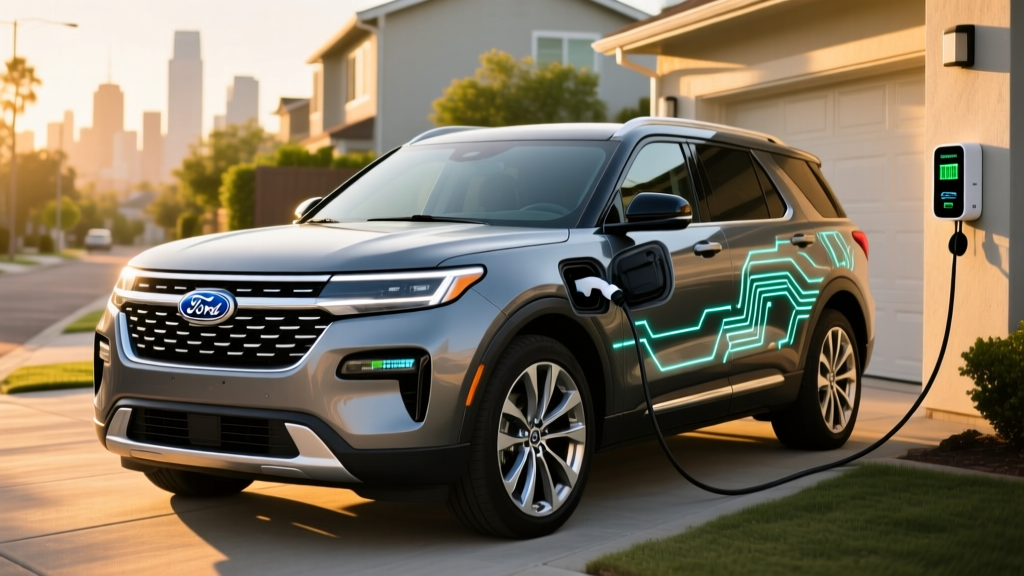
Ford's three-row SUV has offered a hybrid variant for several model years now, but the 2026 Ford Explorer Hybrid remains one of the few conventional hybrid options in its segment. While rivals like the Toyota Highlander Hybrid have dominated the conversation, Ford's approach pairs a turbocharged V6 with an electric motor for a distinctly different driving character. This guide breaks down the exact numbers buyers need — EPA fuel economy, real-world efficiency, powertrain output, battery longevity, and whether this hybrid SUV fits your garage better than a plug-in or full EV.
2026 Ford Explorer Hybrid at a Glance
| Spec | 2026 Explorer Hybrid (HEV) |
|---|---|
| Powertrain | 3.3L V6 + electric motor (conventional hybrid) |
| Combined Horsepower | 318 hp / 322 lb-ft torque |
| Transmission | 10-speed modular hybrid automatic |
| EPA MPG (FWD) | 27 city / 28 highway / 27 combined |
| EPA MPG (AWD) | 23 city / 26 highway / 24 combined |
| Battery | ~1.5 kWh lithium-ion (self-charging, no plug) |
| Seating | 6 or 7 passengers |
| Cargo (behind 3rd row) | 18.2 cu ft |
| Towing Capacity | Up to 5,000 lbs (with tow package) |
| Starting MSRP (Limited Hybrid) | ~$54,815 |
| Hybrid Battery Warranty | 8 years / 100,000 miles |
HEV vs. PHEV: What the Explorer Hybrid Actually Is
Understanding the distinction between hybrid types is essential before evaluating any purchase. Ford currently offers the Explorer only as a conventional hybrid (HEV). There is no Explorer PHEV sold in the United States for the 2026 model year.
| Feature | Explorer Hybrid (HEV) | Typical PHEV SUV | Full BEV SUV |
|---|---|---|---|
| Plug-in Charging Required? | No | Yes (for EV range) | Yes (always) |
| Electric-Only Range | None (motor assists only) | 25–42 miles typical | 250–400+ miles |
| Gasoline Engine | Yes (primary power) | Yes (backup + combined) | No |
| Home Charger Needed? | No | Recommended (Level 2) | Essential (Level 2) |
| Range Anxiety Risk | Very low | Very low | Moderate on road trips |
| Federal Tax Credit (§30D) | Not eligible | Up to $7,500 (if qualified) | Up to $7,500 (if qualified) |
The conventional hybrid setup means the Explorer's small battery pack captures energy during braking and deceleration, then deploys it to assist acceleration and enable brief engine-off coasting. This improves fuel economy without requiring any change to your fueling habits — you still visit gas stations exclusively.
Fuel Economy: EPA Ratings vs. Real-World MPG
| Drivetrain | City | Highway | Combined |
|---|---|---|---|
| FWD Hybrid | 27 MPG | 28 MPG | 27 MPG |
| AWD Hybrid | 23 MPG | 26 MPG | 24 MPG |
| Gas-Only Explorer (2.3L EcoBoost AWD) | 20 MPG | 26 MPG | 23 MPG |
Data sourced from fueleconomy.gov (EPA). The hybrid's advantage is most pronounced in city driving, where regenerative braking recaptures energy at every stoplight. FWD hybrid models see a 7 MPG improvement in city driving over the gas-only AWD variant.
For context, the hybrid powertrain saves roughly 50–80 gallons of fuel per year compared to the 2.3L EcoBoost AWD for a driver covering 15,000 miles annually. At $3.40/gallon, that translates to approximately $170–$270 in annual fuel savings — a modest but real reduction that compounds over years of ownership.
Powertrain Deep Dive: 318 HP From a Hybrid V6
The 2026 Explorer Hybrid uses Ford's 3.3-liter naturally aspirated V6 paired with a 35-kW (47-hp) electric motor integrated into the 10-speed automatic transmission. Combined system output reaches 318 horsepower and 322 lb-ft of torque.
This is a fundamentally different philosophy than Toyota's hybrid approach in the Highlander Hybrid, which uses a 2.5-liter four-cylinder. Ford prioritizes power delivery — the Explorer Hybrid hits 0–60 mph in approximately 6.7 seconds, roughly a second quicker than the four-cylinder Highlander Hybrid. The trade-off is slightly lower combined MPG.
The hybrid battery pack is a ~1.5 kWh lithium-ion unit mounted under the cargo area. It is significantly smaller than a PHEV or BEV battery because it only needs to buffer energy for short bursts of assist, not sustain electric-only driving. This keeps weight down and preserves the Explorer's cargo volume and third-row seating.
Battery Longevity, Warranty, and Replacement Costs
Hybrid battery anxiety is common among first-time hybrid buyers, but the data is reassuring. Ford covers the Explorer Hybrid battery under its 8-year/100,000-mile hybrid component warranty (10 years/150,000 miles in California Air Resources Board states). This warranty covers capacity loss that impairs vehicle function, not normal gradual degradation.
The hybrid system's other components — the electric motor, inverter, and DC-DC converter — are also covered under the hybrid warranty. The 10-speed transmission carries its own 5-year/60,000-mile powertrain warranty. According to NHTSA complaint data, hybrid-specific powertrain failures in the Explorer have been infrequent relative to volume.
Pricing, Trims, and Tax Credit Eligibility
The 2026 Explorer Hybrid is available exclusively in the Limited trim level, starting at approximately $54,815 (including destination). This positions it as a premium offering within the Explorer lineup, roughly $4,000–$6,000 above comparable gas-only Limited models.
The fuel savings of ~$200/year mean the hybrid premium takes roughly 20–30 years to recoup through fuel economy alone at current gas prices. The hybrid's value proposition is better understood as a combination of smoother low-speed driving, reduced emissions, and slightly improved city performance rather than pure payback economics.
- Federal §30D Tax Credit: The Explorer Hybrid does NOT qualify. The IRS §30D clean vehicle credit applies only to plug-in electric vehicles (PHEVs and BEVs) with minimum battery capacities. Conventional hybrids are excluded.
- State Incentives: A small number of states offer rebates for conventional hybrids, but most state-level incentives now target plug-in vehicles. Check your state's energy office for current programs.
- Used Hybrid Credit (§25E): If purchasing a qualifying used Explorer Hybrid (model year at least 2 years old, under $25,000 sale price), the used clean vehicle credit of up to $4,000 may apply — though this credit is also primarily structured around plug-in vehicles. Confirm eligibility with a tax professional.
Explorer Hybrid vs. the Competition
| Spec | 2026 Ford Explorer Hybrid | 2026 Toyota Highlander Hybrid | 2026 Kia Sorento Hybrid |
|---|---|---|---|
| Powertrain | 3.3L V6 + motor | 2.5L I4 + motors | 1.6L Turbo I4 + motor |
| Combined HP | 318 hp | 243 hp | 232 hp |
| EPA Combined MPG (AWD) | 24 MPG | 35 MPG | 34 MPG |
| Third Row | Yes (usable) | Yes (tight) | Yes (very tight) |
| Towing | 5,000 lbs | 3,500 lbs | 2,000 lbs |
| Starting MSRP (Hybrid) | ~$54,815 | ~$46,670 | ~$40,490 |
| Hybrid Battery Warranty | 8 yr / 100k mi | 10 yr / 150k mi | 10 yr / 100k mi |
The Explorer Hybrid trades fuel economy for power and towing capability. If maximizing MPG is your priority, the Highlander Hybrid delivers 11 more combined MPG with AWD — a significant advantage for high-mileage commuters. But if you need 5,000-lb towing, a more spacious third row, and stronger acceleration, the Explorer Hybrid occupies a unique niche.
Who Should Buy the Hybrid Ford Explorer?
Choose the Explorer Hybrid if:
- You want a three-row SUV with genuine towing capability (5,000 lbs) and more power than four-cylinder hybrids
- You cannot install a home charger and want zero changes to your fueling routine
- Your driving is a mix of city and highway, and you value smooth, quiet low-speed operation
- You plan to keep the vehicle 8+ years and want the hybrid warranty coverage
Consider a PHEV or full EV instead if:
- You have home charging access and want to eliminate most gasoline use on daily commutes
- You want federal tax credit eligibility (up to $7,500 for qualifying PHEVs/BEVs)
- Your daily driving is under 35 miles round-trip — a PHEV covers this on electricity alone
- Fuel economy is your top priority — the Highlander Hybrid or a PHEV will deliver higher MPGe
Stick with the gas-only Explorer if:
- You drive mostly highway miles where the hybrid advantage shrinks
- You want the lowest upfront price and don't plan to keep the vehicle long enough to recoup the hybrid premium
Frequently Asked Questions
How many MPG does the hybrid Ford Explorer get?
The 2026 Ford Explorer Hybrid achieves an EPA-estimated 27 city / 28 highway / 27 combined with front-wheel drive, and 23 city / 26 highway / 24 combined with all-wheel drive. Real-world city driving often matches or slightly exceeds the EPA city figure thanks to regenerative braking. Highway-only trips at speeds above 70 mph typically return 24–26 MPG for AWD models.
Do you have to plug in the Ford Explorer Hybrid?
No. The Explorer Hybrid is a conventional hybrid (HEV). It charges its small battery pack through regenerative braking and the gasoline engine. There is no plug, no charging cable, and no electric-only driving range. You fuel it exclusively at gas stations like any conventional vehicle.
Is the Explorer Hybrid reliable?
Ford's hybrid powertrain in the Explorer has shown average to above-average reliability. The 3.3L V6 is a proven engine, and the hybrid components carry an 8-year/100,000-mile warranty. According to IIHS and owner surveys, the hybrid system itself has been largely trouble-free. The Explorer as a platform has had some infotainment and build-quality complaints, but these are unrelated to the hybrid system.
What is the hybrid battery replacement cost?
Out-of-warranty hybrid battery replacement for the Explorer costs approximately $2,500–$4,000 including parts and labor. However, the 1.5 kWh pack operates under minimal stress and real-world data from similar Ford hybrid systems shows packs routinely lasting 150,000+ miles without failure. The 8-year/100,000-mile warranty provides substantial coverage.
Does the Ford Explorer Hybrid qualify for a tax credit?
No. The federal §30D clean vehicle credit applies only to plug-in electric vehicles — battery-electric vehicles (BEVs) and plug-in hybrids (PHEVs). Conventional hybrids like the Explorer Hybrid are not eligible. Some states may offer minor incentives for hybrids, but these are increasingly rare as programs shift focus to plug-in vehicles.
Is there a plug-in hybrid Ford Explorer?
Ford does not currently sell a PHEV version of the Explorer in the United States. The Escape PHEV is Ford's plug-in hybrid SUV offering, but it is a smaller two-row vehicle. If you want a three-row Ford with plug-in capability, you would need to look at the full-electric options or wait for future product announcements.
How does the Explorer Hybrid compare to the Toyota Highlander Hybrid on fuel economy?
The Highlander Hybrid significantly outperforms the Explorer Hybrid on efficiency: 35 MPG combined (AWD) versus 24 MPG combined (AWD). That's an 11 MPG gap. The trade-off is power — the Explorer delivers 318 hp and 5,000-lb towing versus the Highlander's 243 hp and 3,500-lb limit. Your priorities determine which trade-off makes sense.
Pros
- 318 hp provides strong acceleration for a three-row hybrid
- 5,000-lb towing capacity leads the hybrid SUV segment
- No plug-in required — zero lifestyle change from gas vehicles
- Usable third row for adults on short trips
- 8-year/100,000-mile hybrid battery warranty
Cons
- AWD fuel economy (24 combined) trails competitors by 10+ MPG
- Hybrid available only on the expensive Limited trim (~$54,815)
- No federal tax credit eligibility
- Hybrid premium over gas model takes decades to recoup through fuel savings alone
- No PHEV or electric-only option available