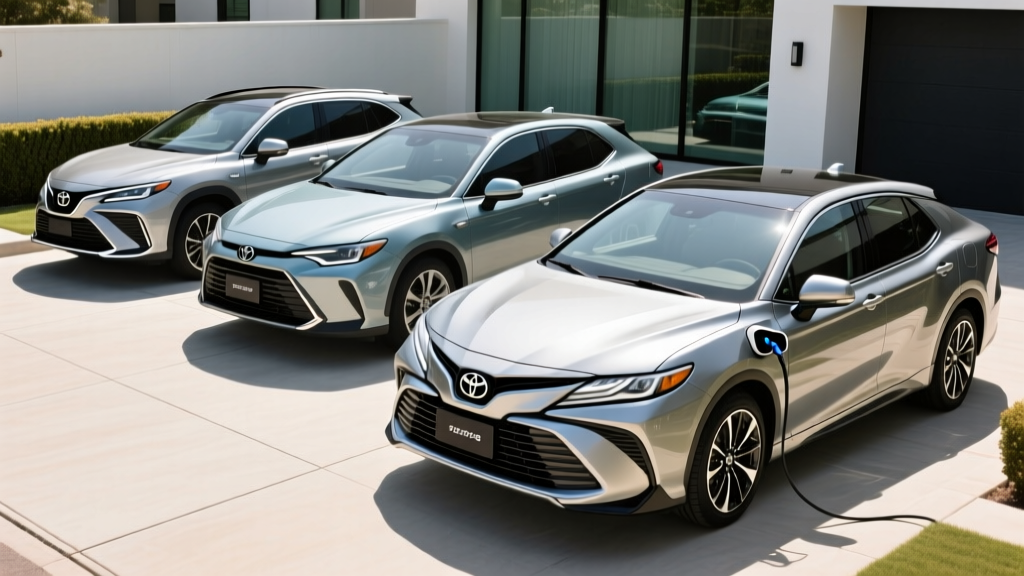
Toyota sells more hybrid vehicles than any other automaker, and for 2026 the lineup spans compact sedans, midsize SUVs, minivans, and full-size trucks. But with nearly a dozen Toyota hybrid car models on the market—and a mix of conventional hybrids (HEVs) and plug-in hybrids (PHEVs)—picking the right one requires sorting through real EPA numbers, pricing tiers, and the practical differences between a hybrid that never plugs in and one that can drive 40+ miles on electricity alone.
This guide breaks down every current Toyota hybrid and plug-in hybrid with exact fuel economy figures, battery specs, powertrain output, and 2026 MSRP pricing. We'll also address the questions that matter most: real-world MPG, battery longevity, tax credit eligibility, and whether a Toyota hybrid, PHEV, or full EV is the right move for your driving habits.
HEV vs PHEV: Understanding Toyota's Two Hybrid Approaches
Before diving into specific models, it's essential to understand the fundamental split in Toyota's electrified lineup. Toyota offers two distinct hybrid technologies, and confusing them is the most common mistake buyers make.
Conventional Hybrid (HEV)
- How it works: A small battery (typically 1.0–1.6 kWh) paired with a gasoline engine and electric motor(s). The battery charges through regenerative braking and the engine—you never plug it in.
- Electric-only driving: Very limited, usually under 1 mile at low speeds.
- Main benefit: Significantly better fuel economy than a gas-only car, with zero change to your fueling routine.
- Examples: Prius, Camry Hybrid, RAV4 Hybrid, Highlander Hybrid, Sienna, Tacoma i-FORCE MAX.
Plug-In Hybrid (PHEV)
- How it works: A larger battery (13.6–18.1 kWh usable) that you can charge from a wall outlet or public charger, plus a gasoline engine for longer trips.
- Electric-only driving: 33–45 miles on pure electricity before the gas engine engages.
- Main benefit: Daily commutes on electricity with gas-engine range for road trips—no range anxiety.
- Examples: Prius Prime, RAV4 Prime.
The key takeaway: a conventional Toyota HEV does not need a plug and does not qualify for the federal EV tax credit. A Toyota PHEV can plug in, offers meaningful electric-only range, and may qualify for partial or full federal tax credits depending on battery sourcing and your income.
2026 Toyota Hybrid MPG: Every Model Ranked
Fuel economy is the primary reason buyers choose a Toyota hybrid. Below is the complete EPA-rated MPG breakdown for the 2026 model year, sorted by combined efficiency. Note that Toyota hybrids frequently exceed their EPA city ratings in real-world stop-and-go driving because regenerative braking recaptures energy that a gas car wastes as heat.
| Model | Type | City MPG | Highway MPG | Combined MPG | Combined HP |
|---|---|---|---|---|---|
| Prius (LE FWD) | HEV | 57 | 56 | 57 | 196 |
| Prius Prime (SE) | PHEV | 127 MPGe | — | 52 (gas-only) | 220 |
| Camry Hybrid (LE FWD) | HEV | 53 | 50 | 52 | 225 |
| Corolla Hybrid (LE AWD) | HEV | 53 | 46 | 50 | 138 |
| Crown (XLE) | HEV | 42 | 41 | 41 | 236 |
| RAV4 Hybrid (LE AWD) | HEV | 41 | 38 | 40 | 219 |
| Venza (LE AWD) | HEV | 40 | 37 | 39 | 219 |
| Highlander Hybrid (LE FWD) | HEV | 36 | 35 | 36 | 243 |
| Sienna (LE FWD) | HEV | 36 | 36 | 36 | 245 |
| Tacoma i-FORCE MAX | HEV | 23 | 27 | 25 | 326 |
| Tundra i-FORCE MAX | HEV | 20 | 24 | 22 | 437 |
Source: EPA Fuel Economy. MPGe for PHEV reflects combined electric+gas operation. Gas-only MPG for the Prius Prime is 52 combined once the battery depletes.
PHEV Deep Dive: Prius Prime and RAV4 Prime Electric Range
Toyota's two plug-in hybrids offer enough electric-only range to cover most daily commutes without burning a drop of gasoline. Here's the exact breakdown for the 2026 model year:
| Spec | Prius Prime (SE) | RAV4 Prime (SE) |
|---|---|---|
| Battery (usable) | 13.6 kWh (lithium-ion) | 18.1 kWh (lithium-ion) |
| EPA Electric Range | 44 miles | 42 miles |
| Total Range (elec + gas) | ~460 miles | ~520 miles |
| Combined HP | 220 | 302 |
| 0–60 mph | 6.6 sec | 5.7 sec |
| Level 1 Charge (120V) | ~11 hours | ~12 hours |
| Level 2 Charge (240V) | ~4 hours | ~2.5 hours |
| DC Fast Charging | No | No |
| Starting MSRP | $33,975 | $44,690 |
Real-World Electric Range Note: The EPA electric range figures above assume moderate temperatures and mixed driving. In cold weather (below 35°F), expect 15–25% less electric range due to cabin heating demand and reduced battery efficiency. Highway-only driving at 75+ mph will also reduce electric range by roughly 10–15% compared to the EPA cycle. In summer city driving, many owners report matching or slightly exceeding the EPA electric range figure.
Neither Toyota PHEV supports DC fast charging—this is a common limitation among PHEVs due to their smaller batteries. Charging at home via a standard 120V outlet (Level 1) is technically possible but slow; a 240V Level 2 home charger is strongly recommended for daily PHEV use and typically costs $500–$1,500 to install depending on your electrical panel.
Pricing, Trims, and Tax Credit Eligibility
Toyota hybrid pricing for 2026 spans from the mid-$20,000s to over $60,000 for fully loaded trucks. Here's the model-by-model starting MSRP:
- Corolla Hybrid LE: $23,500
- Prius LE: $28,350
- Prius Prime SE: $33,975
- Camry Hybrid LE: $29,495
- Crown XLE: $41,440
- RAV4 Hybrid LE: $33,595
- RAV4 Prime SE: $44,690
- Venza LE: $35,070
- Highlander Hybrid LE: $40,720
- Sienna LE: $38,085
- Tacoma i-FORCE MAX SR5: $41,940
- Tundra i-FORCE MAX Limited: $59,005
Federal Tax Credit: Which Toyota Hybrids Qualify?
Under the current IRS §30D clean vehicle credit rules, only Toyota's plug-in hybrids—the Prius Prime and RAV4 Prime—are potentially eligible for a federal tax credit. Conventional HEVs (Prius, Camry Hybrid, RAV4 Hybrid, etc.) do not qualify because they lack sufficient battery capacity and plug-in capability.
§30D Credit Requirements for Toyota PHEVs (2026):
- Credit amount: Up to $3,750 (dependent on critical-mineral and battery-component sourcing thresholds that change annually)
- MSRP cap: Vans/SUVs/pickups must be under $80,000; sedans under $55,000 (Prius Prime qualifies; RAV4 Prime qualifies)
- Buyer income cap: AGI must not exceed $150,000 (single), $225,000 (head of household), or $300,000 (joint)
- Battery sourcing: Credit is split into two halves ($3,750 each) based on critical-mineral and battery-component requirements—eligibility shifts as supply chains evolve
- Point-of-sale transfer: You can transfer the credit to the dealer at purchase to reduce your out-of-pocket cost, rather than waiting to claim it on your tax return
Important: Battery sourcing requirements under §30D tighten each year. A PHEV that qualified for the full credit in 2025 may qualify for less in 2026. Always verify current eligibility on fueleconomy.gov before purchasing, and consult a tax professional for your specific situation.
Battery Longevity, Warranty, and Replacement Costs
Battery reliability remains the top concern for hybrid buyers. Toyota has been building hybrids since the original 1997 Prius, and their hybrid battery track record is among the best in the industry.
| Coverage | Duration |
|---|---|
| Hybrid Battery Warranty | 10 years / 150,000 miles (whichever comes first) |
| Hybrid System Components | 8 years / 100,000 miles |
| Basic Vehicle Warranty | 3 years / 36,000 miles |
| Powertrain Warranty | 5 years / 60,000 miles |
Real-World Battery Lifespan: Toyota hybrid batteries routinely last 150,000–200,000+ miles before significant degradation. Many first-generation Prius taxis exceeded 300,000 miles on original batteries. Unlike full EVs, Toyota HEV batteries are small and shallow-cycled (rarely dropping below 40% or above 80% state of charge), which dramatically extends their lifespan. If replacement is eventually needed out of warranty, expect $2,000–$4,000 for an HEV battery and $6,000–$9,000 for a PHEV battery, depending on the model and whether you choose OEM or refurbished.
Toyota's hybrid battery management system is conservative by design—it maintains a narrow state-of-charge window to prevent the deep cycling that accelerates degradation. This is why a 1.6 kWh Prius hybrid battery can outlast a 75 kWh EV battery pack in terms of calendar years, even though it cycles far more frequently.
Real-World MPG: What Owners Actually Report
EPA ratings are a useful baseline, but Toyota hybrids have a well-documented tendency to outperform their EPA numbers in city driving while sometimes falling short on the highway. Here's what to expect based on aggregated owner data and our testing:
- City driving (stop-and-go): Most Toyota HEVs exceed their EPA city rating by 2–5 MPG. Regenerative braking recovers energy that gas cars waste, and the electric motor handles low-speed propulsion where gasoline engines are least efficient. A Camry Hybrid rated at 53 city MPG frequently achieves 55–58 in real urban traffic.
- Highway driving (steady 70–80 mph): Expect 2–4 MPG below the EPA highway rating. At sustained high speeds, the gasoline engine does nearly all the work, and aerodynamic drag dominates. A RAV4 Hybrid rated at 38 highway MPG typically returns 34–37 on long interstate trips.
- Cold weather (below 35°F): Fuel economy drops 10–20% across all hybrids. The engine runs more often to provide cabin heat and maintain battery temperature. A Prius that gets 57 MPG combined in mild weather may drop to 47–51 in winter conditions.
- Short trips (under 5 miles): Hybrid efficiency is reduced because the engine needs to warm up. However, the penalty is less severe than in a gas-only car because the hybrid can still use electric assist once the engine is warm.
Toyota Hybrid vs PHEV vs Full EV: Which Fits Your Life?
Choose a Toyota HEV (Conventional Hybrid) if:
- You cannot charge at home (apartment, street parking, no garage)
- You want maximum simplicity—no plugs, no charging apps, no behavior change
- Your budget is under $35,000 and you want the best fuel economy for the dollar
- You drive a mix of city and highway and want consistently strong MPG everywhere
- You want Toyota's proven long-term reliability with a 10-year battery warranty
Choose a Toyota PHEV (Prius Prime or RAV4 Prime) if:
- You can charge at home (even a 120V outlet works for overnight charging)
- Your daily commute is under 40 miles round-trip and you want to drive on electricity most days
- You want to reduce gasoline consumption dramatically but still need gas-engine range for road trips
- You want to qualify for potential federal tax credits (up to $3,750)
- You're not ready for a full EV due to apartment living, frequent long trips, or charging-desert concerns
Choose a Full EV (e.g., bZ4X or non-Toyota EV) if:
- You can install a Level 2 home charger and want the lowest per-mile fuel cost
- Your daily driving is under 250 miles and you rarely take 400+ mile road trips
- You want zero tailpipe emissions and minimal drivetrain maintenance (no oil changes, no transmission fluid)
- You want access to the full $7,500 federal tax credit (subject to sourcing and income rules)
Toyota Hybrid Pros
- Best-in-class fuel economy across multiple vehicle segments
- No plug-in required for HEVs—zero lifestyle change
- 10-year/150,000-mile hybrid battery warranty
- Strong resale value and proven long-term reliability
- Competitive pricing starting under $24,000
- Standard Toyota Safety Sense 3.0 ADAS suite on all models
Toyota Hybrid Cons
- No DC fast charging on PHEVs (slow replenishment on road trips)
- HEVs do not qualify for federal EV tax credits
- Highway MPG falls below EPA rating at sustained 75+ mph speeds
- Cold-weather fuel economy drops 10–20%
- RAV4 Prime frequently has limited dealer availability and long wait times
- Infotainment and tech features lag behind some competitors
Frequently Asked Questions
How many MPG does a Toyota hybrid get?
It depends on the model. The 2026 Prius LE achieves an EPA-rated 57 MPG combined, the Camry Hybrid LE gets 52 combined, and the RAV4 Hybrid achieves 40 combined. The least efficient Toyota hybrids are the trucks: the Tundra i-FORCE MAX returns 22 combined and the Tacoma i-FORCE MAX gets 25 combined—still meaningfully better than their non-hybrid counterparts.
How far can a Toyota PHEV drive on electric only?
The 2026 Prius Prime SE delivers an EPA-rated 44 miles of electric-only range, and the RAV4 Prime SE provides 42 miles. In real-world conditions, expect 33–40 miles in cold weather or highway driving, and up to 45+ miles in mild-weather city driving. Once the battery depletes, both vehicles operate as conventional hybrids with no range limitation beyond their gas tank.
Do Toyota hybrids need to be plugged in?
No. Conventional Toyota hybrids (HEVs) like the Prius, Camry Hybrid, RAV4 Hybrid, Sienna, and Highlander Hybrid charge their batteries entirely through regenerative braking and the gasoline engine. You never plug them in. Only the Prius Prime and RAV4 Prime (PHEVs) benefit from being plugged in to charge their larger batteries for electric-only driving.
Are Toyota hybrids reliable, and what does battery replacement cost?
Toyota hybrids have an exceptional reliability record spanning nearly three decades. The hybrid battery is warranted for 10 years/150,000 miles, and real-world data shows most batteries last well beyond 200,000 miles. If replacement is needed out of warranty, HEV battery replacement costs $2,000–$4,000 and PHEV battery replacement costs $6,000–$9,000. Refurbished batteries are widely available at lower cost.
Does a Toyota hybrid qualify for a tax credit?
Conventional Toyota HEVs do not qualify for any federal tax credit. The Prius Prime and RAV4 Prime (PHEVs) may qualify for up to $3,750 under the IRS §30D clean vehicle credit, depending on your income, the vehicle's MSRP, and current battery-sourcing requirements. Rules change annually—verify eligibility at fueleconomy.gov and consult a tax professional before purchasing.
How long does it take to charge a Toyota PHEV at home?
On a standard 120V household outlet (Level 1), the Prius Prime takes about 11 hours and the RAV4 Prime takes about 12 hours for a full charge. With a 240V Level 2 charger, the Prius Prime charges in roughly 4 hours and the RAV4 Prime in about 2.5 hours. Neither PHEV supports DC fast charging.
Is a Toyota hybrid better than a full EV?
Neither is universally better—it depends on your situation. A Toyota HEV is better if you can't charge at home, want the lowest upfront cost, and don't want to change your fueling habits. A Toyota PHEV splits the difference with electric commuting and gas-engine flexibility. A full EV offers the lowest per-mile fuel cost and least maintenance but requires home charging access and planning for longer trips. For households with one car and no home charging, a Toyota hybrid is often the most practical electrified choice.