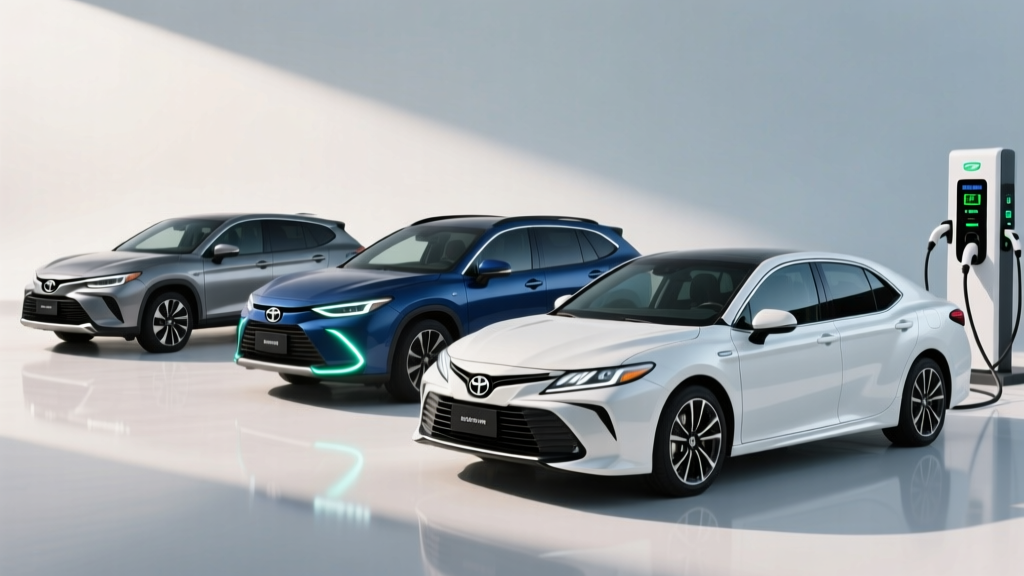
Toyota practically invented the modern hybrid segment with the Prius in the late 1990s, and nearly three decades later the automaker offers the broadest hybrid lineup in the industry. For 2026, Toyota sells hybrid versions of nearly every vehicle it builds — from the compact Corolla Hybrid to the full-size Sequoia SUV and the Tundra pickup. If you're researching hybrid cars by Toyota, you're looking at a range that spans 40 to 50+ MPG combined, starting prices under $24,000, and proven hybrid battery longevity that routinely exceeds 200,000 miles.
But Toyota also sells plug-in hybrids (PHEVs) — notably the RAV4 Prime and Prius Prime — that blur the line between hybrid and full EV. Understanding the difference between Toyota's conventional hybrids (HEVs) and its plug-in hybrids (PHEVs) is critical before you visit a dealer. This guide breaks down every current Toyota hybrid by the numbers: EPA MPG, electric-only range, battery specs, pricing, and real-world ownership data.
Toyota HEV vs PHEV: What's the Difference?
Toyota's hybrid lineup splits into two distinct categories, and confusing them is the most common mistake first-time hybrid buyers make.
Conventional Hybrid (HEV)
How it works: A small battery (typically 1.0–1.6 kWh) is charged entirely by regenerative braking and the gasoline engine. You never plug it in.
Electric-only driving: Minimal — usually under 1 mile at very low speeds. The electric motor assists the gas engine; it doesn't replace it.
Best for: Drivers without home charging access who want maximum MPG with zero behavior change.
Examples: Prius, Corolla Hybrid, Camry Hybrid, RAV4 Hybrid, Highlander Hybrid, Sienna, Tundra i-FORCE MAX.
Plug-in Hybrid (PHEV)
How it works: A larger battery (13.6–18.1 kWh usable) that you plug in to charge. It provides a meaningful electric-only range before the gas engine takes over.
Electric-only driving: 39–45 miles on a full charge — enough for most daily commutes without burning gas.
Best for: Drivers with home or workplace charging who want EV-like commuting but gas-car road-trip flexibility.
Examples: Prius Prime, RAV4 Prime.
The distinction matters for your wallet, your daily routine, and your tax situation. HEVs require zero infrastructure — just fill up with gas and drive. PHEVs reward you enormously if you can charge at home (a standard 120V outlet works, though slowly), but if you never plug in a PHEV, you're simply hauling extra battery weight and paying a premium for electric range you never use.
2026 Toyota Hybrid Lineup: MPG, Range & Pricing
Below is the complete 2026 Toyota hybrid lineup with EPA fuel economy data sourced from fueleconomy.gov, manufacturer pricing, and key specifications. All MPG figures are EPA-rated estimates.
| Model | Type | EPA MPG (City/Hwy/Combined) | PHEV Electric Range | Battery (kWh) | Combined HP | Starting MSRP |
|---|---|---|---|---|---|---|
| Prius LE | HEV | 57 / 56 / 57 | — | ~1.0 | 196 | $28,550 |
| Prius XLE/Limited | HEV | 52 / 52 / 52 | — | ~1.0 | 196 | $31,550 |
| Prius Prime SE | PHEV | 127 MPGe (combined) / 52 MPG gas-only | 45 mi | 13.6 | 220 | $33,975 |
| Corolla Hybrid LE | HEV | 53 / 46 / 50 | — | ~1.0 | 138 | $23,800 |
| Camry Hybrid LE | HEV | 53 / 50 / 51 | — | ~1.1 | 225 | $29,995 |
| RAV4 Hybrid (AWD) | HEV | 41 / 38 / 40 | — | ~1.6 | 219 | $33,575 |
| RAV4 Prime (AWD) | PHEV | 94 MPGe / 38 MPG gas-only | 42 mi | 18.1 | 302 | $44,515 |
| Highlander Hybrid (AWD) | HEV | 35 / 35 / 35 | — | ~1.6 | 243 | $41,670 |
| Grand Highlander Hybrid | HEV | 36 / 32 / 34 | — | ~1.6 | 243 | $46,225 |
| Sienna (FWD/AWD) | HEV | 36 / 36 / 36 | — | ~1.6 | 245 | $39,285 |
| Crown Hybrid | HEV | 42 / 41 / 41 | — | ~1.6 | 236 | $42,590 |
| Venza (AWD) | HEV | 40 / 37 / 39 | — | ~1.6 | 219 | $36,070 |
| Sequoia (i-FORCE MAX) | HEV | 22 / 26 / 24 | — | ~1.9 | 437 | $63,095 |
| Tundra i-FORCE MAX | HEV | 20 / 24 / 22 | — | ~1.9 | 437 | $59,995 |
Source: EPA fuel economy ratings via fueleconomy.gov; MSRP from Toyota's official pricing. Actual mileage varies with driving conditions, temperature, and load.
Real-World MPG: What Owners Actually Get
One of the pleasant surprises with Toyota hybrids is that real-world fuel economy often exceeds EPA estimates in city and mixed driving — the opposite of what happens with conventional gas cars. Here's why: hybrids capture braking energy through regeneration and run the electric motor more in stop-and-go traffic, which is exactly where gas engines are least efficient.
Real-World MPG Expectations vs. EPA Stickers
Prius LE (EPA 57 combined): Owners on fueleconomy.gov's My MPG tracker consistently report 55–62 MPG in mixed driving. Highway-only trips at 75+ MPH typically yield 48–52 MPG. Cold weather drops city MPG by roughly 5–10% due to engine warm-up cycles.
Camry Hybrid (EPA 51 combined): Real-world reports cluster around 48–55 MPG. City-dominant commutes push the upper range; sustained highway cruising at 80 MPH pulls it toward 45–48 MPG.
RAV4 Hybrid AWD (EPA 40 combined): Expect 37–43 MPG in practice. The AWD system's rear electric motor engages frequently in city driving, boosting efficiency beyond the EPA city rating for many owners.
RAV4 Prime (EPA 42 mi electric): In mild weather (60–80°F), expect 40–47 miles on a charge. In freezing conditions, that drops to roughly 32–37 miles as cabin heating draws from the battery. Once the battery depletes, the RAV4 Prime operates as a conventional hybrid at approximately 35–38 MPG.
Prius Prime (EPA 45 mi electric): Real-world electric range lands between 42–50 miles in moderate temperatures, with some hypermilers squeezing out 52+. Gas-only hybrid mode delivers roughly 48–52 MPG.
The critical takeaway: if your driving is primarily urban or suburban (under 45 MPH average), Toyota hybrids will likely beat their EPA numbers. If you spend most of your time at sustained highway speeds above 70 MPH, expect to land slightly below the EPA combined figure.
Toyota PHEV Charging: Battery Specs, Times & Limitations
Toyota currently offers two PHEVs: the Prius Prime and RAV4 Prime. Understanding their charging characteristics is essential because neither supports DC fast charging — a significant limitation for road-trippers who want to top up at highway chargers.
| Model | Battery (kWh Usable) | Level 1 (120V) Charge Time | Level 2 (240V) Charge Time | DC Fast Charge | Onboard Charger |
|---|---|---|---|---|---|
| Prius Prime | 13.6 kWh | ~11 hours | ~4 hours | Not supported | 3.3 kW (6.6 kW on XSE Premium) |
| RAV4 Prime | 18.1 kWh | ~12.5 hours | ~4.5 hours (6.6 kW) / ~2.5 hours (onboard upgrade) | Not supported | 3.3 kW (6.6 kW optional) |
What this means practically: Level 1 charging from a standard household outlet works fine for overnight top-ups if your daily electric-only commute is under 30 miles. For full daily recharges of the RAV4 Prime's larger battery, a Level 2 home charger (240V) is strongly recommended. The good news: because PHEV batteries are small relative to full EVs, even a basic Level 2 charger refills them in a single overnight session.
The DC fast-charge gap: Neither Toyota PHEV supports DC fast charging (CCS, NACS, or CHAdeMO). On road trips, once you deplete the electric range, you're operating as a conventional hybrid. This is actually fine for most road-trip scenarios — the hybrid system still delivers strong MPG — but it means you cannot "refuel" the battery at Electrify America or Tesla Supercharger stations.
Tax Credits & Incentives: What Toyota Hybrids Qualify For
Federal tax credit eligibility for Toyota hybrids depends entirely on whether you're buying an HEV or a PHEV, and the rules under IRS §30D have specific requirements that change annually.
Federal §30D Tax Credit Rules for Toyota PHEVs (2026)
- Eligible models: Only PHEVs (Prius Prime, RAV4 Prime) may qualify — conventional HEVs do not qualify for §30D.
- Maximum credit: Up to $7,500, split between critical minerals ($3,750) and battery components ($3,750) requirements.
- MSRP cap: Vehicle MSRP must not exceed $55,000 for sedans (Prius Prime qualifies) or $80,000 for SUVs/trucks/vans (RAV4 Prime qualifies).
- Buyer income limits: Modified AGI must not exceed $150,000 (single), $225,000 (head of household), or $300,000 (married filing jointly).
- Battery sourcing: A percentage of critical minerals and battery components must be sourced from the U.S. or free-trade-agreement countries — percentages increase annually. Check current-year requirements at irs.gov.
- Point-of-sale transfer: Since 2024, you can transfer the credit to the dealer at purchase, reducing your out-of-pocket cost immediately rather than waiting for tax filing.
- Assembly requirement: Vehicle must undergo final assembly in North America (both Toyota PHEVs currently sold in the U.S. are assembled in Japan — verify current eligibility for your specific model year at the IRS VIN lookup tool).
The Japan assembly complication: Toyota's Prius Prime and RAV4 Prime are built in Japan. Under current §30D rules, the vehicle must have final assembly in North America to qualify for the federal credit. This has historically disqualified both Toyota PHEVs from the $7,500 federal credit. Always verify current eligibility using the fueleconomy.gov tax credit tool before purchasing, as manufacturing locations and trade agreements can shift.
State incentives: Several states offer their own rebates for PHEVs regardless of assembly location. California's Clean Fuel Reward, Colorado's state tax credit, and New York's Drive Clean Rebate have at various times included the RAV4 Prime and Prius Prime. Check your state's energy office or DMV for current programs.
Conventional hybrids (HEVs): Toyota's standard hybrids (Prius, Camry Hybrid, RAV4 Hybrid, etc.) do not qualify for the federal §30D clean vehicle credit. Some states and utilities offer small rebates for HEVs, but these are less common and typically range from $250–$1,000.
Battery Longevity, Warranty & Replacement Costs
Hybrid battery replacement cost is the single biggest concern we hear from prospective Toyota hybrid buyers. Here's the data-driven reality: Toyota hybrid batteries are among the most durable in the industry, and catastrophic failure before 150,000 miles is rare.
Toyota Hybrid Battery Warranty
Coverage: 10 years or 150,000 miles (whichever comes first) for all 2020+ model year Toyota hybrids and PHEVs. Prior to 2020, coverage was 8 years / 100,000 miles (10/150,000 in California Air Resources Board states).
What's covered: Battery capacity loss below a specified threshold (typically 60–70% of original capacity) and complete battery failure.
Real-world lifespan data: Taxi fleets and high-mileage owners regularly report Toyota Prius hybrid batteries lasting 200,000–300,000+ miles with gradual capacity loss. The original NiMH batteries in early Prius models are still running in some vehicles at 250,000+ miles. Modern lithium-ion packs in the current-generation Prius and PHEVs are expected to match or exceed this longevity.
| Model | Battery Chemistry | Warranty | Estimated Replacement Cost (Out of Warranty) |
|---|---|---|---|
| Prius (HEV) | Lithium-ion (current gen) | 10 yr / 150,000 mi | $2,500–$3,500 |
| Prius Prime (PHEV) | Lithium-ion | 10 yr / 150,000 mi | $4,000–$5,500 |
| Camry Hybrid | Lithium-ion | 10 yr / 150,000 mi | $2,500–$4,000 |
| RAV4 Hybrid | Nickel-metal hydride (NiMH) | 10 yr / 150,000 mi | $3,000–$4,500 |
| RAV4 Prime (PHEV) | Lithium-ion | 10 yr / 150,000 mi | $5,500–$7,500 |
| Highlander / Sienna Hybrid | NiMH | 10 yr / 150,000 mi | $3,500–$5,000 |
Cost context: At an average annual mileage of 12,000–15,000 miles, a Toyota hybrid battery should last well beyond the 10-year warranty period. If a replacement is needed after warranty, the $2,500–$7,500 range is comparable to a major transmission repair on a conventional car — and far less frequent. Third-party remanufactured batteries are also available at 30–50% lower cost from companies like Green Bean Battery.
Toyota Hybrid vs PHEV vs Full EV: Which Fits You?
The right choice depends on your daily mileage, charging access, and budget. Here's a decision framework based on real ownership patterns:
Choose a Toyota HEV (Prius, Camry Hybrid, RAV4 Hybrid, etc.) if:
- You cannot install a home charger and lack reliable workplace charging.
- Your commute is mixed city/highway with no opportunity to plug in.
- You want maximum MPG (40–57 combined) with zero lifestyle change.
- Your budget is $24,000–$45,000 and you don't want to pay a PHEV premium.
- You drive a lot of highway miles where PHEV electric range provides minimal benefit.
Choose a Toyota PHEV (Prius Prime, RAV4 Prime) if:
- You can charge at home (even a standard 120V outlet works for overnight).
- Your daily commute is under 45 miles round-trip — you could drive months without buying gas.
- You want EV-like quietness and instant torque for daily driving but need gas flexibility for road trips.
- You live in a state with PHEV incentives that offset the higher purchase price.
- You're not ready to commit to a full EV but want to reduce emissions and fuel costs.
Choose a full BEV (Tesla Model 3/Y, Hyundai Ioniq 5, etc.) instead if:
- You have reliable Level 2 home charging and your daily driving is under 250 miles.
- You want zero tailpipe emissions and the lowest per-mile fuel cost.
- You want access to the full $7,500 federal tax credit (many BEVs assembled in North America qualify where Toyota PHEVs may not).
- You're comfortable with public DC fast charging for road trips.
Pros and Cons of Toyota's Hybrid Lineup
Pros
- Class-leading fuel economy across most segments (50+ MPG in Prius, Camry, Corolla)
- No charging infrastructure needed for HEVs — zero behavior change
- Proven battery longevity with 10-year / 150,000-mile warranty
- Strong resale value — Toyota hybrids hold value better than most competitors
- Smooth, quiet powertrain with instant electric torque at low speeds
- Broadest hybrid model range of any automaker (14+ models)
- PHEV options (Prime models) offer 42–45 miles electric for gas-free commuting
- Toyota Safety Sense (TSS 3.0) standard on most models — adaptive cruise, lane-keeping, AEB
Cons
- PHEVs (Prime models) do not support DC fast charging — a notable road-trip limitation
- Federal §30D tax credit eligibility is uncertain due to Japan assembly
- RAV4 Prime and Prius Prime carry a $4,000–$10,000 price premium over HEV equivalents
- Infotainment systems in some models lag behind competitors in responsiveness
- Highlander Hybrid and Sequoia MPG (24–35 combined) are modest vs. their HEV sedan siblings
- Dealer markups on high-demand models (especially RAV4 Prime) remain common in some markets
- HEV battery capacity is small — no meaningful electric-only driving mode
Frequently Asked Questions
How many MPG does a Toyota hybrid get?
It depends on the model. The 2026 Prius LE achieves an EPA-rated 57 MPG combined (57 city / 56 highway). The Corolla Hybrid gets 50 combined, the Camry Hybrid gets 51 combined, and the RAV4 Hybrid AWD gets 40 combined. Larger models like the Sienna and Highlander Hybrid achieve 34–36 combined. In real-world city driving, many owners report exceeding the EPA combined figure by 2–5 MPG thanks to regenerative braking efficiency.
How far can the Toyota PHEVs go on electric only?
The 2026 Prius Prime SE delivers an EPA-rated 45 miles of electric-only range. The RAV4 Prime provides 42 miles. In real-world conditions, expect 40–50 miles from the Prius Prime and 37–47 miles from the RAV4 Prime, depending on temperature, speed, and climate control usage. Cold weather (below freezing) reduces electric range by approximately 15–20%.
Is a Toyota hybrid reliable, and what does battery replacement cost?
Toyota hybrids consistently rank among the most reliable vehicles in J.D. Power and Consumer Reports surveys. The hybrid battery is warranted for 10 years / 150,000 miles, and real-world data shows many batteries lasting 200,000+ miles with gradual capacity loss. If replacement is needed after warranty, costs range from roughly $2,500 (Prius HEV) to $7,500 (RAV4 Prime PHEV), with remanufactured options available at lower cost.
Do Toyota hybrids qualify for any tax credit?
Conventional Toyota hybrids (HEVs) do not qualify for the federal §30D clean vehicle credit. Toyota PHEVs (Prius Prime, RAV4 Prime) could theoretically qualify for up to $7,500, but current §30D rules require North American final assembly — and both Toyota PHEVs are built in Japan, which has historically disqualified them. Always verify current eligibility at irs.gov before purchasing. Some state incentives (California, Colorado, New York, and others) may still apply to Toyota PHEVs regardless of assembly location.
Do I need to plug in a Toyota hybrid?
No — if you buy a conventional Toyota HEV (Prius, Camry Hybrid, RAV4 Hybrid, etc.), you never plug it in. The battery charges through regenerative braking and the gasoline engine. Only the PHEV models (Prius Prime, RAV4 Prime) benefit from plugging in, and even they function perfectly fine as conventional hybrids if you skip charging — you just lose the electric-only range advantage.
Which Toyota hybrid is the best value?
For pure efficiency per dollar, the Corolla Hybrid LE at $23,800 and 50 MPG combined is arguably the best value in the entire Toyota lineup. For families needing cargo space, the RAV4 Hybrid at $33,575 and 40 MPG combined is the segment benchmark. If you can charge at home and want to minimize gas use, the Prius Prime SE at $33,975 delivers 45 miles of electric range plus 52 MPG in hybrid mode — potentially the lowest fuel cost of any Toyota you can buy.
How does Toyota hybrid all-wheel drive work?
Toyota's AWD hybrid system uses a separate electric motor on the rear axle rather than a mechanical driveshaft from the engine. This means AWD engages electronically and instantaneously when slip is detected, without the weight and friction losses of a traditional AWD system. The AWD penalty on fuel economy is minimal — typically 1–2 MPG less than the FWD equivalent.