Quick Verdict: The Original Plug-In Hybrid Minivan Still Holds Up
When Chrysler launched the 2017 Pacifica Hybrid, it became the first plug-in hybrid minivan sold in the United States — a bold move for a segment defined by family hauling and fuel-cost sensitivity. Nearly a decade later, used examples of the 2017 Chrysler Pacifica Hybrid minivan remain one of the most practical PHEVs on the secondhand market, offering 33 miles of electric-only range and a combined 84 MPGe when the battery is charged. But with a 16 kWh battery pack that's now aging past its original warranty window, prospective used buyers need hard data on degradation, reliability, and what ownership actually costs in 2026.
This guide breaks down every spec that matters — from real-world MPG to battery replacement costs — so you can decide whether a used 2017 Pacifica Hybrid fits your family's driving routine or whether a newer PHEV or full EV makes more sense.
HEV vs PHEV: What the 2017 Pacifica Hybrid Actually Is
Conventional Hybrid (HEV): A small battery (typically 1–2 kWh) recharges through regenerative braking and the engine. You never plug it in. Examples: Toyota Sienna Hybrid, Honda CR-V Hybrid. Benefit: better MPG without lifestyle changes.
Plug-In Hybrid (PHEV): A larger battery (the Pacifica Hybrid uses 16 kWh) that you plug in to recharge, giving you a meaningful electric-only driving range before the gas engine kicks in. You can still drive it without ever plugging in — it simply operates as a conventional hybrid once the battery depletes.
The 2017 Chrysler Pacifica Hybrid is a PHEV. Its 16 kWh lithium-ion battery pack (manufactured by LG Chem) provides an EPA-rated 33 miles of electric-only range. Once that range is depleted, the vehicle seamlessly transitions to hybrid operation, where the gasoline engine and electric motors work together for continued driving without any plug-in requirement.
This dual nature is the Pacifica Hybrid's core appeal: plug in overnight for school runs and errands on electricity, then take a 500-mile road trip without hunting for chargers.
Powertrain, Battery, and Performance Specs
| Specification | 2017 Chrysler Pacifica Hybrid |
|---|---|
| Powertrain Type | Plug-In Hybrid (PHEV) |
| Engine | 3.6L Pentastar V6 (Atkinson cycle) |
| Electric Motors | Dual motor eFlite electrically variable transmission (EVT) |
| Combined System Output | 287 hp |
| Battery Capacity | 16 kWh lithium-ion (LG Chem NMC) |
| Usable Battery Capacity | ~13 kWh (buffer protects longevity) |
| EPA Electric-Only Range | 33 miles |
| Total Combined Range | ~566 miles (electric + gas) |
| EPA MPGe (Electric Mode) | 84 MPGe combined |
| EPA MPG (Gas/Hybrid Mode) | 32 MPG combined |
| Level 1 Charging (120V) | ~14 hours (full charge) |
| Level 2 Charging (240V) | ~2 hours (full charge at 6.6 kW onboard charger) |
| DC Fast Charging | Not supported |
| 0–60 mph | ~7.4 seconds |
| Drivetrain | Front-wheel drive |
| Seating | 7 passengers (Stow 'n Go unavailable in 2nd row due to battery) |
A critical packaging note: the battery pack sits beneath the second-row floor, which means the 2017 Pacifica Hybrid loses Chrysler's signature Stow 'n Go second-row seats. The second-row captain's chairs must be manually removed if you need a flat load floor. The third row still folds flat. For many families, this is a meaningful trade-off against the fuel savings.
Fuel Economy: EPA Numbers vs Real-World MPG
| Driving Mode | EPA City | EPA Highway | EPA Combined | Real-World Expectation |
|---|---|---|---|---|
| Electric Only (MPGe) | — | — | 84 MPGe | 70–90 MPGe depending on temperature and speed |
| Gas/Hybrid Mode (MPG) | 32 | 33 | 32 | 28–35 MPG (see notes below) |
Real-world context from owner reports and testing:
- City driving in hybrid mode: Hybrids typically exceed EPA city estimates because regenerative braking recovers energy in stop-and-go traffic. Owners regularly report 33–36 MPG in urban driving once the battery is depleted.
- Highway driving in hybrid mode: Expect 28–31 MPG at 70+ mph. The Pacifica Hybrid is a 5,000-pound minivan with the aerodynamics of one — highway efficiency drops noticeably above 65 mph.
- Cold weather (below 35°F): Electric-only range drops 20–30%, meaning your 33-mile EPA range may shrink to 22–26 miles in winter. The engine also runs more frequently to provide cabin heat, reducing hybrid-mode MPG by roughly 2–4 MPG.
- Electric-only range reality: In moderate temperatures at city speeds, 33 miles is achievable. At highway speeds or with climate control running hard, expect 25–28 miles before the engine engages.
According to fueleconomy.gov, the 2017 Pacifica Hybrid's official ratings hold up well for daily commutes under 30 miles — which covers the majority of American driving days according to FHWA data.
Charging: What You Need at Home
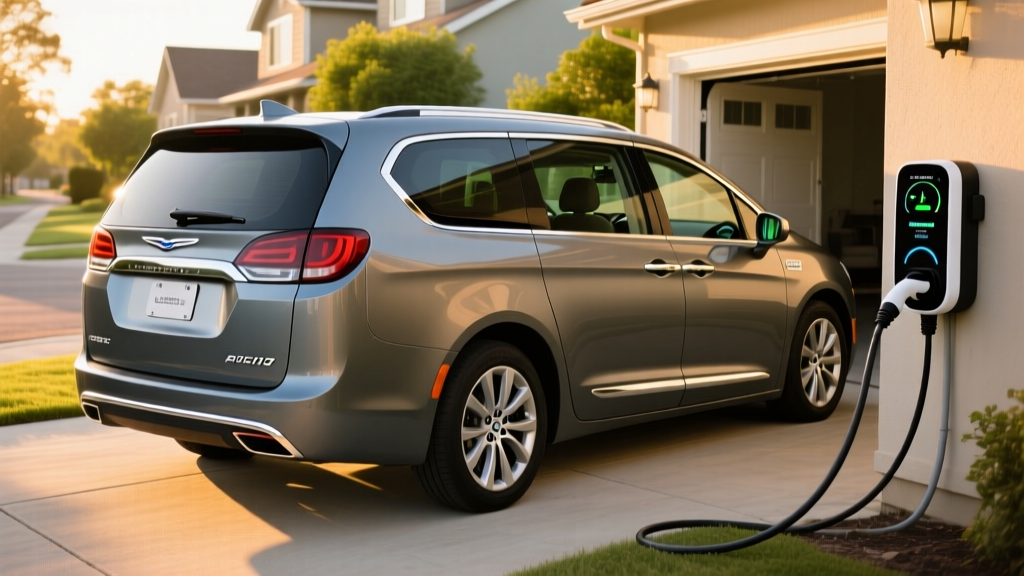
The 2017 Pacifica Hybrid comes with a portable Level 1 (120V) charging cord that plugs into any standard household outlet. A full charge from empty takes roughly 14 hours — functional for overnight charging if your daily electric-only needs are modest.
For practical daily use, most owners install a Level 2 (240V) home charger. The Pacifica Hybrid has a 6.6 kW onboard charger, meaning it can accept up to 6.6 kW from a Level 2 station. At this rate, a full charge takes approximately 2 hours.
No DC Fast Charging: The 2017 Pacifica Hybrid does not support DC fast charging. There is no CCS or CHAdeMO port. This is typical for PHEVs of this era — the 16 kWh battery is small enough that Level 2 charging is sufficient for overnight replenishment, and the cost/weight of DC fast-charge hardware wasn't justified.
Level 2 installation cost (2026 estimates):
| Item | Cost Range |
|---|---|
| Level 2 charger (24–48A, J1772 connector) | $200–$600 |
| Electrician labor (240V outlet or hardwire) | $500–$2,000 |
| Permit and inspection | $50–$300 |
| Electrical panel upgrade (if needed, 100A → 200A) | $1,500–$4,000 |
| Total typical install | $750–$2,900 (without panel upgrade) |
Because the Pacifica Hybrid only needs 6.6 kW, you don't need an expensive 48A charger — a 32A unit on a 40A circuit is perfectly sufficient, which keeps equipment and wiring costs on the lower end.
Battery Health, Warranty, and Replacement Cost
This is the most important section for anyone shopping a used 2017 Chrysler Pacifica Hybrid minivan in 2026. The vehicle is now 8–9 years old, and Chrysler's original battery warranty is either expiring or already expired depending on the in-service date.
Original Battery Warranty: 8 years / 100,000 miles (10 years / 150,000 miles in CARB states including California, New York, Massachusetts, and others that follow California emissions standards). The warranty covers battery capacity dropping below 70% of original capacity.
Battery degradation reality: PHEV batteries tend to degrade more slowly than full EV batteries because the vehicle's software uses a large buffer — only about 13 of the 16 kWh is usable, keeping the cells from hitting extreme high or low states of charge. Owner reports on forums and NHTSA complaint databases suggest most 2017 Pacifica Hybrids retain 80–90% of original capacity at 80,000–100,000 miles, though individual results vary based on climate and charging habits.
Battery replacement cost (2026): If the battery does fail out of warranty, expect to pay between $5,500 and $8,500 for a replacement pack including labor at a dealership. Independent hybrid battery shops may offer refurbished packs for $3,500–$5,000. Module-level repair (replacing individual bad cells rather than the full pack) is sometimes available for $1,500–$3,000.
Pre-purchase battery check: Before buying a used 2017 Pacifica Hybrid, have a dealer or qualified hybrid technician run a State of Health (SoH) diagnostic on the battery. This takes about 15 minutes and gives you a percentage reading of remaining capacity. Aim for vehicles showing 80%+ SoH.
Reliability and Known Issues
The 2017 model year was the Pacifica Hybrid's first year of production, and early models carried the typical first-year issues. Key items to watch:
- Power inverter recall: Chrysler issued a recall for certain 2017–2018 Pacifica Hybrids related to the power inverter, which could potentially overheat. Verify any used example has had this recall performed (free at any Chrysler dealer).
- 12V auxiliary battery: Like many PHEVs and EVs, the Pacifica Hybrid has experienced 12V battery drain issues when parked for extended periods. A dead 12V battery can prevent the vehicle from starting even if the high-voltage battery is full.
- Transmission (eFlite EVT): The dual-motor electrically variable transmission has been generally reliable, but some owners report occasional shuddering or hesitation during the transition between electric and gas modes at low speeds.
- Overall reliability: The Pacifica Hybrid sits at average to slightly below average in long-term reliability surveys. The conventional gas Pacifica has more reported issues than the hybrid variant, partly because the hybrid's Atkinson-cycle V6 operates under less stress than the standard engine.
Pricing, Tax Credits, and Total Cost of Ownership
Original MSRP (2017): The Pacifica Hybrid launched in three trims — Premium ($41,995), Premium Plus ($43,995), and Platinum ($46,095), before destination charges and before any tax credits.
Federal tax credit (original purchase): When new, the 2017 Pacifica Hybrid qualified for the full $7,500 federal tax credit under the pre-2023 IRS §30D rules, which had no income caps, no MSRP caps, and no battery-sourcing requirements. This brought the effective starting price to roughly $34,495 — competitive with a well-equipped gas Pacifica.
Used EV tax credit (2026 rules): If you buy a used 2017 Pacifica Hybrid from a dealer in 2026, you may qualify for the Used Clean Vehicle Credit under current IRS rules: 30% of the sale price, up to a maximum of $4,000. Requirements include:
- Sale price must be $25,000 or less
- Buyer income must not exceed $75,000 (single), $112,500 (head of household), or $150,000 (joint)
- Vehicle must be purchased from a licensed dealer (private-party sales do not qualify)
- Vehicle must be at least 2 model years old (2017 qualifies)
- Credit can be transferred to the dealer at point of sale for an upfront price reduction
Used market pricing (early 2026): Expect to pay $16,000–$24,000 for a 2017 Pacifica Hybrid depending on mileage, condition, and trim. Well-maintained examples under 80,000 miles command the higher end. At these prices, the used-EV credit could save eligible buyers up to $4,000 — always verify eligibility with a tax professional before relying on the credit.
Pros
- 33 miles of electric range covers most daily school/errand trips
- 32 MPG in hybrid mode beats the gas Pacifica by ~10 MPG
- No range anxiety — 566-mile total range, fills up at any gas station
- Spacious 7-passenger minivan with car-seat-friendly LATCH anchors
- Used prices have dropped significantly; eligible for up to $4,000 used-EV credit
- Smooth, quiet electric driving in EV mode
Cons
- No Stow 'n Go second-row seats (battery occupies the under-floor bins)
- No DC fast charging — Level 2 only
- 2017 first-year reliability concerns; check recall status
- Battery warranty likely expired or expiring — replacement cost $5,500–$8,500
- Heavy at ~5,000 lbs; highway MPG drops at sustained high speeds
- FWD only — no AWD option (added in later Pacifica Hybrid years)
Who Should Buy the 2017 Pacifica Hybrid — and Who Shouldn't
Choose the 2017 Pacifica Hybrid if:
- You can charge at home (Level 1 or Level 2) and your daily driving is under 35 miles
- You need a minivan but want to reduce fuel costs without going full EV
- You take regular road trips where public DC charging infrastructure would be inconvenient
- You find a well-maintained example with verified battery SoH above 80%
- You qualify for the used-EV tax credit and can bring effective cost below $15,000
Look at a full EV (like a used Tesla Model X or Kia EV9) if:
- You want zero gasoline maintenance (no oil changes, no engine)
- Your daily driving exceeds 35 miles and you want to eliminate gas entirely
- You have reliable home and/or workplace charging
Choose a conventional hybrid minivan (Toyota Sienna Hybrid) if:
- You cannot install a home charger
- You want simpler ownership with no plug-in routine
- You prioritize Stow 'n Go-style flexible seating (the Sienna Hybrid offers fold-flat seats)
Frequently Asked Questions
How many MPG does the 2017 Chrysler Pacifica Hybrid get?
The EPA rates it at 32 MPG combined (32 city / 33 highway) when operating in hybrid mode after the battery is depleted. In real-world city driving, owners often see 33–36 MPG thanks to regenerative braking. Highway driving at 70+ mph typically yields 28–31 MPG. When the battery is charged, the combined rating is 84 MPGe.
How far can the 2017 Pacifica Hybrid go on electric only?
The EPA rates it at 33 miles of electric-only range. In real-world conditions at moderate temperatures and city speeds, that's achievable. Highway driving, cold weather (below 35°F), or heavy climate-control use can reduce electric range to 22–28 miles.
Does the 2017 Pacifica Hybrid qualify for a tax credit in 2026?
It no longer qualifies for the new-vehicle §30D credit (that applied at original purchase). However, if you buy one from a dealer in 2026 for $25,000 or less and meet income limits ($75K single / $150K joint), you may qualify for the Used Clean Vehicle Credit — 30% of the sale price, up to $4,000. Consult a tax professional and check current IRS guidance before relying on this credit.
Is the 2017 Pacifica Hybrid reliable? What does battery replacement cost?
As a first-year model, the 2017 Pacifica Hybrid had some early-production issues, most notably a power inverter recall. The high-voltage battery has generally held up well thanks to conservative buffer management, but at 8–9 years old, the original warranty (8 years/100,000 miles) is expiring or expired. Out-of-warranty battery replacement runs $5,500–$8,500 at a dealer, or $3,500–$5,000 for a refurbished pack from an independent shop. Always get a battery SoH diagnostic before purchasing.
Can I charge the Pacifica Hybrid at a DC fast charger?
No. The 2017 Pacifica Hybrid only supports Level 1 (120V, ~14 hours) and Level 2 (240V, ~2 hours at 6.6 kW) charging. There is no DC fast-charge port. This is standard for PHEVs of this generation — the battery is small enough that overnight Level 2 charging is sufficient.
Does the Pacifica Hybrid have Stow 'n Go seating?
No. The second-row seats do not fold into the floor because the 16 kWh battery pack occupies that space. The second-row captain's chairs can be manually removed, and the third row still folds flat. If flexible cargo space is a top priority and you don't need plug-in electric range, a conventional hybrid minivan or the gas Pacifica may serve you better.
Hybrid vs PHEV vs EV — which is right for my family?
A conventional hybrid (HEV) like the Toyota Sienna Hybrid requires no plug-in charging and delivers consistent MPG improvements — best if you lack home charging. A PHEV like the Pacifica Hybrid gives you 25–33 miles of electric driving for daily commutes plus gas-engine flexibility for road trips — best if you can charge at home and want to reduce (not eliminate) fuel use. A full EV (BEV) eliminates gasoline entirely with 250+ miles of range — best if you want minimal maintenance and have charging access at home and on your regular routes.