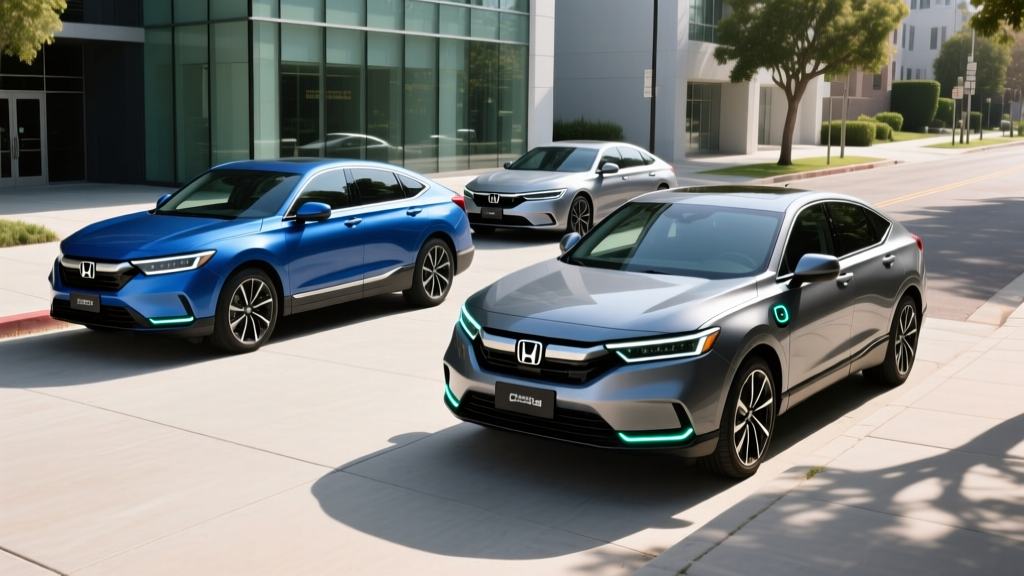
Honda's hybrid strategy in 2026 is built on a straightforward premise: offer conventional hybrid (HEV) versions of its highest-volume models without requiring owners to change their fueling habits. Unlike Toyota, Honda has largely stepped back from plug-in hybrid (PHEV) offerings after discontinuing the Clarity Plug-In Hybrid, focusing instead on its fourth-generation two-motor hybrid system across the Accord, CR-V, and Civic lineups. For buyers searching for a Honda electric hybrid, the reality is that every current Honda hybrid is a self-charging HEV — you never plug it in — but the efficiency gains over gasoline-only models are substantial.
This guide breaks down every 2026 Honda hybrid model with exact EPA figures, real-world MPG expectations, powertrain specs, battery warranty coverage, and a clear framework for deciding whether a Honda HEV, a competitor PHEV, or a full battery-electric vehicle (BEV) is the right fit.
HEV vs PHEV: What Honda Actually Offers in 2026
Before evaluating specific models, it's critical to understand the distinction between Honda's hybrid approach and the plug-in hybrids offered by competitors like Toyota (RAV4 Prime, Prius Prime) and Hyundai (Tucson PHEV).
| Feature | Honda HEV (Conventional Hybrid) | Competitor PHEV (Plug-In Hybrid) |
|---|---|---|
| Plug in to charge? | No — charges via regenerative braking and engine | Yes — plug in for electric-only driving |
| Electric-only range | ~1 mile at low speeds | 25–45 miles (model dependent) |
| Battery size | 1.0–1.1 kWh (small buffer) | 13–20 kWh |
| Home charging needed? | No | Yes, for full benefit |
| DC fast charging? | No | Rarely (most PHEVs are Level 2 only) |
| Federal tax credit (§30D)? | No | Up to $7,500 (if eligible) |
| Best for | Drivers without home charging access | Drivers with home charging and short commutes |
Honda's decision to prioritize HEVs means its hybrids appeal to a broad audience — apartment dwellers, street parkers, and anyone who wants better fuel economy without installing a home charger. The trade-off is that you won't get the 30–40 miles of electric-only commuting that a RAV4 Prime or Prius Prime delivers.
2026 Honda Hybrid Models: EPA MPG and Specs
Honda equips three core models with its two-motor hybrid powertrain for 2026. Here's the complete EPA data, sourced from fueleconomy.gov, alongside powertrain specifications.
| Model | Drivetrain | City MPG | Highway MPG | Combined MPG | Combined HP | Base MSRP |
|---|---|---|---|---|---|---|
| Accord Hybrid (Sport/L/EX-L/Sport-L/Touring) | FWD | 51 | 44 | 48 | 204 | $34,995 |
| CR-V Hybrid (Sport/Sport Touring) | FWD | 43 | 36 | 40 | 204 | $37,695 |
| CR-V Hybrid AWD | AWD | 40 | 34 | 37 | 204 | $39,195 |
| Civic Hybrid (Sport) | FWD | 50 | 47 | 49 | 200 | $30,845 |
All three models use Honda's fourth-generation two-motor hybrid system, which pairs a 2.0-liter Atkinson-cycle four-cylinder engine with two electric motors — one functioning as a generator and the other as the primary drive motor. In most driving conditions below ~45 mph, the Accord and CR-V Hybrid operate primarily in EV mode, with the engine acting as a generator to feed the drive motor. At highway speeds, a lock-up clutch connects the engine directly to the wheels for optimal efficiency.
| Specification | Accord Hybrid | CR-V Hybrid | Civic Hybrid |
|---|---|---|---|
| Engine | 2.0L Atkinson I-4 | 2.0L Atkinson I-4 | 2.0L Atkinson I-4 |
| Engine HP / lb-ft | 146 / 134 | 146 / 134 | 146 / 134 |
| Drive Motor HP / lb-ft | 184 / 247 | 184 / 247 | 184 / 247 |
| Combined System HP | 204 | 204 | 200 |
| Hybrid Battery | ~1.1 kWh lithium-ion | ~1.1 kWh lithium-ion | ~1.1 kWh lithium-ion |
| Transmission | e-CVT (no gears) | e-CVT (no gears) | e-CVT (no gears) |
| 0–60 mph (est.) | ~6.8 sec | ~7.6 sec | ~7.2 sec |
Real-World MPG: What to Actually Expect
EPA numbers tell part of the story, but Honda's two-motor system has a distinct characteristic: it consistently exceeds its EPA city rating in real-world urban driving while falling slightly short on the highway. This is the opposite pattern of most gasoline cars and is due to the system's heavy reliance on electric-motor propulsion at low speeds, where regenerative braking recaptures energy at every stop.
Based on aggregated owner data and independent testing, here's what to expect:
- Accord Hybrid: Owners regularly report 52–56 MPG in mixed city driving. Highway cruising at 75+ mph drops to 40–42 MPG. Expect a combined real-world average of 46–50 MPG.
- CR-V Hybrid (FWD): City driving yields 42–46 MPG. Highway drops to 32–35 MPG at sustained speeds. Real-world combined: 38–41 MPG.
- CR-V Hybrid (AWD): The AWD system adds mechanical drag. Expect 35–38 MPG combined, with highway figures closer to 31–33 MPG.
- Civic Hybrid: The lightest Honda hybrid delivers strong real-world results: 48–52 MPG combined, with city driving sometimes touching 55 MPG.
Cold-Weather MPG Impact
Like all hybrids, Honda's system loses efficiency in cold weather. Expect a 10–15% MPG reduction in winter months (below 35°F) due to the engine running more frequently to maintain cabin heat and warm up the catalytic converter. The Accord Hybrid may drop to 42–44 MPG combined in deep winter — still far ahead of its gasoline counterpart.
Battery Warranty, Lifespan, and Replacement Cost
Hybrid battery longevity remains the top concern for buyers considering a Honda electric hybrid. Honda addresses this with robust warranty coverage that matches or exceeds the industry standard.
| Coverage | Term |
|---|---|
| Hybrid Battery Warranty (non-CARB states) | 8 years / 100,000 miles |
| Hybrid Battery Warranty (CARB states*) | 10 years / 150,000 miles |
| Hybrid System Components | 8 years / 100,000 miles |
| Powertrain Warranty | 5 years / 60,000 miles |
*CARB states include California, Colorado, Connecticut, Delaware, Maine, Maryland, Massachusetts, New Jersey, New York, Oregon, Pennsylvania, Rhode Island, Vermont, Virginia, and Washington.
In practice, Honda's lithium-ion hybrid batteries have demonstrated excellent longevity. The small ~1.1 kWh battery pack operates within a narrow state-of-charge window (roughly 40–80%), which significantly reduces degradation stress. Owner reports of hybrid battery failures before 150,000 miles are rare for the current-generation system.
If replacement is needed out of warranty, a Honda hybrid battery pack costs between $2,000 and $4,000 including labor at a dealership. Independent hybrid specialists often offer refurbished packs for $1,200–$2,000. This is a fraction of the cost of a full EV battery replacement because the pack is small and modular.
Tax Credits and Incentives: What Honda Hybrids Qualify For
This is where the distinction between HEV and PHEV becomes financially significant. Under current IRS §30D rules, conventional hybrids like the Accord Hybrid, CR-V Hybrid, and Civic Hybrid do not qualify for the federal electric vehicle tax credit. The §30D credit of up to $7,500 is reserved for plug-in electric vehicles (PHEVs and BEVs) that meet battery capacity, critical-mineral sourcing, and MSRP thresholds.
- Federal §30D credit: Not eligible — Honda's 2026 hybrids are HEVs, not plug-in vehicles.
- Federal Alternative Fuel Vehicle Refueling Property Credit (§30C): Not applicable to the vehicle itself, but available for home charging equipment if you also own a PHEV/BEV.
- State incentives: Some states offer modest rebates or HOV-lane access for hybrids. Check your state's energy office or AFDC state laws database for specifics.
- Insurance discounts: Some insurers offer 5–10% discounts for hybrid vehicles — check with your provider.
If the federal tax credit is a priority, you would need to look at a PHEV from another manufacturer (Toyota RAV4 Prime, Chrysler Pacifica PHEV) or a full BEV like the Honda Prologue (Honda's only all-electric model, which may qualify depending on sourcing and income requirements — see IRS clean vehicle credit rules).
Honda Hybrid vs PHEV vs Full EV: Which Fits You?
Choose a Honda HEV if:
- You don't have access to home or workplace charging
- You want better fuel economy without changing any habits
- You drive more than 40 miles per day and don't want to manage electric range
- You want a lower purchase price than a PHEV or BEV
- You frequently take long road trips and don't want to plan charging stops
Choose a PHEV (from Toyota, Hyundai, etc.) if:
- You have home Level 2 charging and a commute under 40 miles
- You want to drive primarily on electricity but need a gas engine for road trips
- You want to qualify for the $7,500 federal tax credit (subject to eligibility)
- You're willing to pay a $5,000–$8,000 premium over an HEV
Choose a full BEV (like Honda Prologue) if:
- You have reliable home charging
- Your daily driving is under 250 miles and you can plan road-trip charging
- You want the lowest per-mile fuel cost and minimal maintenance
- You want to qualify for federal and state EV incentives
Pros and Cons of Honda's Hybrid Lineup
Pros
- Excellent real-world city MPG — often beats EPA estimates
- No plug-in charging required; works with any lifestyle
- Smooth, quiet electric-motor-dominant driving at low speeds
- Strong reliability track record; 8–10 year hybrid battery warranty
- Competitive pricing — hybrid premium is only $1,500–$2,000 over gas trims
- No range anxiety; total range exceeds 500 miles per tank
Cons
- No plug-in hybrid option — can't drive on electricity alone for commutes
- No federal tax credit eligibility
- Highway MPG is good but not class-leading (Toyota Camry Hybrid rates higher)
- AWD availability limited to CR-V (no Accord Hybrid AWD)
- Small hybrid battery means no meaningful electric-only range
Reliability and Safety Ratings
Honda's hybrid system is among the most proven in the industry, now in its fourth generation with millions of units on the road. The two-motor architecture has fewer moving parts than a traditional automatic transmission (no gear shifts, no torque converter), which contributes to long-term durability.
Safety ratings for Honda's hybrid models are strong across the board. The Accord and CR-V both earn IIHS Top Safety Pick+ ratings and 5-star overall ratings from NHTSA. All trims come standard with Honda Sensing, a Level 2 driver-assistance suite including adaptive cruise control, lane-keeping assist, and automatic emergency braking. Note: Honda Sensing is a driver-assist system — you must remain engaged and keep your hands on the wheel at all times.
Frequently Asked Questions
How many MPG does the Honda Hybrid get?
The 2026 Accord Hybrid achieves an EPA-rated 51 city / 44 highway / 48 combined MPG. The CR-V Hybrid FWD rates 43/36/40 MPG, and the Civic Hybrid rates 50/47/49 MPG. In real-world city driving, owners often exceed these EPA numbers by 2–4 MPG thanks to regenerative braking.
Does Honda make a plug-in hybrid in 2026?
No. Honda discontinued the Clarity Plug-In Hybrid and does not currently offer a PHEV in the U.S. market for 2026. All Honda hybrids are conventional self-charging HEVs. If you need plug-in capability from Honda, the all-electric Honda Prologue is the closest alternative.
Is the Honda Hybrid reliable, and what does battery replacement cost?
Yes — Honda's fourth-generation hybrid system has an excellent reliability record. The hybrid battery is warranted for 8 years/100,000 miles (10 years/150,000 miles in CARB states). Out-of-warranty replacement costs $2,000–$4,000 at a dealer, or $1,200–$2,000 from an independent hybrid specialist. Most hybrid batteries last well beyond 150,000 miles.
Does the Honda Hybrid qualify for a tax credit?
No. Conventional hybrids (HEVs) are not eligible for the federal §30D clean vehicle tax credit, which is limited to plug-in vehicles (PHEVs and BEVs). Some states may offer minor incentives for hybrids — check your state's energy office. The IRS clean vehicle credit page details current eligibility rules.
How far can a Honda Hybrid drive on electric only?
Less than 1 mile at very low speeds (under 25 mph). Honda's HEV system uses its small battery for brief electric assist and low-speed maneuvering, not for sustained electric driving. For meaningful electric-only range, you need a PHEV or BEV.
Is the Honda Hybrid better than a full EV?
It depends on your situation. A Honda HEV is better if you lack home charging, drive long distances frequently, or want a lower purchase price. A full EV (like the Honda Prologue or Tesla Model Y) is better if you have home charging, want the lowest per-mile fuel cost (~$0.04–$0.06/mile vs ~$0.08–$0.10/mile for a Honda Hybrid), and qualify for tax credits.