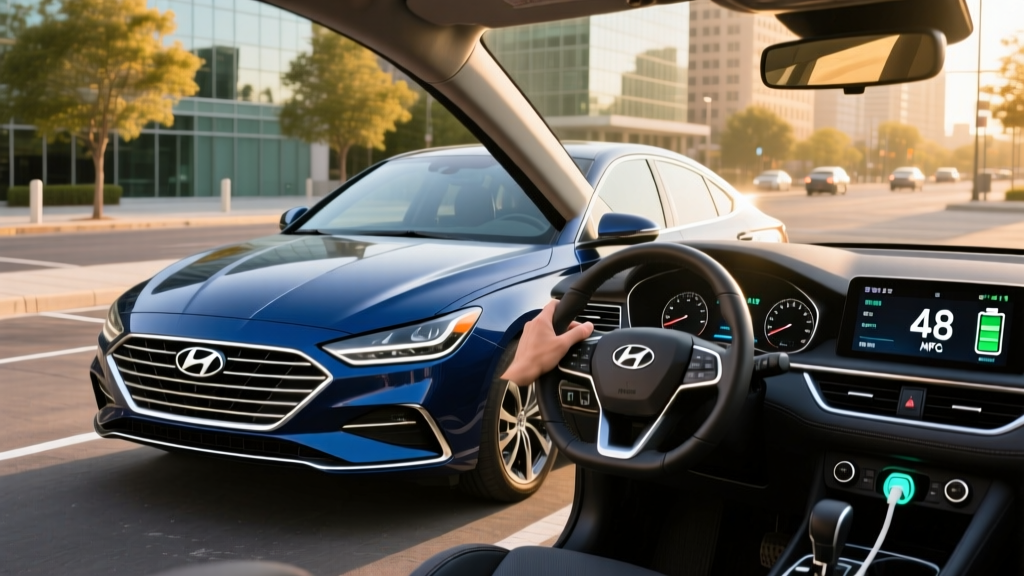
The 2026 Hyundai Sonata Hybrid SEL occupies a narrow but appealing lane: a midsize sedan that squeezes exceptional fuel economy out of every gallon without asking you to plug in, change your driving habits, or pay a premium for electrification. With an EPA-estimated 47 MPG combined, a proven hybrid powertrain, and a starting MSRP around $30,250, the Sonata Hybrid SEL is one of the most pragmatic sedans on the market for buyers who want hybrid efficiency without the complexity of a plug-in hybrid or the infrastructure demands of a full EV.
This guide breaks down every number that matters — EPA and real-world fuel economy, powertrain specs, battery warranty coverage, tax-credit eligibility, and how the Sonata Hybrid SEL stacks up against PHEV and BEV alternatives.
EPA Fuel Economy and Real-World MPG
The headline number for the Sonata Hybrid SEL is its EPA rating. Hyundai pairs a 2.0-liter four-cylinder engine with an electric motor and a 6-speed automatic transmission (not a CVT), which contributes to a more natural driving feel than many competitors.
| Metric | EPA Estimate | Real-World Expectation |
|---|---|---|
| City MPG | 50 MPG | 48–53 MPG (hybrids often beat EPA in city) |
| Highway MPG | 44 MPG | 40–44 MPG (aerodynamic drag reduces hybrid advantage) |
| Combined MPG | 47 MPG | 44–49 MPG depending on driving mix |
| Fuel Tank Capacity | 13.2 gallons | — |
| Total Range | ~620 miles | ~580–640 miles |
Hybrids typically outperform their EPA city estimates in stop-and-go traffic because regenerative braking recaptures energy that a gas car wastes as heat. In our experience and consistent with fueleconomy.gov owner submissions, drivers who do predominantly city and suburban driving frequently report 49–52 MPG. Highway-heavy commutes at 75+ MPH pull the average down toward 42–44 MPG due to the Sonata's relatively conventional aerodynamic profile and the reduced role of regen at sustained speeds.
For context, the average US driver covers roughly 13,500 miles per year. At 47 MPG combined and $3.40/gallon gas, annual fuel cost lands near $975. A comparable gas-only midsize sedan averaging 30 MPG would cost roughly $1,530 per year — a savings of about $555 annually with the hybrid.
Hybrid vs. Plug-In Hybrid: What the Sonata Offers
It's important to be precise about what the Sonata Hybrid SEL is — and what it isn't. Hyundai previously sold a Sonata Plug-In Hybrid in earlier generations, but the current lineup is a conventional hybrid (HEV). Understanding the distinction matters for your expectations around charging, range, and tax incentives.
| Feature | HEV (Sonata Hybrid SEL) | PHEV (e.g., Prius Prime) | BEV (e.g., Tesla Model 3) |
|---|---|---|---|
| Plug-in charging required? | No — gas only | Yes, for EV range | Yes, exclusively |
| Electric-only range | 0 miles (EV assists, doesn't solo drive far) | 25–44 miles typical | 250–360+ miles |
| Total range | ~620 miles | ~400–550 miles combined | 250–360+ miles |
| Home charging needed? | No | Recommended (Level 2, 120V fallback) | Essential |
| Federal tax credit (§30D) | Not eligible | Up to $7,500 (if requirements met) | Up to $7,500 (if requirements met) |
| Upfront cost premium vs gas car | ~$1,000–$2,500 | ~$4,000–$8,000 | ~$5,000–$15,000+ |
The Sonata Hybrid SEL's advantage is simplicity. You refuel at any gas station, never think about charging infrastructure, and still cut fuel consumption by roughly 40% compared to a gas-only midsize sedan. The trade-off: no electric-only driving, no federal tax credit, and no ability to run emission-free on short commutes.
Powertrain Specs and Driving Character
| Specification | 2026 Hyundai Sonata Hybrid SEL |
|---|---|
| Engine | 2.0L GDI 4-cylinder |
| Engine Horsepower | 150 HP |
| Electric Motor Output | 51 HP (39 kW) |
| Combined System Output | 192 HP |
| Transmission | 6-speed automatic (torque converter) |
| Drivetrain | Front-wheel drive |
| 0–60 MPH (est.) | ~7.8 seconds |
| Hybrid Battery | ~1.6 kWh lithium-ion (HEV, not plug-in) |
| Curb Weight | ~3,490 lbs |
The 192 combined horsepower figure puts the Sonata Hybrid SEL in a competitive spot — it's more potent than the Toyota Camry Hybrid LE (225 HP combined, but heavier) and comparable to the Honda Accord Hybrid (204 HP). The 6-speed automatic is a deliberate choice by Hyundai: it avoids the drone and rubber-band feel associated with CVTs, delivering familiar shift points during acceleration.
The ~1.6 kWh battery pack is small by EV standards, but that's by design. In a conventional hybrid, the battery doesn't need to store miles of range — it buffers energy captured from regenerative braking and supplements the gas engine during acceleration. The battery charges entirely from the engine and regen; there is no plug and no external charging capability.
Pricing, Trims, and Tax-Credit Reality
The 2026 Hyundai Sonata Hybrid SEL is positioned as the value-oriented hybrid trim. Pricing breaks down approximately as follows:
- Sonata Hybrid SEL: ~$30,250 MSRP (destination included)
- Sonata Hybrid Limited: ~$37,500 MSRP (adds leather, HUD, premium audio, panoramic roof)
Standard equipment on the SEL includes a 12.3-inch dual-screen setup, wireless Apple CarPlay/Android Auto, Hyundai SmartSense (adaptive cruise, lane-keeping, automatic emergency braking, blind-spot monitoring), heated front seats, and proximity key with push-button start.
Federal Tax Credit: Not Eligible
The Hyundai Sonata Hybrid SEL does not qualify for the IRS §30D Clean Vehicle Credit. That credit applies only to plug-in electric vehicles (PHEVs and BEVs) with sufficient battery capacity and meeting sourcing, MSRP, and buyer income requirements. Conventional hybrids like the Sonata Hybrid SEL are excluded regardless of price or efficiency. There is currently no federal tax incentive specifically for HEV purchases. Some states or utilities may offer minor rebates for high-efficiency vehicles, but these are uncommon and vary by jurisdiction — check your local programs.
The lack of a federal credit stings on paper, but the math still works: the Sonata Hybrid SEL costs only about $1,000–$1,500 more than a comparably equipped gas-only Sonata SEL. At roughly $555 in annual fuel savings, the hybrid premium pays for itself in about 2–3 years — well within typical ownership horizons.
Battery Warranty, Reliability, and Replacement Cost
Battery longevity is the number-one concern we hear from hybrid shoppers, and Hyundai addresses it directly.
| Coverage Item | Hyundai Warranty |
|---|---|
| Hybrid Battery | 10 years / 100,000 miles (original owner) |
| Hybrid System Components | 10 years / 100,000 miles |
| Powertrain (engine, transmission) | 10 years / 100,000 miles |
| New Vehicle (bumper-to-bumper) | 5 years / 60,000 miles |
| Battery Capacity Retention Threshold | Below 70% of original capacity (typical Hyundai hybrid warranty trigger) |
Hyundai's 10-year/100,000-mile hybrid battery warranty is among the best in the industry. Toyota matches it with 10 years/150,000 miles on hybrid batteries for models from 2020 onward. For second owners, Hyundai's hybrid battery warranty typically transfers as 10 years/100,000 miles from original in-service date, though you should confirm with the dealer for the specific model year.
In practice, hybrid battery failures before 150,000 miles are uncommon. The small ~1.6 kWh pack in the Sonata Hybrid SEL operates within a narrow state-of-charge window (roughly 40%–80%), which dramatically reduces stress on the cells compared to a full EV that cycles from 10% to 90%. Many Toyota and Hyundai hybrid owners report 200,000+ miles on the original battery with minimal degradation.
If replacement is eventually needed out of warranty, expect a cost in the range of $2,000–$4,000 for a new OEM hybrid battery pack, with refurbished options available for $1,000–$2,000. This is far less than an EV traction battery replacement ($8,000–$20,000+) because the hybrid pack is physically small and stores far less energy.
Who Should Choose the Sonata Hybrid SEL?
Choose the Sonata Hybrid SEL If
- You want 45+ MPG without plugging in or changing habits
- You lack home charging access (apartment, street parking)
- Your budget is around $30,000–$33,000 out the door
- You drive a city-heavy commute where hybrids shine
- You want a conventional trunk (no battery hump) and sedan comfort
- You plan to own the car 8–10 years (warranty covers the battery)
Look Elsewhere If
- You want electric-only driving for short commutes (consider a PHEV)
- You need the $7,500 federal tax credit (PHEV/BEV only)
- You want AWD (Sonata Hybrid is FWD only; Camry Hybrid offers AWD)
- You prefer a hatchback or SUV body style
- You tow — the Sonata Hybrid is not rated for towing
The Sonata Hybrid SEL is the rational pick for sedan buyers who want to cut fuel costs without the lifestyle adjustments that a PHEV or BEV demands. If you can charge at home and your daily commute is under 30 miles, a PHEV like the Toyota Prius Prime gives you electric-only daily driving with gas backup — and may qualify for a federal tax credit that dramatically lowers effective cost. If you've already decided to go fully electric and have charging sorted, a BEV eliminates gasoline entirely and has lower per-mile "fuel" costs.
But if you rent, live in an apartment, take frequent long road trips, or simply don't want to think about charging, the Sonata Hybrid SEL delivers near-PHEV efficiency with zero infrastructure requirements. That's a genuinely compelling value proposition.
How It Stacks Up: Sonata Hybrid vs. Key Rivals
| Metric | 2026 Sonata Hybrid SEL | 2026 Toyota Camry Hybrid LE | 2026 Honda Accord Hybrid Sport |
|---|---|---|---|
| EPA Combined MPG | 47 MPG | 52 MPG | 44 MPG |
| Combined HP | 192 HP | 225 HP | 204 HP |
| Transmission | 6-speed auto | eCVT | eCVT |
| AWD Available? | No | Yes | No |
| Base MSRP (hybrid) | ~$30,250 | ~$29,995 | ~$33,655 |
| Hybrid Battery Warranty | 10yr/100k mi | 10yr/150k mi | 8yr/100k mi (10yr/150k in CARB states) |
| Cargo Volume | 15.1 cu ft | 15.1 cu ft | 16.7 cu ft |
The Camry Hybrid LE edges the Sonata on pure MPG and offers AWD, making it the default pick for cold-climate buyers. The Accord Hybrid trades some efficiency for a more engaging drive and a larger trunk. The Sonata Hybrid SEL splits the difference: strong MPG, a conventional automatic transmission that some drivers prefer over CVTs, Hyundai's generous warranty, and competitive pricing. Per IIHS ratings, the Sonata earns strong safety marks, reinforcing its family-sedan credentials.
Frequently Asked Questions
How many MPG does the 2026 Hyundai Sonata Hybrid SEL get?
The EPA rates the Sonata Hybrid SEL at 50 MPG city, 44 MPG highway, and 47 MPG combined. Real-world results vary: city-heavy drivers often see 49–53 MPG thanks to regenerative braking, while sustained highway driving at 75+ MPH may return 40–44 MPG. Annual fuel cost averages around $975 for a typical driver at current gas prices.
Does the Sonata Hybrid SEL need to be plugged in?
No. The Sonata Hybrid SEL is a conventional hybrid (HEV), not a plug-in hybrid (PHEV). Its small battery charges entirely through regenerative braking and the gas engine. You refuel at any gas station and never need a charging outlet or home charger.
Does the 2026 Sonata Hybrid qualify for any federal tax credit?
No. The IRS §30D Clean Vehicle Credit applies only to plug-in electric vehicles (PHEVs and BEVs) that meet battery sourcing, MSRP caps, and buyer income requirements. Conventional hybrids like the Sonata Hybrid SEL do not qualify for this credit or any current federal EV incentive.
How long will the Sonata Hybrid battery last, and what does replacement cost?
Hyundai covers the hybrid battery for 10 years or 100,000 miles. In practice, hybrid batteries often last 150,000–200,000+ miles because they operate in a narrow charge window that minimizes cell stress. If replacement is eventually needed, expect $2,000–$4,000 for a new OEM pack, or $1,000–$2,000 for a refurbished unit — far less than a full EV battery replacement.
Hybrid vs. PHEV vs. EV — which should I choose?
Choose a conventional hybrid (like the Sonata Hybrid SEL) if you can't charge at home, take frequent long road trips, or want maximum simplicity. Choose a PHEV if you have home charging and a short commute — you'll drive electric most days with gas backup. Choose a full EV if you want zero tailpipe emissions, have reliable charging access, and want the lowest per-mile energy cost. The Sonata Hybrid SEL is the lowest-friction option: no plugs, no range planning, just better MPG.
Is the Sonata Hybrid SEL available with AWD?
No. The 2026 Sonata Hybrid is front-wheel drive only. If AWD is essential (for snow-belt climates or traction preference), the Toyota Camry Hybrid offers electronic AWD as an option across most trims.