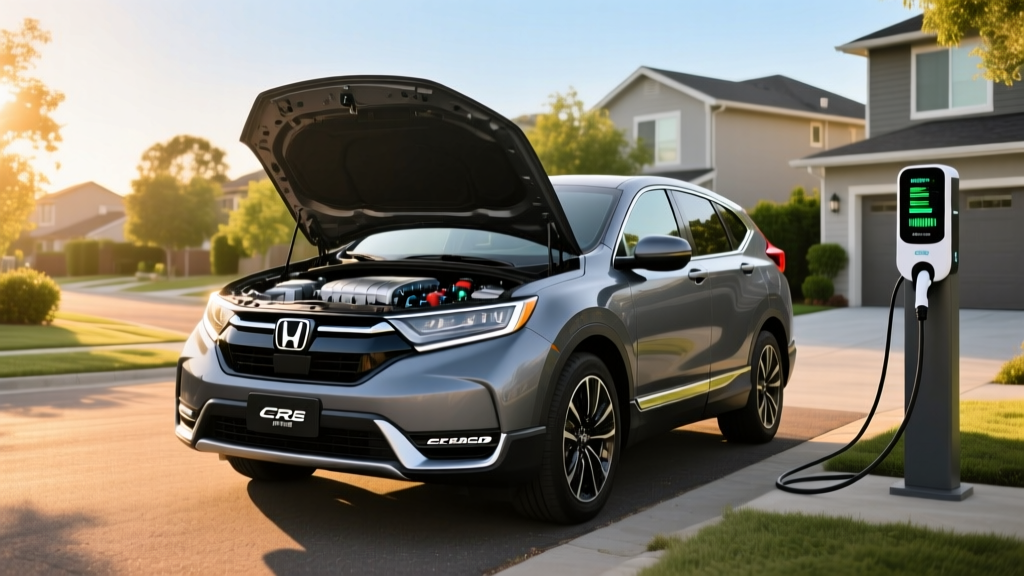
If you've been scanning Honda CR-V Hybrid lease deals for a compact SUV that sips fuel without plugging in, you're not alone. The CR-V Hybrid has become one of the most leased electrified vehicles in America, and for 2026, Honda continues to refine the formula. But before you sign that lease, you need the exact numbers — real MPG, powertrain output, battery warranty coverage, and how this hybrid stacks up against a plug-in hybrid or a full battery-electric vehicle.
This guide cuts through the marketing and gives you the data-driven breakdown of what the 2026 CR-V Hybrid actually delivers, what a competitive lease looks like, and whether it's the right electrified choice for your driving pattern.
HEV vs. PHEV: What the CR-V Hybrid Actually Is
The Honda CR-V Hybrid is a conventional hybrid electric vehicle (HEV), not a plug-in hybrid (PHEV). This distinction matters enormously for both daily use and expectations:
| Feature | CR-V Hybrid (HEV) | Typical PHEV (e.g., Toyota RAV4 Prime) | Full EV (e.g., Tesla Model Y) |
|---|---|---|---|
| Plug-in charging required? | No — self-charging via regenerative braking | Yes — 120V or 240V outlet | Yes — Level 2 or DC fast charge |
| Electric-only range | ~1 mile at low speed | ~42 miles EPA | 270–330 miles EPA |
| Total range | ~470 miles (12.8-gal tank) | ~600 miles combined | 270–330 miles (battery only) |
| Fuel source | Gasoline + regen | Gasoline + grid electricity | Grid electricity only |
| Federal tax credit (§30D) | Not eligible | Up to $7,500 (sourcing rules apply) | Up to $7,500 (sourcing rules apply) |
| Maintenance reduction | Moderate (less brake wear) | Moderate | Significant (no engine) |
The CR-V Hybrid uses its electric motor to assist the gasoline engine, enable engine-off coasting at low speeds, and recapture energy during braking. You never plug it in. You fuel it like any other car, but it uses substantially less gasoline — especially in city driving where the electric motor does the heaviest lifting.
2026 CR-V Hybrid Fuel Economy: EPA and Real-World MPG
The 2026 Honda CR-V Hybrid carries forward the powertrain that earned strong efficiency marks in prior model years. Here are the official EPA fuel economy estimates:
| Drivetrain | City MPG | Highway MPG | Combined MPG |
|---|---|---|---|
| FWD (Sport Hybrid) | 43 | 36 | 40 |
| AWD (Sport Touring Hybrid) | 40 | 34 | 37 |
Real-world MPG reality check: Honda's two-motor hybrid system excels in city and suburban driving, where owners consistently report matching or slightly exceeding the EPA city figure — 42–45 MPG is common in stop-and-go traffic. Highway driving at sustained 75+ MPH, however, typically drops to 32–35 MPG for AWD trims. Cold weather (below 30°F) reduces city efficiency by roughly 10–15% due to increased engine runtime for cabin heat. If your commute is mostly urban, the CR-V Hybrid will reward you. If you're a highway-dominant driver, the advantage over a turbo gas CR-V narrows considerably.
Total range estimate: With a 12.8-gallon fuel tank and 37 MPG combined (AWD), expect approximately 470 miles per fill-up under normal conditions. Highway-heavy road trips will see that closer to 410–430 miles. Cold-weather city driving may push it to 490+.
Powertrain Specs: What Moves the CR-V Hybrid
The 2026 CR-V Hybrid pairs a 2.0-liter Atkinson-cycle four-cylinder engine with Honda's two-motor hybrid system. Combined output is 204 horsepower and 247 lb-ft of torque from the electric motors — which is available from near-zero RPM, giving the CR-V Hybrid a noticeably punchy feel off the line compared to the turbocharged gas model.
| Specification | 2026 CR-V Hybrid (AWD) |
|---|---|
| Engine | 2.0L Atkinson-cycle I-4 |
| Combined system horsepower | 204 hp |
| Electric motor torque | 247 lb-ft |
| 0–60 mph (est.) | ~7.6 seconds |
| Transmission | e-CVT (direct-drive) |
| Drivetrain | FWD or Real-Time AWD |
| Towing capacity | 1,000 lbs |
| Fuel tank | 12.8 gallons |
| Cargo volume (behind rear seats) | 36.3 cu ft |
The e-CVT isn't a belt-and-pulley CVT like you'd find in some competitors. Honda's system uses a direct-drive arrangement that mechanically links the engine to the wheels at highway speeds, avoiding the "rubber-band" drone common to traditional CVTs. It's one of the smoother hybrid powertrains in the segment.
Battery Warranty, Lifespan, and Replacement Cost
The hybrid battery is the number-one concern for used hybrid buyers and lease-return shoppers. Here's what Honda provides:
2026 CR-V Hybrid Battery Warranty:
- Duration: 8 years / 100,000 miles (10 years / 150,000 miles in CARB states including CA, CT, ME, MA, NJ, NY, OR, RI, VT, WA)
- Coverage: Defects and capacity loss below functional threshold
- Battery chemistry: Lithium-ion (small capacity, ~1.1 kWh usable — designed for charge/discharge cycling, not large energy storage)
How long do CR-V Hybrid batteries actually last? Based on fleet data from earlier-generation Honda hybrids (Insight, Accord Hybrid), the lithium-ion hybrid battery typically lasts well beyond 150,000 miles with gradual capacity loss. Unlike a full EV battery, the CR-V Hybrid's small pack is shallow-cycled — it never fully charges or fully depletes, which significantly extends cell life. Honda's battery management system keeps the state of charge in a narrow 40–60% window during normal operation.
Replacement cost if out of warranty: A new OEM hybrid battery pack for the CR-V Hybrid runs approximately $2,000–$3,500 installed at a dealership. Third-party refurbished packs are available for $1,200–$2,000. Given the shallow-cycling design, most original owners will never face this cost — and lessees certainly won't, since the battery warranty far exceeds a typical 36-month lease term.
Breaking Down 2026 Honda CR-V Hybrid Lease Deals
Lease pricing fluctuates monthly and varies by region, dealer, and credit tier, but here's the framework for evaluating any CR-V Hybrid lease deal in 2026:
| Trim Level | MSRP (approx.) | Typical Lease Structure | Estimated Monthly Payment |
|---|---|---|---|
| Sport Hybrid (FWD) | $36,700 | 36 months / 12K mi/yr, $2,999 due at signing | $349–$389 |
| Sport Hybrid (AWD) | $38,200 | 36 months / 12K mi/yr, $2,999 due at signing | $369–$409 |
| Sport Touring Hybrid (AWD) | $42,350 | 36 months / 12K mi/yr, $3,499 due at signing | $419–$469 |
What makes a good CR-V Hybrid lease deal: Look for a money factor (lease interest rate equivalent) below 0.00250, which roughly translates to a 6% APR. Honda Financial Services periodically offers subsidized lease rates on hybrid trims as incentives to boost fleet electrification — these "subvented" leases can drop the money factor to 0.00125 or lower, saving $30–$50/month. Check Honda's current national offers page and compare against local dealer quotes.
Negotiation leverage: The capitalized cost (negotiated selling price the lease is based on) is negotiable. Aim for $500–$1,000 below MSRP before incentives. Don't let a dealer tell you "lease prices are fixed" — the cap cost is always negotiable, even on subvented leases.
Federal tax credit note: The CR-V Hybrid (HEV) does not qualify for the IRS §30D federal clean vehicle credit. That credit is reserved for plug-in electric vehicles (PHEVs and BEVs) meeting battery sourcing and MSRP/income requirements. The CR-V Hybrid's fuel savings come at the pump, not on your tax return. Some states offer hybrid-specific rebates — check your state energy office for current programs.
CR-V Hybrid vs. PHEV vs. Full EV: Which Fits You?
The CR-V Hybrid occupies a specific niche. Here's a decision framework to determine whether it's the right electrified vehicle for your situation:
Choose the CR-V Hybrid (HEV) if:
- You can't install a home charger (apartment, street parking, landlord restrictions)
- You want better fuel economy with zero change to your fueling routine
- Your driving is 50%+ city/suburban where hybrid efficiency shines
- You want lower upfront cost than a PHEV or EV
- You regularly drive 400+ miles between fill-ups and don't want to plan charging stops
Choose a PHEV (e.g., Toyota RAV4 Prime, Hyundai Tucson PHEV) if:
- You can charge at home (even a standard 120V outlet works for overnight top-ups)
- Your daily commute is under 35 miles round-trip (you'd rarely use gas)
- You want the $7,500 federal tax credit (subject to IRS §30D sourcing and income rules)
- You take occasional long road trips and want gas-engine backup
Choose a full EV (e.g., Tesla Model Y, Hyundai Ioniq 5) if:
- You have reliable Level 2 home charging
- Your daily driving is under 200 miles and you road-trip infrequently
- You want the lowest per-mile fuel cost and minimal maintenance
- You want the full $7,500 federal credit (eligibility permitting)
- You want the fastest acceleration and quietest ride in the segment
Pros and Cons of the CR-V Hybrid
Pros
- 43 MPG city (FWD) — among the best in the compact SUV segment
- No plug-in charging required — zero lifestyle change from a gas car
- 247 lb-ft of electric motor torque delivers responsive low-speed acceleration
- 36.3 cu ft cargo space — no battery-pack intrusion into the cargo area
- Honda Sensing suite (adaptive cruise, lane-keeping, automatic emergency braking) standard on all trims
- 8-year/100K-mile hybrid battery warranty (10/150K in CARB states)
- Strong resale value — CR-V Hybrid holds value well at lease-end
Cons
- Highway MPG (34–36) is less impressive — advantage over gas model narrows at speed
- No federal tax credit — HEVs are ineligible for §30D
- 1,000-lb towing capacity — significantly less than gas CR-V (1,500 lbs) or competitors
- AWD system is reactive (rear wheels engage only when slip is detected), not full-time
- No spare tire — tire-inflation kit only, which matters for remote-area driving
- Hybrid trims start at ~$36,700 — a $3,000+ premium over the gas LX base model
Frequently Asked Questions
How many MPG does the 2026 Honda CR-V Hybrid get?
The FWD Sport Hybrid is EPA-rated at 43 city / 36 highway / 40 combined. The AWD Sport Touring Hybrid drops to 40 city / 34 highway / 37 combined. In real-world city driving, owners frequently report 42–45 MPG. Highway driving at 75+ MPH typically yields 32–35 MPG.
Does the CR-V Hybrid need to be plugged in?
No. The CR-V Hybrid is a conventional (self-charging) hybrid. It recovers energy through regenerative braking and the gasoline engine to keep its small lithium-ion battery charged. You fuel it normally at any gas station.
Is the CR-V Hybrid reliable, and what does a battery replacement cost?
Honda's hybrid system has a strong reliability track record across the Accord Hybrid and Insight lineages. The hybrid battery is warranted for 8 years/100,000 miles (10/150K in CARB states). If replacement is ever needed out of warranty, expect $2,000–$3,500 for an OEM pack installed. The shallow-cycling battery management means most batteries last well past 150,000 miles.
Does the CR-V Hybrid qualify for any tax credits?
The CR-V Hybrid (HEV) does not qualify for the federal §30D clean vehicle credit, which requires plug-in capability. Some states and municipalities offer hybrid-specific incentives — check your state energy office or the Alternative Fuels Data Center state laws database for current programs in your area.
What's a good lease payment for the 2026 CR-V Hybrid?
A competitive 36-month lease with 12,000 miles per year on the AWD Sport Hybrid should fall in the $369–$409/month range with roughly $3,000 due at signing. Watch for Honda Financial Services subvented lease offers, which periodically lower the money factor and can save $30–$50/month. Always negotiate the capitalized cost — it's not fixed even on advertised lease specials.
CR-V Hybrid vs. RAV4 Hybrid — which is better?
The Toyota RAV4 Hybrid (AWD, EPA 41 combined) slightly beats the CR-V AWD Hybrid on highway MPG and offers 10 years/150,000 miles of hybrid battery warranty nationwide. The CR-V Hybrid counters with more cargo space (36.3 vs. 37.6 cu ft — comparable), a more refined e-CVT feel, and a more intuitive infotainment interface in Sport Touring trim. Lease pricing tends to be similar. Test-drive both and let the deal on the table decide — the better lease offer is usually the right answer for a 36-month commitment.
Should I lease or buy the CR-V Hybrid?
Leasing makes sense if you want the lowest monthly payment, plan to stay under 12,000–15,000 miles per year, and want to avoid long-term battery risk (though the warranty covers you either way). Buying makes sense if you drive high annual miles (where lease overage penalties of $0.15–$0.25/mile add up), want to keep the vehicle 5+ years, or want to build equity. The hybrid's fuel savings pay back the price premium over the gas model in roughly 4–5 years at current fuel prices for a 12,000-mile/year driver.
The Verdict: Is a CR-V Hybrid Lease Worth It?
The 2026 Honda CR-V Hybrid is one of the most practical electrified vehicles you can lease today — particularly if you lack home charging access and want a compact SUV that delivers 40 MPG in real-world city driving without any plug-in routine. The lease math often works out favorably because Honda uses hybrid trims to attract buyers into the showroom, which means periodic subvented lease rates and competitive cap costs.
Where the CR-V Hybrid falls short is highway efficiency (the advantage over the gas model compresses at 75 MPH) and the absence of a federal tax credit. If you can charge at home and your commute is short, a PHEV will save more fuel and may net you $7,500 back at tax time. If you're ready to go fully electric, the savings on fuel and maintenance are even greater.
But for the buyer who wants a do-everything compact SUV with meaningfully lower fuel bills and zero charging infrastructure required, the CR-V Hybrid lease deal — at the right price — is one of the smartest plays in the segment. Target a sub-$400/month payment on the AWD Sport Hybrid, verify the money factor, negotiate the cap cost, and you'll have a fuel-efficient daily driver with Honda's hybrid warranty backing you for the entire lease term and well beyond.