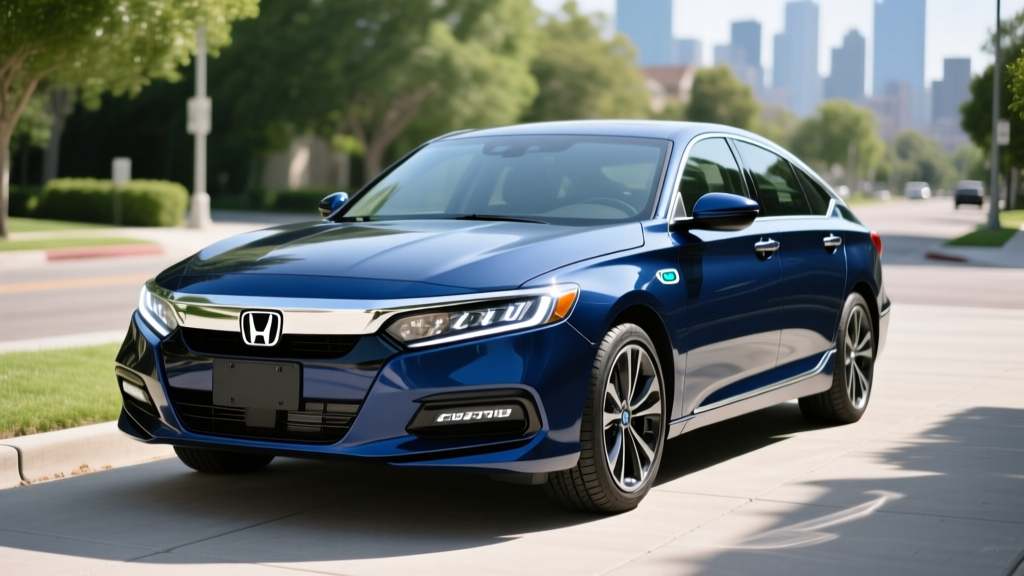
The 2017 Honda Accord Hybrid occupies a specific niche in the used-car market: a midsize sedan that delivers exceptional city fuel economy without requiring any change in driving habits. No plugs, no range anxiety, no charging infrastructure to research — just a gasoline engine paired with a two-motor hybrid system that sips fuel in stop-and-go traffic. For buyers in 2026 searching for honda accord 2017 hybrid mpg data before pulling the trigger on a used example, this guide covers the exact numbers, real-world expectations, battery longevity, and how this generation stacks up against modern hybrids, PHEVs, and full EVs.
EPA Fuel Economy: The Official 2017 Accord Hybrid MPG Numbers
The 2017 Honda Accord Hybrid is rated by the EPA at 48 mpg city, 47 mpg highway, and 48 mpg combined. These figures apply to all trims (Hybrid, Hybrid EX-L, and Hybrid Touring) because the powertrain is identical across the lineup. Honda achieved a notable milestone with this model year — the Accord Hybrid briefly held the title of the most fuel-efficient midsize sedan in America when it launched.
| Metric | Value |
|---|---|
| City MPG | 48 |
| Highway MPG | 47 |
| Combined MPG | 48 |
| Fuel Tank Capacity | 12.8 gallons |
| EPA Estimated Total Range | ~614 miles |
| Annual Fuel Cost (EPA est.) | ~$1,050 (15,000 mi/yr at avg. gas prices) |
Source: fueleconomy.gov — 2017 Honda Accord Hybrid
Real-World MPG: What Owners Actually Report
EPA estimates are a starting point, not a guarantee. The 2017 Accord Hybrid's real-world fuel economy varies based on driving style, climate, and route composition — but unlike many vehicles, Honda's hybrid system tends to meet or slightly exceed its EPA ratings in mixed driving.
- City-dominant commuting (stop-and-go): 44–50 mpg — the hybrid system recovers the most energy in frequent braking scenarios
- Mixed suburban/highway: 42–47 mpg — steady cruising at 65–75 mph yields solid but not class-leading results
- Predominantly highway (70+ mph): 38–43 mpg — aerodynamic drag and the engine running more frequently reduce efficiency
- Cold weather (below 32°F): 36–42 mpg — the engine runs longer to heat the cabin and maintain battery temperature
Owner-reported averages on Fuelly and similar platforms cluster around 43–46 mpg combined over tens of thousands of miles, which aligns closely with the EPA figure when accounting for seasonal variation.
Powertrain Specs: Two-Motor i-MMD System
The 2017 Accord Hybrid uses Honda's Intelligent Multi-Mode Drive (i-MMD) system, which is fundamentally different from the planetary-gear hybrid designs used by Toyota. Instead of a traditional transmission, the Accord Hybrid operates primarily as a series hybrid at low speeds (the engine generates electricity for the drive motor) and switches to a direct mechanical connection via a lock-up clutch at highway speeds.
| Component | Specification |
|---|---|
| Engine | 2.0L Atkinson-cycle 4-cylinder |
| Engine Output | 143 hp / 129 lb-ft torque |
| Drive Motor | AC synchronous permanent-magnet |
| Drive Motor Output | 184 hp / 232 lb-ft torque |
| Combined System Output | 212 hp |
| Hybrid Battery | 1.3 kWh lithium-ion (usable capacity smaller) |
| Transmission | Electronic CVT (no physical belt/pulleys) |
| 0–60 mph | ~7.5 seconds |
| Drivetrain | Front-wheel drive |
The 212 combined horsepower is competitive with the V6-equipped gas Accord of the same era, and the electric motor's instant 232 lb-ft of torque gives it strong off-the-line response. This is not a slow car — it's a midsize sedan that happens to get nearly 50 mpg.
HEV vs PHEV vs EV: Where the Accord Hybrid Fits in 2026
The 2017 Accord Hybrid is a conventional hybrid electric vehicle (HEV). It has no plug, no electric-only driving mode of meaningful distance, and it cannot be charged from an external source. The small 1.3 kWh battery recharges solely through regenerative braking and the gasoline engine. This is a critical distinction from plug-in hybrids and full EVs.
HEV (This Car)
Example: 2017 Accord Hybrid
Battery: 1.3 kWh
Plug-in? No
Electric-only: ~1 mile at low speed
Fuel: Gasoline only
Best for: Drivers without home charging access who want maximum MPG with zero behavior change
PHEV
Example: 2026 Toyota RAV4 Prime
Battery: 18.1 kWh
Plug-in? Yes (Level 1/2)
Electric-only: ~42 miles
Fuel: Electricity + gasoline
Best for: Drivers with home charging who want EV commuting + gas road trips
BEV (Full EV)
Example: 2026 Hyundai Ioniq 6
Battery: 77.4 kWh
Plug-in? Yes (Level 1/2/DC)
Electric-only: 361 miles (EPA)
Fuel: Electricity only
Best for: Drivers with reliable home/work charging who want zero tailpipe emissions and lowest per-mile cost
The decision framework is straightforward:
- Choose the 2017 Accord Hybrid (HEV) if: You lack access to any plug (apartment, street parking, no garage), you want a proven sedan with low running costs, and you're buying on a used-car budget of $14,000–$22,000.
- Choose a PHEV if: You can install a Level 2 charger at home, your daily commute is under 40 miles, and you want to drive mostly on electricity while keeping the gas engine for longer trips.
- Choose a full EV if: You have reliable home charging, you want the lowest cost-per-mile, and you're ready to plan around DC fast charging on road trips.
Battery Longevity, Warranty & Replacement Cost
Hybrid battery degradation is the single most common concern among used hybrid buyers — and it's the area where the 2017 Accord Hybrid has a strong track record.
- Original factory warranty: 8 years / 100,000 miles (hybrid battery and IMA system components) — extended to 10 years / 150,000 miles in CARB states (CA, CT, ME, MD, MA, NJ, NY, OR, RI, VT, WA)
- Real-world lifespan: Most 2017 Accord Hybrid batteries are performing well at 120,000–180,000+ miles with minimal capacity loss. The 1.3 kWh pack is small and lightly stressed compared to EV traction batteries.
- Replacement cost (2026): A new OEM hybrid battery from Honda runs approximately $2,000–$3,000 installed. Refurbished/remanufactured units are available for $1,200–$1,800 installed through independent hybrid specialists.
- Failure rate: Low. Honda's i-MMD system in this generation has not shown the widespread premature battery failures that affected some earlier hybrid models from other manufacturers.
Because the 2017 model is now 9 years old, original factory battery warranty coverage has expired for most examples unless the vehicle was purchased late in the model year and has very low mileage. Budget-conscious buyers should factor a potential $1,500–$3,000 battery replacement into their total cost of ownership — though statistically, many of these packs will last well beyond 200,000 miles.
Source: Honda Warranty Information
Used Pricing & Tax Credit Eligibility in 2026
The 2017 Honda Accord Hybrid was never eligible for the federal §30D new clean vehicle credit when it was sold new — conventional HEVs have never qualified for the federal EV tax credit, which requires a minimum 4 kWh battery with plug-in capability. This hasn't changed.
| Trim | Mileage Range | Approx. Used Price |
|---|---|---|
| Hybrid (base) | 80,000–120,000 mi | $14,000–$17,000 |
| Hybrid EX-L | 70,000–110,000 mi | $16,000–$19,500 |
| Hybrid Touring | 60,000–100,000 mi | $18,000–$22,000 |
The federal Previously Owned Clean Vehicle Credit (§25E) offers up to $4,000 or 30% of the sale price (whichever is lower) on qualifying used electrified vehicles. However, the 2017 Accord Hybrid does not qualify — this credit applies only to used EVs (BEVs) and plug-in hybrids (PHEVs) with a minimum 4 kWh battery that meet sourcing requirements. Conventional HEVs are excluded.
Source: IRS — Used Clean Vehicle Credit
Some states and municipalities offer their own incentives for used hybrid purchases, but these vary widely and change frequently. Check your state's energy or environmental agency website for current programs.
Should You Buy a 2017 Accord Hybrid in 2026?
Pros
- 48 mpg EPA combined — still competitive with 2026 hybrids
- Strong 212 hp output; not a compromise on power
- No plug needed — works with any lifestyle
- Proven Honda reliability; Accord platform is well-regarded
- Spacious midsize cabin, large trunk (no battery intrusion in this gen)
- Low annual fuel cost (~$1,050/yr at 15k mi)
- Affordable used entry point ($14k–$22k)
Cons
- Original battery warranty mostly expired by 2026
- No EV mode or plug-in capability — gasoline is always required
- Highway MPG drops noticeably above 70 mph
- Older infotainment (no wireless CarPlay; touchscreen can be sluggish)
- No eligibility for any federal tax credit (new or used)
- 9th-gen Accord styling is conservative — subjective but noted
- CVT engine drone under hard acceleration (common Honda hybrid trait)
Frequently Asked Questions
How many MPG does the 2017 Honda Accord Hybrid actually get?
The EPA rates it at 48 city / 47 highway / 48 combined. Real-world owner averages cluster around 43–46 mpg combined, with city-dominant drivers sometimes seeing 50 mpg and highway-heavy drivers seeing 38–43 mpg. Cold weather reduces efficiency by roughly 10–15%.
Is the 2017 Accord Hybrid a plug-in hybrid?
No. It is a conventional hybrid (HEV). There is no plug, no charging port, and no meaningful electric-only range. Honda did not offer a plug-in Accord in the US market for this generation. If you want a Honda plug-in, look at the Clarity Plug-In Hybrid (discontinued after 2021) or the 2026 CR-V e:FCEV/PHEV variants where available.
How reliable is the 2017 Accord Hybrid battery?
Honda's i-MMD lithium-ion pack in this generation has shown low failure rates. Most examples are still on their original battery at 100,000+ miles. If replacement becomes necessary, expect to pay $2,000–$3,000 for an OEM unit or $1,200–$1,800 for a refurbished pack.
Does the 2017 Accord Hybrid qualify for any tax credit?
No. It did not qualify for the federal §30D new vehicle credit when new, and it does not qualify for the §25E used clean vehicle credit in 2026. Both credits require plug-in capability and a minimum battery capacity that the Accord Hybrid's 1.3 kWh pack does not meet.
How does the 2017 Accord Hybrid compare to a 2026 Toyota Camry Hybrid?
The 2026 Camry Hybrid is rated at 52 mpg combined (LE trim) — a modest improvement over the Accord Hybrid's 48 mpg. However, a 2026 Camry Hybrid starts at approximately $30,000+ new, while a 2017 Accord Hybrid can be had for under $20,000 used. If you're buying on a budget and don't need the latest tech, the 2017 Accord Hybrid delivers 90%+ of the fuel economy at roughly half the price.
What should I check before buying a used 2017 Accord Hybrid?
Prioritize a pre-purchase inspection that includes: hybrid battery state-of-health (SoH) readout via OBD-II scanner, inverter and IMA system diagnostic codes, 12V auxiliary battery age, and standard mechanical items (brakes, suspension, tires). Also verify whether the hybrid system warranty was ever extended through a TSB or recall — Honda issued some service campaigns for early 9th-gen hybrid models.