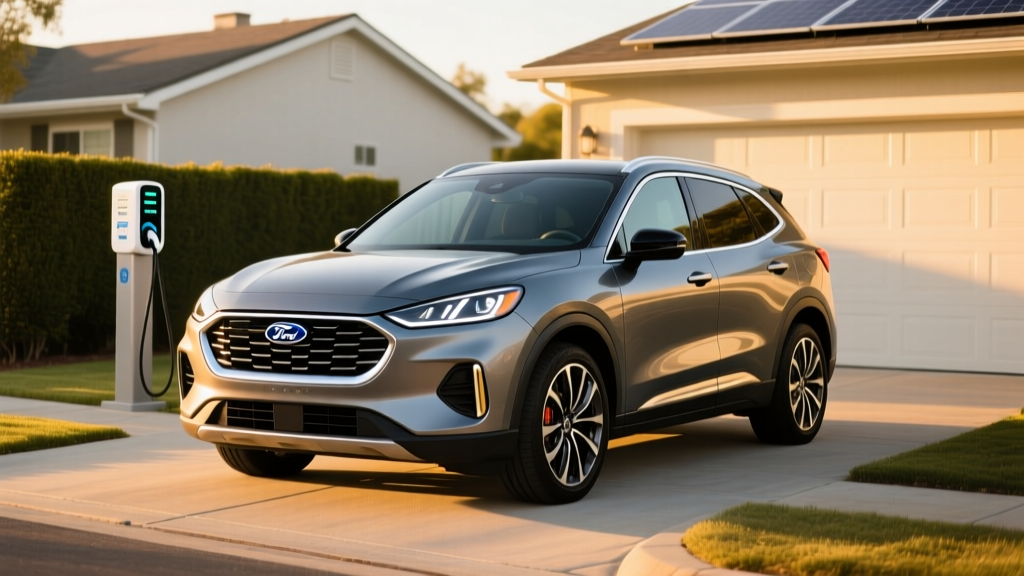
The Ford Escape Hybrid occupies a practical middle ground for buyers who want electrified efficiency without the lifestyle change of a full battery-electric vehicle. For 2026, Ford continues to offer the Escape in both a conventional hybrid (HEV) and a plug-in hybrid (PHEV) configuration, each with distinctly different use cases, range profiles, and pricing. This guide breaks down every number that matters — EPA MPG, electric-only range, battery capacity, warranty terms, and total cost — so you can decide which Escape Hybrid variant, if either, fits your driving routine.
HEV vs PHEV: Two Very Different Escape Hybrids
Before diving into specs, it's essential to understand that the Escape HEV and Escape PHEV share a nameplate but serve fundamentally different purposes.
| Attribute | Escape Hybrid (HEV) | Escape Plug-In Hybrid (PHEV) |
|---|---|---|
| Plug-in required? | No — self-charging via regenerative braking and engine | Yes — plug in to access electric-only driving |
| Electric-only driving | Brief low-speed EV mode only (under ~1 mile) | Up to 37 miles EPA on battery alone |
| Battery capacity | ~1.1 kWh (small buffer pack) | 14.4 kWh usable lithium-ion |
| Charging hardware | None — no charge port | J1772 AC port, Level 1 & Level 2 capable |
| DC fast charging | N/A | Not available — AC charging only |
| Best for | Drivers without home/work charging access | Drivers with home charging and short commutes |
The conventional HEV is a "gas it and forget it" proposition: the small battery recharges through regenerative braking and the gasoline engine. You never plug it in. The PHEV, by contrast, rewards owners who plug in nightly with nearly gas-free commuting, while retaining the gasoline engine for longer road trips.
Fuel Economy: EPA MPG and Real-World Numbers
How many MPG does the Escape Hybrid get? The answer depends on which powertrain you choose and how you drive. Here's the full EPA breakdown per fueleconomy.gov:
| Model | City MPG | Highway MPG | Combined MPG | MPGe (PHEV EV mode) |
|---|---|---|---|---|
| Escape Hybrid FWD (HEV) | 42 | 36 | 39 | N/A |
| Escape Hybrid AWD (HEV) | 42 | 36 | 39 | N/A |
| Escape PHEV (FWD only) | 40 (hybrid mode) | 37 (hybrid mode) | 39 (hybrid mode) | 105 MPGe |
Real-World MPG vs. EPA Sticker
Hybrids routinely beat their EPA city estimates in real-world stop-and-go driving because regenerative braking recovers energy that a gas car wastes as heat. Owners on fuel-tracking platforms commonly report 41–44 MPG in urban and suburban driving with the HEV. Highway driving is a different story: at sustained 70–80 MPH speeds, the electric motor contributes less and the 2.5-liter Atkinson-cycle engine does most of the work. Expect 33–36 MPG on the highway with the HEV, slightly below the EPA sticker.
For the PHEV, the 105 MPGe figure only applies when you're driving on battery power. Once the battery depletes, the PHEV reverts to its 39 MPG combined hybrid-mode rating — essentially identical to the HEV. The real-world variable here is discipline: if you plug in every night and commute under 37 miles, you may use almost no gasoline for weeks. If you never plug in, you're simply carrying 300+ pounds of extra battery weight for no benefit.
Electric-Only Range and Total Range (PHEV)
How far can the Escape PHEV go on electric only? The EPA rates it at 37 miles of electric-only range. That figure assumes moderate temperatures, flat terrain, and speeds under 55 MPH. In practice:
- Ideal conditions (spring/fall, city driving, under 45 MPH): 35–39 miles
- Highway driving (65+ MPH): 28–32 miles before the engine engages
- Cold weather (below 32°F with cabin heat): 24–28 miles — cabin heating draws heavily from the battery, and lithium-ion chemistry is less efficient at low temperatures
Once the battery depletes, the PHEV operates as a conventional hybrid with its full 14.1-gallon fuel tank, giving a combined gas-plus-electric total range of approximately 490–520 miles depending on conditions. The HEV, with its 14.1-gallon tank and 39 MPG combined, delivers roughly 550 miles of total range — no plug required.
Powertrain, Performance, and Battery Specs
| Specification | Escape Hybrid (HEV) | Escape PHEV |
|---|---|---|
| Engine | 2.5L Atkinson-cycle 4-cylinder | 2.5L Atkinson-cycle 4-cylinder |
| Electric motor | Permanent-magnet synchronous (integrated in eCVT) | Permanent-magnet synchronous (higher output) |
| Combined system horsepower | 192 hp (FWD) / 210 hp (AWD) | 210 hp |
| Transmission | eCVT (power-split device) | eCVT (power-split device) |
| Drivetrain | FWD or AWD | FWD only |
| 0–60 MPH | ~7.8 sec (FWD) | ~8.2 sec |
| Battery chemistry | Lithium-ion | Lithium-ion (NMC) |
| Battery capacity | ~1.1 kWh | 14.4 kWh usable |
| Towing capacity | 1,500 lbs | 1,500 lbs |
The eCVT in both models is not a belt-driven CVT like you'd find in a Subaru. It's a planetary gearset power-split device — the same architecture Toyota pioneered with the Prius. It's proven, smooth, and has no belts or cones to wear out.
PHEV Charging Times
The Escape PHEV accepts AC charging only — there is no DC fast-charge capability. This is typical for PHEVs in this class, since the battery is small enough that overnight Level 2 charging is sufficient.
- Level 1 (120V household outlet): ~10–12 hours for a full charge. Practical if you drive under 20 miles daily and plug in at night.
- Level 2 (240V, 32A): ~3.5 hours for a full charge. A home Level 2 station lets you top up during short stops or fully recharge between commute legs.
Pricing, Trims, and Tax Credit Eligibility
For the 2026 model year, the Escape Hybrid lineup is priced as follows (MSRP, destination included):
- Escape Hybrid (HEV) Active: ~$34,995
- Escape Hybrid (HEV) Premium: ~$38,495
- Escape Hybrid (HEV) Premium AWD: ~$40,495
- Escape PHEV: ~$40,500 (single well-equipped trim)
Does the Escape Hybrid Qualify for a Tax Credit?
Here's where the HEV and PHEV diverge sharply under current IRS §30D rules:
Conventional HEV: Does not qualify for any federal tax credit. The §30D credit applies only to plug-in vehicles with a battery capacity of at least 7 kWh. The HEV's ~1.1 kWh pack falls far short.
PHEV: The Escape PHEV's 14.4 kWh battery exceeds the 7 kWh threshold. However, eligibility for the full $7,500 credit depends on three factors that change periodically:
- MSRP cap: SUVs must be priced at or below $80,000 — the Escape PHEV clears this easily.
- Buyer income cap: Modified AGI must not exceed $150,000 (single) / $300,000 (joint). Check your tax situation.
- Battery sourcing & critical minerals: As of 2026, increasingly strict requirements govern where battery components and minerals are sourced. Ford's supply chain compliance determines how much of the $7,500 the PHEV qualifies for — it may be $3,750 or the full $7,500 depending on current-year sourcing rules. Verify on the IRS clean vehicle credit page before purchasing.
The §30D credit can now be transferred to the dealer at point of sale as an upfront discount, rather than waiting to claim it on your tax return. Ask the dealer to confirm current eligibility at the time of purchase.
Battery Warranty, Lifespan, and Replacement Cost
Is the Escape Hybrid reliable, and what happens when the battery ages? This is the top concern for hybrid buyers, and the data is reassuring.
Ford Hybrid Battery Warranty: 8 years / 100,000 miles (whichever comes first). In California Air Resources Board (CARB) states, the warranty extends to 10 years / 150,000 miles. This covers defects and capacity loss below a defined threshold (typically 60–70% of original capacity).
How Long Will the Battery Actually Last?
Ford's hybrid powertrain architecture is mature — the eCVT power-split system has been refined across multiple generations since the early 2000s (Ford's first hybrid was the 2005 Escape Hybrid). Real-world evidence from high-mileage hybrid taxis and fleet vehicles shows these batteries routinely lasting 150,000–200,000+ miles before significant degradation. The PHEV's larger battery cycles more frequently but is also engineered with a substantial buffer — you never use the full 14.4 kWh, which reduces stress on the cells.
Battery Replacement Cost
If your hybrid battery does fail outside warranty, replacement costs are:
- HEV battery pack: $2,500–$4,000 (parts and labor) — the pack is small and relatively affordable to replace.
- PHEV battery pack: $5,000–$8,000 — the larger 14.4 kWh pack costs more, but failures are rare within the vehicle's typical lifespan.
For context, a conventional gas vehicle's transmission replacement often costs $3,000–$5,000. The hybrid battery is not the financial time bomb that some fear-mongering suggests. Ford's eCVT also eliminates the traditional automatic transmission entirely — there are no clutch packs, torque converters, or bands to service.
Who Should Buy the Escape Hybrid (and Who Shouldn't)
Reasons to Choose It
- 42 MPG city without changing any habits (HEV)
- PHEV covers most commutes gas-free with 37-mile EV range
- No range anxiety — gas engine provides 490+ mile total range
- Proven, mature hybrid powertrain with strong reliability record
- 8-year/100,000-mile battery warranty (10/150k in CARB states)
- PHEV may qualify for up to $7,500 federal credit at point of sale
- Comfortable ride, good cargo space (34.4 cu ft behind rear seats)
Limitations to Consider
- PHEV is FWD only — no AWD option for snow-belt buyers
- No DC fast charging on PHEV (AC only, 3.5 hours on Level 2)
- Highway MPG drops to ~33–36 (HEV) — hybrids shine in the city
- PHEV cargo space reduced slightly due to larger battery pack
- 0–60 in ~8 seconds — adequate, not quick
- HEV gets no federal tax credit
Escape Hybrid vs. a Full EV vs. a Gas Car
The decision framework comes down to three questions:
Choose the Escape HEV if: You want maximum MPG without plugging in, you lack reliable home or workplace charging, or you regularly take long road trips where charging infrastructure is sparse. It's the lowest-friction path to 40+ MPG.
Choose the Escape PHEV if: You have home Level 2 charging, your daily commute is under 35 miles round-trip, and you want EV-like daily driving with the safety net of a gas engine for weekend trips. The potential $7,500 tax credit also narrows the price gap with the HEV.
Choose a full BEV (like the Ford Mustang Mach-E or Hyundai Ioniq 5) if: You want zero tailpipe emissions, have reliable home charging, your daily driving exceeds 37 miles (making PHEV EV range insufficient), and you're ready to plan around DC fast charging on road trips.
Stick with a gas-only Escape if: Your budget is strictly under $30,000, you drive very few miles per year (making fuel savings negligible), or you plan to keep the vehicle only 2–3 years.
Frequently Asked Questions
How many MPG does the 2026 Ford Escape Hybrid get?
The HEV is EPA-rated at 42 city / 36 highway / 39 combined MPG. The PHEV matches the 39 MPG combined in hybrid mode after the battery depletes and achieves 105 MPGe in electric mode. Real-world city driving often yields 41–44 MPG in the HEV thanks to regenerative braking.
How far can the Escape PHEV go on electric only?
The EPA rates the Escape PHEV at 37 miles of electric-only range. Expect 28–32 miles at highway speeds and as little as 24–28 miles in freezing weather with cabin heat running.
Do I need to plug in the Escape Hybrid (HEV)?
No. The conventional Escape Hybrid (HEV) has no charge port. Its small battery recharges through regenerative braking and the gasoline engine. Only the PHEV variant requires plugging in to access its electric-only range.
Is the Ford Escape Hybrid reliable?
Ford's hybrid powertrain is one of the most mature in the industry, with roots going back to the 2005 Escape Hybrid. The eCVT power-split design has no traditional transmission components to fail. The hybrid battery carries an 8-year/100,000-mile warranty (10 years/150,000 miles in CARB states), and real-world data shows these packs routinely lasting 150,000–200,000+ miles.
What does a replacement hybrid battery cost?
The HEV battery replacement runs approximately $2,500–$4,000. The PHEV battery is $5,000–$8,000. Both are rare within a typical ownership period, and the long warranty coverage mitigates the risk for most buyers.
Does the Escape Hybrid qualify for a federal tax credit?
The conventional HEV does not qualify for any federal tax credit. The PHEV may qualify for up to $7,500 under IRS §30D rules, subject to buyer income caps ($150K single / $300K joint), the $80,000 SUV MSRP cap, and battery-sourcing requirements that change periodically. Confirm eligibility at irs.gov before purchase. The credit can be applied as a point-of-sale discount at the dealer.
Can the Escape PHEV DC fast charge?
No. The Escape PHEV supports AC charging only — Level 1 (120V, ~10–12 hours) and Level 2 (240V, ~3.5 hours). This is standard for PHEVs in this segment, as the 14.4 kWh battery is small enough to refill overnight without DC infrastructure.
Is the Escape PHEV available with AWD?
No. The Escape PHEV is front-wheel drive only. If you need AWD, you'll need to choose the conventional Escape Hybrid (HEV), which offers AWD on select trims.