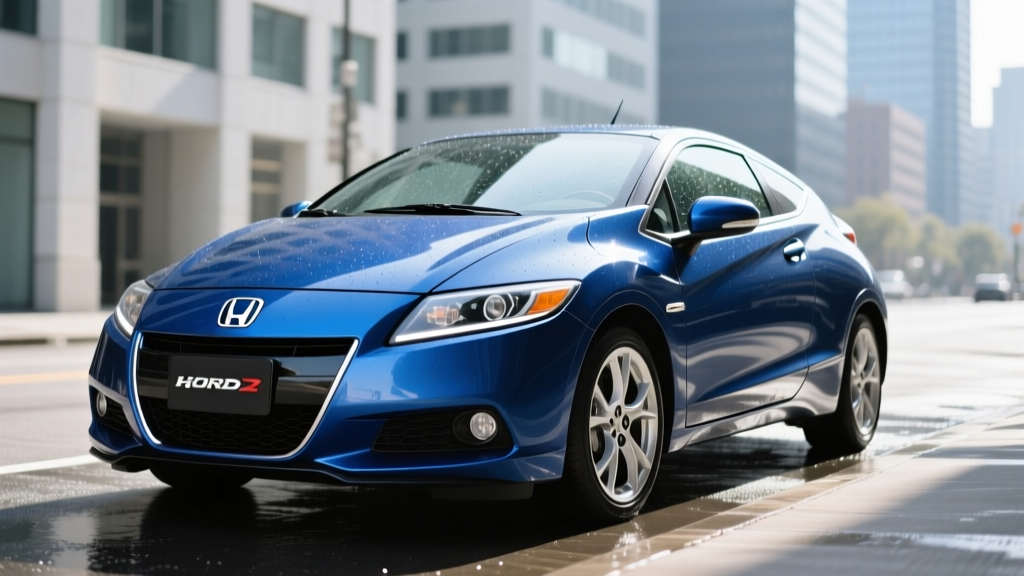
The 2012 Honda CR-Z occupies a strange corner of hybrid history. Marketed as a "sport hybrid," it paired a 1.5-liter four-cylinder with Honda's Integrated Motor Assist (IMA) system in a sleek two-seat coupe body. More than a decade after its debut, used CR-Z examples remain popular among buyers seeking an affordable, efficient commuter with a manual transmission option — something almost no other hybrid has ever offered. This guide breaks down exactly what you get, what to watch for, and whether the CR-Z still makes sense as a used hybrid purchase in 2026.
2012 Honda CR-Z Hybrid: Powertrain and Key Specifications
The CR-Z uses Honda's IMA parallel-hybrid system, where a small electric motor is sandwiched between the gasoline engine and the transmission. Unlike Toyota's series-parallel Hybrid Synergy Drive, the IMA motor primarily assists the gas engine rather than driving the wheels independently for extended distances. The result is modest electric assist, not electric-only propulsion.
| Specification | Value |
|---|---|
| Powertrain | 1.5L i-VTEC 4-cyl + IMA electric motor |
| Combined Horsepower | 122 hp @ 6,000 rpm (123 hp CVT) |
| Combined Torque | 128 lb-ft (MT) / 127 lb-ft (CVT) |
| Transmission | 6-speed manual or CVT |
| Hybrid Type | Conventional hybrid (HEV) — no plug-in |
| IMA Battery | ~0.5 kWh, nickel-metal hydride (NiMH) |
| Drivetrain | Front-wheel drive |
| 0-60 mph | ~9.7 seconds |
| Curb Weight | ~2,665 lbs |
| Seating | 2 passengers |
| Cargo Volume | 25.1 cu ft (rear seats folded) |
A critical point for used buyers: the 2012 CR-Z is a conventional hybrid (HEV), not a plug-in hybrid (PHEV). You never plug it in. The IMA battery recharges through regenerative braking and the gasoline engine. If you're looking for electric-only driving range, this isn't the vehicle — you'd need a PHEV like the Toyota Prius Prime or a full BEV for that.
EPA Fuel Economy and Real-World MPG
Fuel economy varies by transmission. The CVT-equipped model returns the best numbers, while the 6-speed manual sacrifices a small amount of efficiency for driver engagement.
| Transmission | City MPG | Highway MPG | Combined MPG |
|---|---|---|---|
| CVT | 35 | 39 | 37 |
| 6-Speed Manual | 31 | 39 | 34 |
Source: EPA / fueleconomy.gov
The CR-Z's IMA system provides modest assist, so real-world results depend heavily on driving style. Owners on Fuelly report averages of 34-38 MPG combined for CVT models, with some achieving over 40 MPG in gentle city driving where regenerative braking keeps the NiMH battery charged. Highway cruising at 75+ MPH may return 33-36 MPG. The manual transmission version typically delivers 30-34 MPG combined, as enthusiastic driving defeats the efficiency purpose. Cold weather reduces MPG by roughly 5-10% due to longer engine warm-up cycles and reduced battery assist.
HEV vs PHEV vs EV: Where the CR-Z Fits
Understanding the CR-Z requires knowing the three categories of electrified vehicles. Here's how they differ and where the CR-Z sits:
Conventional Hybrid (HEV)
Example: 2012 Honda CR-Z, Toyota Prius
- No plug-in required
- Small battery (~0.5-1.5 kWh)
- Electric motor assists gas engine
- No electric-only range
- Best for: drivers without charging access
Plug-in Hybrid (PHEV)
Example: Toyota Prius Prime, Chrysler Pacifica Hybrid
- Plugs in to charge
- Larger battery (~8-18 kWh)
- 25-45 miles electric-only range
- Gas engine for longer trips
- Best for: home chargers wanting EV commuting + road trips
Battery Electric (BEV)
Example: Tesla Model 3, Hyundai Ioniq 5
- Plugs in, no gas engine
- Large battery (~50-100 kWh)
- 200-400 miles range
- Zero tailpipe emissions
- Best for: drivers with reliable charging access
The CR-Z is firmly in the HEV column. Its tiny 0.5 kWh NiMH battery exists to recapture braking energy and provide brief torque-fill — not to drive on electricity alone. If you want a used Honda with plug-in capability, you'd need to look at later models like the Clarity Plug-In Hybrid (discontinued after 2021) or consider a modern PHEV from another brand.
IMA Battery Health, Warranty, and Replacement Costs
The nickel-metal hydride IMA battery is the single biggest concern for used CR-Z buyers. Unlike the large lithium-ion packs in modern EVs, the CR-Z's NiMH pack is small and relatively inexpensive to replace — but it's still a cost factor to budget for on a 14-year-old vehicle.
Honda covered the 2012 CR-Z's IMA battery under its hybrid-system warranty: 8 years / 80,000 miles in most states, extended to 10 years / 150,000 miles in CARB states (California, New York, Massachusetts, and others adopting California emissions standards). By 2026, all factory warranties have expired on 2012 models.
Signs of IMA Battery Degradation
- IMA warning light on the dashboard — indicates a battery system fault
- Reduced assist — the acceleration-charge gauge rarely shows "charge" during braking
- Lower MPG — a failing battery forces the gas engine to work harder, dropping fuel economy by 3-6 MPG
- Recalibration cycles — the engine idles at high RPM to charge the battery, a sign the pack has lost capacity
Replacement Cost Breakdown
| Option | Cost Range | Notes |
|---|---|---|
| New OEM Honda pack | $2,000 - $2,800 | Dealer-installed; increasingly hard to source for discontinued models |
| Refurbished / reconditioned pack | $800 - $1,500 | Aftermarket hybrid battery specialists; typically 1-3 year warranty |
| Individual cell replacement | $200 - $500 | DIY-friendly for experienced hobbyists; replaces only failed cells |
| Used pack from salvage | $300 - $700 | Risky — unknown remaining life; best as temporary solution |
Compared to a modern EV battery replacement (often $10,000-$20,000+), the CR-Z's IMA pack is a manageable expense. Many CR-Z owners report original batteries lasting 120,000-160,000 miles before needing replacement, though climate and driving habits significantly affect longevity. Hot climates accelerate NiMH degradation.
Driving Experience: The "Sport" in Sport Hybrid
The CR-Z's appeal was never raw performance — it's about lightweight, tossable handling with a hybrid conscience. At roughly 2,665 lbs, it's nearly 500 lbs lighter than a 2026 Toyota Prius, and the available 6-speed manual makes it one of the most engaging hybrids ever sold.
Honda's 3-mode drive system (Sport, Normal, Econ) adjusts throttle response, steering assist, and A/C operation. In Sport mode, the throttle sharpens and the IMA system delivers maximum electric assist. In Econ mode, the engine and A/C are dialed back for efficiency. The differences are noticeable, though the overall power output remains modest at 122 hp.
Regenerative braking is aggressive enough to slow the car meaningfully when you lift off the throttle, though it doesn't achieve true one-pedal driving like a modern EV. The brake pedal feel is better than most early hybrids — Honda tuned the transition between regen and friction braking to be relatively linear.
Used Pricing and Tax Credit Eligibility in 2026
The 2012 CR-Z originally carried an MSRP of approximately $19,800 (base) to $23,000 (EX with navigation). In the 2026 used market, well-maintained examples with 80,000-120,000 miles typically sell for $5,500 to $9,500, depending on condition, mileage, transmission type, and whether the IMA battery has been replaced.
Manual-transmission examples command a premium — often $1,000-$2,000 above equivalent CVT models — because the CR-Z is one of the last affordable manual-transmission hybrids.
Does the 2012 CR-Z Qualify for Any Tax Credit?
No. The federal §30D tax credit for new clean vehicles does not apply to the 2012 CR-Z for two reasons:
- The used EV credit (§25E) covers only plug-in electric vehicles (BEVs and PHEVs) with a minimum battery capacity of 7 kWh. The CR-Z's 0.5 kWh NiMH pack and conventional hybrid powertrain make it ineligible.
- The original new-vehicle hybrid tax credits that existed in 2012 have long since expired and were based on phase-out schedules tied to manufacturer sales volumes.
Source: IRS — Clean Vehicle Credits
If tax incentives are a priority, you'd need to look at a used PHEV or BEV that meets the §25E used-vehicle requirements (sale price under $25,000, income caps, minimum 7 kWh battery).
Pros
- Available 6-speed manual — unique among hybrids
- Lightweight, fun handling at ~2,665 lbs
- 34-37 MPG combined (EPA) with low running costs
- Affordable used pricing ($5,500-$9,500)
- Cheap IMA battery replacement vs modern EV packs
- Distinctive styling that still turns heads
- Honda reliability reputation for non-hybrid components
Cons
- Only 2 seats — impractical for most buyers
- Modest 122 hp — slow by modern standards (9.7s to 60)
- Tiny cargo area (25.1 cu ft max)
- IMA battery likely needs replacement at this age
- No electric-only driving capability
- No federal tax credit eligibility
- Outdated infotainment and no modern safety features
- Rear visibility is poor due to split-window design
Who Should Buy the 2012 Honda CR-Z Hybrid?
Decision Framework
Choose the 2012 CR-Z if: You want an affordable, fuel-efficient commuter with a manual transmission, you only need two seats, and you enjoy lightweight, analog driving dynamics. It's ideal for a single person or couple with short-to-medium commutes who don't have access to plug-in charging.
Choose a used PHEV instead if: You have home charging access and want electric-only commuting (25-45 miles) with gas-engine backup for road trips. Consider a used Toyota Prius Prime, Chevrolet Volt, or Honda Clarity Plug-In Hybrid.
Choose a used BEV instead if: You have reliable home or workplace charging, want zero tailpipe emissions, and your daily driving is under 150 miles. A used Nissan Leaf, Chevrolet Bolt, or early Tesla Model 3 may qualify for the $4,000 used-EV tax credit.
Skip the CR-Z if: You need back seats, want modern ADAS safety features, or prioritize the lowest possible fuel costs — a modern PHEV or BEV will cost less per mile to operate.
Reliability and Long-Term Ownership Costs
The 2012 CR-Z benefits from Honda's generally strong reliability record, and its IMA system is one of the simplest hybrid setups ever mass-produced. There's no complex planetary gearset (as in Toyota's e-CVT) and no high-voltage lithium-ion system to worry about. The 1.5L i-VTEC engine is a proven Honda design shared with the Fit, and parts remain widely available.
Common issues reported by owners and tracked by NHTSA include:
- IMA battery failure (most common hybrid-specific issue; see replacement costs above)
- A/C compressor wear — the electric A/C compressor can fail, costing $800-$1,200 to replace
- 12V battery drain — if the car sits unused for weeks, the conventional 12V battery can discharge and prevent the IMA system from starting
- CVT shudder — some CVT-equipped models develop a shudder under light acceleration; often resolved with a transmission fluid drain-and-fill using Honda HMMF fluid
For a 2026 buyer, budgeting $1,000-$2,000 for an IMA battery replacement (if not already done) and another $500-$1,000 for deferred maintenance (brakes, tires, fluids) is prudent. Even with those costs, total ownership expense remains well below that of a comparable-age conventional sports coupe.
Frequently Asked Questions
How many MPG does the 2012 Honda CR-Z hybrid get?
The EPA rates the CVT-equipped 2012 CR-Z at 35 city / 39 highway / 37 combined MPG. The 6-speed manual version is rated at 31 city / 39 highway / 34 combined. Real-world averages for the CVT typically fall between 34-38 MPG combined, with careful city drivers occasionally exceeding 40 MPG.
Can the 2012 Honda CR-Z drive on electric power only?
No. The CR-Z is a conventional hybrid (HEV) with a small ~0.5 kWh NiMH battery. The electric motor assists the gasoline engine during acceleration but cannot propel the car independently. You cannot plug it in, and it has zero electric-only range. For electric-only driving, you'd need a plug-in hybrid (PHEV) or a battery-electric vehicle (BEV).
How much does it cost to replace the IMA battery in a 2012 CR-Z?
Replacement costs range from approximately $200 for a DIY individual-cell repair to $2,800 for a new OEM Honda pack installed at a dealership. Most owners opt for a refurbished pack ($800-$1,500) from a hybrid battery specialist, which typically includes a 1-3 year warranty. This is far less expensive than replacing a modern EV's lithium-ion traction battery.
Does the 2012 Honda CR-Z qualify for any federal tax credit?
No. The CR-Z is not eligible for the federal §30D new clean vehicle credit or the §25E used clean vehicle credit. The §25E credit requires a plug-in vehicle with at least 7 kWh of battery capacity, and the CR-Z is a conventional hybrid with a ~0.5 kWh NiMH pack. Some states may offer their own incentives for hybrid vehicles, but these are uncommon and vary by jurisdiction — check your state's DMV or energy office for current programs.
Is the 2012 Honda CR-Z reliable?
Overall, yes. The 1.5L engine and manual transmission are proven Honda components with strong longevity records. The primary reliability concern is the IMA NiMH battery, which typically lasts 120,000-160,000 miles before requiring replacement. At 14 years old, most surviving CR-Z examples will need or have already had a battery replacement. The CVT transmission requires regular fluid changes to prevent shudder issues. Honda's hybrid system is among the simplest ever produced, which translates to fewer failure points than more complex hybrid designs.
How does the CR-Z compare to a Toyota Prius of the same era?
The 2012 Toyota Prius delivers significantly better fuel economy (50 MPG combined EPA) and offers four doors, five seats, and more cargo space. The CR-Z trades efficiency for driving engagement — it's lighter, available with a manual transmission, and handles better. If fuel economy and practicality are your top priorities, the Prius wins decisively. If driving enjoyment and style matter more and you only need two seats, the CR-Z is the more engaging choice.
What should I check before buying a used 2012 CR-Z?
Prior to purchase, verify: (1) the IMA battery health — ask for a diagnostic readout showing battery capacity and whether any IMA codes are stored; (2) whether the IMA battery has been replaced and when; (3) CVT fluid change history if equipped with the automatic; (4) 12V battery age; and (5) general maintenance records. A pre-purchase inspection by a Honda-qualified mechanic or hybrid specialist is strongly recommended, especially to assess the IMA system's state of health.