The Honda Clarity Plug-In Hybrid occupies a specific niche in the electrified-vehicle market: a midsize sedan that offers genuine daily electric-only commuting paired with a gasoline engine for longer trips. While Honda discontinued the Clarity after the 2021 model year, thousands remain on the road and in the used market, and its powertrain architecture remains a benchmark for understanding what a well-executed PHEV sedan can deliver. This guide covers the Clarity Plug-In's real-world efficiency, electric range, charging behavior, battery longevity, and whether it still makes sense as a used PHEV purchase in 2026.
Honda Clarity Plug-In: Quick Verdict
The Clarity Plug-In Hybrid pairs a 1.5-liter Atkinson-cycle four-cylinder engine with a 181-hp electric motor and a 17.0 kWh lithium-ion battery pack. The result is an EPA-rated 47 miles of electric-only range — the longest of any PHEV sedan in its class at launch — and 42 MPG combined when operating as a hybrid. For drivers with a commute under 40 miles round-trip and access to Level 2 home charging, the Clarity Plug-In can run on electricity alone for weeks between fill-ups. Its limitation: no DC fast charging capability, meaning road-trip recharge stops are impractical. As a used PHEV in 2026, it remains one of the most efficient and comfortable plug-in sedans available under $25,000.
HEV vs PHEV: Where the Clarity Plug-In Fits
Honda actually sold the Clarity in three variants: a conventional hybrid (HEV), a plug-in hybrid (PHEV), and a battery-electric version (BEV). The distinctions matter enormously for buyers:
| Feature | Clarity Hybrid (HEV) | Clarity Plug-In (PHEV) | Clarity Electric (BEV) |
|---|---|---|---|
| Plug-in charging | No — self-charging only | Yes — Level 1 & Level 2 | Yes — Level 2 & DC fast |
| Electric-only range | None (motor assists engine) | 47 miles (EPA) | 89 miles (EPA) |
| Battery capacity | ~1.3 kWh | 17.0 kWh | 25.5 kWh |
| Combined MPG / MPGe | 44 MPG combined | 42 MPG / 110 MPGe | 114 MPGe |
| Total range | ~570 miles | ~340 miles (EV + gas) | 89 miles |
The conventional Clarity Hybrid never plugs in — it recovers energy through regenerative braking and engine operation. The Clarity Plug-In is the focus of this guide: it offers a large enough battery for meaningful electric-only driving, plus a gas tank for unlimited range when needed. If you cannot install a home charger, the HEV variant is the better choice, as a PHEV operated without plugging in simply becomes a heavier, less efficient hybrid.
Fuel Economy and Electric Range: The Numbers
The EPA rates the Honda Clarity Plug-In Hybrid at 47 miles of electric-only range on a full charge, with a combined fuel-economy equivalent of 110 MPGe in electric mode. Once the battery is depleted, the gasoline engine engages and the car operates as a conventional hybrid, delivering 42 MPG combined.
| Driving Mode | City | Highway | Combined |
|---|---|---|---|
| Electric-only (MPGe) | 118 MPGe | 102 MPGe | 110 MPGe |
| Hybrid (gasoline) MPG | 44 MPG | 40 MPG | 42 MPG |
Real-world expectations: In mixed suburban driving at moderate temperatures (60-75°F), owners consistently report achieving the full 47-mile electric range, and some exceed it slightly on flat terrain at lower speeds. However, highway driving at 70+ mph reduces electric range to approximately 35-38 miles. In cold weather (below 30°F), expect electric-only range to drop to roughly 35-40 miles due to cabin heating demands and reduced battery efficiency. The gasoline hybrid mode's 42 MPG combined is achievable in real-world mixed driving — city-heavy routes can push it to 44-46 MPG thanks to regenerative braking, while sustained highway cruising settles around 38-40 MPG.
EPA Electric Range: 47 miles
Real-world electric range: 38-47 miles depending on speed, temperature, and terrain. Highway and cold weather reduce range by 15-25%.
Total combined range (EV + gas): Approximately 340 miles with a full charge and full 10.0-gallon tank.
Battery, Charging, and Powertrain Specs
The Clarity Plug-In's 17.0 kWh lithium-ion battery pack (approximately 14.0 kWh usable to protect longevity) uses NMC (nickel-manganese-cobalt) chemistry. It mounts beneath the floor and rear seats, which preserves cabin space but does reduce trunk capacity to 15.5 cubic feet compared to the HEV variant.
| Specification | Detail |
|---|---|
| Battery capacity | 17.0 kWh total / ~14.0 kWh usable |
| Battery chemistry | NMC (lithium-ion) |
| Electric motor output | 181 hp / 232 lb-ft torque |
| Gasoline engine | 1.5L Atkinson-cycle I4, 103 hp |
| Combined system output | 212 hp |
| 0-60 mph | ~7.5 seconds |
| EPA electric range | 47 miles |
| EPA combined MPG (hybrid) | 42 MPG |
| Level 1 charging (120V, 12A) | ~12 hours (0-100%) |
| Level 2 charging (240V, 32A) | ~2.5 hours (0-100%) |
| DC fast charging | Not supported |
| Charge port | J1772 (Level 1/2) |
| Fuel tank | 10.0 gallons |
| Drivetrain | Front-wheel drive |
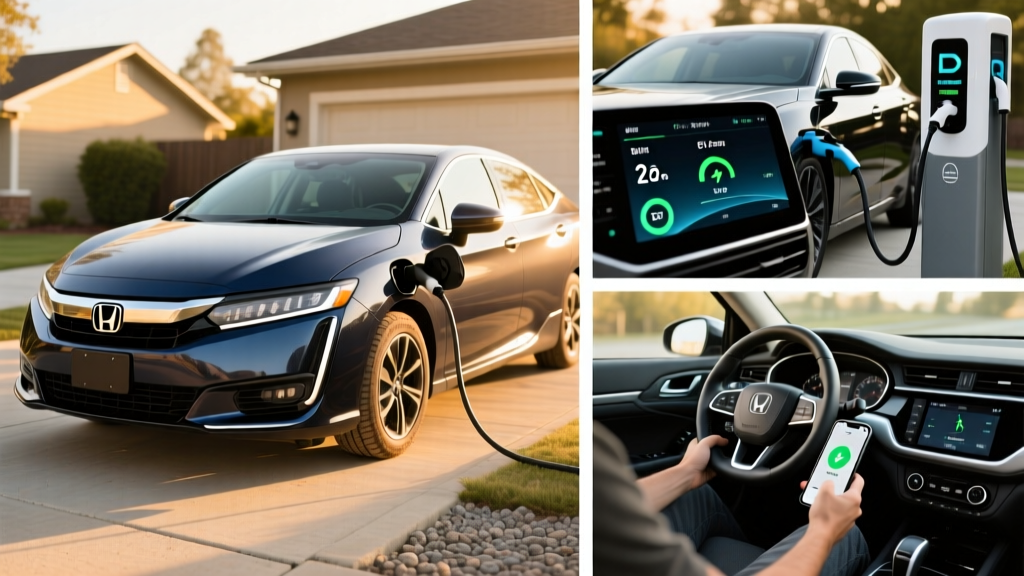
Charging reality: The Clarity Plug-In charges at a maximum of 6.6 kW on Level 2 (240V). A full charge from empty takes approximately 2.5 hours on a 32-amp Level 2 home charger. On a standard 120V household outlet (Level 1), plan for about 12 hours — sufficient for overnight replenishment if your daily driving is under 40 miles. The absence of DC fast charging is the Clarity's most significant limitation for road trips: you cannot top up the battery at public fast-charging stations. On long highway drives, the car operates purely as a 42-MPG hybrid, which is still efficient but negates the PHEV advantage.
Pricing, Tax Credits, and Used Market Value
When new, the Honda Clarity Plug-In Hybrid carried an MSRP starting at approximately $33,400 (base) to $37,000 (Touring trim). As of 2026, the Clarity is only available on the used market. Typical pricing for a 2019-2021 model ranges from $18,000 to $26,000 depending on mileage, condition, and trim.
Federal tax credit (used EV credit, §25E): Under current IRS rules, purchasing a used Clarity Plug-In from a dealer may qualify for the Used Clean Vehicle Credit (§25E), which provides up to $4,000 or 30% of the sale price (whichever is lower). Eligibility requirements include:
- Sale price must be $25,000 or below
- Buyer income caps: $150,000 (married filing jointly), $112,500 (head of household), $75,000 (single)
- Vehicle must be at least two model years old (all Clarity models qualify)
- Must purchase from a licensed dealer (private-party sales do not qualify)
- Credit is non-refundable — you must have federal tax liability to claim it
- Vehicle must have been previously sold (original new-vehicle credit already claimed or expired)
New-vehicle §30D credit (historical): When sold new, the Clarity Plug-In qualified for the full $7,500 federal tax credit. This credit is no longer available for new purchases since the model is discontinued. However, the used-vehicle credit makes it an attractive budget option for qualifying buyers in 2026.
Reliability, Battery Warranty, and Replacement Cost
Honda's hybrid and PHEV powertrains have demonstrated strong long-term reliability across multiple model lines. The Clarity Plug-In uses a well-proven two-motor hybrid system shared in concept with the Accord Hybrid. The 1.5L Atkinson-cycle engine operates under relatively low stress, and the electric drive motor has fewer wear components than a conventional transmission.
Hybrid Battery Warranty (original): 8 years / 100,000 miles (10 years / 150,000 miles in CARB states including California, New York, Massachusetts, and others adopting California emissions standards).
Powertrain Warranty (original): 5 years / 60,000 miles.
2026 Status: For a 2021 model year Clarity, the original 8-year battery warranty extends through 2029. For 2019 models, the standard 8-year warranty expired in 2027, meaning some early examples may be out of warranty unless covered under the 10-year CARB-state extension.
Battery replacement cost: If the high-voltage battery requires replacement outside of warranty, expect a cost of approximately $3,000 to $5,000 for the battery pack plus labor at a Honda dealer. Independent hybrid-battery specialists may offer refurbished packs for $2,000-$3,500. Battery degradation data from owner reports suggests the Clarity's 17 kWh pack loses approximately 8-12% of capacity over the first 100,000 miles, which translates to roughly 4-5 miles of electric range reduction — a modest decline that most owners find acceptable. According to fueleconomy.gov, the Clarity Plug-In maintains strong efficiency figures even as the battery ages.
Who Should Choose the Clarity Plug-In?
Pros
- 47-mile EPA electric range covers most daily commutes entirely on electricity
- 42 MPG combined in hybrid mode — efficient even without plugging in
- Comfortable, quiet ride with spacious rear seating
- Standard Honda Sensing suite (adaptive cruise, lane-keeping, collision mitigation)
- Strong reliability record; battery warranty still active on most used examples
- Eligible for up to $4,000 used-EV tax credit if purchased under $25,000 from a dealer
Cons
- No DC fast charging — road trips rely entirely on gasoline
- Discontinued after 2021 — no new models available; parts supply may tighten long-term
- Trunk space reduced to 15.5 cu ft due to battery placement
- Infotainment system feels dated compared to 2024+ competitors
- FWD only — no all-wheel-drive option for snow-belt buyers
- 2.5-hour Level 2 charge time is slower than newer PHEVs with larger onboard chargers
Hybrid vs PHEV vs EV: Which Fits You?
Choose the Clarity Plug-In (PHEV) if: You have a commute under 40 miles, can charge at home overnight on Level 2, want to eliminate most daily gasoline use, but still need unlimited range for road trips without charging-infrastructure planning.
Choose a conventional hybrid (HEV) if: You cannot install a home charger, drive unpredictable or very long daily distances, or want the simplest ownership experience with no plug-in behavior to manage.
Choose a full battery-electric vehicle (BEV) if: Your daily driving is under 250 miles, you have reliable home charging, you want zero tailpipe emissions and minimal maintenance, and you're comfortable planning DC fast-charging stops on road trips.
Ownership Costs: Clarity PHEV vs Alternatives
At current national-average electricity and gasoline prices (approximately $0.16/kWh and $3.30/gallon as of early 2026), driving the Clarity Plug-In in electric mode costs roughly $0.04 per mile, compared to $0.08 per mile in hybrid gasoline mode and approximately $0.12 per mile for a comparable 30-MPG gasoline sedan. Over 15,000 miles of annual driving — with 10,000 of those on electricity — a Clarity PHEV owner can save approximately $600-$900 per year in fuel costs versus a gas-only Accord.
Insurance costs for the Clarity Plug-In are moderate — typically $1,400-$1,800 annually depending on location and driving record, which is comparable to other midsize sedans. Maintenance is minimal: the gasoline engine requires oil changes every 7,500-10,000 miles, and regenerative braking significantly extends brake pad life. Many owners report original brake pads lasting beyond 80,000 miles.
Frequently Asked Questions
How many MPG does the Honda Clarity Plug-In get?
The EPA rates the Clarity Plug-In at 44 MPG city, 40 MPG highway, and 42 MPG combined when operating on gasoline after the battery is depleted. In electric mode, it achieves 110 MPGe combined. Real-world results align closely with these figures, with city-heavy driving often exceeding 44 MPG thanks to regenerative braking.
How far can the Clarity Plug-In go on electric only?
The EPA rates it at 47 miles of electric-only range. In real-world driving, expect 38-47 miles depending on speed, temperature, and terrain. Highway driving at 70+ mph and cold weather below 30°F reduce electric range by 15-25%.
Does the Honda Clarity Plug-In qualify for any tax credit in 2026?
The $7,500 new-vehicle federal credit (§30D) is no longer available since the Clarity is discontinued. However, buying a used Clarity Plug-In from a licensed dealer for $25,000 or less may qualify for the Used Clean Vehicle Credit (§25E) of up to $4,000, subject to buyer income limits. Consult a tax professional for your specific eligibility.
Is the Honda Clarity Plug-In reliable, and what does a battery replacement cost?
Honda's PHEV powertrain has a strong reliability record. The high-voltage battery is warranted for 8 years/100,000 miles (10 years/150,000 miles in CARB states). Out-of-warranty battery replacement costs approximately $3,000-$5,000 at a dealer. Real-world degradation data shows approximately 8-12% capacity loss over 100,000 miles — about 4-5 miles of range reduction.
Can the Clarity Plug-In charge at DC fast-charging stations?
No. The Clarity Plug-In only supports Level 1 (120V) and Level 2 (240V) AC charging via its J1772 port. Maximum Level 2 charge rate is 6.6 kW, taking approximately 2.5 hours for a full charge. On road trips, the car operates as a 42-MPG hybrid using its gasoline engine.
Should I buy a used Clarity Plug-In or a newer PHEV?
The Clarity Plug-In offers exceptional value as a used PHEV — 47 miles of electric range remains competitive with 2025-2026 PHEV sedans, and the $18,000-$26,000 used price (potentially $14,000-$22,000 after the used-EV credit) undercuts new PHEVs by $10,000+. The trade-off is no DC fast charging, a discontinued model with potential long-term parts concerns, and an older infotainment system. If budget is the priority and you can charge at home, it remains one of the best PHEV values available.