Quick Verdict: The 2025 Kia Sorento Hybrid EX at a Glance
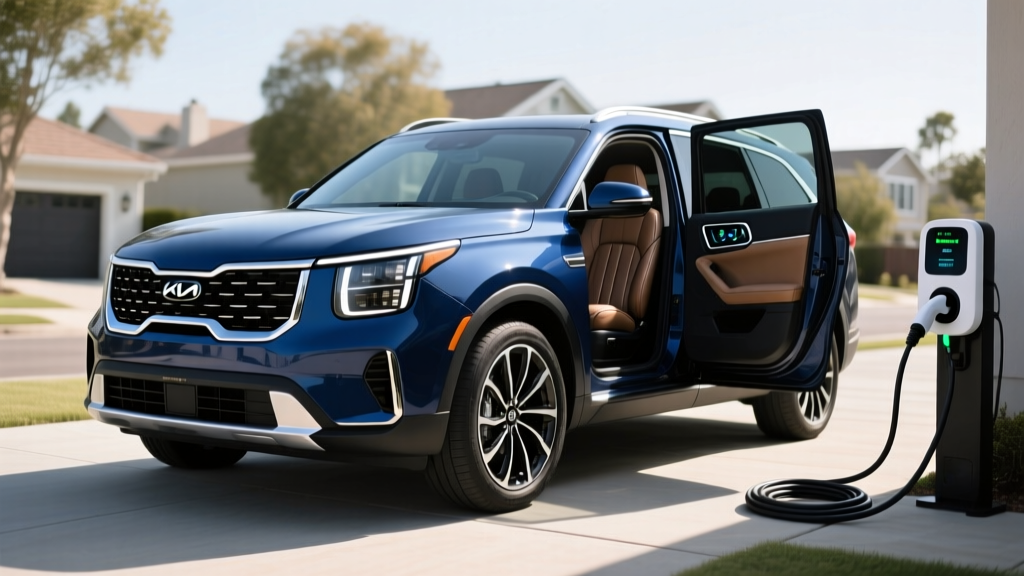
The 2025 Kia Sorento Hybrid EX occupies a practical middle ground for three-row SUV buyers who want electrified efficiency without plug-in dependency. As a conventional hybrid (HEV), it requires zero behavioral change from a gas-car owner — no charging cable, no range planning, no outlet hunting. You simply fuel up at any gas station and let the hybrid powertrain recover energy under braking and low-speed driving.
For the EX trim specifically, Kia bundles the most desirable features (leatherette seating, 12.3-inch infotainment, power liftgate, Highway Driving Assist) at a price point that undercuts comparable hybrid SUVs from Toyota and Honda. The real question isn't whether it's efficient — it is — but whether the HEV version or the plug-in hybrid (PHEV) variant better suits your daily routine.
| Spec | Value |
|---|---|
| Powertrain | 1.6L turbocharged 4-cyl + electric motor |
| Combined Horsepower | 261 hp |
| Combined Torque | 258 lb-ft |
| Transmission | 6-speed automatic |
| Drivetrain | AWD (standard on Hybrid EX) |
| EPA MPG (City / Hwy / Combined) | 34 / 34 / 34 |
| Fuel Tank Capacity | 14.8 gallons |
| Total Driving Range | ~503 miles |
| 0-60 mph (est.) | ~7.5 seconds |
| Towing Capacity | 2,000 lbs |
| Cargo Volume (behind 3rd row) | 12.6 cu ft |
| Cargo Volume (behind 2nd row) | 45.0 cu ft |
| Seating | 6 passengers (captain's chairs std on EX) |
| Base MSRP (EX AWD) | $40,090 |
| Hybrid Battery Warranty | 10 years / 100,000 miles |
HEV vs PHEV: Which Sorento Hybrid Is Right for You?
Kia sells the Sorento in two electrified flavors, and confusing them is the most common mistake shoppers make. Here's the essential distinction:
| Attribute | Sorento Hybrid (HEV) | Sorento Plug-In Hybrid (PHEV) |
|---|---|---|
| Battery Size | ~1.49 kWh (small buffer) | 13.8 kWh (usable) |
| Needs to Plug In? | No — self-charging via regen + engine | Yes — plug in for EV range |
| Electric-Only Range | None (motor assists engine) | 32 miles (EPA) |
| EPA Combined MPG | 34 MPG | 35 MPG (hybrid mode after EV depleted) |
| MPGe (PHEV combined) | N/A | 79 MPGe |
| Level 2 Charge Time | N/A | ~3 hours 25 min (3.3 kW onboard) |
| DC Fast Charging | N/A | No DC fast-charge capability |
| Combined HP | 261 hp | 261 hp |
| Federal Tax Credit | Not eligible | Not eligible under 2025 §30D rules |
| Starting MSRP | ~$38,690 (S trim) | ~$50,290 (SX trim) |
The HEV is the right call if you lack access to home or workplace charging, drive primarily highway miles, or want the lowest upfront cost. The PHEV makes sense if you can plug in overnight and your daily commute falls within 32 miles round-trip — effectively turning it into an EV for weekday errands with a gas engine for weekend road trips.
Fuel Economy: EPA Numbers vs Real-World MPG
The 2025 Kia Sorento Hybrid EX carries an EPA rating of 34 MPG city / 34 MPG highway / 34 MPG combined, per fueleconomy.gov. That parity between city and highway is typical of conventional hybrids — the electric motor handles low-speed stop-and-go efficiently, while the turbocharged engine manages highway loads.
| Driving Condition | EPA Estimate | Real-World Expectation |
|---|---|---|
| City | 34 MPG | 33–36 MPG (hybrids often exceed EPA in city) |
| Highway (70 mph) | 34 MPG | 29–32 MPG (aero drag + turbo load) |
| Combined | 34 MPG | 31–34 MPG (mixed driving) |
| Cold Weather (below 30°F) | — | 28–31 MPG (engine runs more for cabin heat) |
Hybrid owners in warm climates with city-heavy commutes routinely report 35–37 MPG in real-world driving, slightly exceeding the EPA sticker. Highway-dominant drivers should expect a 2–4 MPG shortfall, particularly at sustained speeds above 70 mph where the Sorento's boxy three-row profile creates aerodynamic drag. Cold weather compounds this: the engine must run more frequently to generate cabin heat and warm the catalytic converter, reducing electric-motor contribution.
Powertrain and Driving Impressions
Kia pairs a 1.6-liter turbocharged four-cylinder (178 hp on its own) with a 47.7 kW electric motor integrated into the transmission housing. Combined output is 261 hp and 258 lb-ft of torque, routed through a conventional 6-speed automatic to all four wheels. Unlike Toyota's planetary-gear hybrid system, Kia's setup uses a traditional transmission, which gives it a more familiar driving feel — you feel gear shifts rather than the rubber-band sensation of a CVT.
The torque fill from the electric motor is immediate, making the Sorento Hybrid feel brisk off the line despite its ~4,400-pound curb weight. Merging onto highways and climbing grades are handled confidently. The AWD system uses an electronically controlled coupling rather than a mechanical connection to the rear axle; the electric motor primarily drives the front wheels, with the rear axle engaged on demand for traction.
Pricing, Trims, and Tax Credit Eligibility
The 2025 Kia Sorento Hybrid is offered in S, EX, and EX Prestige trims. The EX — our focus here — starts at approximately $40,090 (including destination). That positions it competitively against the Toyota Highlander Hybrid LE (~$42,000) and below the Mazda CX-90 PHEV.
Federal Tax Credit Status: The conventional Sorento Hybrid (HEV) does not qualify for the IRS §30D Clean Vehicle Credit. The Sorento Plug-In Hybrid (PHEV) also currently falls outside §30D eligibility due to battery component and critical-mineral sourcing requirements that changed under the Inflation Reduction Act. Always verify current rules at IRS.gov's qualified vehicles list, as eligibility can change model-by-model and quarter-by-quarter.
Some states offer additional hybrid or alternative-fuel rebates — check your state energy office or dealer for local programs. These vary by jurisdiction and are separate from federal credits.
Key EX-trim inclusions over the base S trim: synthetic leather upholstery, heated front seats, power-adjustable driver's seat, smart power liftgate, wireless phone charging, and Kia's Highway Driving Assist (a Level 2 ADAS combining adaptive cruise with lane-centering). The EX Prestige adds ventilated front seats, a panoramic sunroof, and a head-up display for roughly $3,000 more.
Battery Warranty, Lifespan, and Replacement Cost
Hybrid battery longevity is the single most common concern among first-time hybrid buyers. Kia addresses this with one of the strongest warranties in the industry.
Hybrid Battery Warranty: 10 years or 100,000 miles (whichever comes first) for the high-voltage hybrid battery pack. This applies to both the HEV and PHEV variants. The standard powertrain warranty covers 10 years / 100,000 miles as well, and the basic vehicle warranty is 5 years / 60,000 miles.
The HEV's 1.49 kWh battery is small and operates within a narrow state-of-charge window (roughly 40–60%), which minimizes degradation stress. Lithium-polymer cells in this application typically outlast the warranty period by a significant margin. Toyota Prius batteries from the early 2000s are still running at 200,000+ miles, and Kia's chemistry and thermal management have improved since then.
If replacement is needed out of warranty — rare before 150,000 miles — expect a cost in the range of $2,000–$3,500 for the HEV battery pack (parts and labor), based on current aftermarket and dealer pricing. The PHEV's larger 13.8 kWh pack would cost significantly more, roughly $5,000–$8,000, though failures before 100,000 miles are uncommon. Third-party refurbishment options are increasingly available and can reduce costs by 30–40%.
Who Should Choose the Sorento Hybrid EX — And Who Shouldn't
Strengths
- 34 MPG combined in a three-row AWD SUV — genuinely efficient for the class
- 261 hp provides confident acceleration and highway merging
- 10-year / 100,000-mile hybrid battery and powertrain warranty
- EX trim well-equipped at ~$40k — strong value vs Highlander Hybrid
- No plug-in required — zero lifestyle change from a gas vehicle
- Six-passenger captain's-chair seating standard on EX
Limitations
- Highway MPG drops below EPA estimate at sustained 70+ mph
- Cargo space (12.6 cu ft behind 3rd row) is tight for a three-row SUV
- No federal tax credit eligibility
- Towing limited to 2,000 lbs (insufficient for boats or large trailers)
- Third row best suited for children — adults will find it cramped
- Regen braking feel takes adjustment if coming from a gas car
Decision Framework
Choose the Sorento Hybrid EX if: You need three rows occasionally, drive a mixed city/highway commute, lack home charging access, and want to reduce fuel costs without changing your refueling habits.
Choose the Sorento PHEV instead if: You have Level 2 charging at home or work, your daily driving is under 32 miles, and you want EV-like operating costs on weekdays with gas-car flexibility on weekends.
Choose a full EV (e.g., Kia EV9, Hyundai Ioniq 5) if: You have reliable home charging, your daily range needs are under 250 miles, you want zero tailpipe emissions, and you're willing to plan for longer road-trip charging stops.
Stick with a gas-only SUV if: You drive mostly highway miles at high speeds, tow frequently, or live in a remote area with limited hybrid-service dealer access.
Ownership Costs: Fuel Savings Over 5 Years
To put the Sorento Hybrid's efficiency in context, consider a 15,000-mile/year driver (the U.S. average) paying $3.40/gallon for regular unleaded:
| Vehicle | Combined MPG | Annual Fuel Cost | 5-Year Fuel Cost |
|---|---|---|---|
| 2025 Sorento Hybrid EX AWD | 34 | $1,500 | $7,500 |
| 2025 Toyota Highlander Hybrid AWD | 35 | $1,457 | $7,285 |
| 2025 Kia Sorento (gas, 2.5T AWD) | 23 | $2,217 | $11,087 |
| 2025 Hyundai Santa Fe (gas, 2.5T AWD) | 22 | $2,318 | $11,591 |
The hybrid saves roughly $3,500–$4,000 in fuel over five years compared to the gas-only Sorento 2.5T — enough to offset a meaningful portion of the hybrid's price premium. Insurance premiums for the Sorento Hybrid tend to run 5–10% higher than the gas version, per industry averages, so factor that into your total cost of ownership calculation.
Frequently Asked Questions
How many MPG does the 2025 Kia Sorento Hybrid EX get?
The EPA rates it at 34 MPG city, 34 MPG highway, and 34 MPG combined. Real-world results typically range from 31–36 MPG depending on driving mix and climate. City-dominant drivers in warm weather often exceed the EPA estimate; highway-dominant drivers in cold weather may see 28–31 MPG.
Does the Sorento Hybrid need to be plugged in?
No. The conventional Sorento Hybrid (HEV) charges its small battery entirely through regenerative braking and the gasoline engine. You never plug it in. Only the Sorento Plug-In Hybrid (PHEV) variant requires a charging cable to access its 32-mile electric-only range.
How far can the Sorento PHEV go on electric only?
The 2025 Sorento PHEV delivers an EPA-estimated 32 miles of electric-only range on its 13.8 kWh battery. Real-world EV range is typically 26–30 miles in mixed driving, dropping to 22–25 miles in cold weather or at highway speeds. Once depleted, it operates as a conventional hybrid at 35 MPG combined.
Is the Sorento Hybrid reliable?
Kia's 1.6L turbo hybrid powertrain has been in production since 2022 across the Sorento, Tucson, and Santa Fe lineups, and reported failure rates are low. The 10-year / 100,000-mile hybrid battery and powertrain warranty is among the best in the industry. Independent reliability surveys (Consumer Reports, J.D. Power) rate the Sorento Hybrid as average to above-average for the midsize SUV class.
Does the Sorento Hybrid qualify for a federal tax credit?
The conventional Sorento Hybrid (HEV) does not qualify for any federal tax credit. The Sorento PHEV also currently does not meet the IRS §30D battery-sourcing and critical-mineral requirements. Always check the IRS qualified vehicle list before purchasing, as eligibility can change. Some state-level incentives may apply — consult your state energy office.
What does hybrid battery replacement cost?
Out-of-warranty replacement for the HEV's 1.49 kWh pack runs approximately $2,000–$3,500 (parts and labor). The PHEV's 13.8 kWh pack costs roughly $5,000–$8,000. However, failures before 150,000 miles are uncommon, and the 10-year/100,000-mile warranty covers premature degradation.
How does the Sorento Hybrid compare to the Toyota Highlander Hybrid?
The Highlander Hybrid edges ahead on fuel economy (35 vs 34 MPG combined) and cargo space, but starts roughly $2,000 higher and has a less powerful powertrain (243 hp vs 261 hp). The Sorento Hybrid also offers a longer basic warranty (5yr/60k vs 3yr/36k). If third-row space is a priority, the Highlander is roomier; if value and acceleration matter more, the Sorento Hybrid EX is the stronger pick.