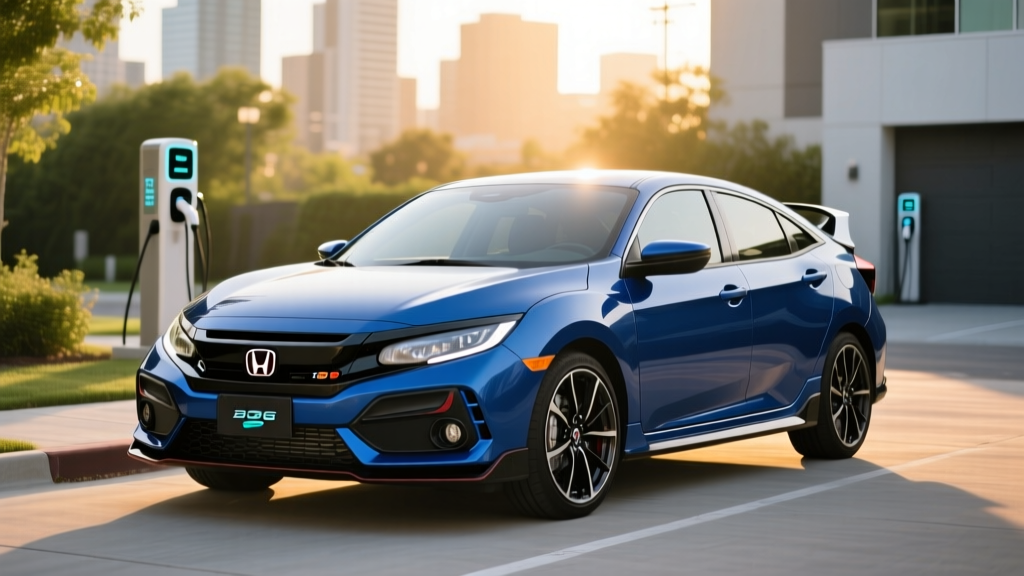
The Honda Civic Sport Hatchback Hybrid occupies a specific niche in the 2026 compact-car market: it delivers the cargo versatility of a hatchback with the efficiency of a series-parallel hybrid system, without requiring you to change how you refuel. Unlike plug-in hybrids or full EVs, the Civic Hybrid needs no home charger, no plug, and no route planning. You fill it with gas and drive. For the 140,000+ buyers who search for compact hybrids every month, that simplicity is the entire point.
This guide covers everything a research-driven buyer needs to know about the 2026 Honda Civic Sport Hatchback Hybrid — EPA fuel economy, real-world MPG expectations, the two-motor powertrain, battery longevity, pricing, and where it fits against PHEVs and BEVs in today's market.
HEV vs. PHEV: What the Civic Sport Hatchback Hybrid Actually Is
Before evaluating the Civic, it is critical to distinguish between the two hybrid architectures available in 2026's market, because buyers routinely confuse them.
| Feature | Conventional Hybrid (HEV) | Plug-In Hybrid (PHEV) |
|---|---|---|
| Plug-in charging required? | No — refuels with gas only | Yes — plugs into Level 1/2 charger |
| Battery capacity | ~1.0–1.5 kWh (small buffer) | ~12–20 kWh (large pack) |
| Electric-only range | ~1 mile at low speed (motor assist only) | 20–50 miles EPA typical |
| Primary energy source | Gasoline (motor assists engine) | Electricity first, then gasoline |
| Federal tax credit (§30D) | Not eligible | Up to $7,500 if eligible |
| Example | Honda Civic Hybrid | Toyota Prius Prime |
The 2026 Honda Civic Sport Hatchback Hybrid is a conventional hybrid (HEV). It uses Honda's fourth-generation two-motor hybrid system paired with a 2.0-liter Atkinson-cycle four-cylinder engine. There is no plug. There is no electric-only commute mode. The battery recharges through regenerative braking and the engine, and the electric motor's role is to supplement torque, enable low-speed electric creep, and optimize the engine's operating range for maximum efficiency.
If you need electric-only commuting, you are looking for a PHEV like the Toyota Prius Prime or a full BEV like the Chevrolet Equinox EV. The Civic Hybrid is for drivers who want dramatically better fuel economy without altering their refueling habits.
Fuel Economy: EPA Ratings and Real-World MPG
The 2026 Civic Sport Hatchback Hybrid carries an EPA-estimated 50 MPG combined rating, making it one of the most efficient non-plug-in vehicles in its class. Here is the full breakdown:
| Driving Condition | EPA Estimate | Real-World Expectation |
|---|---|---|
| City | 53 MPG | 50–56 MPG |
| Highway | 46 MPG | 42–48 MPG |
| Combined | 50 MPG | 46–52 MPG |
Source: fueleconomy.gov
Why the City Number Is Higher Than Highway
This is characteristic of series-parallel hybrids and often surprises first-time hybrid buyers. In city driving, the Civic Hybrid operates primarily in EV mode at low speeds, using the electric motor for propulsion while the engine either shuts off or runs as a generator at its most efficient RPM. Regenerative braking recaptures energy at every stoplight. Stop-and-go traffic is where this powertrain thrives.
On the highway, the engine must sustain higher loads and the aerodynamic drag of the hatchback body style (slightly taller than the sedan) reduces efficiency. Expect 42–48 MPG on sustained highway runs at 70–75 mph. In cold weather (below 35°F), the engine runs more frequently for cabin heat, dropping combined real-world economy to roughly 44–47 MPG until the powertrain warms up.
Total Range
With a 12.4-gallon fuel tank and 50 MPG combined, the Civic Sport Hatchback Hybrid delivers approximately 620 miles of total range per fill-up — enough for most drivers to visit a gas station once every two to three weeks.
Powertrain and Performance Specs
Honda's fourth-generation hybrid system in the 2026 Civic Sport Hatchback pairs a 2.0-liter direct-injection Atkinson-cycle engine with two electric motors and a lithium-ion battery pack. The system prioritizes electric-motor drive in most conditions, engaging the gasoline engine primarily as a generator or for direct drive at highway cruising speeds via a lock-up clutch.
| Specification | 2026 Civic Sport Hatchback Hybrid |
|---|---|
| Engine | 2.0L 4-cylinder Atkinson-cycle |
| Combined System Horsepower | 200 hp |
| Combined System Torque | 232 lb-ft (motor peak) |
| Transmission | e-CVT (single-speed direct drive) |
| Drivetrain | Front-wheel drive |
| 0–60 mph | ~7.3 seconds |
| Hybrid Battery | ~1.0 kWh lithium-ion (buffer) |
| Cargo Volume (rear seats up) | 24.5 cu ft |
| Cargo Volume (rear seats folded) | ~47 cu ft |
The 200-horsepower combined output gives the Civic Sport Hatchback Hybrid genuinely quick off-the-line acceleration, thanks to the electric motor's instant torque delivery. In our experience, the Sport Hybrid feels noticeably more responsive from 0–30 mph than its non-hybrid 1.5L turbocharged counterpart, even though the turbo Civic eventually catches up at higher speeds. The e-CVT is smooth and avoids the rubber-band sensation that older CVTs produced — Honda's system uses a fixed gear ratio for highway cruising that eliminates the drone.
Pricing, Trims, and Tax Credit Eligibility
The 2026 Honda Civic Sport Hatchback Hybrid is positioned as a value-oriented efficiency play. Pricing starts in the low $30,000 range before destination charges.
| Trim | MSRP (approx.) | Key Features |
|---|---|---|
| Sport Hybrid | ~$30,950 | 18" wheels, 7" touchscreen, Honda Sensing suite, wireless CarPlay/Android Auto |
| Sport Touring Hybrid | ~$35,950 | 9" touchscreen, Bose 12-speaker audio, leather, heated seats, wireless charging, navigation |
Does the Civic Hybrid Qualify for a Federal Tax Credit?
No. The 2026 Honda Civic Sport Hatchback Hybrid is a conventional HEV and does not qualify for the IRS §30D Clean Vehicle Credit. That credit — up to $7,500 — is reserved for plug-in electric vehicles (BEVs and PHEVs) that meet battery-sourcing, critical-mineral, MSRP cap, and buyer income requirements. Conventional hybrids receive no federal purchase incentive under current IRS rules.
Some states offer their own rebates for hybrids, but these vary widely by jurisdiction and change frequently. Check your state's energy or environmental agency website for current programs. Do not rely on dealer claims about hybrid incentives — verify independently.
Battery Longevity, Warranty, and Replacement Cost
Battery durability is consistently the top concern for first-time hybrid buyers. Here is what you need to know about the Civic Hybrid's lithium-ion pack.
Honda Hybrid Battery Warranty
- Coverage: 8 years / 100,000 miles (10 years / 150,000 miles in CARB states including CA, NY, MA, and others)
- What's covered: Defects and capacity loss below a defined threshold (typically ~60-70% of original capacity)
- Transferable: Yes, warranty follows the vehicle to subsequent owners
Real-World Degradation
Because the Civic Hybrid's battery is small (~1.0 kWh) and the system operates within a narrow state-of-charge window (roughly 40%–60%), the battery experiences minimal stress compared to a full EV or PHEV pack. Honda's hybrid battery management system is conservative by design — it never fully charges or fully depletes the pack, which dramatically extends cycle life.
Based on long-term data from Honda's hybrid lineup (Insight, Accord Hybrid, CR-V Hybrid), most Civic Hybrid batteries show negligible capacity loss over 150,000+ miles. Failures within the warranty period are rare, and out-of-warranty replacements are uncommon before 200,000 miles.
Battery Replacement Cost
If replacement is needed out of warranty, expect $2,000–$4,000 for a new or remanufactured hybrid battery pack, including labor. This is significantly less than a full EV battery replacement ($5,000–$20,000+) because the Civic Hybrid's pack is small and modular. Independent hybrid-battery specialists can often refurbish the pack at the lower end of that range.
Real-World Ownership: What It Is Like to Live With
After extended driving in mixed conditions, several practical observations stand out about the Civic Sport Hatchback Hybrid:
Driving Impressions
The hybrid system is nearly silent at low speeds, where the electric motor handles propulsion. Engine engagement is smooth and well-damped — you rarely feel the transition between EV and engine modes. The regenerative braking is progressive and predictable, with selectable regen levels via paddle shifters. In its strongest setting, you can approach one-pedal driving in city traffic, though the Civic Hybrid does not come to a complete stop on regen alone like a full EV.
Cargo and Practicality
The hatchback body style provides 24.5 cubic feet behind the rear seats — substantially more than the Civic sedan's 14.8 cubic feet. With the 60/40 split rear seats folded, you get roughly 47 cubic feet, enough for furniture-store runs or camping gear. The hybrid battery is packaged under the rear seats and does not intrude on cargo space.
Insurance and Maintenance
Insurance premiums for the Civic Hybrid are typically 5–10% higher than the gas-only Civic due to the higher MSRP and hybrid-component repair costs. However, maintenance is low: no timing belt (chain-driven), regenerative braking extends pad life significantly, and Honda's hybrid system has no transmission fluid to change at short intervals. Expect standard Honda maintenance — oil changes every 7,500–10,000 miles, tire rotations, and cabin air filter replacements.
Who Should Buy This Hybrid vs. a PHEV or Full EV?
The decision between a conventional hybrid, a plug-in hybrid, and a battery-electric vehicle comes down to your charging access, commute pattern, and willingness to adapt your refueling behavior.
Choose the Civic Sport Hatchback Hybrid If:
- You cannot install a home charger (apartment, street parking, no garage)
- You want maximum MPG without plugging in
- Your commute is mixed city/highway, not short-distance only
- You want a lower purchase price than a PHEV or BEV
- You take frequent long road trips and want zero range-planning hassle
- You want hatchback cargo space in a compact footprint
Consider a PHEV or Full EV Instead If:
- You have Level 2 home charging and a short commute (PHEV covers it on electricity alone)
- You want zero tailpipe emissions for daily driving (BEV)
- You want to qualify for the $7,500 federal tax credit (PHEV/BEV only)
- Your electricity rate is low enough to make electric-only driving cheaper than 50 MPG gas
- You want the strongest acceleration and lowest center of gravity (BEV)
The Cost-per-Mile Comparison
At $3.40/gallon and 50 MPG, the Civic Hybrid costs roughly $0.068 per mile in fuel. A comparable PHEV running on electricity at $0.15/kWh and 4 mi/kWh costs about $0.038 per mile — nearly half. But that advantage only applies while the PHEV is running on its battery. Once the PHEV depletes its electric range and switches to hybrid mode, its MPG (typically 40–48) is comparable to or slightly below the Civic Hybrid's 50 MPG. If you cannot charge at home, the PHEV's cost advantage disappears entirely.
Reliability and Safety Ratings
Honda's hybrid powertrain has a strong reliability track record across multiple model lines. The Civic platform earns top marks in crash testing.
- IIHS Rating: The Civic Hatchback is an IIHS Top Safety Pick when equipped with qualifying headlights, earning Good ratings across all crashworthiness tests.
- NHTSA Rating: The Civic family typically earns a 5-star overall NHTSA safety rating.
- Honda Sensing: Standard on all trims — includes adaptive cruise control, lane-keeping assist, forward collision warning with automatic emergency braking, and traffic sign recognition. This is an SAE Level 1 driver-assist system; the driver must remain fully engaged at all times.
Honda's hybrid-specific components (power control unit, electric motors, battery) have proven durable across millions of vehicles in the field. Consumer Reports and J.D. Power consistently rate Honda's hybrid systems among the most reliable in the industry.
Frequently Asked Questions
How many MPG does the 2026 Honda Civic Sport Hatchback Hybrid get?
The EPA rates it at 53 city / 46 highway / 50 combined MPG. In real-world mixed driving, most owners report 46–52 MPG combined. City driving tends to exceed the EPA estimate due to the hybrid system's electric-motor dominance at low speeds. Highway-only driving at 75 mph may yield 42–46 MPG. Cold weather (below 35°F) reduces efficiency by roughly 5–10% due to increased engine operation for cabin heat.
Does the Civic Hybrid need to be plugged in?
No. The Civic Sport Hatchback Hybrid is a conventional hybrid (HEV). It charges its small lithium-ion battery through regenerative braking and the gasoline engine. There is no plug, no charging cable, and no electric-only commute range. You refuel exclusively at gas stations.
How far can it go on electric only?
Effectively zero miles in the way a PHEV or EV operates on electricity. The Civic Hybrid's electric motor can propel the car at very low speeds (under ~25 mph) for brief distances — typically under a mile — when the battery has sufficient charge. This is motor assist, not a usable electric-only mode. If you need 20–50 miles of electric-only commuting, you need a PHEV like the Toyota Prius Prime.
Is the hybrid battery reliable and what does replacement cost?
Honda's hybrid batteries are among the most reliable in the industry, with most lasting 150,000–200,000+ miles with minimal degradation. The battery is covered by an 8-year/100,000-mile warranty (10 years/150,000 miles in CARB states). Out-of-warranty replacement costs $2,000–$4,000 including labor — significantly less than a full EV battery because the pack is small (~1.0 kWh).
Does the Civic Hybrid qualify for any tax credit?
No federal tax credit is available for the Civic Hybrid. The IRS §30D Clean Vehicle Credit applies only to plug-in electric vehicles (BEVs and PHEVs) that meet battery-sourcing, MSRP, and buyer-income requirements. Conventional hybrids do not qualify. Some states offer separate hybrid incentives — check your state's energy agency for current programs.
How does it compare to the Toyota Prius?
The Toyota Prius (Liftback) achieves a slightly higher EPA combined rating of up to 57 MPG in its LE FWD trim and offers a PHEV variant (Prius Prime) with 44 miles of electric-only range. However, the Civic Sport Hatchback Hybrid provides a more engaging driving experience, more rear-seat legroom, and a sportier design. The Prius wins on pure efficiency; the Civic Hybrid wins on driving dynamics and interior space. Both are excellent choices — the decision comes down to whether you prioritize maximum MPG or a more driver-focused experience.
Is the hybrid more expensive to maintain than a gas Civic?
No. The hybrid system actually reduces some maintenance costs: regenerative braking extends brake-pad life (often 80,000+ miles on original pads), and the e-CVT has fewer wear components than a traditional automatic transmission. Oil-change intervals are the same (7,500–10,000 miles). The only hybrid-specific maintenance consideration is the battery cooling system filter, which Honda recommends inspecting periodically. Overall, long-term maintenance costs for the Civic Hybrid are comparable to or slightly lower than the gas-only Civic.