Quick Verdict: A Proven Hybrid Family Hauler
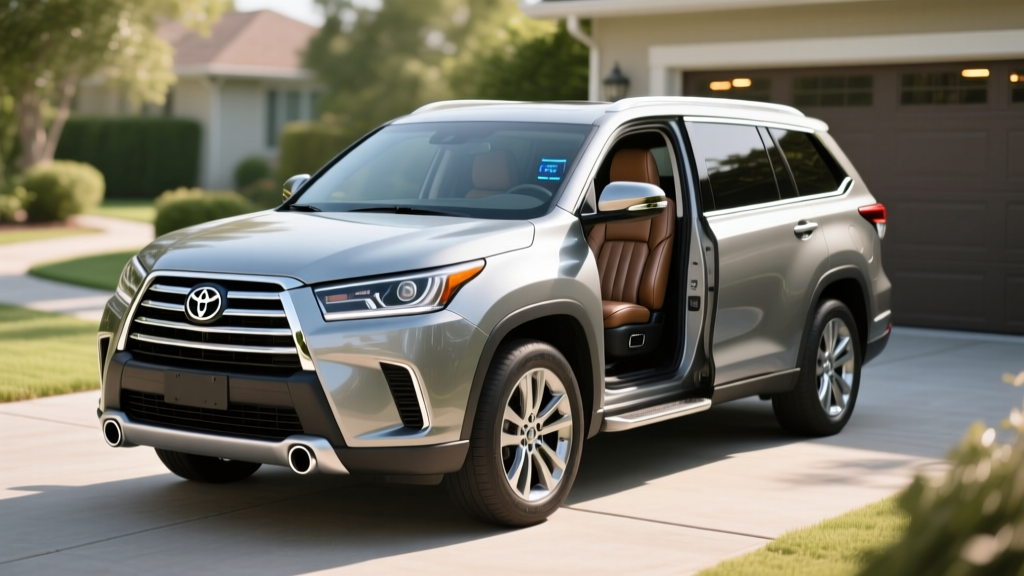
The 2019 Toyota Highlander Hybrid Limited represents the final model year of the third-generation Highlander before Toyota's 2020 redesign switched to a turbocharged four-cylinder platform. For used-car shoppers in 2026, this SUV remains a compelling option: a naturally aspirated 3.5L V6 paired with Toyota's proven hybrid synergy drive, standard all-wheel drive, and EPA-estimated fuel economy that still competes with newer rivals. The Limited trim adds premium leather, navigation, and advanced safety features that make it one of the most complete three-row hybrid SUVs on the used market.
| Spec | Value |
|---|---|
| Powertrain | 3.5L V6 + 2 electric motors (AWD-i) |
| Combined Horsepower | 306 hp |
| EPA MPG (City / Hwy / Combined) | 29 / 27 / 29 |
| Fuel Tank | 17.9 gallons |
| Total Range | ~519 miles |
| 0-60 mph | ~7.5 seconds |
| Drivetrain | Electronic on-demand AWD (AWD-i) |
| Seating | 7 passengers |
| Cargo (behind 3rd / 2nd / 1st row) | 13.8 / 42.3 / 83.7 cu ft |
| Original MSRP (Limited) | $47,030 |
| Typical 2026 Used Price | $26,000 – $34,000 |
HEV vs PHEV: What the Highlander Hybrid Actually Is
Before evaluating this SUV, it is critical to understand what it is — and what it is not. The 2019 Highlander Hybrid is a conventional hybrid electric vehicle (HEV). It is not a plug-in hybrid (PHEV), and it does not have a charge port.
| Feature | HEV (This Vehicle) | PHEV (e.g., RAV4 Prime) | BEV (e.g., Tesla Model X) |
|---|---|---|---|
| Plug-in Charging | No — self-charging via regen & engine | Yes — Level 1/2 AC | Yes — Level 1/2/DC |
| Electric-Only Range | ~1 mile at low speed | 25–42 miles typical | 250–400 miles |
| Battery Size | ~1.9 kWh (NiMH) | 13–18 kWh (Li-ion) | 75–130 kWh (Li-ion) |
| Federal Tax Credit (§30D) | Not eligible | Up to $7,500 (if eligible) | Up to $7,500 (if eligible) |
| Used EV Credit (§25E) | Not eligible | Up to $4,000 (if eligible) | Up to $4,000 (if eligible) |
The Highlander Hybrid's small nickel-metal hydride (NiMH) battery pack recharges itself through regenerative braking and the gasoline engine. You never plug it in. The electric motors assist the V6 during acceleration and enable brief electric-only movement at very low speeds (parking lots, stop-and-go traffic), but this is measured in yards, not meaningful miles. If you need substantial electric-only driving, you would need a PHEV like the Toyota RAV4 Prime or a full battery-electric vehicle (BEV).
Fuel Economy: EPA Ratings vs Real-World MPG
The EPA rates the 2019 Highlander Hybrid AWD-i at 29 MPG city, 27 MPG highway, and 29 MPG combined. These figures are notable because, unlike most gas vehicles, the hybrid achieves better fuel economy in city driving than on the highway. This is a hallmark of Toyota's hybrid system: regenerative braking recaptures energy during stop-and-go driving, and the electric motors handle low-speed propulsion where internal combustion engines are least efficient.
| Driving Scenario | EPA Estimate | Real-World Expectation |
|---|---|---|
| City (stop-and-go) | 29 MPG | 29–33 MPG (hybrids often beat EPA in city) |
| Highway (70+ mph) | 27 MPG | 24–27 MPG (aero drag reduces hybrid advantage) |
| Combined | 29 MPG | 27–30 MPG |
| Cold weather (below 32°F) | N/A | 24–27 MPG (engine runs more for cabin heat) |
| Towing (up to 3,500 lbs) | N/A | 18–22 MPG |
In real-world ownership, many Highlander Hybrid drivers report averaging 28–31 MPG in mixed suburban driving. The hybrid system's city advantage is genuine — owners who commute in heavy traffic often see 30+ MPG, while sustained highway trips at 75–80 MPH may dip to 25 MPG. Cold weather reduces efficiency because the V6 must run more frequently to provide cabin heat, as the Highlander Hybrid uses engine waste heat rather than an electric heat pump.
Compared to the gas-only 2019 Highlander V6 AWD (rated at 20 MPG combined), the hybrid saves approximately 3.5 gallons per 100 miles — roughly $12–$15 per 100 miles at 2026 fuel prices. Over 15,000 annual miles, that translates to $1,800–$2,250 in annual fuel savings.
Powertrain Deep Dive: V6 Hybrid Synergy Drive
The 2019 Highlander Hybrid uses Toyota's well-established Hybrid Synergy Drive system, pairing a 3.5-liter DOHC V6 engine (245 hp, 263 lb-ft of torque) with a front-mounted electric motor (167 hp, 247 lb-ft) integrated into the transaxle. A second, smaller electric motor (68 hp, 103 lb-ft) drives the rear axle, providing electronic on-demand all-wheel drive (AWD-i) without a mechanical driveshaft.
Combined system output is 306 horsepower, making this one of the more powerful midsize hybrid SUVs of its era. The V6 provides smooth, linear power delivery, while the electric motors fill in torque instantly at low RPM — eliminating the sluggish off-the-line feel that plagues some four-cylinder turbo hybrids. The continuously variable transmission (CVT) is optimized for efficiency rather than sportiness, and there is no traditional gearshift feel.
The AWD-i system engages the rear motor automatically when front-wheel slip is detected or during hard acceleration. It is not designed for off-road use or heavy snow — think of it as a traction and stability enhancement rather than a true off-road system. For most family hauling duties in rain and light snow, it performs admirably.
Hybrid Battery: Lifespan, Warranty, and Replacement Cost
The 2019 Highlander Hybrid uses a ~1.9 kWh nickel-metal hydride (NiMH) battery pack located under the second-row seats. Unlike the larger lithium-ion packs in PHEVs and BEVs, this small pack undergoes relatively shallow charge-discharge cycles, which contributes to exceptional longevity.
Battery Warranty Coverage
- Original warranty: 8 years / 100,000 miles (10 years / 150,000 miles in California and states adopting CARB emissions standards)
- 2020+ extension: Toyota extended hybrid battery coverage to 10 years / 150,000 miles for all 2020 and newer models, and retroactively applied this to existing hybrid vehicles still within original warranty as of January 2020
- For a 2019 model in 2026: A vehicle purchased new in early 2019 may still carry residual coverage through 2029 or 150,000 miles under the extended policy — verify with a Toyota dealer using the VIN
Toyota's NiMH hybrid batteries have an outstanding longevity track record. Data from fleet operators and long-term owners indicates that Highlander Hybrid batteries routinely last 150,000–200,000+ miles before significant degradation. The battery management system keeps the pack within a narrow state-of-charge window (typically 40–80%), avoiding the deep cycles that accelerate wear in larger BEV packs.
If replacement becomes necessary, here is what to expect:
- New OEM battery from Toyota: $3,000–$4,000 (parts + labor at dealership)
- Refurbished/remanufactured battery: $1,500–$2,500 (from third-party hybrid specialists)
- Individual cell/module replacement: $500–$1,200 (if only specific modules have failed — a hybrid shop can test and replace individual cells)
For a 7-year-old Highlander Hybrid with typical mileage (80,000–110,000 miles), battery failure remains statistically unlikely. The more common high-mileage maintenance items are the standard suspension components, brakes (which last longer than gas models due to regenerative braking), and the inverter coolant pump.
Reliability, Safety, and Ownership Costs
The third-generation Highlander (2014–2019) earned strong reliability marks from both IIHS and long-term ownership surveys. The 2019 model received the IIHS Top Safety Pick designation when equipped with the standard Toyota Safety Sense P (TSS-P) suite, which includes pre-collision braking, lane departure alert, automatic high beams, and dynamic radar cruise control.
NHTSA awarded the 2019 Highlander an overall 5-star safety rating. The hybrid variant shares the same structural platform and crash performance as the gas model.
Common ownership considerations for the 2019 Highlander Hybrid Limited include:
- Brakes: Expect 80,000–100,000+ miles on original brake pads thanks to regenerative braking handling much of the deceleration load
- Tires: Factory 19-inch tires (Limited trim) typically need replacement at 40,000–50,000 miles; budget $800–$1,200 for a set
- Insurance: Average annual premium of $1,400–$1,800 depending on state and driver profile — comparable to the gas V6 Limited
- Infotainment: The 2019 model's Entune system lacks Apple CarPlay and Android Auto (Toyota added CarPlay in the 2020 redesign). Aftermarket head-unit swaps are possible but cost $500–$1,000
Tax Credits and Used Pricing in 2026
As a conventional hybrid (HEV), the 2019 Toyota Highlander Hybrid does not qualify for the federal §30D new clean vehicle credit or the §25E used clean vehicle credit. Both credits are restricted to plug-in vehicles — PHEVs and BEVs — with minimum battery capacity thresholds that the Highlander Hybrid's ~1.9 kWh pack does not meet.
Some states offer their own incentives for hybrid purchases, but most have shifted focus to plug-in vehicles. Check your state's energy office or department of revenue for current programs.
On the used market in 2026, the 2019 Highlander Hybrid Limited typically sells for $26,000–$34,000 depending on mileage, condition, and region. Low-mileage examples (under 60,000 miles) in excellent condition command the upper end of this range. Compared to the original MSRP of $47,030, buyers are getting a well-equipped three-row hybrid SUV at 40–50% depreciation — reasonable for a 7-year-old Toyota.
Pros
- Proven V6 hybrid powertrain with 306 hp — no turbo lag
- 29 MPG combined in a 3-row, 7-passenger SUV
- Standard AWD-i for all-weather traction
- Excellent hybrid battery longevity track record
- Strong IIHS/NHTSA safety ratings with TSS-P standard
- Limited trim includes premium leather, JBL audio, navigation
Cons
- No Apple CarPlay or Android Auto
- Not eligible for any federal EV/hybrid tax credits
- AWD-i is light-duty — not for serious off-road or heavy towing
- Third row is tight for adults on longer trips
- CVT drones under hard acceleration
- Dated infotainment interface vs 2020+ redesign
Who Should Buy This vs a PHEV or Full EV?
Choose the 2019 Highlander Hybrid if:
- You need three rows and 7-passenger seating on a sub-$35K budget
- You cannot charge at home (apartment, street parking, no garage) and need a vehicle that requires zero plug-in infrastructure
- You want Toyota's proven hybrid reliability with minimal maintenance surprises
- Your driving is primarily suburban/city where the hybrid system delivers its best MPG
Consider a PHEV (e.g., Toyota Sienna, Kia Sorento PHEV) if:
- You can install a Level 2 home charger and want 25–35 miles of daily electric-only commuting
- You want to qualify for the §25E used plug-in credit (up to $4,000 on eligible models under $25,000)
- Your daily commute is under 30 miles round-trip and you want to drive mostly on electricity
Consider a Full EV (e.g., Tesla Model X, Kia EV9) if:
- You have reliable home Level 2 charging and access to DC fast-charging networks
- You want to eliminate gasoline costs entirely and reduce maintenance (no oil changes, fewer brake replacements)
- You are eligible for the §30D or §25E federal tax credit on a qualifying new or used EV
The Highlander Hybrid occupies a specific niche: maximum practicality with zero lifestyle change. You fuel it like any other vehicle, maintain it at any Toyota dealer or competent independent shop, and enjoy meaningfully better fuel economy than a gas-only equivalent. For buyers who cannot yet commit to plug-in infrastructure or who regularly take long road trips through areas with sparse charging networks, this remains a rational, low-risk choice.
Frequently Asked Questions
How many MPG does the 2019 Toyota Highlander Hybrid Limited get?
The EPA rates it at 29 MPG city, 27 MPG highway, and 29 MPG combined. In real-world driving, expect 27–31 MPG depending on your driving mix, with city-heavy commutes often exceeding the EPA estimate and sustained highway driving falling slightly below.
Can you plug in the 2019 Highlander Hybrid to charge it?
No. The 2019 Highlander Hybrid is a conventional hybrid (HEV), not a plug-in hybrid (PHEV). It has no charge port. The battery recharges itself through regenerative braking and the gasoline engine. You never need to plug it in.
Is the 2019 Highlander Hybrid reliable and what does a battery replacement cost?
Yes — Toyota's hybrid system is among the most reliable powertrains in the industry. The NiMH hybrid battery typically lasts 150,000–200,000+ miles. If replacement is needed, expect $3,000–$4,000 for a new OEM battery or $1,500–$2,500 for a refurbished unit. Toyota's extended 10-year/150,000-mile hybrid battery warranty may still provide partial coverage depending on the vehicle's in-service date.
Does the 2019 Highlander Hybrid qualify for any federal tax credit?
No. The federal §30D clean vehicle credit and §25E used clean vehicle credit apply only to plug-in vehicles (PHEVs and BEVs) with battery packs meeting minimum capacity thresholds. The Highlander Hybrid's ~1.9 kWh NiMH pack does not qualify. Check your state for any local hybrid incentives.
How does the 2019 Highlander Hybrid compare to the 2020+ redesign?
The 2020 redesign switched to a 2.5L four-cylinder hybrid (243 hp combined) with slightly better EPA ratings (35–36 MPG combined) and added Apple CarPlay/Android Auto. However, the 2019 V6 offers substantially more power (306 hp vs 243 hp), a smoother power delivery, and a proven long-term reliability record. If you prioritize towing and acceleration, the 2019 V6 is the stronger choice. If you prioritize maximum fuel economy and modern infotainment, the 2020+ model is preferable.
What is the towing capacity of the 2019 Highlander Hybrid?
The 2019 Highlander Hybrid is rated to tow up to 3,500 pounds when properly equipped. This is adequate for a small boat, utility trailer, or a pair of dirt bikes, but falls short of the gas-only V6 Highlander's 5,000-pound rating. If heavy towing is a priority, the hybrid is not the best fit.