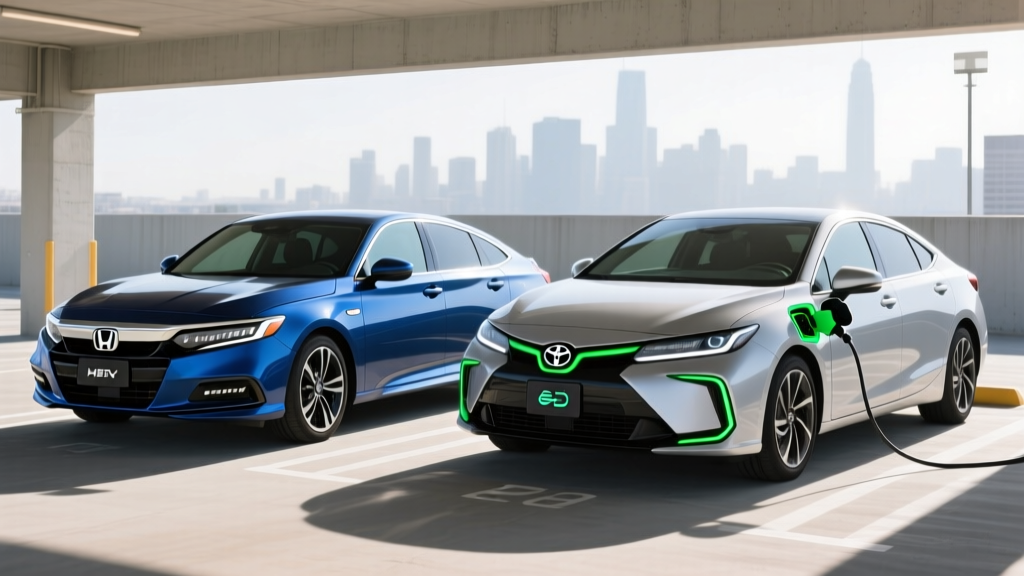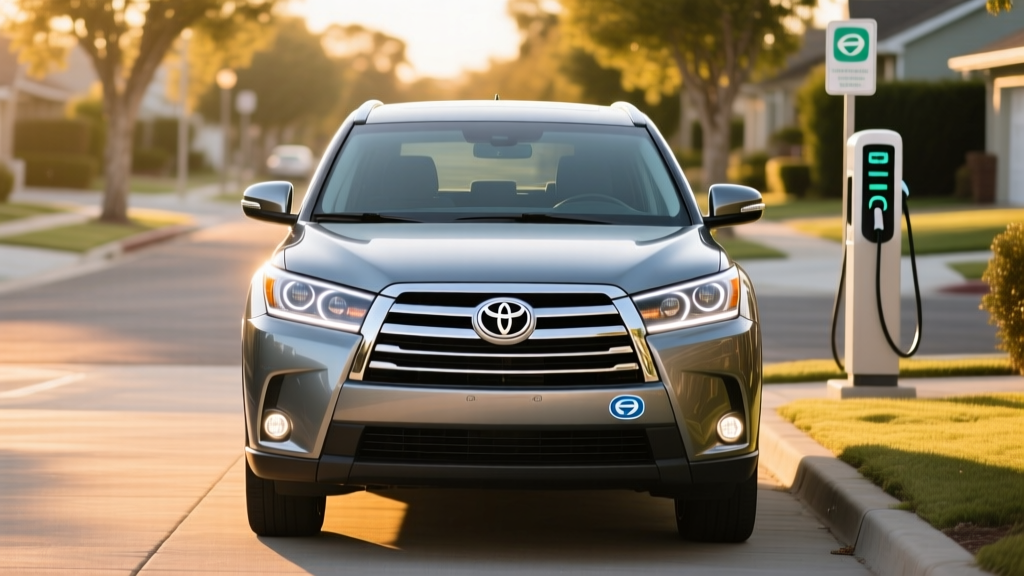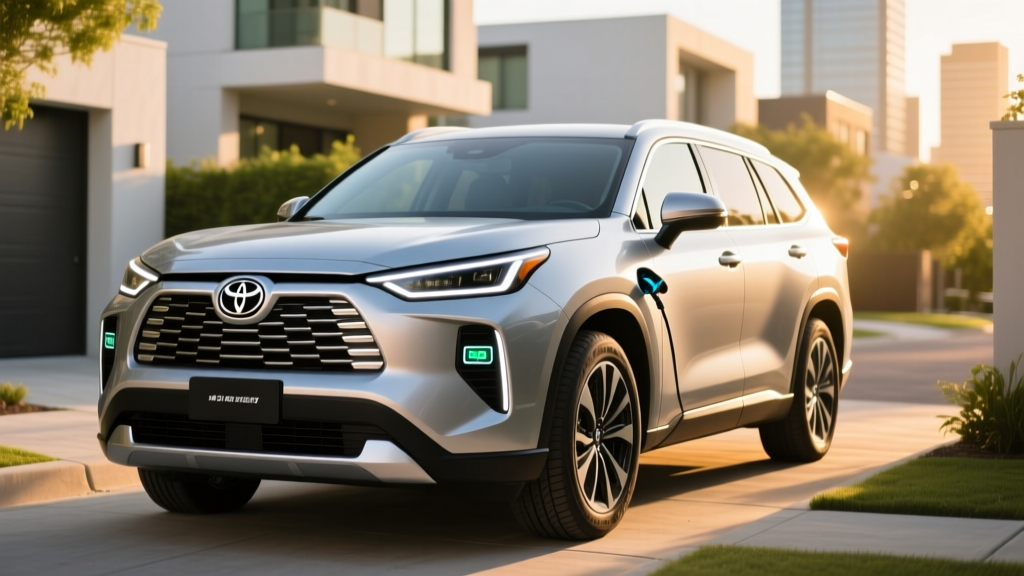
The Grand Highlander Plug-In Hybrid at a Glance
Toyota's three-row Grand Highlander Hybrid MAX and the Grand Highlander Plug-In Hybrid occupy different lanes. The conventional hybrid (HEV) delivers strong fuel economy with no plug required. The plug-in hybrid variant, built on Toyota's Hybrid Synergy Drive architecture, adds a larger battery pack, an external charging port, and roughly 32 miles of electric-only driving before the 2.5-liter four-cylinder engine fires up. For families who can charge at home and mostly drive under 30 miles daily, the PHEV behaves like an EV on weekdays and a hybrid on road trips — eliminating range anxiety entirely.
But the plug-in variant costs more upfront, carries additional weight, and only makes financial sense if you can actually plug it in. This guide breaks down the real numbers — EPA MPG, electric range, charging times, powertrain output, warranty coverage, and whether the Grand Highlander PHEV qualifies for the §30D federal tax credit — so you can decide which version fits your household.
HEV vs PHEV: Which Grand Highlander Hybrid Is Which?
Toyota offers the Grand Highlander with two distinct hybrid systems. Confusing them at the dealership is easy, so here is the distinction:
| Attribute | Grand Highlander Hybrid (HEV) | Grand Highlander Plug-In Hybrid (PHEV) |
|---|---|---|
| Plug-in charging | No — charges via engine and regen | Yes — Level 1 or Level 2 AC |
| Battery capacity | ~1.6 kWh (small buffer) | 18.1 kWh usable |
| Electric-only range | ~1 mile at low speed | 32 miles (EPA est.) |
| Combined system HP | 245 HP (standard hybrid) / 362 HP (Hybrid MAX) | 302 HP |
| EPA combined MPG | 34 MPG (HEV) / 27 MPG (Hybrid MAX) | 34 MPG (hybrid mode) + 32 mi electric |
| Starting MSRP (2026) | ~$45,000 | ~$54,000 |
| Federal tax credit | Not eligible | See §30D rules below |
The conventional HEV is the right call for buyers without home charging access or those who want the lowest purchase price. The PHEV rewards buyers who can charge overnight and whose daily commute stays under the 32-mile electric envelope. On longer trips, both systems operate as standard hybrids — the PHEV simply reverts to gasoline operation once its battery depletes to a reserve threshold.
Fuel Economy and Electric Range: The Real Numbers
The EPA rates the Grand Highlander PHEV at 32 miles of electric-only range and 34 MPG combined when operating as a hybrid after the battery is depleted. That combined figure breaks down as follows:
| Driving Mode | City | Highway | Combined |
|---|---|---|---|
| Electric-only (32 mi) | — | — | 94 MPGe |
| Hybrid (charge-sustaining) | 35 MPG | 33 MPG | 34 MPG |
Real-world range note: The EPA's 32-mile electric estimate assumes moderate temperatures and mixed driving. In our experience with Toyota's PHEV systems, expect 26–30 miles of electric range at sustained highway speeds (70+ MPH) and in cold weather below 40°F, where cabin heating draws from the battery. City driving with frequent regen braking can push the electric range slightly above the EPA figure, to 34–36 miles in mild conditions.
Total combined range — electric plus gasoline — exceeds 520 miles, thanks to the 17.9-gallon fuel tank. That puts it in league with the conventional hybrid for road-trip endurance, with the bonus of electric-only commuting capability when charged.
Powertrain and Performance
The Grand Highlander PHEV pairs a 2.5-liter four-cylinder Atkinson-cycle engine with front and rear electric motors for electronic on-demand all-wheel drive. Combined system output is 302 horsepower — more than the standard 245-HP hybrid but less than the 362-HP Hybrid MAX, which uses a turbocharged 2.4-liter engine and trades efficiency for performance.
Acceleration to 60 MPH takes approximately 6.7 seconds. That is brisk for a three-row SUV weighing over 4,700 pounds. The electric motors deliver immediate low-end torque, making the PHEV feel responsive around town in EV mode, where the gas engine stays silent entirely.
| Specification | Value |
|---|---|
| Engine | 2.5L 4-cyl Atkinson-cycle |
| Electric motors | Front + rear (eAWD) |
| Combined system HP | 302 HP |
| 0–60 MPH | ~6.7 sec |
| Battery (usable) | 18.1 kWh, lithium-ion |
| EPA electric range | 32 miles |
| EPA combined MPG (hybrid) | 34 MPG |
| EPA combined MPGe (electric) | 94 MPGe |
| Fuel tank | 17.9 gal |
| Total range (est.) | 520+ miles |
| Towing capacity | 3,500 lbs (est.) |
| Drivetrain | Electronic AWD |
Charging the Grand Highlander PHEV: Times, Levels, and Limitations
The PHEV's 18.1 kWh battery charges exclusively via AC — Level 1 (120V household outlet) or Level 2 (240V home or public charger). There is no DC fast charging capability, which is typical for PHEVs in this class. The battery is simply too small to justify the cost and weight of DC hardware.
| Charging Level | Power | 0–100% Time | Notes |
|---|---|---|---|
| Level 1 (120V) | ~1.4 kW | ~12–13 hours | Standard outlet; sufficient for overnight |
| Level 2 (240V) | ~3.3 kW (onboard limit) | ~5.5 hours | Home wall charger or public Level 2 |
| DC fast charge | Not supported | N/A | — |
With a Level 2 home charger, a full charge takes about 5.5 hours. Most PHEV owners plug in when they get home and wake up to a full battery every morning — the 18.1 kWh pack is small enough that even a basic Level 1 outlet can replenish it overnight if you start charging by early evening. Level 2 is still the recommendation for convenience and to preheat or precondition the cabin while plugged in.
One practical note: the onboard charger is limited to approximately 3.3 kW. Installing a 48-amp Level 2 charger at home (capable of 11.5 kW) will not charge the Grand Highlander PHEV any faster than a 16-amp unit. Save money by sizing your home charger to the vehicle's acceptance rate.
Pricing, Trims, and Tax Credit Eligibility
The 2026 Grand Highlander PHEV is offered in XLE and Limited trims. Pricing starts around $54,000 for the XLE and climbs to approximately $58,500 for the Limited, including destination charges. That represents a $9,000–$10,000 premium over the conventional Grand Highlander Hybrid XLE.
Does the PHEV qualify for the §30D federal clean vehicle credit? This requires careful verification each model year. The credit — up to $7,500 — is subject to three major requirements that change frequently:
- MSRP cap: SUVs must have an MSRP at or below $80,000 (the Grand Highlander PHEV clears this)
- Buyer income cap: Modified AGI must not exceed $150,000 (single) / $300,000 (joint)
- Battery sourcing: Critical minerals and battery components must meet escalating domestic-content thresholds — Toyota's supply chain has historically faced challenges meeting these thresholds, and eligibility can shift mid-year
- Point-of-sale transfer: As of 2024, buyers can transfer the credit to the dealer for an immediate price reduction, provided eligibility is confirmed at purchase
Before committing, verify current eligibility on fueleconomy.gov or ask the dealer to run the IRS VIN-check tool. Do not assume the credit applies — it depends on the specific vehicle's battery sourcing compliance at the time of delivery.
Battery Warranty, Reliability, and Replacement Cost
Toyota Hybrid Battery Warranty: Toyota covers the hybrid battery pack and related components for 10 years or 150,000 miles, whichever comes first, on all 2020-and-later hybrids and PHEVs. This applies nationwide regardless of state emissions laws.
Toyota's hybrid systems have an extensive reliability track record. The Prius, RAV4 Hybrid, and Highlander Hybrid have collectively logged billions of miles in consumer hands, and battery failures within the warranty period are uncommon. Toyota's PHEV system uses a proven lithium-ion chemistry with conservative state-of-charge buffering — the vehicle never allows the battery to fully deplete or fully charge at the cell level, which extends cycle life significantly.
If the battery does require replacement after the warranty window, expect a cost between $4,000 and $6,500 for the pack and labor at a Toyota dealer. Third-party refurbished packs are beginning to appear for Toyota hybrid systems at lower cost ($2,500–$3,500), but availability for the Grand Highlander PHEV specifically is still limited given the model's relative newness.
For context, the conventional Grand Highlander Hybrid shares the same 10-year/150,000-mile hybrid battery warranty. The powertrain (engine, transmission, eAWD motors) carries Toyota's standard 5-year/60,000-mile coverage.
Grand Highlander PHEV vs Full EV vs Gas: Which Fits Your Household?
The decision between the Grand Highlander PHEV, a conventional hybrid, a full battery-electric SUV (like the Kia EV9 or Tesla Model X), or a gas-only three-row SUV depends on your daily driving pattern and charging access.
Choose the Grand Highlander PHEV if:
- You can charge at home (garage or driveway with 120V/240V access)
- Your daily driving is mostly under 30–35 miles round trip
- You take regular road trips and don't want to plan around DC charging stops
- You want three rows, AWD, and the ability to tow modest loads
Choose the conventional Grand Highlander Hybrid (HEV) if:
- You cannot charge at home (apartment, street parking, no garage)
- You want the lowest upfront cost and simplest ownership
- Your daily mileage exceeds the PHEV's electric range most days anyway
Choose a full EV (Kia EV9, Tesla Model X) if:
- You can install a Level 2 home charger
- Your daily driving is under 250 miles and you're willing to plan DC fast-charge stops on road trips
- You want zero tailpipe emissions and the lowest per-mile energy cost
- Local DC charging infrastructure is strong (Electrify America, Tesla Supercharger, EVgo)
Stick with a gas-only SUV if:
- You drive very low annual miles and the fuel-cost savings of hybridization won't offset a higher purchase price
- Upfront cost is the dominant purchase factor
Pros, Cons, and the Bottom Line
Pros
- 32 miles electric covers most daily commutes gas-free
- 34 MPG in hybrid mode after battery depletes — no range penalty on road trips
- 302 HP with eAWD; confident acceleration for a three-row SUV
- 10-year/150,000-mile hybrid battery warranty
- No DC charging dependency — works for apartment dwellers who can Level 1 charge
- Three-row seating with usable cargo space behind the third row
Cons
- ~$9,000 premium over the conventional hybrid — payback depends on electricity vs gas prices and daily mileage
- 3.3 kW onboard charger limits Level 2 speed; no DC fast charging
- Federal tax credit eligibility uncertain due to battery-sourcing rules
- Electric range drops to ~26 miles in cold weather or sustained highway driving
- Heavier than the conventional hybrid, slightly reducing handling agility
The Grand Highlander PHEV is a compelling bridge vehicle for families not yet ready to commit to a full EV but who want meaningful electric driving. If your household can charge at home and most weekday miles fall within the 32-mile envelope, you will burn very little gasoline during the work week while retaining full hybrid flexibility for weekends and vacations. The conventional hybrid makes more sense for those without plug-in access or whose daily mileage dwarfs the electric range.
Frequently Asked Questions
How many MPG does the Grand Highlander plug-in hybrid get?
The EPA rates it at 34 MPG combined (35 city / 33 highway) when operating as a hybrid after the battery is depleted. In real-world driving, city-heavy routes with frequent stops can yield 36–38 MPG thanks to regenerative braking, while sustained highway driving at 75+ MPH may return 30–32 MPG.
How far can the Grand Highlander PHEV go on electric only?
The EPA estimates 32 miles of electric-only range. In practice, expect 26–30 miles at highway speeds or in cold weather, and potentially 34–36 miles in mild city driving with regen braking. Total combined range (electric + gas) exceeds 520 miles.
Does the Grand Highlander PHEV qualify for the $7,500 federal tax credit?
Possibly, but it depends on current battery-sourcing rules under §30D. The MSRP is under the $80,000 SUV cap, and most buyers fall under the income limits. However, Toyota's battery supply chain compliance with critical-mineral and component requirements can change. Verify eligibility on fueleconomy.gov or through the dealer's IRS VIN-check tool before purchasing.
Is the Grand Highlander hybrid reliable, and what does a battery replacement cost?
Toyota's hybrid systems are among the most proven in the industry, with the 10-year/150,000-mile hybrid battery warranty providing long-term coverage. Out-of-warranty battery replacement runs $4,000–$6,500 at a dealer. Real-world data from Toyota's hybrid fleet shows most packs last well beyond 150,000 miles with normal use.
Do I need to plug in the conventional Grand Highlander Hybrid?
No. The conventional HEV charges its small battery entirely through the gasoline engine and regenerative braking. There is no plug and no electric-only range beyond very low-speed maneuvering. Only the PHEV variant requires (and benefits from) plug-in charging.
How long does it take to charge the Grand Highlander PHEV at home?
On a standard 120V outlet (Level 1), expect 12–13 hours for a full charge — adequate if you plug in when you get home. On a 240V Level 2 charger, it takes approximately 5.5 hours. The onboard charger is capped at ~3.3 kW, so higher-amperage Level 2 units will not charge the vehicle faster.