Ford's Electrified Transit Lineup: What "Hybrid" Actually Means for 2026
Search for a Ford Transit van hybrid and you'll encounter a confusing landscape. Ford does not currently sell a conventional hybrid (HEV) Transit in the United States. What Ford does offer is the E-Transit — a fully battery-electric van — alongside the Transit PHEV (plug-in hybrid), which is available in select European and international markets but has not been officially imported to the US as of the 2026 model year. For US fleet buyers, the practical choice is between the battery-electric E-Transit, the gasoline-powered EcoBoost Transit, or waiting to see if Ford brings the PHEV variant stateside.
This guide breaks down every electrified Transit option available or announced, with exact MPG figures, range data, battery specs, and total cost of ownership so you can make an informed fleet or owner-operator decision.
HEV vs. PHEV vs. BEV: Which Transit Powertrain Fits Your Operation?
| Powertrain Type | How It Works | Plug Required? | US Transit Availability (2026) |
|---|---|---|---|
| HEV (Conventional Hybrid) | Gas engine + small electric motor; battery recharges via regen and engine | No | Not offered |
| PHEV (Plug-In Hybrid) | Gas engine + larger motor/battery; drives on electric-only for limited range before engine engages | Yes (Level 2 or 120V) | Not sold in US; available in Europe |
| BEV (Battery Electric) | Electric motor only; no gas engine | Yes (Level 2 / DC fast) | E-Transit — available now |
This distinction matters because many buyers searching for a "Ford Transit van hybrid" are actually looking for any electrified Transit that reduces fuel cost without committing to full electric. Understanding what's actually purchasable in the US prevents wasted research time.
Ford E-Transit (2026): The US Electric Option — Range, Efficiency, and Specs
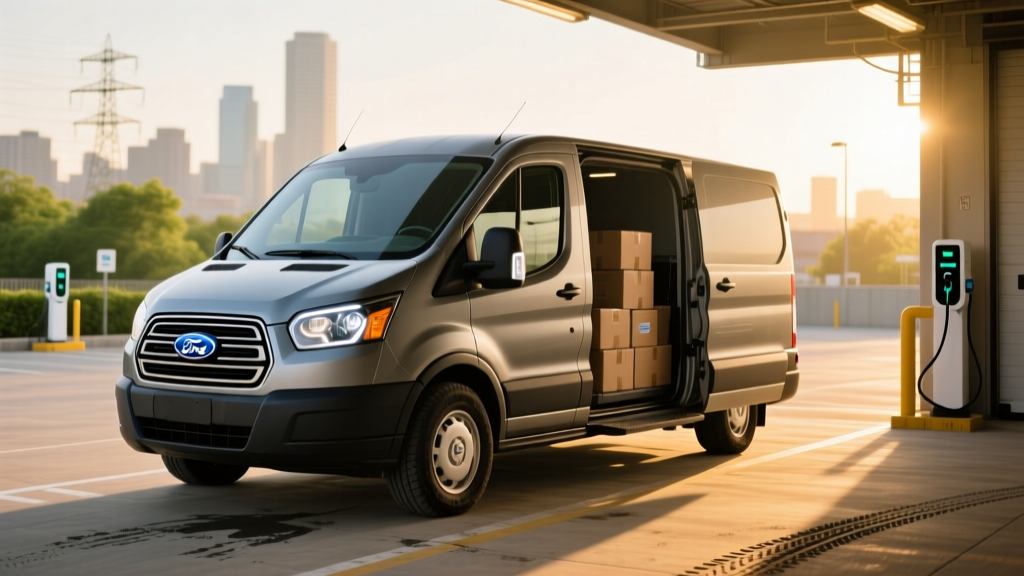
The 2026 Ford E-Transit is the only electrified Transit you can buy in the United States today. It is a fully battery-electric van, not a hybrid, but it's the vehicle most fleet managers land on when they search for fuel-saving Transit alternatives.
| Specification | 2026 E-Transit (Cutaway/Cargo Van) |
|---|---|
| Powertrain | Single rear-mounted electric motor |
| Horsepower | 266 hp (198 kW) |
| Torque | 317 lb-ft |
| Usable Battery Capacity | 68 kWh (NMC lithium-ion) |
| EPA Estimated Range | 126 miles (low-roof cargo van) |
| Real-World Range Expectation | ~95–115 mi loaded/highway; ~105–126 mi city routes |
| Efficiency | ~2.0 kWh/mile (varies by body config) |
| Max DC Fast Charge Rate | 115 kW (CCS) |
| 10–80% DC Fast Charge Time | ~45 minutes |
| Level 2 Charge Rate | 10.5 kW (onboard charger) |
| Level 2 Full Charge Time | ~8 hours |
| Payload Capacity | Up to 3,880 lbs (cargo van) |
| Starting MSRP | ~$51,000 (cargo van, before incentives) |
| Battery Warranty | 8 years / 100,000 miles |
Transit PHEV (Custom/Chassis Cab): The Hybrid That Isn't (Yet) in the US
Ford has offered a Transit Custom PHEV in Europe, primarily in the smaller Transit Custom body style (not sold in the US). This variant pairs a 1.0L EcoBoost engine with an electric motor and an 11.8 kWh battery pack, delivering roughly 20–25 miles of electric-only range before the gasoline engine takes over. Total combined range exceeds 300 miles.
However, the full-size Transit sold in the US has never received a PHEV variant. Ford's 2026 US commercial vehicle lineup positions the E-Transit as the electrified option and the 3.5L EcoBoost V6 as the gasoline workhorse. There has been no official announcement of a US-market Transit PHEV as of early 2026.
If you need a plug-in hybrid commercial van in the US today, your options remain extremely limited — essentially no direct competitor offers a full-size PHEV cargo van stateside.
Fuel Economy and Efficiency: E-Transit MPGe vs. Gas Transit MPG
| Model | City | Highway | Combined | Energy/Fuel Cost per Mile |
|---|---|---|---|---|
| 2026 E-Transit (BEV) | 11 MPGe (city equiv.) | ~1.9–2.2 kWh/mi | ~2.0 kWh/mi | ~$0.24–$0.30/mi (at $0.13/kWh) |
| 2026 Transit 3.5L EcoBoost (Gas) | ~14 MPG | ~18 MPG | ~16 MPG | ~$0.22–$0.25/mi (at $3.60/gal) |
The per-mile energy cost of the E-Transit and the gasoline Transit are closer than many expect, especially at current US electricity and fuel prices. The E-Transit's advantage grows significantly when:
- You charge at depot rates (commercial electricity at $0.08–$0.10/kWh drops cost to ~$0.16–$0.20/mi)
- You operate in stop-and-go city routes where regenerative braking maximizes efficiency
- You factor in eliminated oil changes, reduced brake wear (regen), and fewer moving parts
The gas Transit's advantage appears on long highway routes, in extreme cold, and when depot charging infrastructure isn't feasible.
Charging Infrastructure: What Fleets Need to Budget For
The E-Transit uses the CCS1 connector standard and supports DC fast charging up to 115 kW. For fleet depot charging, here's what installation typically costs:
| Item | Per-Charger Cost Range |
|---|---|
| Level 2 charger hardware (40A–48A, commercial-rated) | $600–$1,500 |
| Electrical panel capacity assessment | $200–$500 |
| Wiring, conduit, and labor (per stall) | $1,500–$4,000 |
| Permitting and utility coordination | $500–$2,000 |
| Panel upgrade (if needed, shared across chargers) | $3,000–$10,000+ |
| Total per Level 2 stall (typical) | $3,000–$7,000 |
Fleet operators should also explore IRS §45W Commercial Clean Vehicle Credit, which provides up to $7,500 for qualifying commercial EVs (vehicles with GVWR under 14,000 lbs). Unlike the consumer §30D credit, §45W does not have buyer income limits but does require the vehicle to be used for business and meet domestic sourcing requirements. Consult a tax professional to confirm eligibility for your specific fleet configuration.
Additionally, many utilities offer commercial EV charging rebates and demand-management programs that can offset depot installation costs by 30–50%. Check with your local utility's commercial EV program.
Battery Longevity, Warranty, and Replacement Cost
For fleet buyers, this warranty is critical. A Transit used for daily delivery routes averaging 60–80 miles/day will accumulate roughly 22,000–29,000 miles per year. The 100,000-mile cap means warranty coverage extends approximately 3.5–4.5 years for high-mileage fleet use — shorter than the 8-year time limit in many cases.
Battery replacement cost: If the E-Transit's 68 kWh battery requires full replacement out of warranty, current industry estimates place the cost between $12,000 and $18,000 including parts and labor. NMC battery pack prices have declined steadily, and by the time most E-Transits exit warranty coverage, replacement costs may be lower. Third-party refurbishment and module-level repair options are also emerging, potentially reducing out-of-pocket cost to $5,000–$8,000 for partial repairs.
Degradation expectations: Based on data from Ford's commercial fleet testing and comparable NMC packs, expect approximately 10–15% capacity loss over 100,000 miles under normal use. DC fast charging exclusively (never using Level 2) and frequent charging to 100% accelerate degradation slightly. Fleets that charge to 80–90% on Level 2 overnight and reserve DC fast charging for mid-day top-ups typically see the best long-term battery health.
Who Should Choose the E-Transit vs. Gas Transit vs. Waiting for a PHEV?
E-Transit Is Right If:
- Your daily routes are under 100 miles and return to a depot
- You can install Level 2 charging at your base of operations
- Your operation is city-heavy with frequent stops (maximizes regen)
- You want to reduce maintenance costs and eliminate fuel-price volatility
- Your fleet qualifies for §45W commercial credits or utility rebates
- Noise restrictions or zero-emission zones apply in your service area
Gas Transit Is Right If:
- Your routes regularly exceed 150 miles per day
- You operate in extreme cold climates without heated storage
- Depot charging installation is not feasible (leased property, inadequate power)
- You need maximum payload and towing capacity
- Your routes include long highway stretches at sustained speed
Quick Decision Framework
Choose E-Transit if: Daily miles < 100 + depot charging available + city routes = strong TCO advantage.
Stick with gas Transit if: Daily miles > 150 OR no charging access OR extreme cold AND highway routes = gas remains practical.
Wait for a PHEV if: You need 100–200 mile daily range, want some electric operation for city segments, and cannot commit to full electric — but understand that no US-market Transit PHEV is confirmed as of 2026.
Frequently Asked Questions
Does a Ford Transit hybrid exist in the US?
No. Ford does not sell a conventional hybrid (HEV) or plug-in hybrid (PHEV) Transit in the United States as of the 2026 model year. The only electrified Transit available in the US is the fully electric E-Transit. A Transit Custom PHEV exists in Europe but is not imported stateside.
How many miles of range does the E-Transit get?
The EPA estimates 126 miles for the low-roof cargo van variant. Real-world range with payload and highway driving typically falls between 95 and 115 miles. In cold weather (below freezing), expect 75–90 miles. This makes the E-Transit suitable for last-mile and urban delivery routes but not for long-haul or intercity runs.
Does the E-Transit qualify for any tax credit?
The consumer §30D credit does not apply to commercial fleet purchases. However, the §45W Commercial Clean Vehicle Credit provides up to $7,500 per qualifying vehicle for business use, subject to MSRP caps, domestic battery-sourcing requirements, and vehicle weight classification. Consult a tax professional and verify current IRS guidance, as sourcing rules continue to tighten.
Is the E-Transit reliable for daily fleet use?
The E-Transit shares its platform and many components with the gasoline Transit, which has been a fleet staple for years. The electric powertrain has fewer moving parts than a gas engine, eliminating oil changes, spark plugs, and transmission fluid service. Ford's 8-year/100,000-mile battery warranty provides a defined reliability floor. Early fleet adopters report lower-than-expected maintenance costs, though the limited range requires careful route planning.
What is the battery replacement cost for the E-Transit?
Out-of-warranty replacement of the 68 kWh NMC battery pack is estimated at $12,000–$18,000 including labor. Module-level repairs and third-party refurbishment may reduce this to $5,000–$8,000. Battery costs continue to decline, and prices may be lower by the time most E-Transits require replacement.
How long does it take to charge the E-Transit?
On a Level 2 charger (10.5 kW onboard), a full charge takes approximately 8 hours — suitable for overnight depot charging. On a 115 kW DC fast charger, the battery goes from 10% to 80% in roughly 45 minutes. The E-Transit does not support charging above 115 kW, so 350 kW chargers will not charge it faster.
Should I wait for a Ford Transit PHEV?
There is no confirmed timeline for a US-market Transit PHEV. Ford's current US commercial electrification strategy centers on the E-Transit for zero-emission needs and the EcoBoost gasoline lineup for range-heavy operations. If a PHEV is essential to your fleet strategy, you may need to evaluate non-Transit platforms or plan around the E-Transit's range limitations with mid-day charging.