Quick Verdict: Two Sorento Hybrids, Two Very Different Use Cases
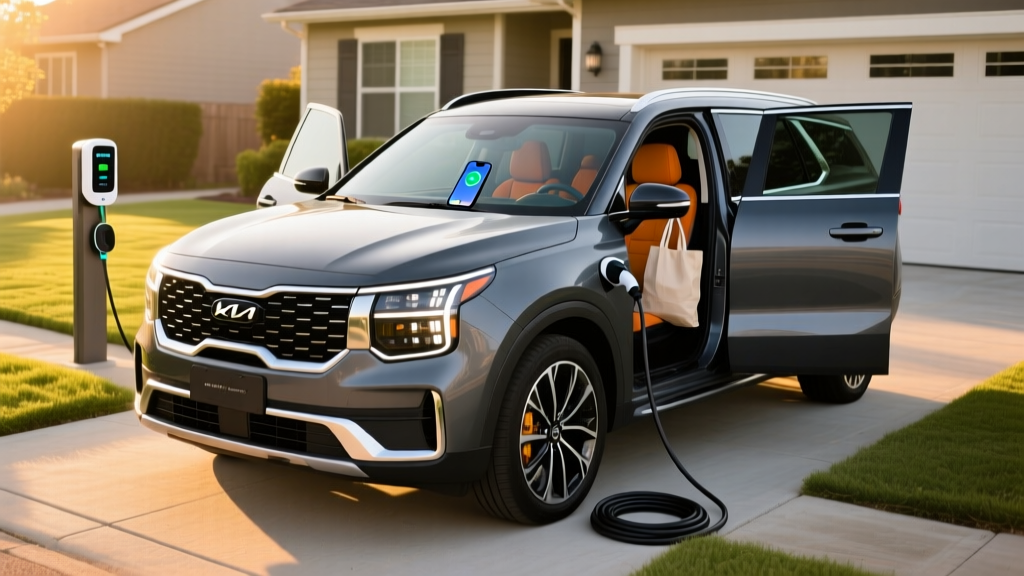
The 2024 Kia Sorento arrives in two electrified flavors that buyers frequently conflate: a conventional hybrid (HEV) and a plug-in hybrid (PHEV). Both seat up to six, both use Kia's 1.6-liter turbocharged four-cylinder paired with an electric motor, but their operating philosophies diverge sharply. The HEV never plugs in and delivers a strong 37 MPG combined. The PHEV plugs in, gives you 32 miles of electric-only driving, and then operates as a hybrid once the battery depletes.
If you have reliable home charging and a commute under 30 miles round-trip, the PHEV can run on electricity most weekdays while retaining gas-engine freedom for road trips. If you live in an apartment, lack a garage, or simply don't want to think about plugging in, the HEV delivers excellent efficiency with zero behavioral change. Let's break down exactly what each version offers in range, cost, and daily practicality.
HEV vs PHEV: Which 2024 Sorento Hybrid Is Which?
Before diving into specs, it's essential to understand the fundamental difference, because no amount of trim-level shopping will compensate for choosing the wrong powertrain type for your lifestyle.
| Attribute | Sorento HEV (Conventional Hybrid) | Sorento PHEV (Plug-In Hybrid) |
|---|---|---|
| Plugs in to charge? | No — regenerative braking and engine charge the battery | Yes — Level 1 or Level 2 AC charging |
| Battery capacity | 1.49 kWh (small buffer) | 13.8 kWh usable |
| Electric-only driving | Minimal (low-speed assist only) | 32 miles EPA rated |
| Fuel when battery depletes | Gasoline only | Operates as a hybrid on gasoline |
| Best for | No home charging access; set-it-and-forget-it buyers | Home chargers with short commutes + road-trip flexibility |
The conventional hybrid's small 1.49 kWh battery serves as a buffer for regenerative braking energy and brief electric-motor assist during acceleration. You never interact with it directly. The PHEV's much larger 13.8 kWh pack is the key to its 32-mile electric-only range — enough to cover the average American's daily commute (roughly 16 miles one-way, per Census Bureau data) entirely on electricity.
Fuel Economy: EPA MPG Breakdown and Real-World Expectations
Hybrid efficiency varies dramatically between city and highway driving because regenerative braking recaptures energy in stop-and-go conditions that a gas car simply wastes as heat. This is why hybrids often exceed their EPA city estimates in real-world urban driving.
| Model | City MPG | Highway MPG | Combined MPG | Total Range |
|---|---|---|---|---|
| 2024 Sorento HEV (FWD) | 39 | 35 | 37 | ~495 miles |
| 2024 Sorento HEV (AWD) | 36 | 33 | 34 | ~455 miles |
| 2024 Sorento PHEV (AWD, charge-depleting) | 79 MPGe (combined electric + gas) | ~420 mi gas + 32 mi electric | ||
| 2024 Sorento PHEV (charge-sustaining, no plug) | 36 | 33 | 34 | ~390 miles |
Real-world MPG note: According to data aggregated on fueleconomy.gov, Sorento HEV owners frequently report 35–40 MPG in mixed driving. City-heavy routes tend to push the HEV above its EPA sticker thanks to regen braking, while sustained 75+ MPH highway cruising can drop it to the low 30s. The PHEV's charge-sustaining MPG (after the battery depletes) tracks similarly to the AWD HEV — roughly 34 MPG combined.
For PHEV owners who charge nightly, the effective "MPG" is almost irrelevant for weekday commuting. You're burning zero gasoline on a 20-mile round-trip commute, then taking a 400-mile road trip on the weekend with no range anxiety. That dual personality is the PHEV's core value proposition.
PHEV Electric-Only Range and Charging Details
The Sorento PHEV's 32-mile EPA-rated electric range is competitive within the three-row PHEV segment, though it trails the Toyota RAV4 Prime's 42 miles. Here's what you need to know about living with that range day to day:
- EPA electric range: 32 miles
- Real-world electric range: Expect 28–30 miles in mild weather with mixed driving. Highway-speed driving and cold temperatures (below 40°F) can reduce this to 22–25 miles.
- Battery capacity: 13.8 kWh usable (lithium-ion polymer)
- Level 1 charging (120V household outlet): ~11 hours from empty to full — practical only for overnight topping off if you drive fewer than 30 miles daily
- Level 2 charging (240V, 3.3 kW onboard charger): ~3 hours 45 minutes from empty to full
- DC fast charging: Not available. The Sorento PHEV does not support DC fast charging — this is common for PHEVs in this class.
The 3.3 kW onboard charger is the limiting factor. Even if you connect to a 7.2 kW Level 2 home station, the Sorento PHEV will only draw 3.3 kW. That means a dedicated 16-amp or 20-amp 240V circuit is sufficient — no need for a 48-amp hardwired unit. A standard Level 2 plug-in charger (like a ChargePoint Home Flex set to 16A) handles the job well and costs roughly $500–$700 for the equipment before installation.
Battery Warranty and Replacement Cost
Kia covers the Sorento's hybrid/PHEV battery with a 10-year / 100,000-mile warranty (in CARB states, this extends to 10 years/150,000 miles for emissions-related components). The warranty covers battery capacity loss below approximately 70% of original capacity, as well as defects in the hybrid control module, inverter, and related powertrain electronics.
Should the battery need replacement outside of warranty, expect a cost between $2,500 and $4,500 for the HEV pack (smaller, less expensive) and $5,000 to $8,000 for the PHEV pack, based on current dealer parts pricing and independent hybrid shop estimates. However, hybrid battery failure before 150,000 miles remains uncommon — Kia's lithium-ion polymer packs have proven durable in the Niro and Sorento lineages.
Powertrain Specs: Horsepower, Engine, and Acceleration
| Specification | Sorento HEV | Sorento PHEV |
|---|---|---|
| Engine | 1.6L turbo 4-cylinder | 1.6L turbo 4-cylinder |
| Engine output | 178 hp / 195 lb-ft | 178 hp / 195 lb-ft |
| Electric motor output | 44 kW (59 hp) / 195 lb-ft | 66.9 kW (90 hp) / 224 lb-ft |
| Combined system output | 227 hp / 258 lb-ft | 261 hp / 258 lb-ft |
| Transmission | 6-speed automatic | 6-speed automatic |
| Drivetrain | FWD or AWD | AWD (standard) |
| 0–60 mph (est.) | ~7.8 sec | ~7.0 sec |
| Towing capacity | 2,000 lbs | 2,000 lbs |
| Cargo (behind 2nd row) | 30.5 cu ft | 30.5 cu ft |
The PHEV's more powerful electric motor gives it a noticeable acceleration advantage — the 261 combined horsepower and instant electric torque make it feel genuinely quick off the line, especially in EV mode where the response is immediate. The HEV's 227 hp is adequate for daily driving and highway merging, though it won't feel sporty in a vehicle that weighs between 4,100 and 4,400 pounds depending on configuration.
Both versions use a conventional 6-speed automatic rather than the continuously variable transmissions (CVTs) found in many competitors. This is a deliberate choice by Kia — the stepped shifts feel more natural to drivers accustomed to gas vehicles, and the trade-off in peak efficiency is modest.
Pricing, Trims, and Tax Credit Eligibility
Here's where the math gets interesting — and where many buyers leave money on the table by not understanding current incentive rules.
| Trim | Powertrain | MSRP (2024) | Est. Out-the-Door |
|---|---|---|---|
| S (FWD) | HEV | $36,990 | ~$39,500 |
| EX (FWD) | HEV | $39,590 | ~$42,500 |
| EX (AWD) | HEV | $41,590 | ~$44,500 |
| SX Prestige (AWD) | HEV | $46,690 | ~$50,000 |
| EX (AWD) | PHEV | $50,290 | ~$53,500 |
| SX Prestige (AWD) | PHEV | $53,490 | ~$57,000 |
Federal Tax Credit: What Applies to the Sorento?
Under current IRS §30D rules, the Sorento PHEV qualifies for up to $7,500 in federal tax credit — but only if you, the buyer, meet all of the following requirements:
- Income cap: Modified AGI must not exceed $150,000 (single), $225,000 (head of household), or $300,000 (married filing jointly)
- MSRP cap: The vehicle MSRP must not exceed $80,000 for SUVs — both Sorento PHEV trims clear this easily
- Battery sourcing: A percentage of critical minerals and battery components must be sourced from the US or free-trade-agreement countries. These thresholds tighten annually. Verify current-year compliance on the fueleconomy.gov tax credit page before purchasing.
- Point-of-sale transfer: As of 2024, buyers can transfer the credit to the dealer at purchase, receiving the benefit as an immediate price reduction rather than waiting to claim it on their tax return.
The conventional HEV does not qualify for the §30D federal tax credit — it lacks the minimum battery capacity and plug-in capability required by the statute. However, some states and utilities offer separate rebates for conventional hybrids. Check with your state energy office and local utility for programs that may apply.
Tax credit rules are subject to change. Always confirm eligibility with a tax professional and consult IRS.gov for the latest guidance before making a purchase decision.
Who Should Choose the Sorento HEV, PHEV, or a Full EV?
Sorento HEV: Choose This If…
- You rent or live in a condo with no charging access
- You want three rows and strong MPG without plugging in
- Your budget starts around $37,000
- You take frequent long road trips and don't want to plan charging stops
- You prefer the simplest possible ownership experience
Sorento PHEV: Choose This If…
- You can install a 240V Level 2 charger at home (garage or driveway)
- Your daily round-trip commute is under ~30 miles
- You want EV-like daily driving with gas-engine backup for road trips
- You qualify for the $7,500 federal credit, effectively closing the price gap with the HEV
- You value the extra 34 hp and stronger electric acceleration
HEV vs PHEV vs Full EV — Decision Framework
| Factor | Choose HEV | Choose PHEV | Choose Full EV (e.g., EV9, Ioniq 5) |
|---|---|---|---|
| Home charging | Not needed | Required (Level 2 ideal) | Required (Level 2 strongly recommended) |
| Daily commute | Any distance | Under ~30 miles round-trip | Under ~200 miles round-trip |
| Road trips | No planning needed | No planning needed | Requires DC fast-charge route planning |
| Upfront cost | Lowest (~$37K) | Higher (~$50K, offset by credit) | Highest ($50K–$70K+, credit eligible) |
| Fuel cost per mile | ~$0.12–$0.14 | ~$0.04 (EV mode) / ~$0.13 (gas mode) | ~$0.04–$0.06 |
| Maintenance | Oil changes, standard hybrid service | Oil changes (less frequent), hybrid service | Minimal — no oil, fewer moving parts |
Reliability, Ownership Costs, and Long-Term Outlook
Kia's hybrid powertrain has matured significantly since its early Optima Hybrid days. The 1.6L turbo-hybrid system shared across the Sorento, Tucson, and Santa Fe families has demonstrated strong reliability in J.D. Power and Consumer Reports assessments. The 6-speed automatic transmission avoids the drone and rubber-band feel of CVTs, and it's a proven design with a long service history.
The 10-year/100,000-mile hybrid battery warranty is among the best in the industry — Toyota matches it, but most competitors offer only 8 years/100,000 miles. For context, Kia's hybrid batteries have shown minimal degradation in real-world use; owners on forums and tracking sites like Fuelly commonly report less than 5% capacity loss over 80,000+ miles.
Insurance costs for the Sorento Hybrid are generally competitive with gas-powered midsize SUVs, though the PHEV may carry a 5–10% premium due to its higher MSRP. Get a quote from your insurer before committing — the difference between HEV and PHEV insurance is usually modest but worth verifying.
Five-year total cost of ownership favors the PHEV if you charge regularly and qualify for the federal credit. Here's a simplified comparison assuming 15,000 miles/year, $3.50/gallon gas, and $0.14/kWh electricity:
| Cost Factor (5 Years) | Sorento HEV (AWD EX) | Sorento PHEV (AWD EX, with credit) |
|---|---|---|
| Purchase (after incentives) | ~$42,500 | ~$46,000 ($53,500 − $7,500) |
| Fuel / electricity | ~$9,400 | ~$4,800 (assuming 70% EV-mode driving) |
| Maintenance | ~$3,200 | ~$2,800 |
| Insurance (est.) | ~$8,500 | ~$9,200 |
| 5-Year Total (est.) | ~$63,600 | ~$62,800 |
The PHEV narrows the gap through fuel savings and the tax credit, essentially breaking even with the HEV over five years — while giving you electric daily driving and a more powerful powertrain. If you don't qualify for the credit (income above the cap), the HEV becomes the clear financial winner.
Frequently Asked Questions
How many MPG does the 2024 Kia Sorento Hybrid get?
The FWD Sorento HEV achieves 39 city / 35 highway / 37 combined MPG per the EPA. The AWD version drops slightly to 36/33/34 MPG. Real-world reports from owners cluster between 33 and 40 MPG depending on driving mix — city-heavy routes tend to yield higher numbers thanks to regenerative braking.
How far can the Sorento PHEV go on electric only?
The EPA rates the Sorento PHEV at 32 miles of electric-only range. In real-world conditions, expect 28–30 miles in mild weather and as few as 22–25 miles in cold weather or at sustained highway speeds. Once the battery depletes, the vehicle operates as a conventional hybrid with an EPA rating of 34 MPG combined.
Does the Sorento Hybrid qualify for any tax credit?
The conventional HEV does not qualify for the federal §30D clean vehicle credit. The PHEV qualifies for up to $7,500, subject to buyer income limits ($150K single / $300K joint), MSRP caps ($80K for SUVs), and battery-sourcing requirements. The credit can be transferred to the dealer at point of sale for an immediate price reduction. Confirm current eligibility at fueleconomy.gov and consult a tax professional.
Is the Sorento Hybrid reliable, and what does battery replacement cost?
Kia's 1.6L turbo-hybrid system has proven reliable across multiple model lines. The hybrid battery is covered by a 10-year / 100,000-mile warranty. Out-of-warranty replacement costs range from approximately $2,500–$4,500 for the HEV battery and $5,000–$8,000 for the PHEV battery. Premature battery failure is uncommon based on owner reports and industry data.
Can the Sorento PHEV DC fast charge?
No. The Sorento PHEV supports only AC charging — Level 1 (120V, approximately 11 hours) and Level 2 (240V at 3.3 kW, approximately 3 hours 45 minutes). DC fast charging is not available, which is typical for plug-in hybrids in this class. The relatively small 13.8 kWh battery makes Level 2 charging adequate for overnight replenishment.
Does the Sorento Hybrid have three rows?
Yes. Both the HEV and PHEV offer seating for up to six passengers with a second-row bench, or six with optional captain's chairs (reducing capacity to six in a 2-2-2 layout). Cargo space behind the second row is 30.5 cubic feet in both versions, with no significant battery intrusion into the cargo area.
Hybrid vs PHEV vs EV — which should I choose?
Choose the HEV if you can't charge at home and want maximum simplicity. Choose the PHEV if you have home charging, a short commute, and want EV-like daily driving with gas-engine road-trip flexibility. Choose a full EV (like the Kia EV9 or Hyundai Ioniq 5) if you have reliable home charging, rarely drive more than 200 miles in a day, and want the lowest operating costs and minimal maintenance. The Sorento PHEV occupies a compelling middle ground — particularly if the $7,500 federal credit brings its effective price close to the HEV.