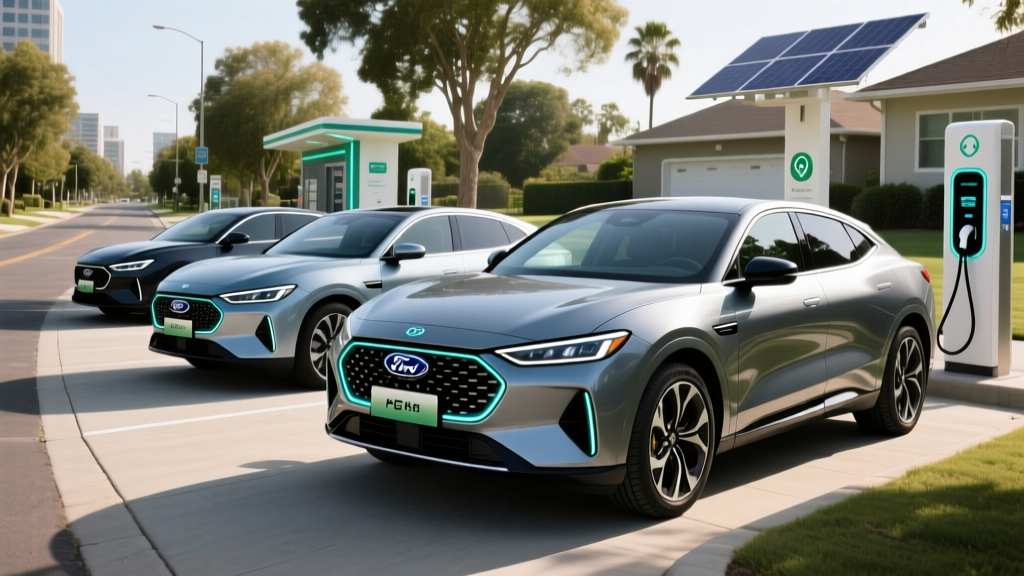
Ford's approach to electrification in 2026 diverges sharply from the all-EV pledges some rivals made and later walked back. The Ford hybrid electric vehicle strategy centers on high-volume nameplates — the Maverick compact truck, the Escape crossover, and the F-150 full-size pickup — offered with conventional hybrid (HEV) powertrains, while reserving plug-in hybrid (PHEV) and full battery-electric (BEV) variants for specific use cases. This guide breaks down every current Ford hybrid and plug-in hybrid, with exact EPA figures, real-world expectations, battery warranties, and federal tax-credit eligibility so you can decide which powertrain fits your driving pattern.
HEV vs PHEV: How Ford's Two Hybrid Types Differ
Conventional Hybrid (HEV): A small battery (typically 1.1–1.5 kWh) is recharged entirely by the gasoline engine and regenerative braking. You never plug it in. The electric motor assists the engine and enables brief electric-only motoring at low speeds, but the primary benefit is improved MPG — especially in stop-and-go city driving.
Plug-In Hybrid (PHEV): A larger battery (typically 10–20 kWh) can be charged from a wall outlet or public charger, giving 30–40+ miles of true electric-only driving before the gas engine engages. After the battery depletes, it operates as a conventional hybrid. Best for drivers with short commutes who can charge at home or work.
Ford's current U.S. lineup leans heavily on HEVs. The Escape PHEV remains the brand's sole plug-in hybrid for passenger vehicles as of the 2026 model year, while the F-150 Lightning and Mustang Mach-E serve the BEV side of the strategy. Here is how every Ford hybrid stacks up.
2026 Ford Maverick Hybrid: MPG, Specs, and Pricing
The Maverick Hybrid pairs a 2.5-liter Atkinson-cycle four-cylinder engine with an electric motor for a combined output of 191 horsepower. Power routes to the front wheels through an electronic continuously variable transmission (eCVT). All-wheel drive is available on hybrid trims, which adds a rear-mounted electric motor and drops fuel economy slightly.
| Spec | FWD Hybrid | AWD Hybrid |
|---|---|---|
| Combined HP | 191 hp | 191 hp |
| EPA City MPG | 40 | 38 |
| EPA Highway MPG | 33 | 31 |
| EPA Combined MPG | 37 | 34 |
| Battery Capacity | ~1.5 kWh (NiMH) | ~1.5 kWh (NiMH) |
| Towing Capacity | 2,000 lb | 2,000 lb |
| Base MSRP (XL Hybrid) | $28,145 | $29,645 |
Real-world MPG note: Hybrid trucks and crossovers routinely beat their EPA city estimates in gentle suburban driving because regenerative braking recaptures energy at every stop. Expect 42–45 MPG city in warm weather with a light foot. Highway MPG tends to run 1–3 MPG below the sticker at sustained 70–80 mph speeds because the electric motor provides less assistance at high velocity. In cold weather (below 30°F), expect combined MPG to drop 3–5 MPG as the engine runs more frequently for cabin heat.
2026 Ford Escape Hybrid and Escape PHEV
The Escape is where Ford's hybrid electric vehicle strategy splits into two distinct products. The conventional Escape Hybrid uses the same 2.5L hybrid system as the Maverick, tuned for crossover duty. The Escape PHEV adds a significantly larger battery and more powerful electric motor for genuine electric-only commuting.
| Variant | City MPG / MPGe | Highway MPG / MPGe | Combined MPG / MPGe | Electric-Only Range |
|---|---|---|---|---|
| Escape Hybrid FWD | 44 mpg | 37 mpg | 41 mpg | N/A (HEV) |
| Escape Hybrid AWD | 42 mpg | 36 mpg | 39 mpg | N/A (HEV) |
| Escape PHEV | 105 MPGe | 93 MPGe | 101 MPGe | 37 miles |
| Escape PHEV (gas only) | 42 mpg | 38 mpg | 40 mpg | N/A |
Escape PHEV deep-dive: The plug-in variant carries a 14.4 kWh lithium-ion battery (usable capacity approximately 11.5 kWh) powering a 131-hp electric motor on the front axle. Combined system output with the 2.5L engine reaches 210 hp. Level 2 charging (240V, 32A) replenishes the battery from empty in roughly 3.5 hours. The Escape PHEV does not support DC fast charging — a deliberate engineering choice to save weight and cost on a battery this size. Total combined range (electric + gasoline) exceeds 520 miles.
The Escape PHEV is front-wheel drive only. If you need AWD, Ford directs you to the conventional Escape Hybrid.
2026 Ford F-150 PowerBoost Hybrid
The F-150 PowerBoost is the workhorse anchor of Ford's hybrid strategy. It pairs a twin-turbo 3.5-liter V6 with a 47-hp electric motor integrated into the 10-speed automatic transmission. Combined output: 430 hp and 570 lb-ft of torque. This is the only hybrid in the F-150 lineup and is available with 4×4.
| Spec | Value |
|---|---|
| Combined HP / Torque | 430 hp / 570 lb-ft |
| EPA City MPG | 22 |
| EPA Highway MPG | 24 |
| EPA Combined MPG | 23 |
| Max Towing (properly equipped) | 12,700 lb |
| Pro Power Onboard | Up to 7.2 kW |
| Battery Capacity | ~1.5 kWh (lithium-ion) |
| Base MSRP (PowerBoost trim) | ~$58,995 (Lariat) |
Real-world MPG note: The PowerBoost's city MPG advantage over the non-hybrid 3.5L EcoBoost V6 (rated 17 city / 22 combined) is substantial — roughly 5 MPG combined. On the highway, the gap narrows because aerodynamic drag dominates at speed and the hybrid system's assistance tapers. Unloaded highway driving yields about 23–25 MPG. Towing a 6,000-lb trailer drops that to 12–14 MPG, which is typical for any full-size truck.
The standout feature is Pro Power Onboard at up to 7.2 kW, which turns the truck bed into a mobile generator — enough to run a job-site compressor, a welder, or a home refrigerator during an outage. This capability, unique to the PowerBoost hybrid among F-150 gas/hybrid trims, is a core reason Ford positions the hybrid as a productivity tool rather than solely an efficiency play.
Battery Warranty, Reliability, and Replacement Costs
Ford Hybrid Battery Warranty (2026 models): All Ford HEV and PHEV high-voltage batteries carry an 8-year / 100,000-mile warranty (10 years / 150,000 miles in California Air Resources Board states: CA, CO, CT, DE, ME, MD, MA, NJ, NM, NY, OR, RI, VT, WA). The warranty covers battery capacity falling below 70% of original capacity for PHEVs, and any defect or premature failure for HEVs.
Reliability track record: Ford's 2.5L hybrid powertrain (Maverick, Escape Hybrid, Escape PHEV) has been in production since the early 2010s in various forms. Nickel-metal hydride (NiMH) packs in the conventional hybrids are chemically conservative and have demonstrated 200,000+ mile lifespans in fleet use. The PHEV's lithium-ion pack has less long-term field data but benefits from active thermal management.
Replacement cost if out of warranty: Based on current dealer parts pricing and independent hybrid shops:
- Maverick / Escape Hybrid (HEV): $2,500–$4,000 for a remanufactured NiMH pack installed; $4,500–$6,500 for a new OEM pack.
- Escape PHEV (14.4 kWh Li-ion): $6,000–$9,000 for a new OEM pack installed.
- F-150 PowerBoost: $3,500–$5,500 (smaller Li-ion pack, less complex than PHEV).
For context, most hybrid batteries outlast the vehicle's useful economic life. According to fueleconomy.gov data and owner surveys, fewer than 5% of modern hybrid batteries require replacement before 150,000 miles.
Tax Credits and Incentives: What Qualifies?
Under the current IRS §30D federal tax credit rules for 2026, only plug-in electric vehicles with a battery capacity of at least 7 kWh are eligible. This means:
- Escape PHEV (14.4 kWh battery): Potentially eligible for up to $7,500, subject to MSRP cap ($80,000 for SUVs/vans/pickups), buyer income limits ($150,000 single / $300,000 joint MAGI), and critical-mineral/battery-component sourcing requirements. The Escape PHEV's final assembly occurs in the U.S., but battery-component sourcing rules may reduce or eliminate the credit depending on the specific build. Check the latest DOE/IRS eligible vehicle list before purchasing.
- Maverick Hybrid (HEV): Not eligible for §30D. Conventional hybrids do not qualify.
- Escape Hybrid (HEV): Not eligible for §30D.
- F-150 PowerBoost (HEV): Not eligible for §30D.
The Escape PHEV can be charged at home on a standard 120V outlet (Level 1, ~1.4 kW) in about 8–9 hours, or on a 240V Level 2 charger in ~3.5 hours. Point-of-sale credit transfer is available if the dealer is registered with the IRS Energy Credits Online system, letting you apply the credit as a down-payment reduction at purchase.
Ford Hybrid vs PHEV vs Full EV: Which Fits You?
Choose a Ford HEV (Maverick Hybrid, Escape Hybrid, F-150 PowerBoost) if:
- You cannot install a home charger (apartment, street parking, no garage).
- You want better fuel economy with zero change to your refueling habits.
- You drive more than 40 miles daily and don't want to manage charging.
- You need AWD (Escape Hybrid AWD, F-150 PowerBoost 4×4).
- Your priority is lower cost of ownership, not zero tailpipe emissions.
Choose the Escape PHEV if:
- Your daily commute is under 35 miles round-trip and you can charge at home or work.
- You want electric-only commuting most days but need gas flexibility for road trips.
- You want to capture a potential federal tax credit that HEVs cannot offer.
- You don't need AWD.
Choose a full EV (Mustang Mach-E, F-150 Lightning) if:
- You have reliable home Level 2 charging.
- You want zero tailpipe emissions and the lowest per-mile fuel cost.
- Your daily driving is under 250 miles and you're comfortable with public DC fast charging for road trips.
5-Year Ownership Cost Snapshot
| Cost Category | Maverick Hybrid FWD | Escape PHEV | Maverick Gas (2.0T EcoBoost) |
|---|---|---|---|
| MSRP (base) | $28,145 | $40,900 | $27,645 |
| Fed. Tax Credit | $0 | Up to $7,500* | $0 |
| Fuel (gas + electricity) | ~$5,900 | ~$3,800 | ~$8,400 |
| Insurance (avg) | ~$7,200 | ~$7,800 | ~$7,000 |
| Maintenance | ~$2,100 | ~$2,200 | ~$2,800 |
| Est. Depreciation | ~$11,000 | ~$16,500 | ~$12,500 |
| 5-Yr Net Cost | ~$32,345 | ~$37,200 | ~$38,345 |
*Tax credit subject to IRS §30D eligibility at time of purchase. Electricity cost assumes $0.16/kWh national average; gas assumes $3.40/gal. Your results will vary with local fuel prices, driving mix, and electricity rates. Source: fueleconomy.gov and manufacturer MSRP.
Frequently Asked Questions
How many MPG does the Ford Maverick Hybrid get in real-world driving?
The EPA rates the 2026 Maverick Hybrid FWD at 40 city / 33 highway / 37 combined. In real-world suburban driving with moderate traffic, owners consistently report 38–43 MPG combined. Pure city driving with frequent stops can push the number above 42 MPG thanks to regenerative braking. Sustained highway driving at 75+ mph typically yields 30–32 MPG.
How far can the Escape PHEV go on electric power alone?
The EPA rates the 2026 Escape PHEV at 37 miles of electric-only range. In warm weather at moderate speeds (under 55 mph), expect 35–40 miles. In cold weather (below freezing), the gasoline engine may engage sooner for cabin heat, reducing electric-only range to 25–30 miles. After the battery depletes, the Escape PHEV operates as a conventional hybrid rated at 40 MPG combined.
Do Ford conventional hybrids need to be plugged in?
No. The Maverick Hybrid, Escape Hybrid, and F-150 PowerBoost recharge their small batteries entirely through the gasoline engine and regenerative braking. You refuel them exactly like a gas-only vehicle. Only the Escape PHEV requires (or benefits from) plugging in.
Is the Ford hybrid battery reliable, and what does replacement cost?
Ford's hybrid batteries carry an 8-year/100,000-mile warranty (10 years/150,000 miles in CARB states). The NiMH packs in the HEV models have a long track record of lasting 200,000+ miles. Out-of-warranty replacement costs range from $2,500–$4,000 for a remanufactured HEV pack to $6,000–$9,000 for a new Escape PHEV lithium-ion pack. Battery failure before 150,000 miles is statistically uncommon in modern Ford hybrids.
Does any Ford hybrid qualify for the federal tax credit?
Only the Escape PHEV may qualify for the §30D federal clean-vehicle tax credit (up to $7,500), subject to buyer income limits, MSRP caps, and battery-sourcing requirements. Conventional Ford hybrids (Maverick Hybrid, Escape Hybrid, F-150 PowerBoost) do not qualify for the federal credit. Some states offer additional rebates for PHEVs — check your state energy office for current programs.
Why doesn't Ford offer more PHEVs?
Ford's hybrid electric vehicle strategy prioritizes HEVs for volume models because they require no charging infrastructure from the buyer, carry a lower price premium over gas-only trims ($1,000–$3,000 vs $8,000–$12,000 for PHEV), and deliver meaningful MPG gains in city driving where most Americans spend their commute time. For customers wanting plug-in electrification, Ford channels them toward the Mustang Mach-E and F-150 Lightning BEVs, which qualify for the full federal tax credit and offer 230–320 miles of range.